
Every approved amount that has not reached your bank yet: the ACV check, released depreciation, supplements and the deductible. In CRM For Claims each of these is its own invoice with its own balance.
Accounts receivable for roofing and restoration contractors: who is holding your money right now
Accounts receivable on insurance work waits with several parties at once: the carrier, a mortgage company, the homeowner, sometimes your own front desk. CRM For Claims keeps a holder on every open invoice and adds them up, so the office knows who to phone first.
Drawn example with made-up numbers: tile size follows the dollars
$46,200Held by Insurance Company until or if all repairs are completed
$27,900Held by Insurance Company
$19,600Held by Mortgage Company
$11,300Held by Customer
$8,700In transit to you
$4,700In your office
$118,400 owed, and only $4,700 of it can be deposited today.
Each job holds several receivables with different holders
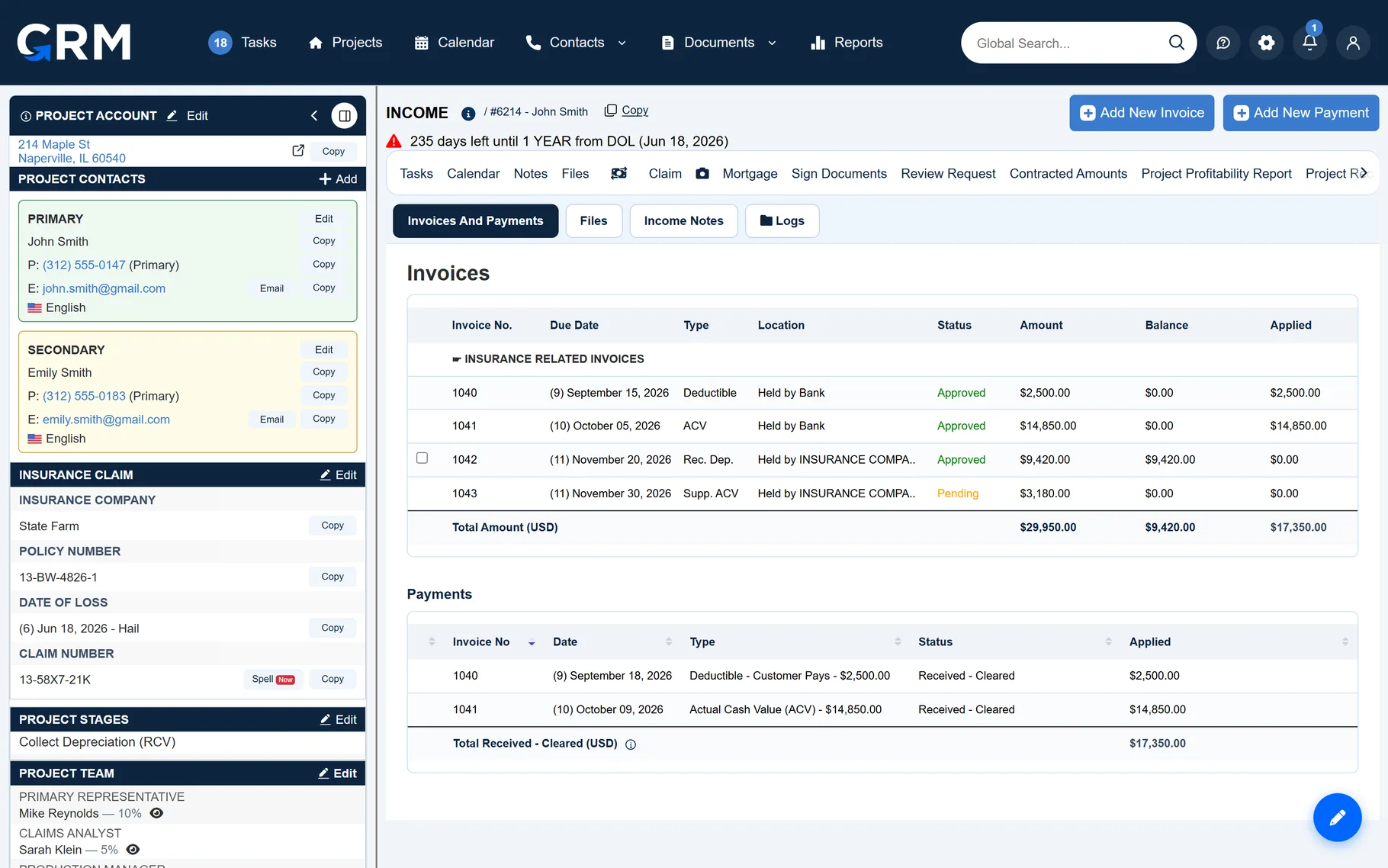
Every invoice on a claim carries its own type, due date, location, status and balance. Income Invoice Location is a required field on the invoice form. On one job the first check can be in your bank while the recoverable depreciation is still with the carrier. How those invoices get raised is on estimates and invoicing.
Two balance sheets for the two questions an office asks
Balance Sheet by Payment Location totals the balance of invoices in status Approved, one line per holder. Balance Sheet by Payment Type totals them by what the money is for, such as Actual Cash Value (ACV) or Recoverable Depreciation (RC). Opening a line lists its projects by PO number and name, and opening a project lists what sits behind it.
Who has it?
Balance Sheet by Payment Location, example
- Held by MORTGAGE COMPANY$19,600
- PO 6120, example project$12,400
- Type of PaymentActual Cash Value (ACV)$12,400
What is it for?
Balance Sheet by Payment Type, example
- Recoverable Depreciation (RC)$46,200
- PO 6214, example project$9,420
- Invoice No.1042$9,420
Each line shows a dollar amount and its percent. A report can be narrowed by range, status, payment type and payment location at once, so depreciation still waiting on finished repairs can be read alone. The type report also draws the split as a pie chart or a column chart. Supplement money has its own types, set out on supplement tracking.
A collections call for each holder
The holder tells the office which call to make. These are the usual calls on an insurance job, one for each line of the location report that still needs someone.
Held by INSURANCE COMPANY
Call the adjuster or the carrierAsk whether the payment has been issued, on what date, and who is named on the check.
Held until or if all repairs are completed
Send the carrier your completion papersThis money waits on you. Once the work is finished, the final invoice and proof of completion go to the carrier.
Held by MORTGAGE COMPANY
Call the loss draft departmentAsk what they still need for the endorsement or the next draw. The lender side has its own page, loss draft tracking.
Held by CUSTOMER
Call the homeownerThe carrier may have paid them already, or this may be the deductible. Agree on a date to collect it.
Held by Bank
Call the bankAsk what is needed before they let the funds go, and who at the bank handles this loan.
In-Transit To Our Company
Watch the mail for a few daysWrite down the date it was sent. If it hasn't turned up after a week, the carrier can trace or reissue it.
In Our Office (Not Deposited)
Walk it to the bookkeeperThe easiest money on the list. It goes to the bank today.
How one invoice keeps its holder up to date
Follow one made-up depreciation invoice of $9,420. The office moves it while the money travels. Once money reaches the bank, the system takes over.
-
Held by Insurance Company until or if all repairs are completed
$9,420 open
The office picks this location when it raises the invoice.
-
In-Transit To Our Company
$9,420 open
Someone with the right to edit several invoices ticks them on the Income tab and uses Change Location to move them together. A payment marked Issued by payee (pending) leaves the balance where it is.
-
Payment cleared on our bank account
$6,000 cleared
A partial payment splits the invoice: the paid part becomes its own row at this location, and the remaining $3,420 stays open at its old one. A payment that covers the whole balance moves the invoice here in one step.
-
Held by CUSTOMER
Back to open
A returned payment on a cleared invoice puts the money back on the invoice and sets its location here.
Nobody can pick Payment cleared on our bank account by hand, because that option is switched off in the list.
Find the balances that have been open too long
The range of a balance sheet goes by the date an invoice was added. A Custom range takes a From date and a To date, so ending it 90 days ago leaves only the older invoices that are still open.
Custom range: From January 1, To 90 days ago
Newer invoices left out
January 1Today
The presets run from Last 7 Days up to Last Year (365 Days). Each invoice on a claim shows its due date, and Change Due Date moves several at a time when a carrier gives a new date. Both balance sheets have a Print button, which gives the person making the calls a sheet to work from.
The money that has arrived, and who sees all of this
What came in
The Account Receivable Report lists invoices that are paid in full, meaning the payment was received, by payment type. The Master Report has a Total Deposited line, which goes by the deposit date entered for each payment. More on these date rules is on claims CRM reporting and KPIs.
Who sees it
One permission opens all three reports, and it is set per person, along with the other rights on roles and permissions. When a payment clears, the commissions tied to it follow, as commission tracking explains.
FAQ
Frequently asked questions
Straight answers about who we serve, what we automate, and how to get started.
No. The balance drops when the payment is marked Received (cleared), and until then the invoice can sit at In-Transit To Our Company.
Run a balance sheet with a Custom range that ends 90 days ago. Open invoices added after that date stay out of the totals.
Set Select Payment Type to Recoverable Depreciation (RC) and Select Payment Location to the line for money held until repairs are completed.
Invoices are part of invoicing, which is on the Professional plan. The pricing page lists what each plan includes.