Short answer: A backcharge is the cost of correcting somebody else’s defective work, charged back to them. It is collectible only when three things exist: a contract that allows it, written notice giving them a chance to fix it themselves, and a cost limited to the defective portion. Most fail on the second.
I build CRM For Claims, and here is a question I have never seen answered off a job costing report: how much did you spend last month going back? Not warranty work after the job closed — that is a separate problem with its own clock. I mean the trips that happen while the claim is still open: the morning a crew spends redoing something a sub did wrong. A backcharge is what you do about that when the cost belongs to somebody else, and almost nobody collects it.
On an insurance job it costs more than it does anywhere else, for a structural reason: the price was agreed with the carrier before the crew arrived, and going back does not change that number. Every return trip is a straight subtraction, taken quietly, because nobody invoices it.
What is a backcharge, and how is it different from a callback?
A callback is a trip. A backcharge is an invoice. The callback is somebody driving back to a property while the job is still running, for any reason. The backcharge is the cost of that trip charged to the party that caused it — nearly always a subcontractor whose work did not conform. Every company has callbacks. Very few have collectible backcharges.
A return trip has to be classified before it can be priced, and the classification only survives if it happens the same day. There are five causes, and each sends the bill somewhere different.
| Why you went back | Who pays | What it is called | What makes it stick |
|---|---|---|---|
| Your own crew’s workmanship | You | Rework | Nothing — but record it or you never see the pattern |
| A subcontractor’s nonconforming work | The sub | Backcharge | Written notice and a chance to correct it first |
| A condition nobody could see at estimate | The carrier, sometimes | Supplement | A dated photo taken while it is still open |
| The homeowner wanted something different | The homeowner | Change order | A signature before the work, not after |
| The product failed, not the installation | The manufacturer | Warranty claim | Product, colour and lot from the original install |
The middle two get confused constantly; I have written about where that line actually sits. A supplement is a change in what the building needs, a change order a change in what the customer asked for.
The real problem is the trip nobody classifies at all. It does not stay unlabelled — three weeks later somebody reconstructs it from a text thread, and it defaults to rework, the one bucket that needs paperwork from nobody and money from you.
Why does a return trip disappear from job costing?
Because it never generates a document. Material has a purchase order. Sub work has a bill. Even a dumpster has an invoice with a date on it. A crew going back on a Thursday has none of those: they are already on payroll, the material comes off a pallet you already bought, and the hours land in a bucket called the job.
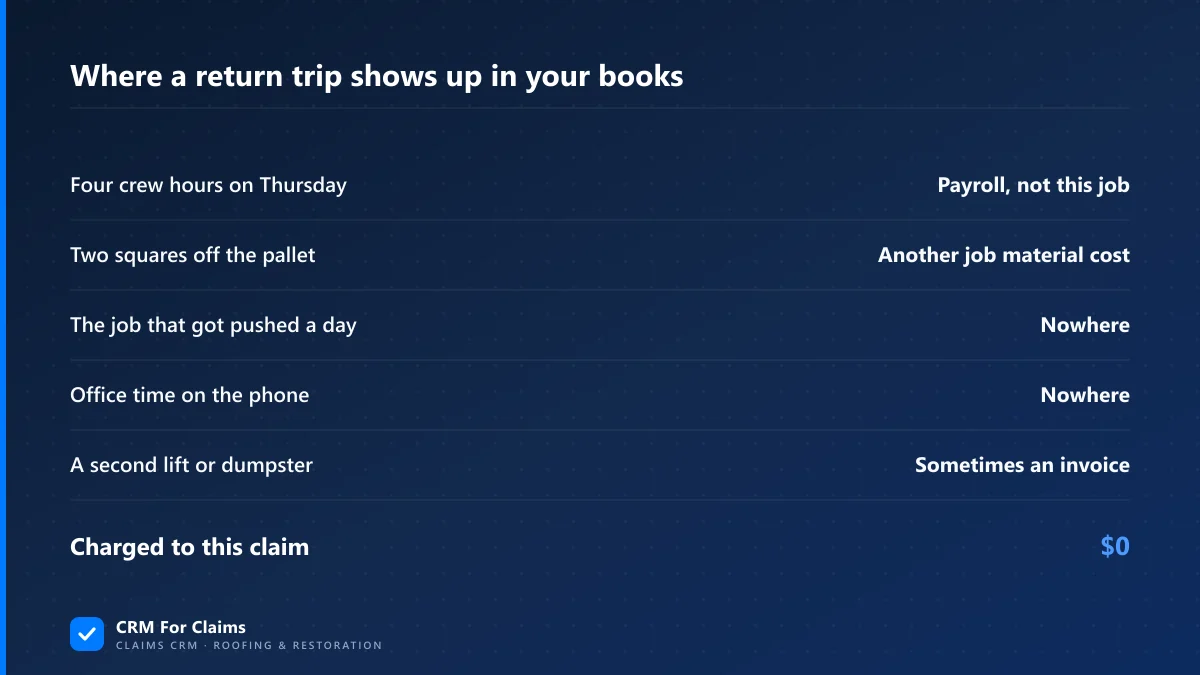
| What the trip actually cost | Where it appears in your books |
|---|---|
| Four crew hours on a Thursday morning | Payroll — but not against this claim |
| Two squares off the pallet | Material cost on whichever job bought the pallet |
| The job that got pushed a day | Nowhere |
| Office time on the phone with the homeowner | Nowhere |
| A second lift, or a second dumpster | Sometimes an invoice, if somebody codes it right |
I am not going to hand you an industry percentage for rework. I have none I could defend, and the figures that circulate come from commercial projects that look nothing like a residential storm job. The narrower claim: this is the only cost on the job that produces no paperwork, which is why it is the number most people cannot say out loud.
What makes a backcharge collectible instead of an argument?
Three things, in this order: a subcontract that permits withholding for nonconforming work, written notice that identified the defect and gave the sub a chance to fix it themselves, and a documented cost limited to the defective portion. Skip the middle one and the reply you get is you never told me — which is usually true, and usually enough.
The sequence is written down most clearly in a federal construction contract, because the government had to word it to survive a dispute. FAR 52.246-12(g) says: “If the Contractor does not promptly replace or correct rejected work, the Government may— (1) By contract or otherwise, replace or correct the work and charge the cost to the Contractor; or (2) Terminate for default the Contractor’s right to proceed.”
Read it backwards and it is full of preconditions. The work has to have been rejected — inspected, found nonconforming, and said so, on a date. The other party has to have failed to promptly correct it. Only then does “charge the cost” appear. The same clause also requires the contractor to “maintain complete inspection records and make them available.” Your subcontract is not a federal contract, but this is the sequence every enforceable backcharge follows.
How much you may hold back, and how you must say so, is state law. Illinois writes it into the Contractor Prompt Payment Act at 815 ILCS 603/10(1): “The payment application shall be deemed approved 25 days after the owner receives it unless the owner provides, before the end of the 25-day period, a written statement of the amount withheld and the reason for withholding payment.” Then the cap: “If the owner finds that a portion of the work is not in accordance with the contract, payment may be withheld for the reasonable value of that portion only.”
One caveat. That Act excludes “single family residences or multiple family residences with 12 or fewer units in a single building” — which is most residential storm work in the state. It may not govern your job; every state writes its own version, and some do not carve out residential at all. I am not a lawyer. Take the shape rather than the statute: writing, an amount, a reason, a deadline, and a cap tied to the defective portion is what a mediator expects to see, and it costs nothing to put in your subcontract now.
A notice that holds up says five things:
- The specific work, and where. Not “the flashing” — the rear elevation chimney flashing, photo attached.
- The requirement it fails. The scope line, the manufacturer instruction, or the code section — without one of those you are disputing taste.
- The date you found it. Everything else is measured from it, including whether you gave a fair chance.
- A deadline to correct it themselves. The step everyone skips because doing it yourself is faster. It is also the step that makes the rest collectible.
- The amount, and how you got there. Hours, material, equipment. A round number invites a round argument.
Send it the day you find it, not the day you pay. The same Illinois section runs in your direction too: a contractor must pay a subcontractor within 15 calendar days of receiving payment for that sub’s work.
What has to be recorded before the crew leaves the first time?
Six things, recorded per day and per trade rather than per job: who was on site by name, what they completed against the line items, the condition of adjacent work when they arrived, a dated photo of the finished portion, what was left open and why, and who looked at it before the next trade covered it up.
Attribution has a shelf life. Once the roof is dried in or the drywall is hung, who did this becomes an argument between two people who remember it differently and neither of whom is lying. The last person who could still see the work has the least incentive to photograph it: they are finished, the truck is loaded.
Two of those six get skipped almost every time, and they decide backcharges.
Condition on arrival. Without it, every defect is arguably pre-existing. A sub who says “that was already cracked when we got there” cannot be contradicted, and on a claim there is a real storm event in the background making it plausible.
Who checked it before it was covered. Not an inspection regime, and no form. It needs a name and a date, so that “did anyone look at this” has an answer other than a shrug three weeks later.
When should you eat the trip instead of charging it back?
When your own record will not survive a question, when the argument costs more than the trip, and when it is a sub you want on a roof next storm. A backcharge you cannot document does not get collected. It gets negotiated away, after you have spent time on it.
Three cases where absorbing it is the right call:
- Your record is thin. If nobody photographed the condition on arrival, you are making a claim you cannot support — and the sub works that out faster than you.
- The amount is small next to the relationship. Storm work runs on crews who answer the phone in October. Make that call deliberately and write down that you made it: an absorbed cost you chose is a decision, an absorbed cost nobody noticed is a leak.
- The homeowner can see it. A dispute with your sub becomes their problem the moment it slows the work, and they are the one writing the review and taking the carrier’s call.
There is also a size answer. If you go back twice a year, build nothing for this. It starts mattering when you cannot say, without opening a file, how many times you went back last month and why — usually around two crews and the first subcontractor you did not personally hire.
How do you track rework without creating paperwork nobody fills in?
Three fields on a record attached to the claim: cause, responsible party, cost. That is the whole system. Anything longer gets abandoned in the first busy week, and an abandoned field is worse than none at all, because it still looks like data when you read it later.
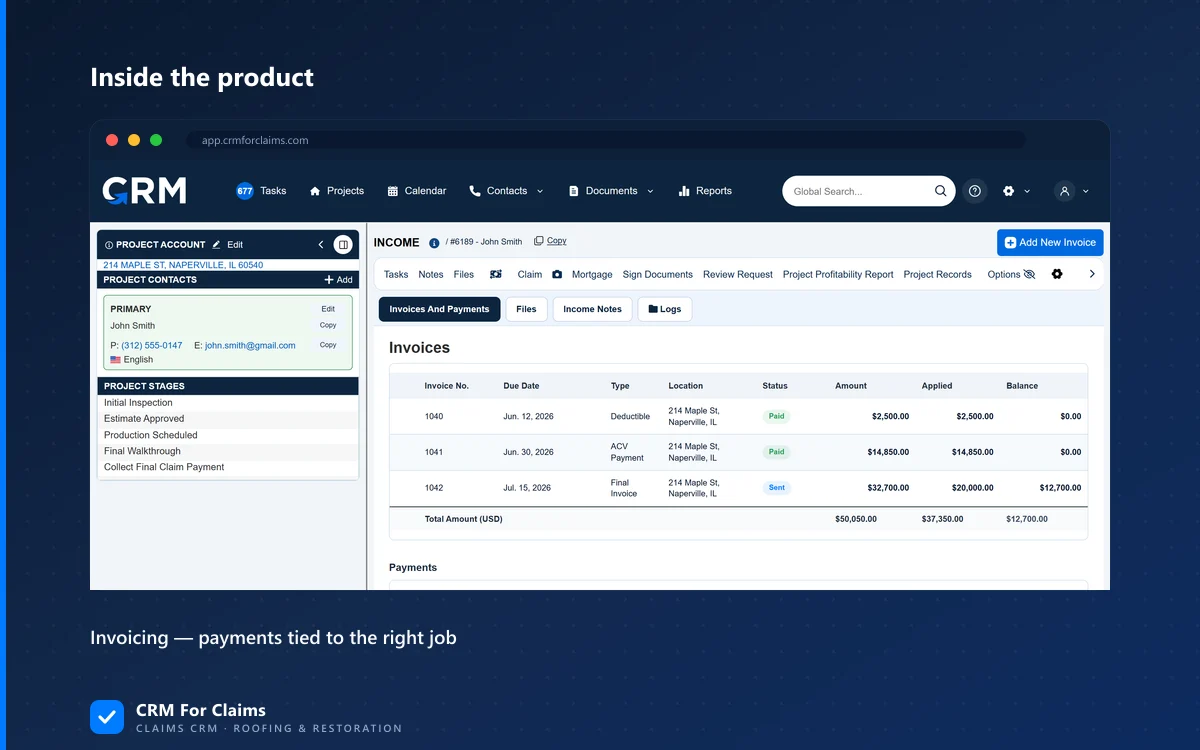
In CRM For Claims a return trip is a record on the claim like any other — dated, with the photos on it, the responsible party named, and a cost sitting against the job rather than the month. The value is not any single record. It is that at the end of a quarter you can sort them.
- By cause. The same flashing detail four times is a training problem with a name attached to it.
- By party. One sub generating half your returns is a purchasing decision, not a personality clash.
- By claim. A job with three return trips was mis-scoped, and the estimate is where that gets fixed.
- By whether anything was recovered. If the answer is never, your notices go out too late to matter.
None of that requires our product; a shared folder and a spreadsheet will do the counting. What software changes is who creates the record and when: the person who made the trip, on the file everyone already has open, that day. See how the claim record, documents and invoicing fit together on the features page, and how that differs from a general contractor CRM on the comparison page. Plans start at $59 a month, plus $39 per additional user, on the pricing page.
The honest limits: it will not make your subcontract enforceable, send a legal notice, or decide whether to eat a trip. It records that the trip happened, who caused it, and what it cost — the part nobody is doing at 4pm on a Thursday.
Here is a ten-minute test. Open last month, count the times somebody went back to a property on a job that was still open, and for each one answer two questions: what caused it, and did anyone pay other than you. If you cannot finish the list, that is the finding — a records problem, not a discipline problem, so the fix is a field and not a meeting. To see that on a real claim file, book a live walkthrough.