Short answer: Every call after a claim closes is one of three things — workmanship you owe, a material defect the manufacturer owes, or a new loss belonging on a new claim. Getting it wrong costs money both ways. The triage takes ten minutes, but only if the closed file still has the photos, product details and completion date on it.
I build CRM For Claims, and warranty callbacks are the part of the job almost nobody designs for. Every process I see is built beautifully for the claim itself: intake, inspection, documents, adjuster, production, paid. Then the file closes and the process simply stops. Eight months later the phone rings, a homeowner says the ceiling is wet again, and the person who ran that job left in March.
The call is not the hard part. Answering it correctly requires facts that were true a year ago — what was installed, who installed it, what the roof looked like the day the crew drove away — and nobody wrote them down, because the job was over.
What counts as a warranty callback, and what is actually a new claim?
Three genuinely different situations arrive as the same phone call. Workmanship: you installed it, it failed, you fix it at your cost. A material defect: the product failed, and the manufacturer covers it if you can prove what went on the building. A new loss: a new date of loss, a new claim, a new deductible, and not your problem to absorb.
All three sound identical when a homeowner describes them. Nobody calls to report a manufacturer defect. They say the roof is leaking. The classification is yours to make, and you make it with evidence or with a guess.
Both directions cost real money. Absorb a new storm loss as a warranty repair and you have donated a crew day and a pallet of material to a claim that would have been covered. Send a homeowner to file a claim on your crew's mistake and you have handed them a deductible and a reason to tell the neighbours. The second one never appears in any report.
| What it is | Who pays | What you have to prove | What it becomes |
|---|---|---|---|
| Workmanship failure | You | Nothing — you accept it | A warranty job at your cost |
| Material or product defect | The manufacturer | Product, lot, install date, registration | A claim against the material warranty, labor often on you |
| New loss from new weather | The carrier | A dated set from the original completion | A brand new claim with its own deductible |
| Outside the original scope | The homeowner | The approved scope, and what it excluded | A quoted repair, sold like any other job |
That fourth row is the one people forget. On an insurance job the approved scope is often narrower than the building: the storm damaged the rear slope, the carrier paid for the rear slope. When the front slope leaks two years later, that is a repair you can sell — if you can show what the original scope included.
How do you triage a callback in the first ten minutes?
Pull the file before you form an opinion. You need six facts: what was done, when it was finished, exactly which part of the building it covered, what product went on, who did the work, and whether there has been weather since. Then ask the homeowner what changed and when they first noticed it. Do not diagnose on the phone.
That last instruction gets ignored the most and costs the most. Whoever answers is trying to be reassuring, so they say "if we did it, we will take care of it" — a promise made without the file open, about a job they may not have worked on. You cannot re-triage a callback after telling the homeowner it is covered. The honest script: I am pulling up your file now, I can see we finished on the ninth of April, tell me what you are seeing and when it started, and I will send someone out.
| Ask | Why it decides the bucket |
|---|---|
| When did you first notice it? | A date landing after a named storm points at a new loss, not workmanship |
| Is it the same area we worked on? | Outside the approved scope is a sale, not a warranty event |
| Has anyone else been on the roof or in the wall since? | Solar, satellite, HVAC and cable installers void more work than weather does |
| Did your carrier write to you about a recent storm? | Tells you whether a new claim already exists that nobody mentioned |
What has to be on a claim before you are allowed to close it?
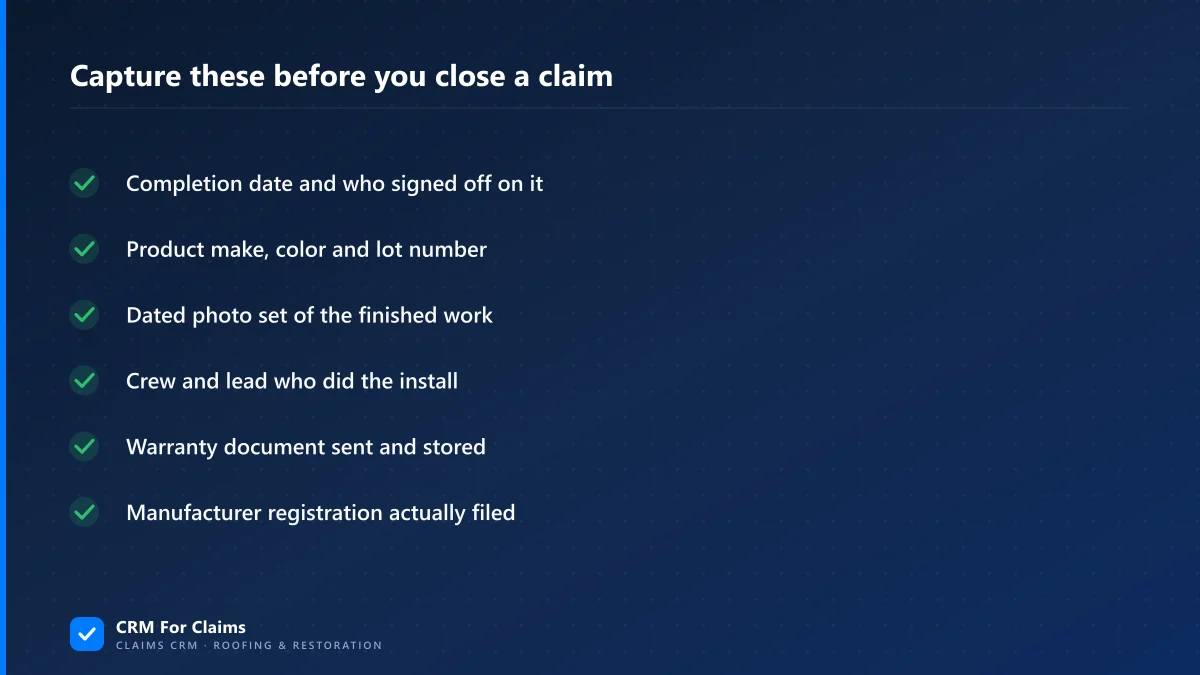
Six things, and each exists purely to answer a phone call you have not received yet: the completion date and sign-off, the product make and lot, a dated photo set of the finished work, the crew who did it, the warranty document, and the manufacturer registration.
None of this is exotic. It is all known on the last day by the people standing on the property. It goes missing because that is the day everyone mentally moves on: the invoice goes out, the file feels finished, and the six facts evaporate with the attention.
Photographs fail most reliably, because the incentive is backwards. During the claim, photos are how you get paid, so they get taken. After production their only job is to prove, a year from now, what the finished work looked like. The habits that make a photo set usable months later apply here with one addition: nobody is motivated to take the completion set, so it has to be a gate rather than a good intention.
| Captured at close | The callback question it answers |
|---|---|
| Completion date and sign-off | Is this inside the warranty term at all? |
| Product make, color, lot | Can we open a manufacturer claim, and on what? |
| Dated completion photo set | Was this condition there when we left? |
| Crew and lead on the job | Who do we ask what actually happened up there? |
| Warranty document sent and stored | What exactly did we promise, in writing? |
| Manufacturer registration filed | Is the material warranty still alive? |
The registration line deserves its own sentence. Many manufacturer warranties require the install to be registered within a defined window after completion, and an unregistered install can fall back to weaker default coverage. The requirement varies by product and program, and the only reliable source is the document itself. But "we always mean to register them" is the same as not registering them.
When does the warranty clock actually start?
Whenever your written warranty says it does. The three common candidates are substantial completion, final inspection, and final payment, and they can sit weeks apart on an insurance job where depreciation is recovered long after the crew has gone. If your document does not name one, that ambiguity will be resolved against you.
Insurance work makes the gap unusually wide. On a retail job, completion and payment are close together. On a claim, work can finish in May and final payment land in August, after the completion paperwork goes back to the carrier. A warranty starting at "final payment" is three months longer on every job — and nobody chose that. It is just how the sentence was written.
There is a second clock underneath yours that you do not control. States set time limits on construction defect actions, typically two: one from when a problem is discovered, a longer one from completion regardless of discovery. They vary by state and are genuinely a legal question. Ask a lawyer in your state, once, and write down the answer.
Where does a closed claim have to live for the callback to be answerable?
Somewhere a person can find it in under a minute, searching the way a homeowner identifies themselves — by address and phone number, not by claim number. Closed should mean finished, not archived. If reopening a two-year-old file means asking somebody to dig a folder out of storage, the callback gets answered from memory instead.
The failure I see most often is not a missing file, it is a split one. Photos in one person's phone, the signed warranty in a sent-items folder, product details on a supplier invoice in accounting, the claim record holding a stage history and little else. Every piece exists. Nobody can assemble them in ten minutes, which is the same as losing them.
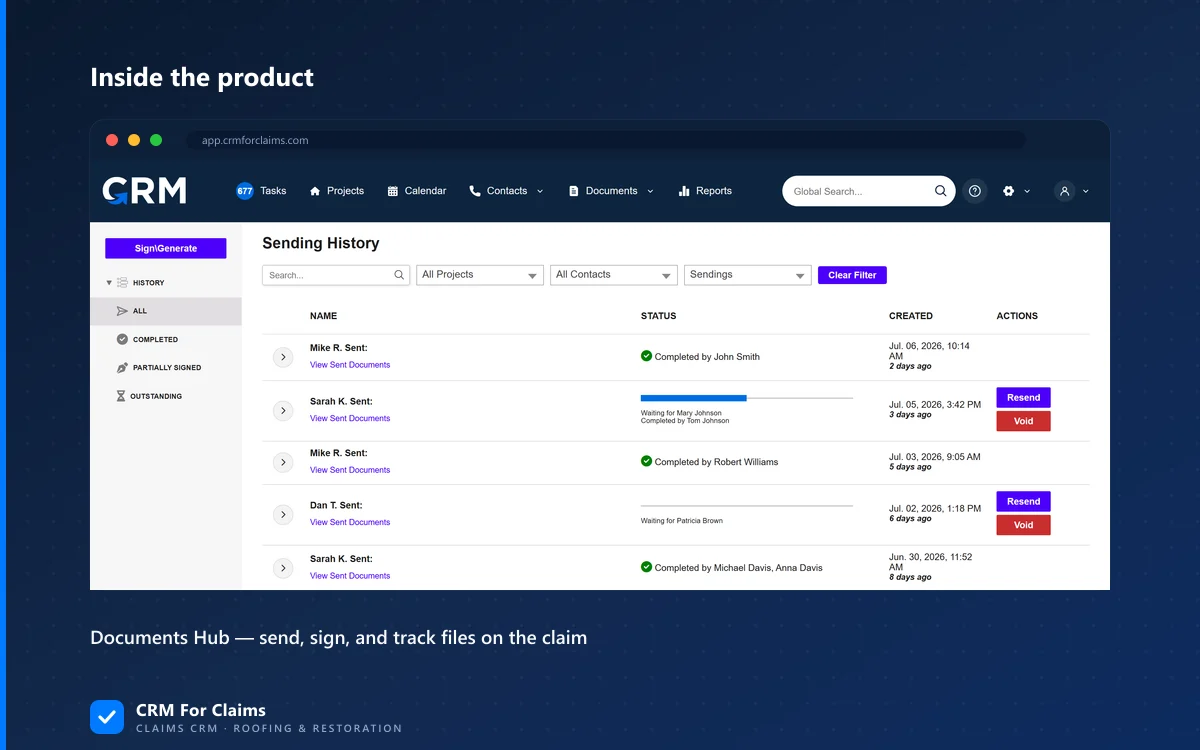
Keeping documents on the claim rather than on a person is the point of a documents hub that files signed paperwork onto the claim automatically, and one of the clearer places where a claims CRM differs from a general contractor CRM: a sales-shaped tool is built around an opportunity that ends when it is won, and a claim keeps generating obligations after that. It is also what makes turnover survivable — a claim whose history lives on the record can be answered by whoever is at the desk today.
Should warranty work be its own pipeline, or just a job?
For most companies, a short stage set that links back to the original claim: Reported, Inspected, Decision, Scheduled, Complete. Five stages, because a warranty job has fewer waiting states than a claim — there is no carrier in it unless triage sends it back to one. What it must not be is a duplicate of the claim record.
The honest counterpoint: if you get two callbacks a year, do not build any of this. Make it a task on the original claim and move on. Structure you do not need is how a CRM turns into homework. Build it when somebody other than you has to run one alone.
- Link, do not copy — a warranty job should point at the claim it came from, so the original scope, photos and documents are one click away.
- Record the bucket — workmanship, defect, new loss or out-of-scope, chosen at inspection. This is the only warranty metric that ever tells you anything.
- Give it a cost — warranty work is real labor and material. If it never appears as a number, it is invisible in every margin you calculate.
- Keep the response short — a callback that waits a week becomes a review. The inspection is cheap; the delay costs you.
- Close it like a job — same six facts, captured again. A warranty repair can generate its own callback, and the second is harder to defend.
The bucket field is worth pushing on, because it turns a vague irritation into something you can act on. Twelve callbacks a year all classified as workmanship on the same detail is a training problem with a name attached. Twelve that turn out to be new losses means your triage works. Without the field, both look identical.
None of this makes callbacks disappear. It moves their cost out of wherever it hides and takes the guessing out of the phone call — a smaller promise than most software makes, and one I can stand behind. Every claim in CRM For Claims keeps its history, documents and contacts after it closes, and stages are set in your own wording during onboarding, including a warranty set if you want one. Seats are what the plan you are on decides, not the number of workflows. To see how a two-year-old closed claim looks when somebody calls about it, book a live walkthrough — bring the oldest job you still get calls about.