Short answer: Reassigning a claim takes a click. Recovering what the departing person had in flight takes a process. Get a claim-by-claim verbal pass while they are still willing to talk, close their access on their last working day, name one new owner per claim in writing, move the open tasks with it, and let the new owner make the customer call.
I build CRM For Claims, and reassigning a claim mid-job is one of the few operational problems where the software half is genuinely easy and the human half is genuinely hard. Changing an owner field takes a second. Working out that the estimator who resigned on Friday had verbally promised three homeowners a start date, booked a re-inspection with an adjuster for Thursday, and had photos for two roofs sitting on a personal phone takes a week — usually a week you find out about one angry phone call at a time.
People leave in the middle of jobs. Sometimes with two weeks of notice and a good attitude, sometimes on a Tuesday afternoon with the truck keys on the desk. Both versions produce the same list of work. The second one just removes your ability to schedule it.
What actually breaks when the person running a claim leaves?
Not the file. The claim number, the stage, the documents and the invoice history are all still there. What breaks is everything that was mid-flight — the calls that were about to happen, the answers somebody was waiting on, and the promises made out loud that never became a record anywhere.
A pipeline stage is a location, not a state of play. "Adjuster review" tells the next person where the claim sits and nothing about whether the adjuster was called yesterday, whether a supplement was already emailed, or whether the homeowner was told a crew would be there on the 22nd. Two claims can sit in the same stage with completely different amounts of unfinished conversation behind them.
| What the record shows | What it usually does not show | Where the missing half lives |
|---|---|---|
| Current stage and claim number | Whether the stage is progressing or parked | The last-contact date, if anyone logs one |
| Documents sent and signed | What was agreed verbally after they were signed | A phone call nobody wrote down |
| Scheduled crew dates | Dates promised to a homeowner but never booked | The departing person's memory |
| The adjuster listed on the claim | Which adjuster is actually handling it this week | An email thread in one inbox |
| Invoices raised | A discount or deductible conversation held at the table | Nowhere at all, most of the time |
That right-hand column is the actual scope of a handoff. Everything in it can be recovered while the person is still reachable, and almost none of it can be recovered afterwards. Which is why the exit conversation matters far more than the software step, and why it should happen before the last day rather than on it.
What has to happen in the first 48 hours?
Five things, and they compete for the same short window. List every claim the person owned with its stage, get a verbal pass on each one, close their access on their last working day, assign a single named owner per claim, and tell the customers before they find out by calling a disconnected number.
The order matters because two of these have a hard deadline attached and three do not. Access closure is tied to a date on a calendar. The verbal pass is tied to how long the person stays willing to talk to you, which for an unplanned exit can be measured in hours.
| Task | Who owns it | Why the clock matters |
|---|---|---|
| Pull the list of claims they owned, with stage and dollar value | Whoever runs the board | You cannot hand off what you have not counted |
| Claim-by-claim verbal pass with the person leaving | Their manager, with the list open | Goodwill has a short half-life, especially after a bad exit |
| Deactivate logins, email, and any shared phone or messaging access | Whoever administers the accounts | Same-day on the last working day, not "when we get to it" |
| Assign one named owner per claim and record it | The manager, in writing | An unowned claim is invisible within a week |
| Contact every active customer and every open adjuster | The new owner of each claim | The first person to explain the change controls the story |
The one people skip is the third. Reassigning work feels urgent and closing access feels like paperwork, so the claims get moved on Monday and the departed user is still active in four systems in October. That is a security problem, but more immediately it is a data problem: an active account keeps receiving the adjuster replies and the portal notifications for claims it no longer owns, into a mailbox nobody reads.
What do you do about promises nobody wrote down?
Assume they exist and go looking for them. Ask the departing person one specific question per claim rather than a general one: not "anything I should know?" but "what did you tell this homeowner would happen next, and when?" The general question produces a shrug. The specific one produces a list.
The commitments that come back are usually the same five kinds, in roughly this order of frequency:
- A start date. Somebody has a week in their head that exists in no calendar. This is the promise that generates the angriest call, because the homeowner has already booked time off work around it.
- A price adjustment. A number agreed at the kitchen table that never made it onto the estimate — a waived upgrade, a rounded-down amount, a "we will sort the gutters out for you".
- A deductible conversation. Whatever was actually said about it. This one matters enough to hear the exact words, because what a contractor may say about a deductible is governed by state rules and getting it wrong is a bigger problem than the handoff.
- A supplement in progress. Photos taken, evidence gathered, nothing submitted. The work exists; the file does not.
- An adjuster relationship. Not a promise, but the same class of asset — who is actually responsive at that carrier, and what they already agreed to informally.
Then verify from the other side. When the new owner calls the homeowner, the useful opener is a short summary of what is on file — the stage, the last document sent, any date recorded — followed by asking whether anything else was agreed. Customers are generally happy to tell you exactly what they were promised. Some of it will be optimistic. Hearing it in week one beats hearing it in week six.
The structural fix is the boring one: fewer commitments living in conversation to begin with. Every message that is sent from the claim record instead of a personal phone survives the person who sent it, which is the whole argument in the piece on messages that log themselves on the claim. The same is true of the field photos on a personal camera roll, covered in the guide to where claim photos actually have to live.
Who tells the homeowner and the adjuster?
The new owner does, by phone, within the first two days, and the message is one sentence about the change and three about the claim. Say who you are, that you now have their file, and then immediately demonstrate you have read it. The reassurance comes from the detail, not from the apology.
What not to do is send a company-wide notification email about staffing. Homeowners in the middle of a restoration job do not care about your org chart; they care whether their roof still has a start date. A departure framed as an internal event invites the customer to wonder whether the job is at risk. A call that opens with "I have your claim, your supplement went to the carrier on the eighth, and I am chasing them Thursday" does not.
The adjuster side is different in one important way: the carrier does not need to know about your staffing at all, but the individual adjuster does need a working contact. Their thread is addressed to a mailbox that is about to stop being read. A short email from the new owner with the claim number in the subject, sent from an address that is monitored, resolves it in one step. Auto-forwarding a departed employee's inbox is a stopgap, not a fix — it keeps the conversation attached to a person who no longer exists rather than to the claim, which is the problem laid out in the post on keeping adjuster conversations on the claim.
What should the CRM do when you reassign a claim?
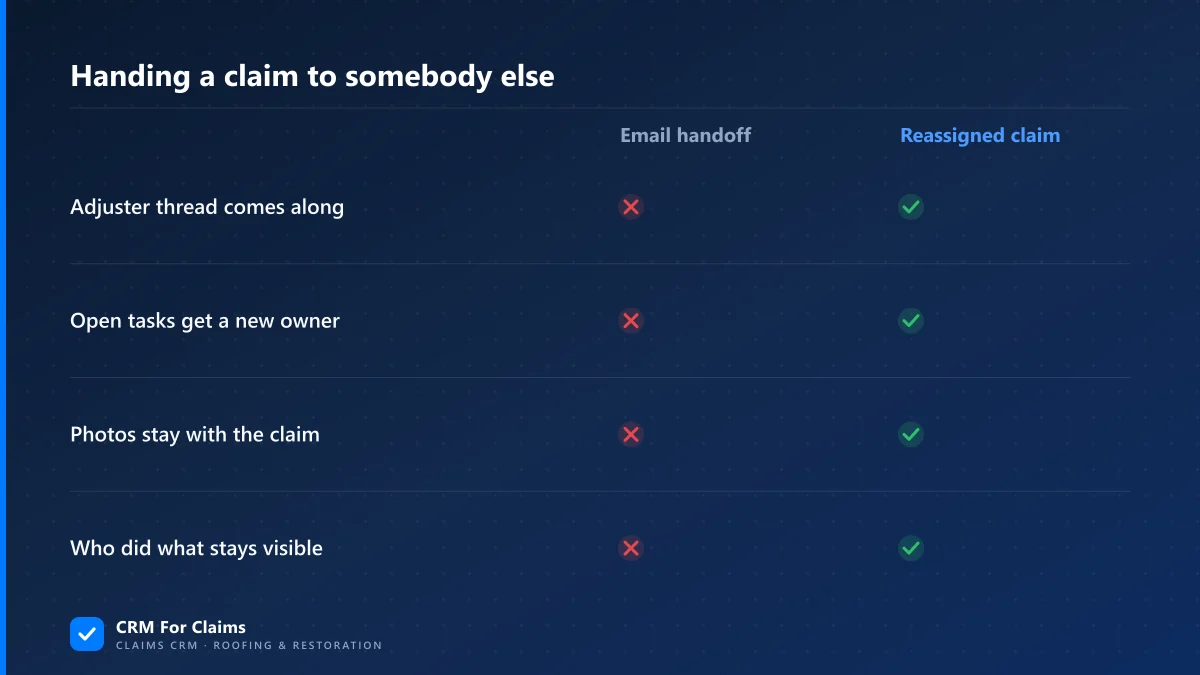
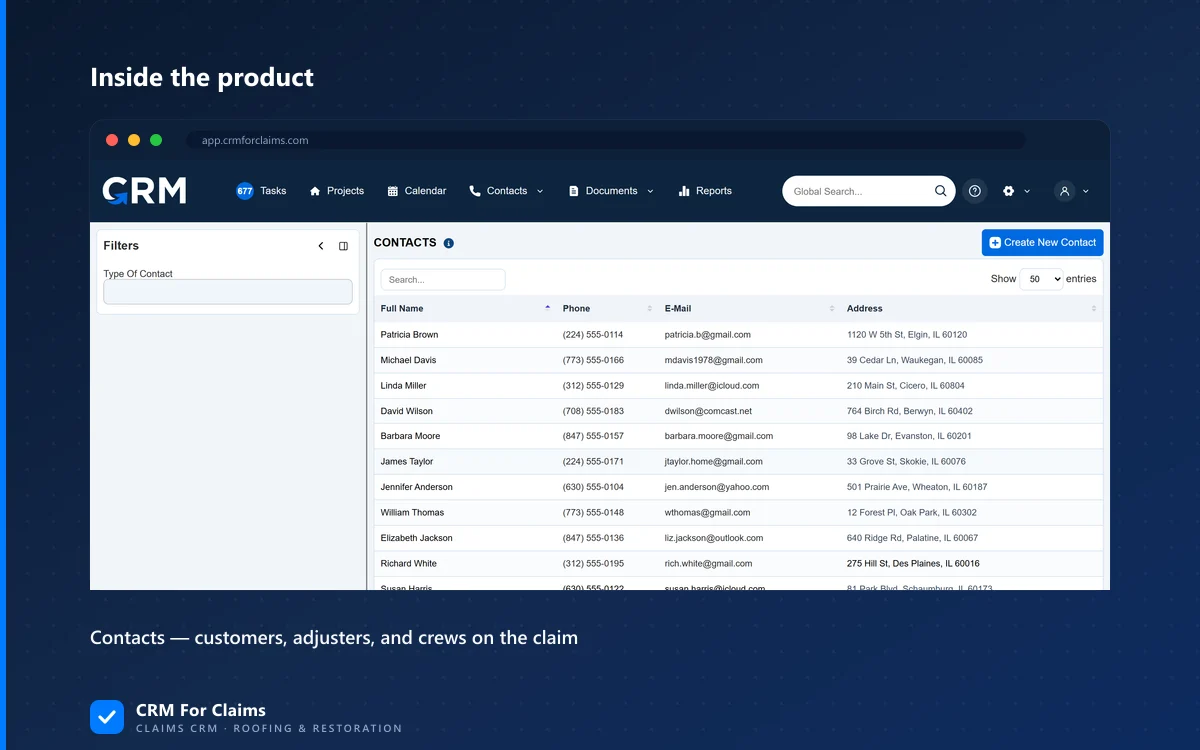
Four things, none of them glamorous. Move ownership without rewriting history, move the open tasks with it, keep the departed user deactivated rather than deleted so the audit trail still reads correctly, and make it obvious on the board which claims currently have no living owner.
The history point is the one that decides whether reassignment is safe. If changing an owner rewrites the record so every past action appears to have been done by the new person, you have destroyed the thing you needed most — the ability to see who inspected the property, who sent the authorization, and who spoke to the adjuster in June. Deleting the departed user does the same damage more quickly. Deactivate them: the login stops working, the name stays attached to everything they did.
Open tasks are the quiet failure. A claim can be reassigned perfectly while five reminders stay pointed at a mailbox nobody opens, so the follow-ups simply never happen and the claim looks healthy right up until it is three weeks stale. Any reassignment worth the name moves the tasks too, so stage automation keeps firing against the new owner instead of an empty seat. That structure is laid out on the features page.
There is a billing dimension too, and it is worth knowing before you are in the middle of it. Seats on CRM For Claims are $39 per month per additional user on top of the base plan, and deactivating a user credits the next invoice, so an exit and a replacement hire do not stack a double charge on you for the overlap. The full arithmetic sits on the pricing page, and the reasons a claims-specific tool tracks ownership differently from a general CRM are on the comparison page.
One thing to avoid entirely: solving turnover with a shared login. It is the fastest way to make a handoff painless and the fastest way to make every record in the system unattributable. The moment two people share an account, "who did this?" becomes unanswerable for every claim, not just the ones affected by the departure.
Is this worth a process for a small team?
If you are two people, no. You already know every claim, and a handoff is a conversation over a truck bed. The threshold is the first time somebody leaves whose claims you cannot personally recite — which for most roofing and restoration teams is somewhere between the third and fifth person on the payroll.
What is worth doing at any size is writing the list once. The five-row table above is the whole procedure, and it takes an afternoon to adapt to your own company. Having it written matters most in the case you cannot plan for, because an unplanned exit is the same list with the calendar removed: no notice period, no verbal pass, and the customer calls landing before you have finished counting the claims.
There is an honest limit to what software can do here. A CRM can hold the ownership, the tasks, the messages and the documents, so that the recoverable part of a departure is genuinely recoverable in an afternoon. It cannot recover a promise that was only ever spoken, and it cannot make the phone call to the homeowner. What it changes is the size of the gap between those two categories — and that gap is entirely a function of how much of the work was happening inside the system before anybody handed in notice.
If you want to see what that looks like against a real claim rather than a demo one, book a live walkthrough and bring the messiest reassignment you have had to do. Reassigning a claim that somebody abandoned halfway is a better stress test of a CRM than any feature list I could show you.