Short answer: Adjuster conversations end up in someone's inbox because email and phone calls are the default channel and nothing forces them back onto the claim. Keeping every adjuster conversation on the claim means the CRM captures the message where the claim lives — not a personal inbox — so anyone on the team can see the full thread without asking the one person who happened to answer the call.
I build CRM For Claims, and this is the complaint I hear most from office managers, not adjusters: "I don't actually know what was said on this claim, I just know Mike talked to the adjuster last week." Adjuster conversations are where a claim's real status lives — approvals, pushback on scope, requests for more photos — and on most teams that information sits inside one person's Gmail, one person's phone, or one person's memory. Keeping adjuster conversations on the claim instead of in someone's inbox is not a nice-to-have. It's the difference between a claim anyone can pick up and a claim only one person can explain.
Why do adjuster conversations end up in someone's inbox instead of on the claim?
Because email and phone are the path of least resistance — an adjuster emails whoever's contact info they have, or calls the cell number on the intake sheet, and that message lands wherever it lands. Nothing about a personal inbox or a phone call automatically ties the conversation back to a specific claim record.
This isn't a discipline problem, and it's not fair to blame the person answering the phone. Adjusters work off whatever contact they were given, and the fastest way for them to get an answer is to email the person who returned their last message. Multiply that across a team running fifteen or twenty active claims, and you get a dozen different adjuster relationships living in a dozen different inboxes, with no shared view of any of them. The claim record shows the stage. It does not show the three back-and-forth emails that got the claim to that stage.
What actually breaks when an adjuster conversation lives in one inbox?
Coverage breaks first — if the person who owns that inbox is out, nobody can answer the adjuster's follow-up without digging or guessing. Then trust breaks, because an adjuster who has to re-explain something they already said once starts treating the whole team as disorganized, which shows up in how claims get scrutinized.
The failure mode is rarely dramatic. It's an adjuster emailing a question on a Tuesday, the person who normally handles that claim being at a job site with no signal, and someone else on the team replying with an answer that contradicts what was already said in a call two weeks earlier — because they never saw that call happen. Now the adjuster has two different answers on file, and every future interaction on that claim starts from a slightly lower level of trust. None of this shows up as a single bad day. It shows up as claims that quietly take longer to close, for reasons nobody can point to directly.
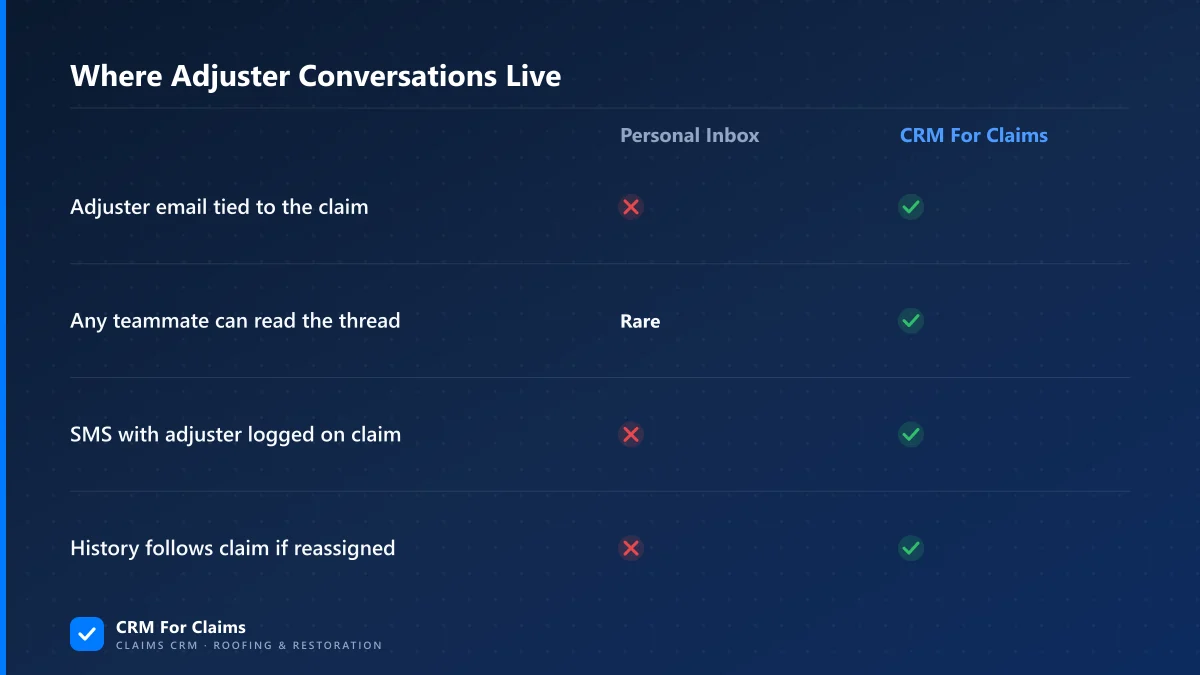
| What you need to check | Personal inbox / phone | CRM For Claims |
|---|---|---|
| Adjuster email tied to the claim automatically | No | Yes |
| Any teammate can read the full thread | Rare | Yes |
| SMS with the adjuster logged on the claim | No — lives on a personal phone | Yes |
| History follows the claim if it's reassigned | No | Yes |
What does keeping adjuster conversations on the claim actually require?
It requires the adjuster existing as a real contact tied to the claim — not a name typed into a notes field — and every email, text, and call logged against that claim record instead of a personal account. That's the structural difference between a CRM that treats adjusters as claim data and one that treats them as an afterthought.
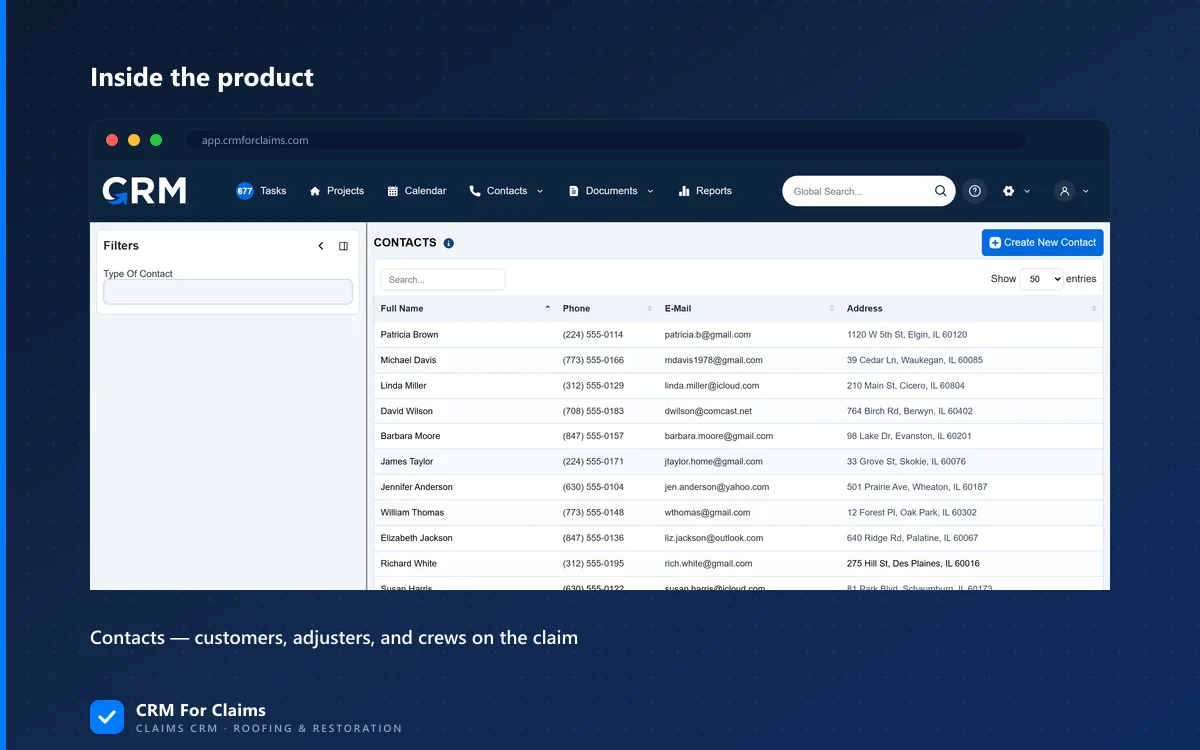
In a claims-built CRM, the adjuster is a contact type of their own, connected to the specific claim they're handling, the same way the customer and the crew are. When a message goes out through the CRM, it's logged on the claim automatically, not copy-pasted in afterward if someone remembers. That single structural choice is what makes "who talked to the adjuster last, and what did they say" a question anyone can answer by opening the claim, instead of a question that requires finding the right person and asking them to remember. Our features page covers how contacts, documents, and stage automation connect to make this the default instead of a manual habit.
Does this mean nobody uses email or phone calls with adjusters anymore?
No — adjusters still call, and email is still often the fastest way to send a document. The point isn't to eliminate those channels, it's to make sure whatever happens on them gets attached to the claim, either automatically through the CRM or with a two-minute note logged right after the call.
A CRM that logs SMS and email sent through it solves most of this on its own, since the message is already tied to the claim the moment it's sent. Phone calls are the harder case, because there's no automatic record of what was said — that part still depends on someone typing a quick note. The realistic goal isn't zero manual logging, it's making the default path the easy one. If sending a message through the claim takes the same effort as sending it from a personal inbox, most people will use the path that leaves a record, simply because it's not extra work.
What should a claim's communication history actually show?
It should show who said what, when, and through which channel, in one chronological view attached to the claim — not scattered across an inbox search, a text thread, and someone's memory of a call. If a teammate has to ask "did anyone talk to the adjuster about this," the history has already failed its one job.
- Every outbound message — email and SMS sent to the adjuster through the claim, timestamped and attributed to whoever sent it.
- Call notes — a short log entry for phone conversations, even a single line, attached to the claim instead of a personal notebook.
- Document exchanges — estimates, photos, and supplements sent to or received from the adjuster, tied to the same record.
- Status context — what the adjuster actually said about scope or approval, not just that a call happened.
This is also where a customer portal earns its place, separate from the adjuster conversation itself — the customer sees the claim moving without needing to be looped into every adjuster email, while the office keeps the adjuster thread contained to the people who actually need it. Compare how this fits against a general contractor CRM on our comparison page, where communication tracking is one of the concrete differences, not a marketing line.
How do you fix this without a full rebuild of every existing adjuster relationship?
Start with active claims only — pull the adjuster's contact info into the CRM for whatever's currently open, and let closed claims keep their history wherever it already lives. Going forward, route new adjuster messages through the CRM by default, and the backlog problem stops growing immediately even before anything old gets cleaned up.
The instinct is to want every past email re-attached to its claim before switching anything over, and that instinct is what stalls this kind of change for months. It's not necessary. An adjuster relationship on a closed claim rarely needs to be searchable again, and the ones that do can be found the old way if it ever comes up. What actually matters is that starting today, the next adjuster email on an open claim goes through a channel that logs it — that one change, applied consistently, is what stops the next six months of claims from having the same gap. For teams weighing what else to bring over first, our guide on what to migrate first covers the same triage for the rest of a claim's data.
If your team's adjuster relationships currently live in three or four different inboxes and one shared understanding of "ask so-and-so," that's a solvable structural gap, not a discipline problem — book a live walkthrough and we'll show you what a claim's communication history looks like when it's built in instead of reconstructed after the fact.