
A roofing sales commission on an insurance job is safest for both sides when it is paid in shares, one share each time a payment on that claim clears. The rep is not left waiting for the last check, and the company never pays out on money it has not received.
I build CRM For Claims, and the commission rules in it work this way on purpose. Most advice on commission plans argues about the rate: eight percent or ten, revenue or profit. On insurance work the date matters as much as the rate, because the money for one roof arrives in up to four pieces spread over several months. This post takes one claim and pays the same rep three different ways, so you can see what each timing costs and who carries the risk.
Why does an insurance job break the usual commission timing?
Because "the customer paid" is not one event. A retail roof has a deposit and a final payment a few weeks apart. A claim has several payers and several dates, and the contract total can still move after the work has started. A plan written for retail jobs has no answer for half of what happens next.
On a typical replacement-cost claim the money comes in like this:
- The first carrier check, which is the approved amount minus the deductible and minus the depreciation the carrier is holding back.
- The deductible, which the homeowner pays you directly. The rules on that are in what contractors can and cannot do with a deductible.
- A supplement, if the carrier approves items that were missing from the first scope. It may arrive before or after the build.
- The held-back depreciation, released after the carrier gets proof the work is finished. Getting it out takes its own packet, described in the post on recoverable depreciation.
If a mortgage company is named on the check there can be a fifth delay while the lender endorses or releases the funds. So the question "do we pay on sold or on collected?" has to be asked again for each of those lines.
What does one claim pay the rep under three timings?
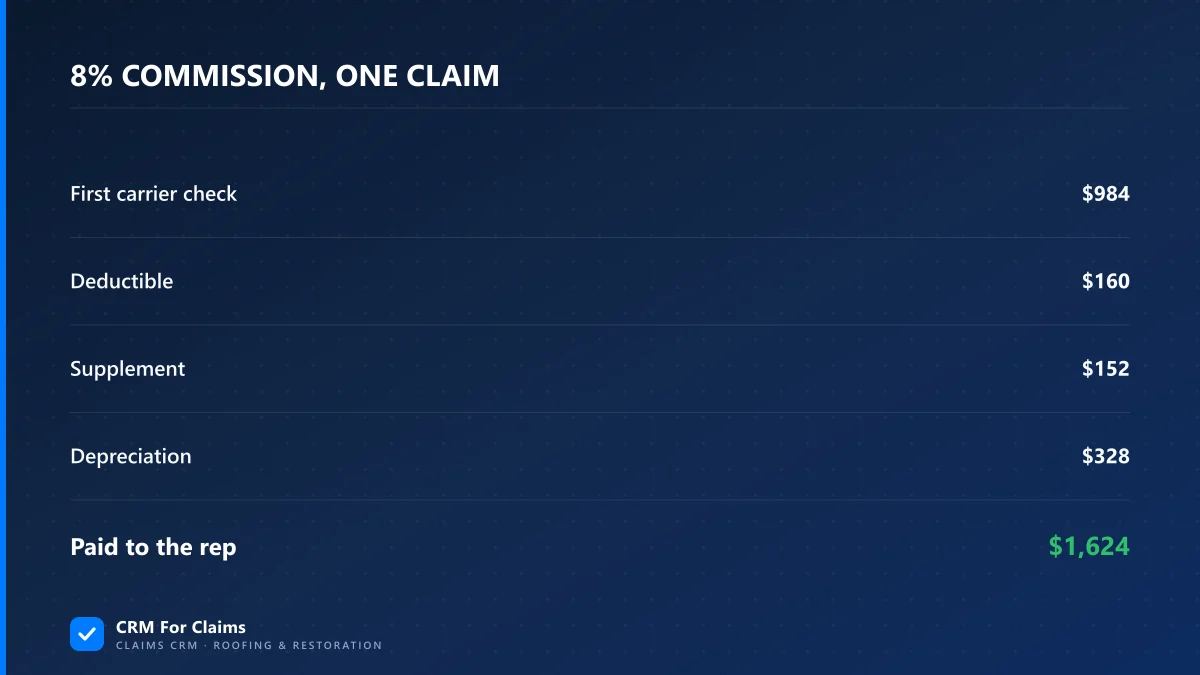
The same total in every case, $1,624 in this example. What changes is when the rep sees it and how much the company has paid out before the matching money is in the bank. The numbers below are made up to keep the arithmetic easy to follow, and the 8% is an example rate, not a recommendation.
The claim: the carrier approves $18,400 at replacement cost. The deductible is $2,000 and the carrier holds back $4,100 of recoverable depreciation, so the first check is $12,300. A $1,900 supplement is approved later, which brings the job to $20,300.
Now the three ways a company could pay that $1,624.
| Timing | What the rep receives | Paid ahead of the money |
|---|---|---|
| All when the job is sold and approved | $1,472 before week 3, then $152 with the supplement | $1,472, until the checks catch up in week 14 |
| All at the final check | $1,624 in week 14, after a 14-week wait | $0 |
| A share with each payment | $984, $160, $152, $328 as each clears, so 61% by week 3 | $0 |
The first row is how you end up asking a rep to hand money back. The second row is how you lose reps: a person on commission only who sells in June and is paid in September has a cash problem by July, and it is a problem the rep cannot fix, since the rep does not chase the carrier for the depreciation release. The third row costs the office more bookkeeping, and that is the whole price. With a spreadsheet it means four calculations per job. With software it means none.
What happens to a commission when the money goes backwards?
It depends on what was already paid. Money goes backwards on a claim in three ways, and a plan that pays at signing has to claw back in all three. A plan that pays as money clears has almost nothing to recover in the first two and a tracked task in the third.
The carrier lowers the approval
A re-inspection removes a slope, or a line item is taken out after review. Say the $18,400 becomes $15,900. A rep already paid on $18,400 now holds $200 too much. A rep paid per payment has simply been paid on what arrived.
The homeowner cancels or the claim is denied
The contract was signed, the rep did the work of selling, and no check ever comes. Paid at signing, the whole commission is out and the conversation about returning it happens with someone who has already spent it. Paid on collection, nothing was released. If you want reps paid something for a signed job that dies, write that as a flat amount in the plan, so it is a decision and not an accident.
A payment is returned after it was recorded
A homeowner check bounces, or a card payment is reversed. This is the one case where per-payment timing can still overpay, because the commission was released on money that looked real. It is rare, and it needs a name on it: one person whose job is to recover that payout or net it from the next one.
How do a setter, a closer and a referral partner fit on one job?
Give each role a percentage of the same payments, and make the percentages add up to no more than the pool you set aside. If the canvasser who set the appointment gets 2% and the closer gets 6%, each of them gets that share of the $12,300 check, then of the $2,000, and so on. Nobody is paid in full while somebody else waits.
Two things go wrong with splits. One is deciding the split after the job is sold, which turns every job into a negotiation. Put the roles and percentages on the job when it is created. The other is the project manager who inherits the claim after signing and gets nothing for carrying it through supplements and the depreciation release. I wrote about that handoff in who owns the claim after signing, and the pay plan is usually the reason it goes badly.
A referral partner is a different kind of payee. A neighbor, an agent or another contractor who sends you a job is commonly paid a fixed amount once, or a percentage, and is not on your payroll. Rules on paying for referrals on insurance work vary by state, so ask a licensed attorney before you set that fee.
What should the written commission plan say?
It should answer the questions a rep will ask on the worst day of a job, in writing, before the first sale. Commission and final-pay rules differ by state, so have an employment attorney read the plan. These are the clauses to bring to that meeting:
- What the percentage is taken from: the invoice amount, or profit after job costs.
- The event that makes a commission payable. "When the customer's payment on that invoice is received and has cleared" leaves no room for argument.
- Whether supplements count, and at what rate. If the rep does not write the supplement, say whether the rep still shares in it.
- Whether the deductible counts. It is part of the contract price, so the plan should say so one way or the other.
- What happens to commissions on jobs still open when a rep leaves.
- What happens when a payment is returned after the commission was paid.
- The pay cycle: weekly, twice a month, or monthly, and the cut-off day for a payment to count.
- Any advance or draw for new reps, and how it is netted against later commissions.
Item five causes the most bad feeling. A rep who leaves in August with six claims waiting on depreciation believes that money is theirs. You may believe the person who finishes the file earned it. Either answer can be fair if it was written down in March.
How does this run in CRM For Claims, and where does it stop?
You put the people on the job first: the closer at 6%, the setter at 2%, whoever else is paid from it. The system refuses a team whose shares add up past 100%. From then on nobody calculates anything. Adding the approved $18,400 invoice creates a $1,104 commission for the closer and a $368 one for the setter, both with the status Pending. They stay Pending until money is recorded against that invoice, and they turn Approved in the same proportion the invoice has been paid.
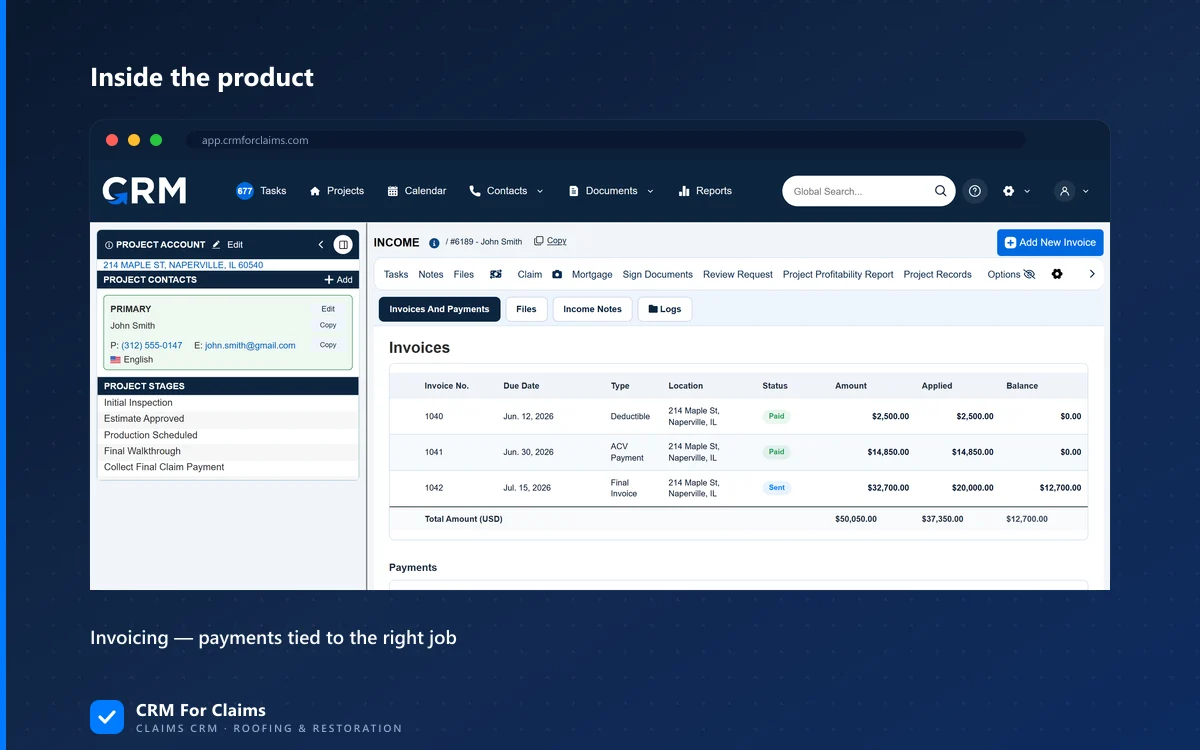
So the $12,300 check in week 3 covers 66.8% of the invoice and releases 66.8% of both commissions: $738 to the closer and $246 to the setter, the $984 from the ledger above. Whoever does your payables sees a task for each released amount. On payday that person opens Payables, picks the closer, ticks the rows that are due, types the check number once and marks them all paid. A bounced homeowner check does not quietly erase a payout that already went out. The payout stays in the history and a recovery task lands on the same payables person. The exact rules are written out on the page for owners.
The limits are worth knowing before a demo. The percentage is taken from the invoice, so a plan that splits profit after job costs is calculated outside the CRM. So are tiers that raise the rate with volume, and draws. The referral fee from the section above can be set either way, as a one-time flat amount or as a percent of every invoice on the job. Invoicing is on the Professional plan, which is $99 a month with $39 for each additional user, as listed on the pricing page. The rest of the money side is on the estimates and invoicing page.
When is paying at signing the right call?
When the job has one payer and the money is certain. A cash retail repair with a deposit collected on the day is a fair case for paying the rep that week. So is a small company where the person selling also collects, because then the rep controls the thing the pay is waiting on.
Paying part of the commission early is also reasonable for a new rep in the first season, as long as the plan calls it an advance and says how it is netted. What does not hold up on claim work is paying the full amount on a signature and hoping the carrier, the lender and the homeowner all do their part. If you want to see a commission follow a payment from Pending to paid on a test claim, book a live walkthrough and bring your current plan. I will tell you which parts the CRM would run and which parts would stay in your spreadsheet.