Short answer: Ownership should sit with whoever the homeowner is going to call when something goes wrong, because that call happens no matter what your org chart says. If they are still calling the salesperson three weeks after signing, you did not hand the claim over. You added a second person to it.
I build CRM For Claims, and claim ownership after signing comes up in almost every walkthrough I do with a company that has grown past three or four people. It usually arrives phrased as a staffing question — should the estimator take it now, or does the rep keep it? — and the staffing answer never settles it, because what is actually changing hands is a set of promises somebody made at a kitchen table.
The signature is the strangest handoff in a claim. Every other one moves a file that is getting fuller: the inspection adds photos, the carrier decision adds a scope, completion adds invoices. The signature moves a file at its thinnest, on the day the promises attached to it are at their maximum. That mismatch is the problem, and it is why job titles are the wrong place to start.
Who should own a claim after the contract is signed?
The person who will answer the homeowner when they call at 7pm about something nobody planned for. Pick that person deliberately and give them the file, the calendar and the authority to commit. If you pick one person on paper and the homeowner keeps dialling another, the org chart lost and you now have two owners, which is the same as none.
Ownership of a claim is made of three things: who is accountable for the next step happening, who is allowed to promise something to a homeowner or an adjuster, and who gets called when neither of those went well. Companies split those three across two people all the time without noticing. The estimator is accountable for the next step. The rep is still allowed to promise. Nobody agreed which of them gets the 7pm call, so both of them get it, separately, and give different answers.
This is a different question from the one I wrote about in splitting office and field work on a claim. That post is about a standing division of labour where both people stay on the job for its whole life. This one is about a moment: the contract is signed, and the claim changes hands or does not.
What actually transfers at the signature, and what does not?
The document transfers. Almost nothing else does automatically. What lands in the file is a signed contract, an inspection photo set if the rep was thorough, and a homeowner name. What does not land is every sentence spoken across the table, which is where the timeline, the money expectations and roughly half of your future problems live.
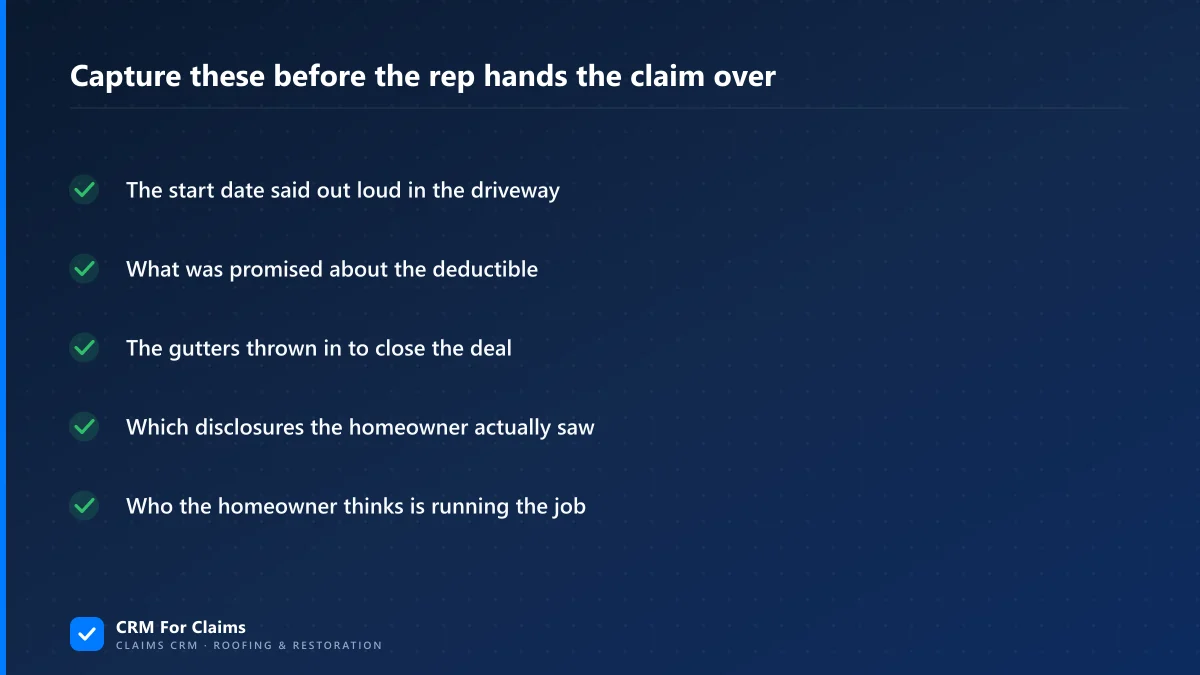
Every item on that list is recoverable, but only from one person, and only for a limited time. The rep who signed four contracts this week can tell you on Tuesday exactly what they said in that living room. Ask them in October and you get a reconstruction. Ask them after they have left the company and you get the homeowner’s version, uncontested.
| What the file shows | What the homeowner heard | Where the gap surfaces |
|---|---|---|
| Contract signed, stage set to Filed | “We should be on the roof in two weeks” | Day 15, when the carrier has not responded yet |
| Scope pending with the carrier | “They always approve the whole thing” | The partial approval, and the conversation about the denied lines |
| Deductible line on the estimate | Whatever was said about it at the table | The first invoice |
| No line item for the gutters | “We will take care of the gutters” | The walkthrough, with the crew already gone |
| Rep listed as the contact | “Call me directly, any time” | Every week, in someone else’s voicemail |
The deductible row is the one I would push hardest on, and also the one where I will not tell you what to say — what a contractor can and cannot do with a deductible is state law and it varies, which I went through in how deductibles work on an insurance job. For a handoff the point is narrower: whatever your policy is, the next owner needs to know which version of it the homeowner was given, in words, on the day they signed.
Does the estimator or the salesperson make the better owner?
Neither, reliably. The better question is when the handoff happens, not who receives it. Most companies default to handing off at the signature because that is when the commission event fires, and that timing is the source of more dropped claims than the choice of person ever is. There are three workable models, and the least common one is usually the best fit.
| Model | Works when | Breaks when |
|---|---|---|
| The rep owns it end to end | Under roughly 15 open claims per rep, and the rep is genuinely good at carrier paperwork | Volume arrives. Selling and supplementing compete for the same afternoon, and selling always wins |
| Handoff at signature | You have a real production or claims coordinator and a written handoff payload | The payload is “the contract is in the folder”, and the promises stay in the rep’s head |
| Handoff at the carrier decision | Storm work, where the gap between signing and approval is weeks of nothing visible | Your comp plan pays at signature, so the rep has no reason to stay through the wait |
Between signature and the carrier’s decision, the job is still being sold: the homeowner needs someone to explain what the adjuster meeting is, why nothing is happening, and what a partial approval will mean. That is the rep’s natural work, and it is precisely the stretch most companies hand to a coordinator who has never spoken to the person. Handing off at the decision instead means the estimator inherits a claim with a known number attached, which is a much easier thing to own than an open question.
Why your commission plan decides this whether you like it or not
Attention follows money on a predictable schedule. If a rep is paid in full at signing, their engagement with that claim drops off the day it is signed, no matter what the process document says. If they are paid at collection, they stay engaged through the supplement and the invoice.
| When the rep is paid | What happens to their attention | What the next owner inherits |
|---|---|---|
| At contract signature | Gone the same week. Follow-up becomes a favour | The promises, without the person who made them |
| At carrier approval | Stays through the adjuster meeting and the scope fight | An approved number and a homeowner who has been kept informed |
| At final collection | Stays to the end, including the awkward deductible conversation | Very little, because there was no real handoff — which is its own problem at volume |
I am not recommending a pay structure; that is a business decision with tax and employment consequences I am in no position to advise on. I am saying that if your comp plan and your ownership model disagree, the comp plan wins, quietly, every time. If you want a clean handoff at signature, the handoff itself has to be an obligation with a deadline rather than a courtesy, because you have removed the financial reason for it to happen.
What can only be done at the table, and never redone later?
Some obligations at signing are performable only in that moment, by the person who is physically present. Disclosures, initials in a margin, the contract itself. If the rep skipped one, the next owner inherits the consequence with no ability to cure it, because the moment the requirement attached to has already passed.
Illinois is where our company is registered, so I will use its statute as the concrete example. The Home Repair and Remodeling Act, 815 ILCS 513/15, reads:
“Prior to initiating home repair or remodeling work for over $1,000, a person engaged in the business of home repair or remodeling shall furnish to the customer for signature a written contract or work order that states the total cost, including parts and materials listed with reasonable particularity and any charge for an estimate.”
On an insurance job, the total cost at signature frequently is not known — that is the entire reason the scope goes to a carrier. Whatever your contract does about that tension, the person who has to satisfy the requirement is the one at the table, not the coordinator who opens the file on Monday.
The next section of the same Act is blunter about what happens when the table step is skipped. Under 815 ILCS 513/15.1, a contractor must advise the consumer of any binding arbitration clause and any jury trial waiver before the contract is executed, and prove it by having the consumer write “accept” or “reject” in the margin next to each clause. Subsection (c):
“Failure to advise a consumer of the presence of the binding arbitration clause or the jury trial waiver clause or to secure the necessary acceptance, rejection or consumer signature as provided in this Section shall render null and void each clause that has not been accepted or rejected and signed by the consumer.”
Every state writes its own version of this and some write none, so read yours rather than mine, and take an actual lawyer’s word over a software person’s. The same structure applies wherever you work: the executed PDF is not proof that the table steps happened, and no one downstream can perform them retroactively. So the handoff payload has to carry evidence of what was disclosed and how, not just the signed document.
How do you make the handoff actually stick?
Attach it to something that already has to happen, give it a deadline, and finish it with the homeowner rather than with the file. Four steps cover it, and the first one does most of the work because it borrows the only lever that reliably moves a busy salesperson.
- The rep writes it down before the commission is released. Four or five sentences, in the claim, about what was promised and when. Tie it to payroll and it takes ten minutes. Tie it to goodwill and it happens for about three weeks.
- The rep introduces the successor by phone. One sentence, from the person the homeowner trusts, naming who is taking over and why. An updated email signature does not do this.
- The new owner reads the file back. On that same call or the next day: here is what I have, here is the timeline, correct me. Anything the rep forgot gets corrected by the only other person who was in the room.
- Open tasks move the same day. A task still assigned to a rep who has mentally closed the file is a follow-up that will not happen, and nobody finds out until the homeowner does.
The third step is the one companies skip and the one that pays. It costs a five-minute call, it catches the promises the rep genuinely forgot, and it moves the homeowner’s attachment from a person to a company. If the homeowner is still dialling the rep a month later, the file was handed over and the customer was not.
What the software should do about it
Less than you would think, and the parts it does are boring. A claim needs one named owner visible on the board, so an ownerless claim is a thing you can see rather than discover. Open tasks need to move with the owner instead of staying attached to whoever created them. And the handoff notes need a field on the claim, because in a text thread they are gone in six weeks.
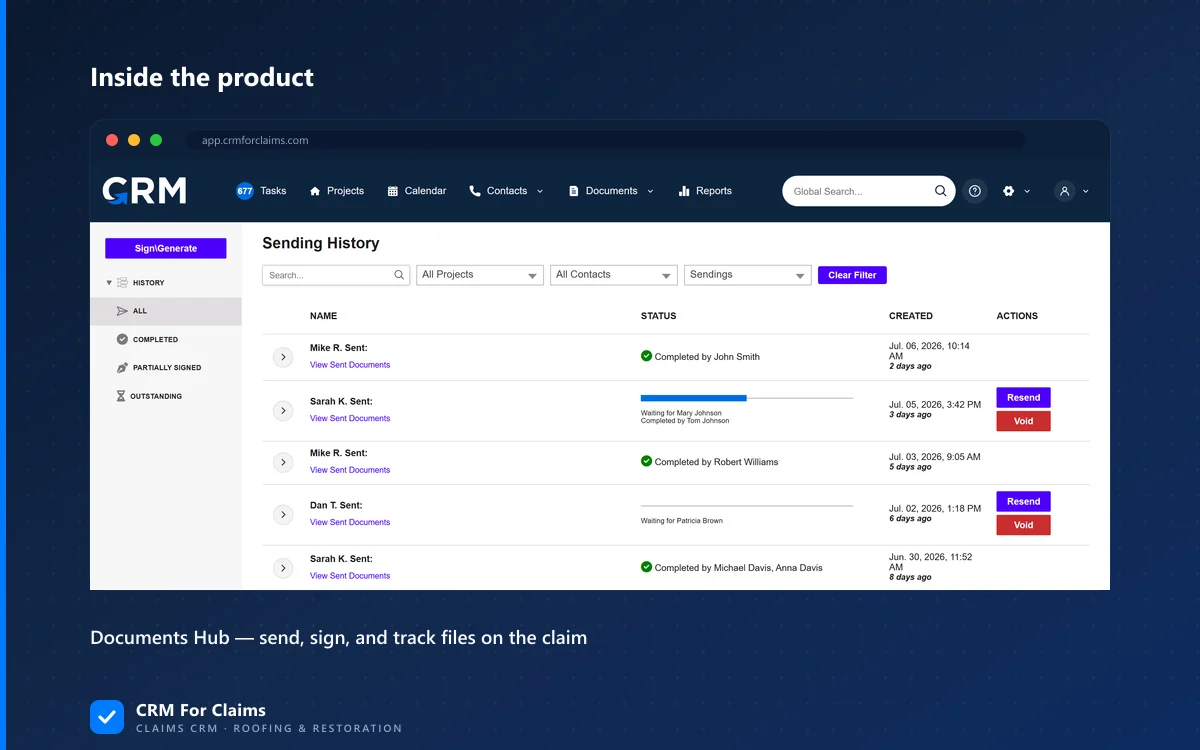
In CRM For Claims that is a primary rep on every claim, tasks that follow the assignment, and a Documents Hub holding the signed contract and disclosures against the job rather than in an inbox. Adjusters, carriers and homeowners are contact records rather than logins, so the only thing that affects what a second seat costs is adding another person from your own team. If you are weighing this against a general-purpose tool, the feature-by-feature comparison is the honest version of where the difference actually is.
None of that decides who should own the claim. That is your call, and mostly a function of your comp plan and your volume. If you have three people and you can still recite every open claim from memory, build nothing — the handoff is a conversation in a truck and it works fine. The threshold is the first claim you cannot recite, which usually arrives at the same time as your second rep. That is also roughly when the question of who sees the money side of a claim stops being theoretical.
If you want to see what a handoff looks like when the promises live on the claim instead of in somebody’s memory, book a live walkthrough and bring a real claim with you. I would rather show you the awkward parts than the demo data.