Short answer: Split a claim by who is allowed to answer a question, not by who has time. The field owns what was observed on the property. The office owns what was promised to anybody. Every handoff either moves one of those across the line with a record, or quietly loses it.
I build CRM For Claims, and the most common way I see a two-person operation lose a claim is not a missed deadline. It is two people who each assumed the other one sent the email. Splitting office and field work on a claim is the first real management problem a roofing or restoration company runs into, and it usually arrives without anyone deciding to take it on: you hire a second person, the work divides itself by whoever is standing closest to it, and for a few months that works fine.
Then a homeowner asks when the crew is coming, gets one answer from the office and a different one from the field, and you find out your division of labour was never actually written down anywhere.
What is actually being split when two people share a claim?
Not the tasks. The authority to answer. A claim produces two kinds of information: what somebody observed on the property, and what somebody promised to a homeowner, an adjuster or a crew. The field produces observations. The office produces commitments. The trouble starts when either one produces the other kind.
Both directions happen every week. The field promises a start date standing in a driveway, where no calendar is open and no crew has been asked — the office learns about it when the homeowner calls to confirm. The office answers a question about the back slope from memory of a photo set, that answer goes into an email to the adjuster, and it is now your position on the scope even though nobody re-inspected anything.
Neither is a discipline problem. Both are people being helpful with information they do not hold. That is why telling everyone to communicate better does nothing: the fix is deciding in advance which questions belong to which person, so that being helpful means routing the question instead of answering it.
| The question | Who owns the answer | What it costs when the other one answers |
|---|---|---|
| Was there damage on the back slope? | Field | A scope position taken from a photo by somebody who was not on the roof |
| When can the crew start? | Office | A driveway date no calendar knows about, and one homeowner who heard it |
| Is that covered? | Neither — the carrier | An informal yes the homeowner quotes back at you when the invoice arrives |
| What did the adjuster approve? | Office | A crew that builds unapproved scope and an amount you end up eating |
| Did the customer sign yet? | Office | Work starting on a verbal, with no authorization in the file behind it |
Where does the office and field handoff actually break?
In four moments, and none of them are stages. After the inspection, after the carrier decision, when the crew finds something that is not in the estimate, and at completion. Each one is a point where information has to move sideways between two people, and nothing on the calendar forces it to happen.
Stages get attention because they are visible in a pipeline. These four are invisible: the claim looks the same before and after the handoff either happens or fails to. You only find out weeks later, usually from the money.
| Handoff | What has to move | What it costs when it does not |
|---|---|---|
| Inspection to office | Photos, measurements, cause and category as found, what the homeowner was told | The submission gets assembled from memory a week later |
| Carrier decision to field | What was approved, and separately what was denied or trimmed | The crew builds scope nobody approved and it comes out of your margin |
| Crew finds a condition | A dated photo of it while the wall or deck is still open | The supplement gets written after the evidence is covered up |
| Completion to office | Final photos, homeowner acceptance, anything still open | The invoice waits on a walk-through nobody scheduled |
What has to travel with a handoff, every time?
Five things, and they are the same five whichever direction it goes: captioned photos, promises with a name attached, what the carrier approved and what it did not, any condition found that was not in the estimate, and a date by which the next person owes an answer back. Miss the last one and you have sent a notification, not a handoff.
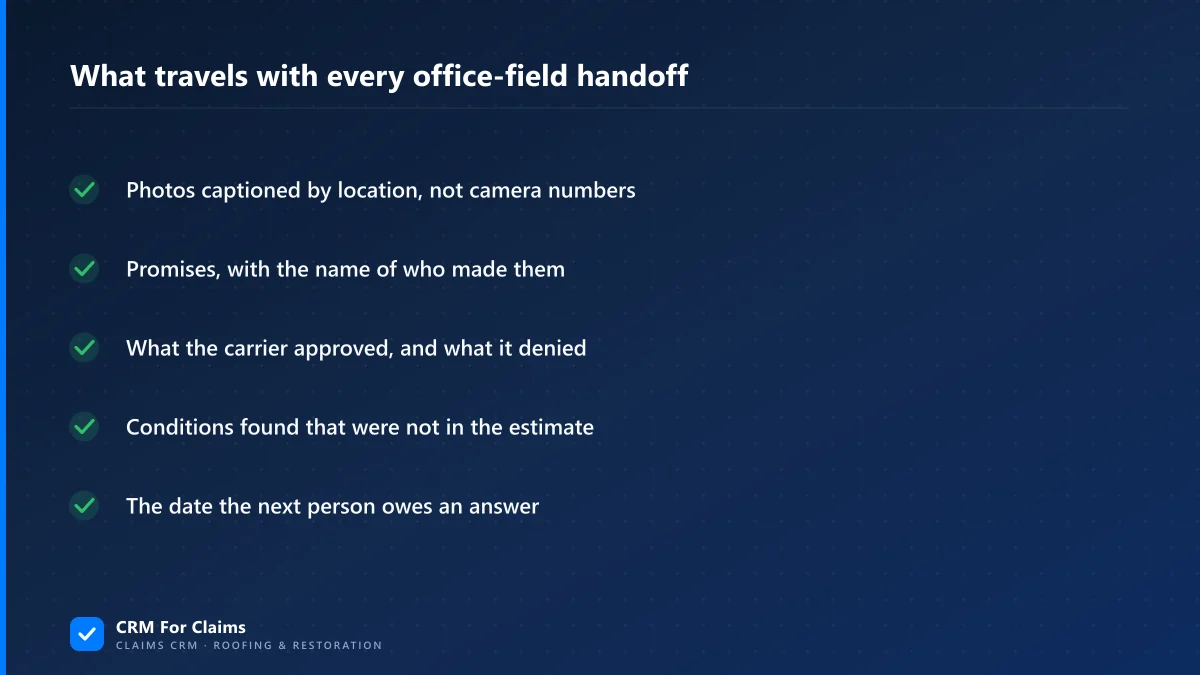
- Captioned photos — named by location and line item, not by camera number. A folder of IMG_4471 files is one unopened folder to the person on the other end, which is why naming and filing conventions that survive a second person are worth twenty minutes of your life.
- Promises, with the name of who made them — "I told the homeowner Tuesday" is a fact about the file, not small talk. It belongs on the claim the same day, because it is the thing you will be held to.
- The approval split — approved and denied recorded separately. Teams pass along the approved list and let the denied one stay verbal, and the denied one is the expensive half.
- Conditions found — photographed and dated on the day they were found, not on the day somebody sits down to write the supplement.
- A due date — every handoff names when the other person owes an answer. Without it, the item is in nobody's week.
Who should talk to the adjuster, the office or the field?
One person, and in a two-person setup it is usually the office. Not because the field knows less — the field knows more — but because carrier communication is a written record that has to stay consistent, retrievable and on a schedule. Two voices talking to one adjuster produce two versions of your position, and the carrier keeps both.
The field's job inside that relationship is to supply observations quickly and in writing, so that the person who does write to the carrier is never writing from memory. That is the whole trade: the field gets to stop drafting emails, and gives up answering the adjuster directly.
The schedule matters more than people expect, because prompt communication is not just etiquette on the carrier's side. California puts it in the statute itself: California Insurance Code section 790.03(h) lists among unfair claims settlement practices "Failing to acknowledge and act reasonably promptly upon communications with respect to claims arising under insurance policies." Most states have their own version of that rule, so check the one where you work — but the practical point travels. Dated follow-ups in writing make silence attributable to somebody. A verbal nudge from a truck creates no record at all, so a carrier that has gone quiet on you looks identical to a carrier that answered.
The office also owns a clock nobody in the field is watching: the homeowner's own obligations under the policy. The standard form policy in California Insurance Code section 2071 requires that "within 60 days after the loss, unless the time is extended in writing by this company, the insured shall render to this company a proof of loss, signed and sworn to by the insured". Your invoice is downstream of that claim staying in good standing. Somebody in your company should know that date exists, and it is not the person on the roof.
Two limits worth stating plainly. Owning the carrier conversation is not the same as owning the money side of the file — who may see costs, margins and payments is a separate decision, covered in roles and permissions on a claims CRM. And communicating about your own scope and your own work is different from advocating on coverage for the homeowner, which is a licensing question in most states. Stay on your side of that line.
What happens when one of the two people is off for a week?
You find out whether the split was real or just a habit. If the handoffs left records, the other person opens the claim and keeps going. If they lived in one phone and one memory, the claim stops — and from outside the company, a stopped claim and a slow claim look exactly the same until a homeowner calls.
There is a cheap test for this, and it takes ten minutes. Pick one open claim at random. Have the other person answer three questions from the file alone: what have we promised and to whom, what is approved and what is denied, and what are we waiting on and since when. If any of the three requires a phone call to the person who is out, that handoff was never written down. Do it on a claim you feel good about, not a problem one; the problem ones already get phone calls.
When is splitting office and field the wrong call?
When the split creates a handoff that did not exist before. A one-person operation has no handoff problem no matter how many claims are open, because the observation and the promise are held by the same head. Adding a part-time office person does not subtract work from that; it converts some of the work into coordination, and coordination is the part that fails.
The honest threshold is not a claim count. It is whether the same person can still be present at both ends of a claim in the same day. Once inspections and carrier follow-up start colliding on the calendar — not occasionally, but as the normal shape of the week — the split is already happening informally, and writing it down is just catching up to reality.
There is also a second way to divide two people that gets overlooked: split by claim rather than by function. Each person owns whole claims end to end, office work included, and you cover for each other. That keeps the observation and the promise in one head, which removes the handoff entirely. It scales badly — it needs both people to be competent at everything, and it falls apart the moment either takes a holiday — but for a two-person shop with a mixed workload it is frequently the better answer, and it is the one nobody suggests because it sounds less organised. If you are at that size and weighing tools, the honest question on the comparison between a claims CRM and a general tool is whether claim structure has started earning its keep yet, not which feature list is longer.
How do you make the handoff happen without a standing meeting?
Attach it to the claim instead of to a person. When the handoff is a task that a stage fires, with an owner and a due date, and the photos, approvals, documents and messages all live on the claim record, the handoff happens whether or not anyone remembered the morning check-in.
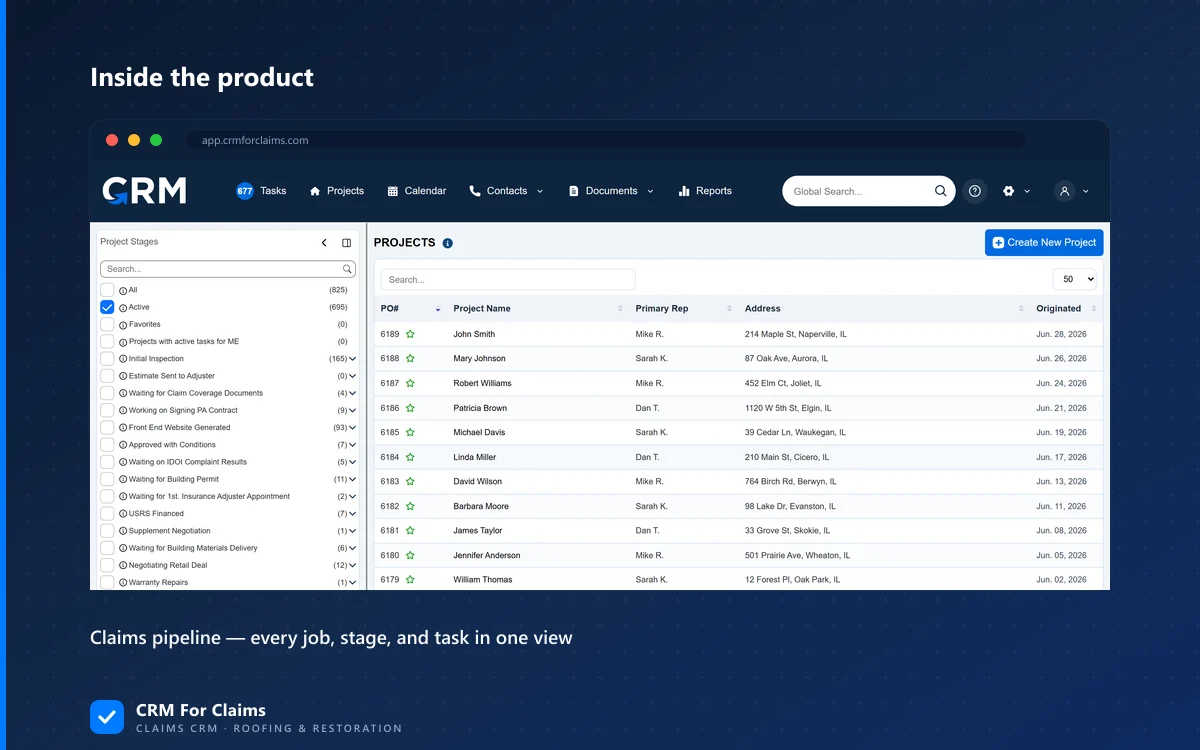
That is what the pipeline is for in CRM For Claims: stages that move a claim, automation that creates the task on the person who owes the next step, documents that sit on the claim rather than in an inbox, and adjusters and crews recorded as real contacts so the next person can see who has been spoken to. When the office opens a claim the field touched an hour ago, the answer to "where is this" is on the screen, not in a text thread.
The second person is also the moment the seat cost becomes a real question, and it is a small one: the base plan covers the company account and the first admin user, and each additional user is $39 a month on top — the full arithmetic is on the pricing page. That is genuinely the cheapest part of hiring somebody. The expensive part is the stretch of weeks where nobody has decided who answers what.
So decide that first, on paper, before any software is involved. Write down which questions belong to the field, which belong to the office, and what has to travel at each of the four handoffs. A CRM will enforce a split you have made and will not invent one you have not — and if you want to see what enforcing it looks like on real claims, book a live walkthrough and bring a claim that went sideways.