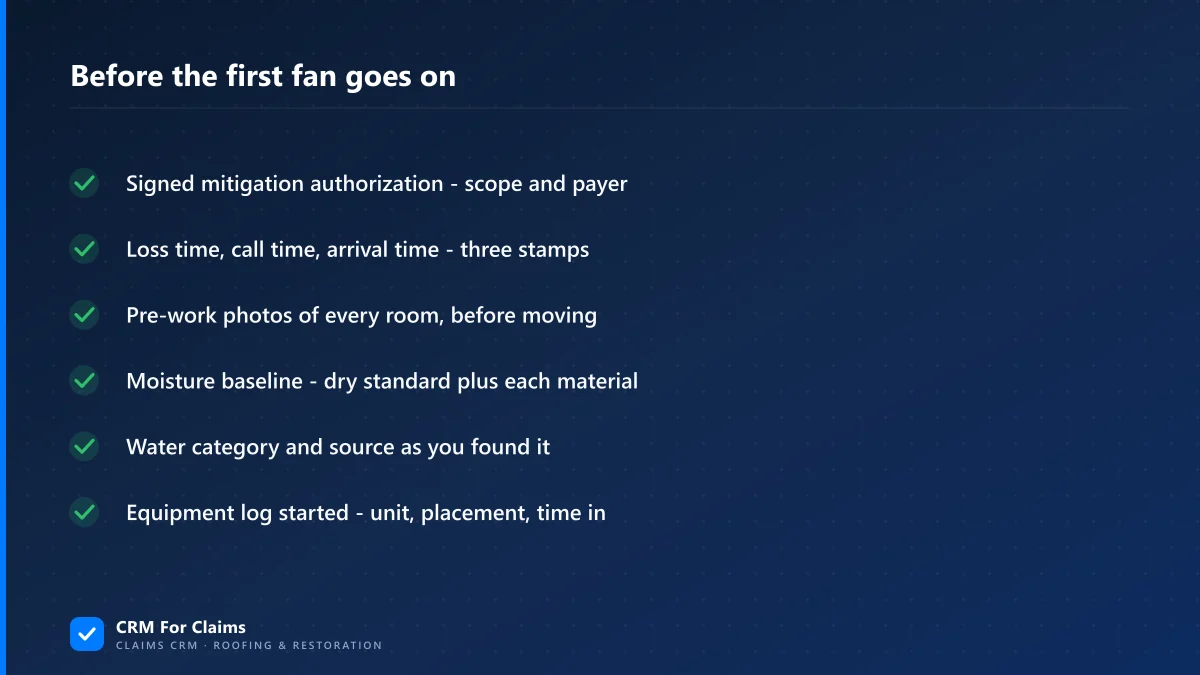
Short answer: Mitigation is the one part of a claim where doing the job correctly destroys the evidence of the job. Before the first fan goes on you need six records: a signed authorization, three timestamps, a pre-work photo set, a moisture baseline, the water category as found, and an equipment log opened at placement.
I build CRM For Claims, and emergency water mitigation is the stage where the gap between a good company and a company that argues with carriers all year is decided in about ninety minutes — at two in the morning, by whoever answered the phone, while a homeowner in a bathrobe stands in the hallway asking what happens now.
Everything about that call is hostile to record-keeping. It is dark. It is loud. The person you are talking to has just watched their ceiling come down and is not in a state to read a contract. Your tech wants to get the water out, because getting the water out is the actual job and every hour of delay makes the loss worse. And then, three weeks later, an adjuster who was never in that house decides what your work was worth, from a file that was assembled by a tired person at 3 a.m. or was not assembled at all.
That is the whole problem. On almost every other stage of a claim you can go back and look. On mitigation you cannot, because you removed it.
What has to be recorded before you touch anything?
Six things, and all six have to exist before mitigation starts: a signed authorization naming the scope and the payer, three separate timestamps, a photo set of every affected room before anything moves, a moisture baseline including an unaffected reference, the water category as you found it, and an equipment log opened the minute equipment is placed.
None of these takes long individually. Together they are maybe twenty minutes of a call that will run four hours. The reason they get skipped is not time, it is that all six pay off later and the water is a problem now.
| Record | Why it has to exist before, not after | What it costs when it is missing |
|---|---|---|
| Signed mitigation authorization | It is the only thing that turns the work into a contract instead of a favour | Collection becomes a negotiation. You have no priced agreement to point at |
| Loss time, call time, arrival time | The response gap is a fact at the moment and a reconstruction afterwards | An adjuster gets to wonder how much of the spread happened on your clock |
| Pre-work photo set | The condition stops existing the moment you start extracting | Every line item you add later is an assertion with no picture behind it |
| Moisture baseline plus dry standard | The drying goal is defined against it, and it cannot be measured backwards | No defensible end point. Equipment days turn into an opinion |
| Water category and source as found | Category degrades with time and cannot be re-established later | You get paid for what the adjuster saw on day four, not what you walked into |
| Equipment log from placement | Mitigation is billed per unit per day, from a start time somebody wrote down | Days you cannot prove are the first thing trimmed off the estimate |
Why does the record have to come before the work?
Because mitigation is destructive on purpose. You pull the pad, cut the drywall two feet up, pull base trim, open a wall cavity and blast air across all of it. Twelve hours later the house is drier and the loss you were paid to respond to is physically gone. There is nothing left to photograph except your own work.
Speed is not optional either, which is why this pressure exists at all. The EPA’s guidance for buildings is blunt about the window: “Clean and dry wet or damp spots within 48 hours.” So the correct behaviour and the documentable behaviour are pulling in opposite directions, and the only way to satisfy both is to make the record a step in the work rather than a report about it.
Category is the sharpest version of this. The condition of the water at the moment of the loss determines what the job is — what gets cleaned versus what gets removed, what protective equipment the crew needs, what the carrier owes. It is also perishable. Clean supply-line water sitting warm in a closed house does not stay clean water, and by the time an adjuster inspects there may be nothing left to distinguish a category that degraded from a category that was misjudged. If your file says what you found and shows why, that is a determination. If it says what you decided, it is a position.
The industry standard that governs this work, ANSI/IICRC S500, lists “administrative procedures, project documentation, and risk management” alongside “inspections, preliminary determinations, and pre-restoration evaluations” in its own scope. Documentation is not an add-on that careful companies do. It is part of the described procedure.
What does a 2 a.m. authorization actually cover?
Mitigation, and only mitigation. An emergency services authorization should name the specific work — extraction, demolition to a stated extent, equipment, monitoring — and name who is paying. It is not a repair contract, it is not an estimate, and signing it does not commit the homeowner to hiring you for the rebuild.
People blur these two documents constantly, usually with good intentions: the homeowner is upset, you are already there, and it feels efficient to get everything signed at once. It is not efficient. It creates a signature obtained under duress at the worst hour of someone’s year, and that is exactly the signature a carrier or a state regulator will look at hardest. Insurance departments tell homeowners the same thing everywhere. New York’s Department of Financial Services puts it flatly: “No permanent repairs should be made until your company or its representative has inspected the property.” The same page tells them to protect the property from further damage and to “save all receipts for the cost of all temporary fixes.” That sentence is the reason emergency mitigation is payable at all. It is also a description of what your paperwork has to look like.
There is a second thing worth knowing, and most crews do not. The FTC’s Cooling-Off Rule gives a buyer three business days to cancel a sale of $25 or more made at their residence. Emergency work is carved out, but the carve-out has a specific shape: the exclusion applies where the buyer initiated the contact for “a bona fide immediate personal emergency… and the buyer furnishes the seller with a separate dated and signed personal statement in the buyer’s handwriting describing the situation requiring immediate remedy and expressly acknowledging and waiving the right to cancel the sale within 3 business days.”
Read what that requires. Separate. Dated. Signed. In the buyer’s handwriting. A pre-printed waiver clause in your authorization with a checkbox next to it is not the thing the rule describes. Many states layer their own home solicitation statutes on top of this with their own wording, so the version your attorney gives you is the one to use — but the shape of it is the same everywhere, and it is a thirty-second step at the kitchen table that a crew has to actually be told to take.
| The signature at 2 a.m. | Does authorize | Does not authorize |
|---|---|---|
| Emergency services authorization | Extraction, stated demolition, equipment, monitoring, and billing for those | Reconstruction, contents, or anything priced later |
| Direction to pay | The carrier sending your portion of the loss payment to you | Taking over the claim or speaking for the homeowner |
| Handwritten emergency statement | Starting work inside the three-day cancellation window | Anything, if you wrote it for them |
| Rebuild contract | Nothing yet — it should not be on the clipboard tonight |
What is a moisture baseline, and why does the carrier pay from it?
A baseline is two sets of readings taken before drying starts: the affected materials, room by room and material by material, and a dry standard taken from the same material in an unaffected part of the building. The dry standard is what defines “dry” for this specific house, and every day of equipment after that is justified against it.
Without the unaffected reference, a moisture number means very little. Hardwood in a humid coastal house in August and hardwood in a heated house in February are not the same material at the same reading, and an adjuster reviewing a drying bill knows that. The dry standard converts your readings from a number into a comparison, which is the only form a reviewer can act on.
Then it has to be repeated. Daily monitoring readings are what turn a pile of equipment into a documented drying process with an end date — and the day the affected materials meet the dry standard is the day the equipment should come out, which protects you as much as it protects the carrier. A crew that pulls equipment on schedule with readings behind it has an answer. A crew that leaves nine air movers running for six days because nobody scheduled the pickup has a bill and a story.
- Dry standard — same material, unaffected area, taken before you start.
- Initial affected readings — per material, per room, with the meter type noted.
- Ambient conditions — temperature and relative humidity, inside and outside, at the start.
- Daily monitoring — the same points, same order, every day the equipment is running.
- Completion readings — the set that says the goal was met and justifies the pickup date.
What has to be on the equipment log?
Unit type, unit count, where each one was placed, and the date and time in and out. Mitigation equipment is billed per unit per day, so the log is not a note about the job — it is the source document for a line on your invoice, and it is the first thing an estimator reduces when it is vague.
The two failures are always the same. The first is a count with no placement: “12 air movers, 2 dehus” on a job where a reviewer expects to see which rooms justified twelve. The second is a missing pickup time, which turns the last day of billing into a rounding argument. Neither is dishonesty. Both are what happens when the log lives on a whiteboard in the shop and gets copied into the estimate from memory a week later.
How do you capture all of this at 2 a.m. without a clipboard?
Honestly: a paper packet in the truck works. I am not going to pretend otherwise. A laminated sequence, a printed authorization, a moisture form and a phone camera will produce a defensible file, on one condition — that somebody photographs the paper into the claim record the same night, before it goes back in the door pocket and gets found in October.
The failure mode is not paper. It is that the record ends up distributed across three places that do not know about each other: photos on one tech’s phone, the signed authorization in the truck, the readings in a notebook, and the equipment count in somebody’s head. Each piece exists. The file does not. When the estimator sits down to write, they assemble a claim from whatever they can chase down by Thursday, and the parts they cannot chase down quietly do not get billed.
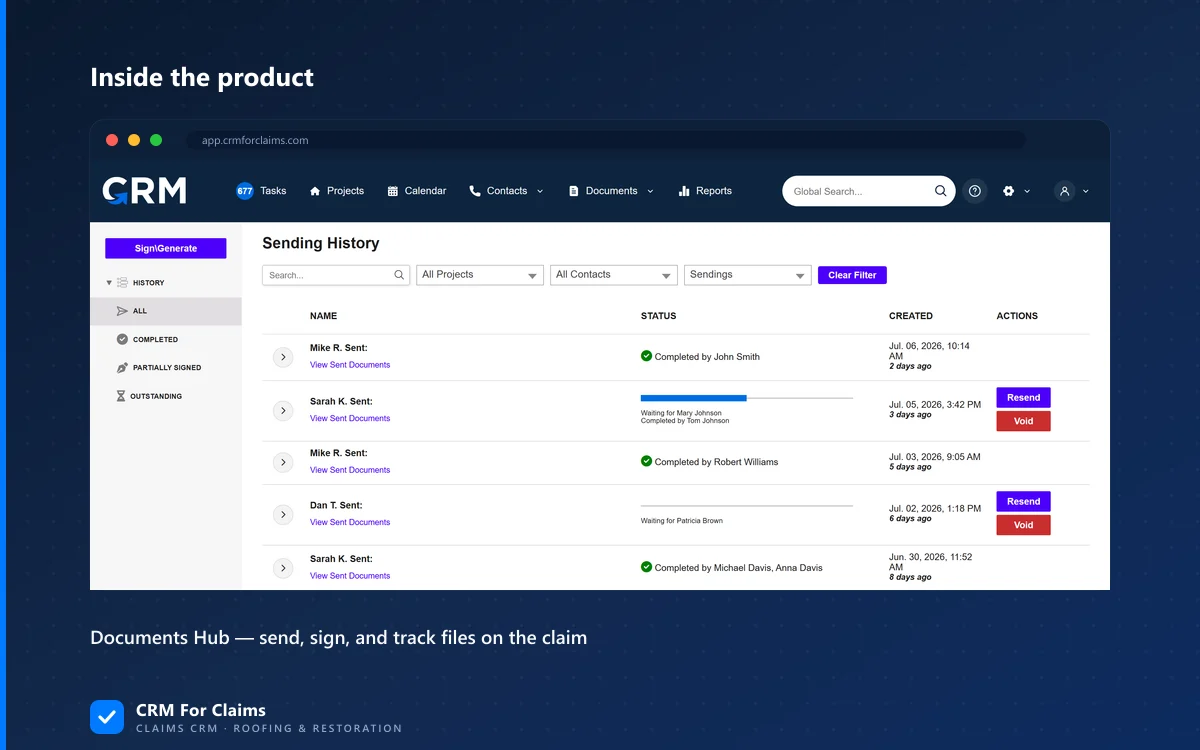
So the only thing that actually matters is that the six records land on one claim, attached to the job, the same night — whatever tool you use to do it. That is the thinking behind how we built the Documents Hub and the claim record in CRM For Claims: the authorization is generated, signed and stored against the claim rather than mailed around, photos attach to the job instead of a person, and the stage the claim is sitting at is the same fact for the tech, the estimator and the office. I have written before about what to shoot on a claim and where it has to live, and about the first 48 hours of a claim hour by hour — mitigation is the sharpest case of both, because it is the only stage that erases its own subject.
Being fair about it: if you run two or three mitigation jobs a year as a sideline to roofing, a good paper packet and a disciplined habit will genuinely serve you, and a system is overhead you do not need yet. The moment it stops being true is the moment there are two crews out at once, because that is when “I know what we did on that job” stops being a single person’s knowledge and starts being a coordination problem. If you want to see the difference against a general-purpose tool before deciding, we lay it out on the comparison page.
The test for any of it is the same, and you can run it tonight on a job you finished last month. Open the file. Can you tell, without calling anyone, what time the crew arrived, what the water was, what it looked like before they started, what the readings were, and how many units ran for how many days? If yes, the system is fine. If you find yourself reaching for the phone, the record was never made — it was remembered, and memory does not survive a claim review. If you want to see how it works on a real mitigation file, book a live walkthrough and bring one of your own jobs to it.