Short answer: The first 48 hours of an insurance claim are the window where the loss is still changing and the record of it does not exist yet. Document before anything is moved or dried, start mitigation, capture the policy and carrier details once, and end every claim with a named next action and a date.
I build CRM For Claims, and if I had to pick the part of a claim that decides the most while looking like the least, it would be the first 48 hours of an insurance claim. Not because anything dramatic happens. Because almost everything that gets argued about in week six — scope, causation, what was already broken, whether mitigation was reasonable — is settled by evidence that either got captured in those two days or did not.
The uncomfortable part is that this window lands on the worst possible day. Somebody is calling you upset, water is still moving, and the person answering the phone is usually whoever was closest to it. The work below is not complicated. It is just easy to do out of order, and the cost of the wrong order shows up months later, when nobody remembers what the ceiling looked like on day one.
Why do the first 48 hours of a claim matter more than the next two weeks?
Because two clocks run at the same time and neither one waits. The physical loss is still getting worse or getting stabilized, and the documentary record of what it looked like is being created or lost. Weeks three through six are negotiation. Days one and two are the only chance to produce the facts that negotiation runs on.
The physical clock is not folklore. The US EPA's guidance on mold cleanup is blunt about the timing: in most cases mold will not grow if wet materials are dried within 24 to 48 hours. That single sentence is why a water loss is an emergency and a hail loss usually is not. Cross that line and a drying job quietly becomes a remediation job, with a different scope, a different price, and a much harder conversation about who let it sit.
The paperwork clock is written into the policy. Standard homeowners policies carry a duties-after-loss section that obliges the policyholder to protect the property from further damage and to keep records of what that cost — the Insurance Information Institute's claim guidance covers the same ground in plain language. Reasonable emergency mitigation is generally covered. Damage that spread because nobody did anything is where carriers push back, and they push back at the homeowner, who then pushes back at you.
Then there is the third clock nobody writes down: the homeowner is deciding whether you are the company handling this. In the first two days they will talk to a neighbour, their agent, and probably one more contractor. Responsiveness in that window is not a marketing idea. It is the whole audition.
What has to happen in each block of those 48 hours?
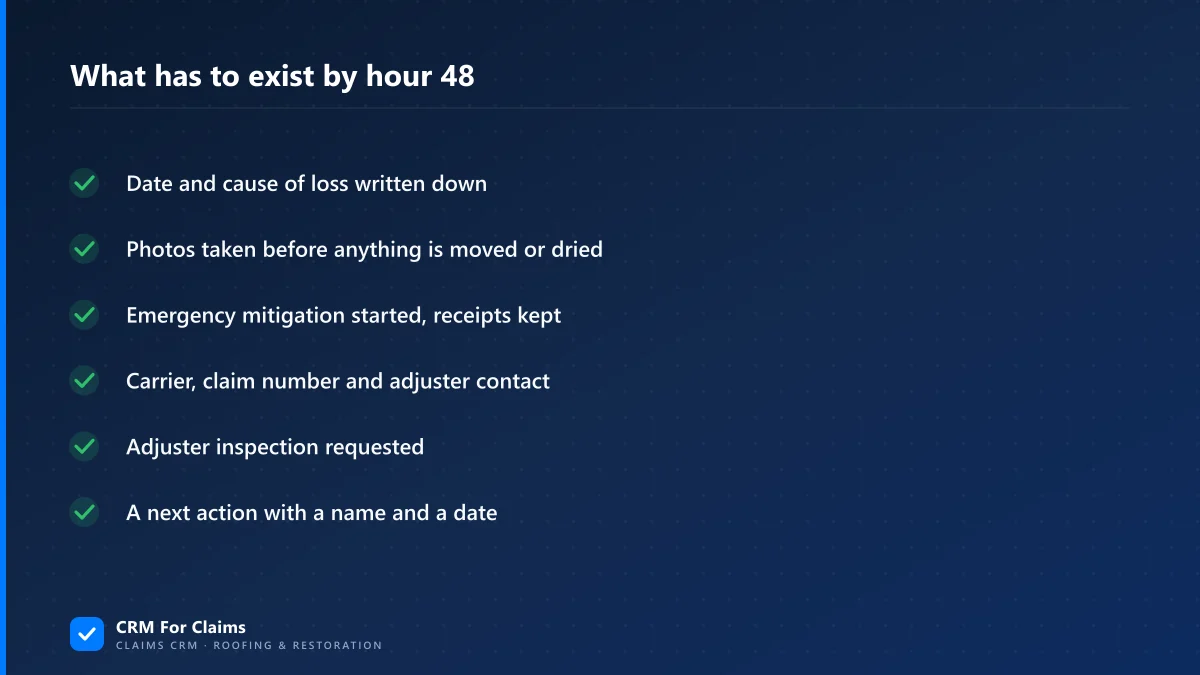
Four blocks, each with one owner and one thing that has to exist when it ends. Hours 0–2 are contact and appointment. Hours 2–8 are documentation and mitigation on site. Hours 8–24 are the carrier notification and the claim number. Hours 24–48 are scope, estimate, and getting the adjuster inspection on a calendar.
| Window | What has to happen | Who owns it | What exists at the end |
|---|---|---|---|
| Hour 0–2 | Answer, qualify the loss, book the site visit | Whoever picks up | Address, date and cause of loss, contact details, an appointment time the customer confirmed |
| Hour 2–8 | Photograph everything before anything is touched, then mitigate — extract, tarp, board, dry | Field | Full photo set with timestamps, moisture readings or tarp in place, signed work authorization |
| Hour 8–24 | Homeowner reports the loss to the carrier; you collect the file identifiers | Office | Claim number, carrier, adjuster name and direct phone, in the claim record and not on a note |
| Hour 24–48 | Scope the loss, start the estimate, request the adjuster inspection, assemble the file | Estimator | Inspection date requested, estimate in progress, mitigation invoice started, next action with a date |
Two notes on that table, both learned the hard way by people who are not me.
First, photographs come before mitigation — the same order the III guidance gives the homeowner: photograph the damage, then take reasonable steps to protect the property. It is a hard rule to obey with water running, but a crew that starts extracting at minute four has destroyed the only proof of the loss at its worst, which is the state the carrier is being asked to pay for. Shoot wide, shoot the room, shoot the source, then work. My longer field guide on what to photograph on a claim and when covers the rest.
Second, hour 8–24 is an office job, not a field job. The technician who is drying a basement is not the person who should be chasing a claim number, and if you make it their task it will happen on day four.
What do you need to capture on the intake call, and what can wait?
Capture what changes the next 48 hours, and defer what only matters at payment. Date of loss, cause of loss, carrier, deductible and whether anyone is still living there all shape what you do today. Mortgagee details, prior claims and policy limits matter enormously later, and asking for them at minute three makes you sound like an insurance company.
| Field | Why it matters inside 48 hours | When to get it |
|---|---|---|
| Date and time of loss | Starts the drying clock and anchors every photo you take | First call |
| Cause of loss | Decides whether this is an emergency response or a scheduled inspection | First call |
| Carrier and policy number | Needed before anyone can report the loss or find the file | First call |
| Deductible amount | The money conversation that goes badly when it is late | First visit |
| Occupancy — is anyone sleeping there | Changes urgency, equipment and whether temporary housing is in play | First call, water losses |
| Claim number and adjuster contact | Every later message needs somewhere to go | As soon as the loss is reported |
| Mortgagee on the policy | Named on the check; delays payment, not the work | Before invoicing |
| Prior claims on the property | Explains pre-existing damage the adjuster will raise | Before the inspection |
The deductible belongs on that list at the first visit, not at the final invoice, and it belongs in the contract. There is a whole legal layer under that sentence which I covered in the post on what contractors can and cannot do with a deductible. For the first 48 hours the only requirement is that the number gets said out loud by someone on your side, early.
Who contacts the carrier first, you or the homeowner?
The homeowner reports the loss. It is their policy, their contract and their claim, and in many states negotiating a claim on their behalf is regulated activity that requires a public adjuster licence. Your job is to make their call easy, then collect what comes out of it: claim number, adjuster name, direct phone, and the inspection date.
Making it easy is more useful than it sounds. Have the policy number, the date of loss and a two-sentence description of the damage ready before they dial, and stay next to them while they do it. Half the friction in that call is a person trying to describe a ceiling while standing under it.
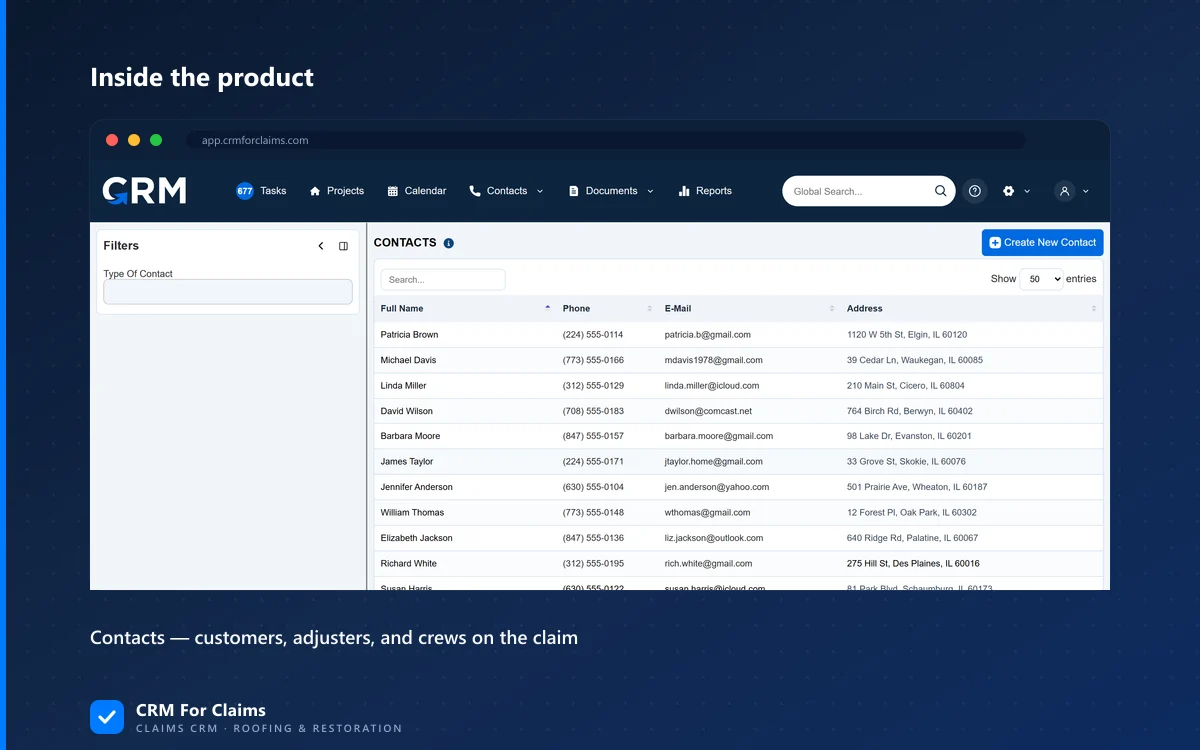
Once the adjuster exists, they are a participant in this job, not a name in somebody's phone. The adjuster, the carrier, the homeowner and your crew all belong on the same claim record, which is the reason our contacts and claim pipeline treats adjusters and carriers as real contact types rather than a text field somebody typed into. When the person who answered the phone on Tuesday is off on Friday, that distinction is the whole difference between a claim that continues and a claim that restarts.
What does a slow first 48 hours actually cost?
Four things, in rough order of how much they hurt. None of them announce themselves on day two — they surface in week six as a scope argument, a price concession, or a job that went to somebody else while you were getting organized.
- Scope you cannot prove — the photos that would have shown standing water were taken after the extraction. You are now negotiating from memory against a written estimate.
- A bigger, harder job — a drying scope that crossed the 24–48 hour line becomes a remediation scope, and the carrier asks why.
- A lost file — the details lived on one person's phone. Then that person went on vacation, or left, and the second visit starts by asking the homeowner questions they already answered.
- A lost job — the homeowner called three companies. The one who showed up first, tarped the roof and left them with a claim number is the one they describe to the adjuster as "my contractor".
The flip side is fair too: rushing the estimate inside 48 hours is its own mistake. Emergency mitigation is urgent. The full repair estimate is not, and a number thrown out on day one is a number you get held to on day forty.
How do you make the first 48 hours repeatable when four claims land at once?
By making the sequence a property of the system rather than a property of whoever answered. One claim a week runs fine on a printed checklist and a good memory. Four in a morning after a storm does not, because the failure mode is never forgetting the whole process — it is one claim quietly skipping hour 8–24 while everybody assumes somebody else called.
What that looks like in practice, whatever tool you use:
- One intake form, always the same fields — so the record does not depend on who took the call or how alarmed they were.
- Stage-based tasks, not personal reminders — creating the claim creates the tasks. The 24-hour carrier-notification check exists because the claim exists, not because someone set an alarm.
- Photos filed to the claim, not to a phone — the camera roll is not a document system, and it walks out the door with its owner.
- A visible board with dates — a claim with no dated next action is a claim that is stalled, and you want that visible on hour 48 rather than week three.
That is the same machinery I described for handling a storm-season spike without dropping claims, applied to the narrowest part of it. And it is worth being honest about scale: if you run a handful of claims a year, a laminated card by the phone will genuinely do the job. The moment a second person has to know what happened on someone else's Tuesday, it will not.
The first 48 hours of an insurance claim reward preparation more than talent. Decide the sequence once, write down who owns each block, and make the system produce the tasks instead of the people producing them. We built CRM For Claims around exactly that shape of work — intake, documentation, adjuster, production, paid — you can see how it compares to a general-purpose contractor CRM, check what it costs on the plan and per-user pricing page, or book a live walkthrough and bring your own worst intake week to test it against.