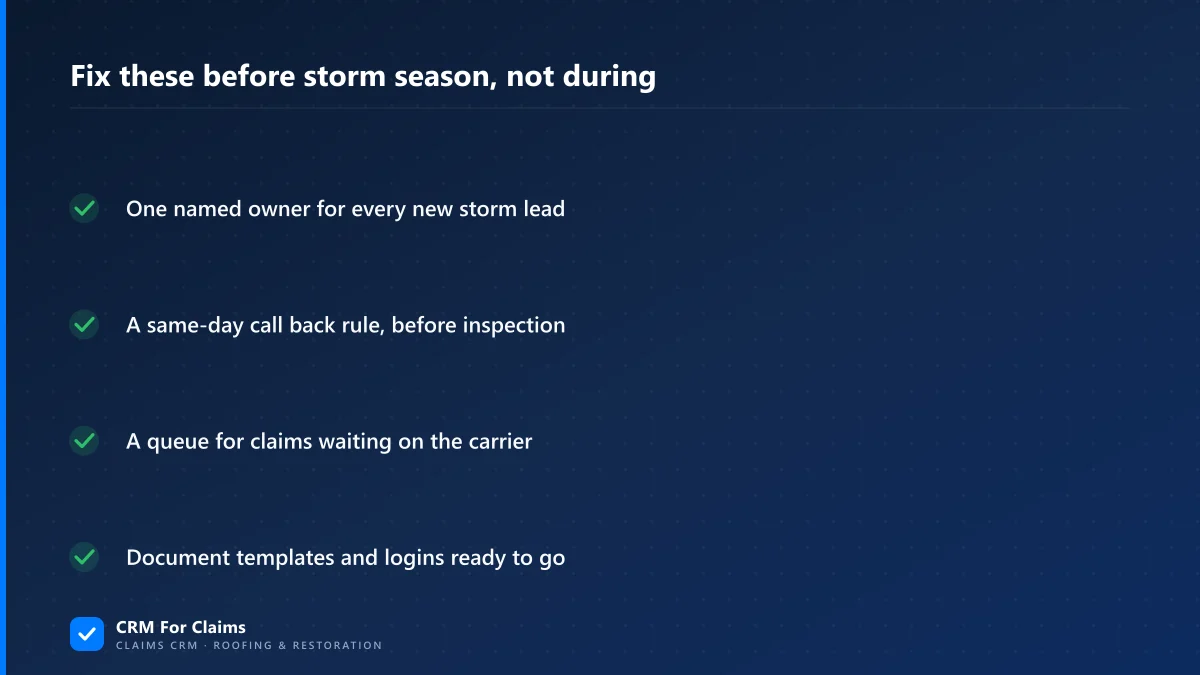
Short answer: A storm season spike does not break a company on crew capacity. It breaks on response time in the first two days, and on the claims parked in somebody else's hands. Decide who owns intake, build a queue for claims waiting on the carrier, and get documents and logins ready before the season starts.
I build CRM For Claims, which means every storm season I watch the same pattern play out from the outside. Hail lands on a few zip codes, and a roofing company that carried twenty open claims without breaking a sweat is suddenly carrying seventy. The crews did not get slower. What changed is that seventy homeowners are now waiting for a call back, and a much bigger share of those claims than usual is sitting with somebody who does not work for you.
The companies that come out of a surge in good shape are rarely the ones with the most crews. They are the ones who settled a few dull questions in advance: who answers a new lead, what happens to a claim on a day nobody is actively working it, and how a seasonal hire gets a login on their first morning. Those decisions take an afternoon in the off-season. They cannot be made in the middle of a surge.
What actually breaks when storm claims spike?
Intake breaks first, follow-up breaks second. Production is the constraint everyone watches, but the jobs you lose are usually lost in the first forty-eight hours to a call back that never happened. The second thing to go is the claim nobody owns — the one waiting on a carrier, and therefore sitting on no person's list at all.
The arithmetic is unforgiving in a way that is easy to miss, because nothing dramatic happens. Twenty open claims fit in a competent person's head. Seventy do not, and the failure is never a single dropped file. It is every claim being two days later than it should have been, all season, until the two days have compounded into a homeowner who signed with somebody else and an adjuster who has moved on to the next zip code.
| Where the load lands | A normal week | A storm week |
|---|---|---|
| Inbound leads | A steady trickle, answered when convenient | Most of a month's volume inside about ten days |
| Inspections | Scheduled comfortably by the estimator | More roofs than one estimator can physically climb |
| Paperwork out | A few agreements and authorizations a week | Dozens at once, rebuilt by hand under time pressure |
| Claims waiting on the carrier | A handful, and everyone knows them by name | The majority of the board, owned by nobody |
| Production scheduling | Roughly matched to what sales signed | Signed work outruns crews, and the dates were verbal |
Read the last two rows together, because that is the pair that does the damage. Sales capacity and production capacity are visible problems with visible fixes — you can hire, you can sub out, you can stop selling. The waiting queue is invisible. Nothing on a wall calendar tells you that eleven claims have had no contact in nine days.
How do you triage storm leads without inspecting every roof?
Sort by whether there is a plausible claim, not by who called first. Four questions on the phone — date of loss, what the homeowner actually saw, whether they have already filed, and whether neighbors on the same street have been paid — put most leads into inspect now, inspect later, or tell them the truth. That last bucket is real, and it is bigger than most people expect.
| What you hear on the phone | What it usually means | What to do with it |
|---|---|---|
| Neighbors on the street were approved | A real storm path with documented losses nearby | Inspect early, and inspect the whole street while you are there |
| Already filed, adjuster appointment booked | The claim is live and its clock is not yours | Get on that appointment. It is the highest-value hour of the week |
| Storm was months ago, nothing filed | Policy notice requirements may already be a problem | Read the policy before promising anything |
| Cosmetic marks, nothing leaking or missing | A claim with a poor chance of approval | Say so on the phone and save both of you the trip |
| Filed once and denied | A re-inspection or supplement question, not a new claim | A different process entirely — do not restart it as fresh intake |
The fourth row is the one worth sitting with. There is real pressure in a storm week to inspect everything and file everything, and it is bad business in both directions. A claim that gets denied is generally recorded in the property's loss history, which the carrier can look at when that policy renews, so the homeowner did not get a free lottery ticket. And on your side, a denied file still consumed an inspection, an estimate and three phone calls.
There is a practical payoff to being the company that tells somebody they do not have a claim. Those homeowners call back when they do have one, and they give your name to the neighbor who does. A skipped inspection costs you an hour; a filed claim that was never going to be approved costs you a day and costs them a mark on the policy.
Why does the carrier side slow down exactly when you speed up?
Because a catastrophe puts the carrier in the same position you are in. Carriers respond by deploying catastrophe teams and independent adjusters into the affected area, and the volume routinely outruns them anyway. So in the weeks when your board is fullest, the proportion of your claims waiting on somebody outside your company is at its highest.
Which is why the single most useful thing you can do to a surge is split the board into two queues: claims waiting on us, and claims waiting on them. They need completely different management. The first queue is a work schedule. The second one is a follow-up schedule, and it needs three things attached to every claim in it — a named owner, a date to act, and the last thing that was actually said.
That third item is the one teams get wrong. "Following up with the adjuster" is not a task anyone can pick up. "Claim 4412, inspection was on the 14th, estimate still not received, last spoke to the desk adjuster on the 19th" is a task any office manager can execute in ninety seconds. The difference is whether that history lives on the claim record or in one person's call log, which is the whole reason a claim pipeline exists at all — the stages we walk through in the claim lifecycle stage by stage are only useful if a stalled stage is visible from across the room.
One thing worth checking rather than assuming: after a declared catastrophe, state insurance departments sometimes issue bulletins that adjust claim handling timelines in the affected counties. Whether that helps you or hurts you depends on the bulletin, and it changes what you should be telling homeowners about how long this will take. Check your state's department, do not repeat what somebody said at the supply house.
What do you do about temporary help during a surge?
Decide before you hire whether each person needs a login or only needs to be reachable. A seasonal estimator or an office helper who writes into claims needs their own account. A sub crew you are only texting is a contact, not a user. Getting that split right before the season is what separates a clean October from an argument about who changed what.
- Never hand out a shared login. It destroys the audit trail at exactly the moment you need it, and you cannot remove one person's access without changing the password for everyone still working.
- Put the removal date in the hire. The day you agree the start date, put the end date on the calendar. Seasonal accounts that nobody closed are how companies find out in February that they have been paying for four people who left in November.
- Scope what a temp can see. Somebody hired for six weeks to book inspections does not need the financial side of every claim.
- Know the seat math before you need it. Ours is an extra $39 a month per additional user on top of the base plan, and deactivating a user credits the next invoice — the numbers are all on the pricing page so you can work out a two-month seasonal seat in advance rather than during a hiring week.
There is a smaller version of this question that gets missed. If the temporary person does exactly one thing — answers the phone and writes down five fields — that might be an intake form rather than a seat. Not everything that touches your claims needs to be inside your claims system, and paying for a login somebody uses twice a day is a choice, not a requirement.
What should you stop doing during a storm spike?
Stop starting new systems. A surge is the worst possible time to redesign a process, and it is the exact moment everybody wants to, because the strain is finally visible. Configure in the off-season; during the storm, the only permitted changes are the ones that take under an hour and remove work.
- Stop building the storm spreadsheet. It always starts as a temporary tracker for one event and it always outlives the storm, quietly becoming a second system that only one person can read.
- Stop promising dates out loud. Verbal production dates given at the kitchen table during a surge are the number one source of angry calls eight weeks later, because nobody wrote down which week was promised.
- Stop routing adjuster calls to one cell phone. That person will be on a roof, on vacation, or gone by spring, and the claim history goes with them.
- Stop signing work you cannot produce. A homeowner sitting under a tarp for six weeks writes a review that will outlast the storm by years. Turning work away is a legitimate business decision and it is cheaper than a bad season.
The stop-signing point deserves more than a bullet. There is enormous pressure in a spike to take everything, because the storm is a fixed quantity of work and the competition is in the same neighborhood. But every contract signed past your real production capacity gets built on a schedule that is already full, so the delay lands on a homeowner who was told a date at the kitchen table. That homeowner then disputes the supplement, questions the invoice, and writes the review — all of it work you pay for later at a worse rate than the job was worth.
What does the tail of a storm season look like?
Longer than the storm. Six months after the peak, the claims still open are the awkward ones: partial approvals, supplements filed after tear-off exposed something, depreciation not yet released, punch lists nobody closed out. The peak gets judged on how many you signed. The year gets judged on how many of those you closed and got paid for.
Most of the money still outstanding in that tail is supplement money, and supplements are where a surge does its quietest damage — they get found in the field during the busiest possible week, mentioned to somebody, and never written up. We covered that mechanism in detail in keeping claim supplements and approvals straight; in a storm year, the volume simply makes each of those gaps more expensive.
When the season winds down, four questions are worth an hour of somebody's time, and all four are answerable from your own records rather than from memory:
- Which stage held claims the longest? Not which stage had the most claims — which one they sat in. That is the bottleneck to fix before the next season, and it is usually not the one people complain about.
- How many leads never got a call back? If you cannot answer that, that is the answer, and it is the cheapest thing on this list to fix.
- What is still open and what specifically is it waiting on? Every open claim should have a one-line answer. The ones that do not are the ones that quietly become write-offs.
- Which seasonal logins are still active? Close them, and check the invoice matches the headcount you actually have.
Do you need software for this, honestly?
Not always. If a storm takes you from six claims to fifteen, a whiteboard and a person who cares still works, and installing a new system to solve one busy month is a bad trade. The threshold is not a claim count, it is whether the waiting-on-them queue has outgrown what one person can hold in their head while doing something else.
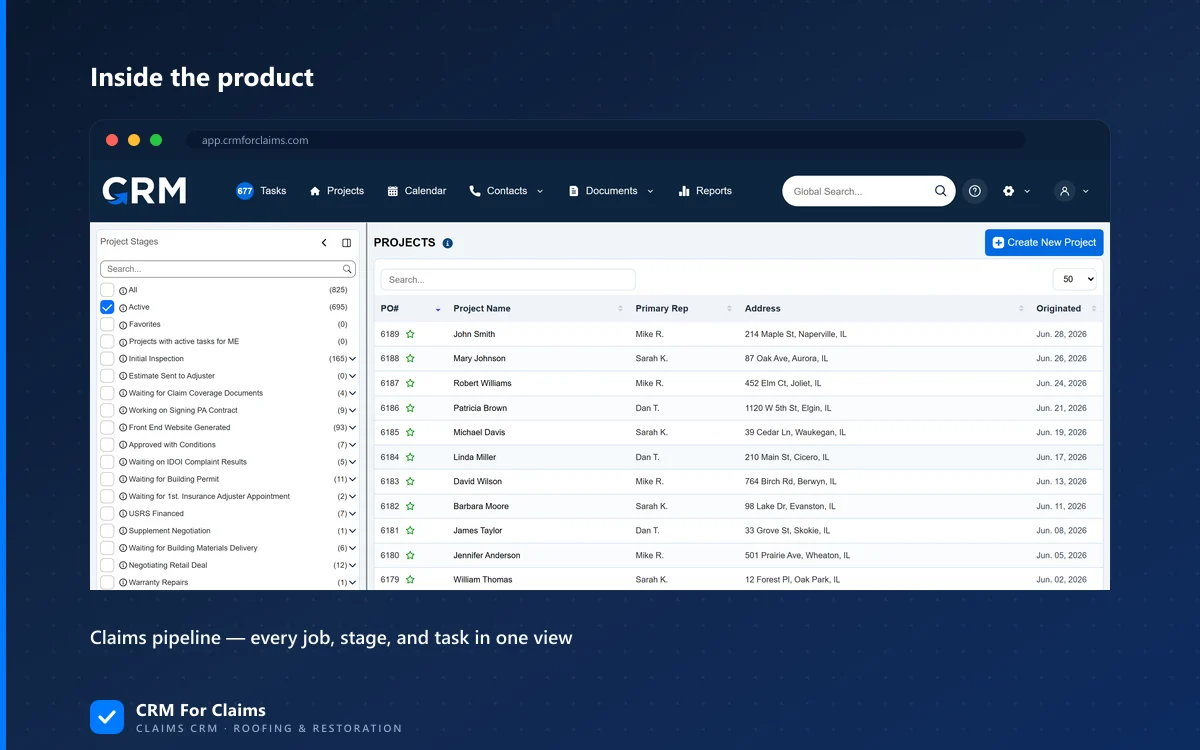
Once it has, the requirement is specific rather than general: stages that reflect a claim rather than a sale, adjusters and carriers as real contacts, messages and documents that file themselves onto the claim, and a view that shows what has gone quiet. That is the whole argument for a claims-first system, laid out on the features page and against the generic alternative on the comparison page — including the cases where a generic tool is genuinely the right call.
If you are heading into a season that you already know will be bigger than the last one, the useful time to look at any of this is now, while nothing is on fire. Bring your worst open claim from last year and the number of leads you think you never called back, and book a live walkthrough — the honest version of that conversation includes me telling you if what you have is already good enough.