Short answer: Every restoration or roofing claim moves through the same seven stages — intake, inspection, estimate, adjuster review, production, completion, and invoicing. Claims stall almost never inside a stage itself; they stall in the handoff between stages, usually while waiting on an adjuster, a signature, or an approval nobody is tracking.
I build CRM For Claims, and after watching a lot of pipelines move (and stop moving), one pattern holds across almost every roofing and restoration shop: the claim lifecycle itself is not complicated. Intake, inspection, estimate, adjuster review, production, completion, invoicing — that's the whole shape, and most operators could recite it from memory. What actually eats weeks is not the work inside any one stage. It's the gap between stages, where a claim is technically "in progress" but nothing is actually happening because whoever needs to act on it doesn't know it's their turn.
What are the real stages of a restoration or roofing claim?
A claim moves through seven stages from first contact to paid: intake, inspection, estimate, adjuster review, production, completion, and invoicing. Each stage has a different owner and a different way to fail, which is why treating them as one blob called "the job" hides where the actual problem is.
| Stage | What happens | Who owns it |
|---|---|---|
| Intake | First contact, claim opened, basic facts recorded | You or office staff |
| Inspection | Damage documented with photos and notes | You or an inspector |
| Estimate | Scope and line items built from the inspection | You or an estimator |
| Adjuster review | Carrier reviews the estimate, approves or negotiates | The adjuster |
| Production | The approved work actually gets done | Your crew |
| Completion | Final walkthrough, sign-off, documentation filed | You and the customer |
| Invoicing | Invoice generated from the approved scope, payment collected | You or office staff |
Notice the ownership column. Every stage flips to a different person, and two of the seven — adjuster review and, partly, completion — hand control to someone outside your company entirely. That's the detail most claim tracking misses, because a claims pipeline built for the work treats "waiting on the adjuster" as a real, visible state, not a gap in your calendar.
Where do claims actually stall — inside a stage or between stages?
Claims stall between stages far more than inside them. The work inside a stage — inspecting a roof, writing an estimate, running a crew — is usually the part your team is good at and does quickly. The stall happens in the handoff, when a claim is done with one stage but nobody has explicitly picked it up for the next.
This is easiest to see with a concrete case. An estimate goes to the adjuster on a Tuesday. The estimator's job is finished — the ball is now genuinely out of your hands. But if nothing marks that claim as "waiting on adjuster" with a date attached, it looks identical to a claim nobody has touched all week, and it sits there until you happen to notice, or the customer calls asking why nothing's happening. The actual production work, once approved, usually takes days. The silent gap before approval routinely takes longer than the work itself.
Which single stage causes the most delay?
Adjuster review is the most common bottleneck, because it's the only stage where the person doing the work is outside your company and outside your control. You can staff up an inspection team or add a second crew, but you can't hire your way out of a carrier's review queue.
That doesn't mean the stage itself is broken — carriers have real workloads and real review processes, and some amount of wait is normal. The problem is when that normal wait becomes an invisible one: nobody logged when the estimate was sent, nobody set a date to follow up, and three weeks later someone finally asks "did we ever hear back on this one?" A stage that's supposed to take five to ten business days can quietly stretch to five weeks purely because no one was watching the clock, not because the carrier was unusually slow. I wrote more about keeping that specific conversation visible in how to keep adjuster conversations on the claim instead of in someone's inbox.
How do you tell a normal wait from a real stall?
A normal wait has a known cause and an expected end date — "sent to the adjuster Tuesday, typical turnaround is a week." A real stall is a claim sitting with no next action, no owner, and no date attached to it at all. The difference isn't how long it's been sitting; it's whether anyone can tell you, right now, what happens next and when.
| Signal | Normal wait | Real stall |
|---|---|---|
| Next action | Known and assigned | Nobody can say what it is |
| Expected date | A rough timeframe exists | No date attached anywhere |
| Visibility | Anyone on the team can check status | Only lives in one person's memory |
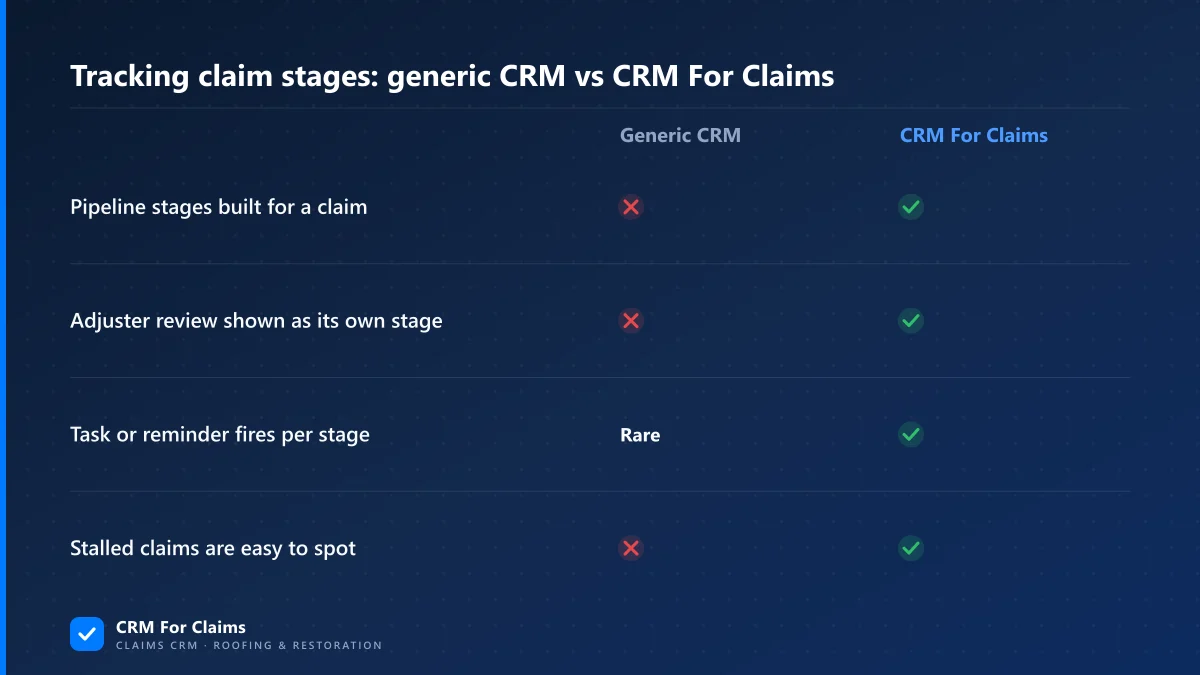
Most shops can answer "what's the next action" for a claim someone is actively looking at. The stalls happen on the claims nobody is actively looking at — the ones that scrolled off the top of a to-do list two weeks ago. That's a visibility problem, not a work-ethic problem, and it's exactly what a real claims pipeline is built to solve: every open claim visible at once, with its current stage, instead of relying on someone remembering to check.
Does stage automation actually prevent stalls, or just paper over them?
Done well, stage automation prevents stalls by attaching a task or a reminder to the moment a claim enters a stage — so "waiting on adjuster" comes with a follow-up date automatically, instead of depending on someone remembering to set one. Done badly, it just adds noise nobody reads.
The useful version is narrow: fire a reminder when an estimate goes out, fire another if there's been no response by the expected date, and stop there. It shouldn't try to automate the judgment calls — deciding whether to push back on an adjuster's counteroffer is still a human decision. I went deeper on where that line sits in what stage automation really means for a restoration claim, including the ways it goes wrong when it tries to do too much.
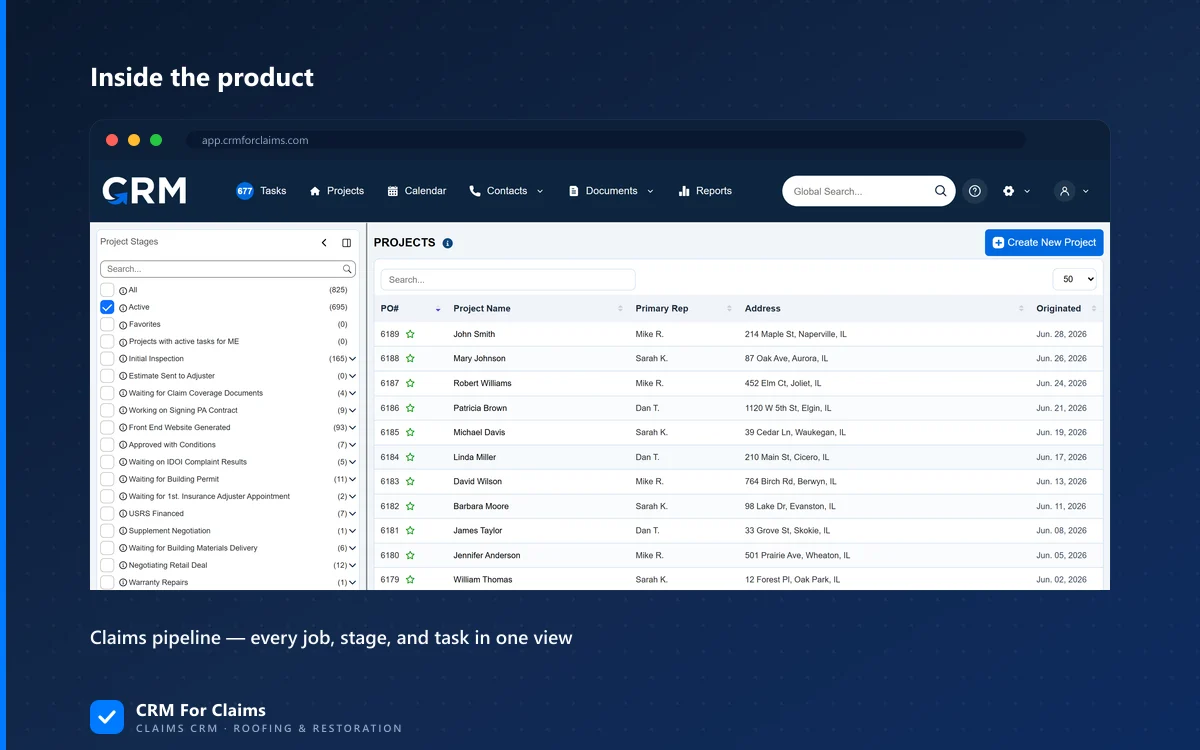
What changes once every stage is tracked as a real pipeline step?
Once every stage is a real, visible step — not just a mental note — a stalled claim becomes something you can see at a glance instead of something you discover when a customer calls. The pipeline itself becomes the answer to "what's stuck and why," rather than a question someone has to go dig for.
- Every claim shows its current stage — no guessing whether a job is "in production" or actually still waiting on approval.
- Handoffs have an owner — a claim moving into adjuster review is visibly someone else's move now, not a gap in your week.
- Old claims can't hide — a claim sitting in one stage for three weeks is as visible as one that moved yesterday.
- Invoicing starts from what was actually approved — the handoff from adjuster review into production carries the approved scope forward instead of losing it. I wrote about that specific handoff in tying invoicing to approved work.
None of this requires a big claim volume to matter. A shop running five claims at once can lose just as much time to an invisible stall as one running fifty — the difference is only how many claims are quietly stuck at once. If you want to see what the actual pipeline looks like with real stages instead of a generic sales funnel bent into shape, book a live walkthrough and I'll show you the real screens.