Short answer: Getting paid faster on a claim starts with tying every invoice to exactly what was approved — RCV, ACV, released depreciation, the deductible, and any signed supplement — instead of a total someone typed in from memory. When the invoice can't drift from the approved scope, there's nothing left for a carrier or adjuster to dispute, and payment stops waiting on a manual check.
I build CRM For Claims, and if there's one thing that quietly slows down claim payments more than anything else, it's an invoice that doesn't match what was actually approved. Not fraud, not padding — just drift. A supplement gets verbally okayed on a phone call and never gets written down. Depreciation gets billed before it's actually recoverable. The deductible gets forgotten and shows up as a surprise on a final invoice. None of that gets caught until the carrier or the customer catches it, and by then the payment is stuck behind a correction. Getting paid faster on claim work isn't really about chasing payments harder — it's about invoicing something nobody can argue with in the first place.
Why can't you just invoice for the work you did?
On an insurance claim, the amount you're owed isn't just "what the job cost" — it's what was approved through a specific process, and invoicing outside that approved scope is what triggers disputes, delayed payment, or a flat refusal to pay. A cash job doesn't have this problem. A claim always does.
On a self-pay remodel, you and the customer agree on a price and you invoice it. Nobody else is involved. On a claim, the adjuster reviewed and approved a scope, the carrier is paying against that approved scope, and the homeowner is often only on the hook for the deductible. If your invoice includes a line item the adjuster never approved — even something reasonable, like extra debris removal that turned out to be necessary — that line item doesn't just get politely declined. It stalls the whole invoice while someone sorts out what's approved and what isn't, and "someone" is usually your office, on the phone, days after the crew already left the property.
What's the difference between RCV, ACV, and depreciation when it comes to invoicing?
RCV is the full replacement cost, ACV is RCV minus depreciation, and depreciation only becomes billable — "recoverable" — once the work is actually completed. Invoicing the wrong one at the wrong time is one of the most common reasons a claim payment gets kicked back for correction.
| Term | What it means | When you can invoice it |
|---|---|---|
| RCV | Full replacement cost of the approved scope | Once the carrier has approved the scope, as the full contract value |
| ACV | RCV minus depreciation | Typically the first payment issued, before work starts |
| Recoverable depreciation | The withheld difference between RCV and ACV | Only after the job is complete and proof of completion is submitted |
| Deductible | The homeowner's own portion of the claim | Collected from the customer directly, tracked separately from the carrier's portion |
None of these are optional details — they're the actual sequence a claim payment follows. A crew that bills the full RCV before the job is even scheduled, or forgets to invoice the deductible until the very end, isn't committing fraud. They're just working from a spreadsheet that doesn't know the difference, and the fix always lands on someone's desk after the fact.
How do supplements change what you can invoice?
A supplement is additional approved scope discovered after the original estimate — hidden water damage, extra material once a wall is opened — and it has to be submitted and approved before it can be invoiced. Invoicing a supplement amount before it's approved is exactly the kind of drift that gets an invoice sent back.
Supplements happen on almost every real job, because the original estimate was written from a visual inspection, not from what's actually behind the drywall. The problem isn't that supplements exist — it's that they tend to get tracked the same loose way the rest of a claim does: a text to the adjuster, a verbal "yeah that's fine," and no record that ties the extra amount to an actual approval. When that supplement shows up on the invoice with nothing behind it, the carrier has every reason to push back, and now you're waiting on payment for the entire invoice, not just the supplement line.
What does it mean to tie invoicing to the approved scope in a CRM?
It means the invoice is generated from the claim's own approved line items — the original scope, any approved supplements, the ACV/RCV split, the deductible — instead of being typed from scratch by whoever's doing billing that week. If it wasn't approved on the claim, it can't quietly end up on the invoice.
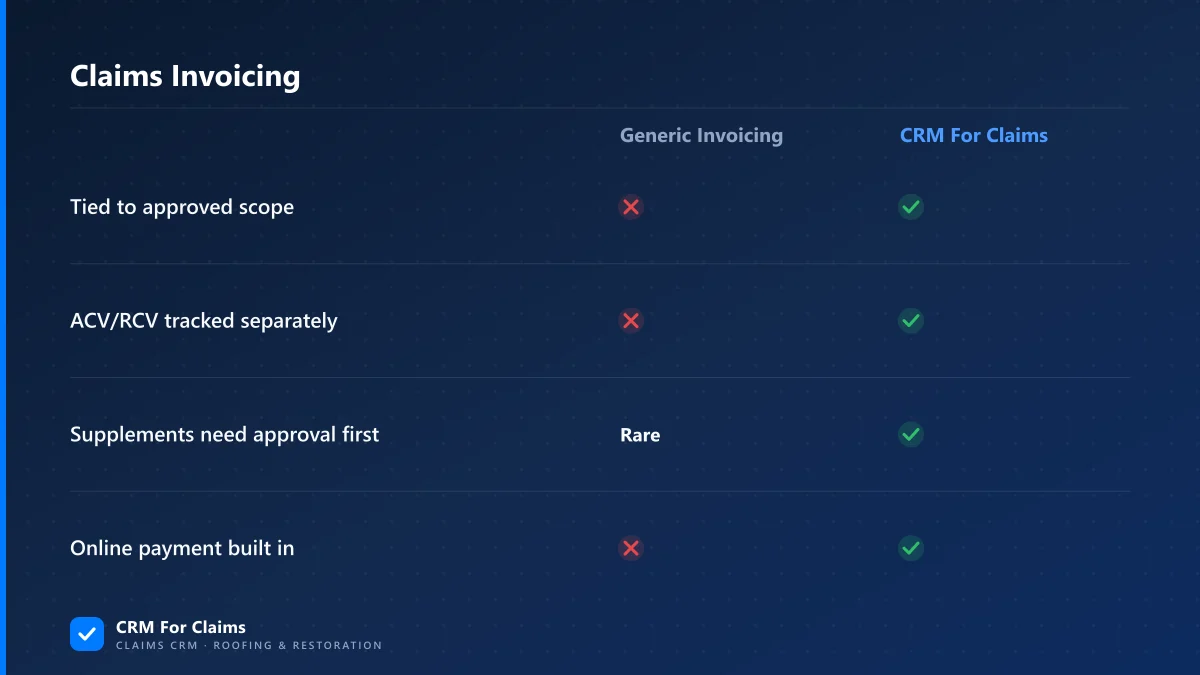
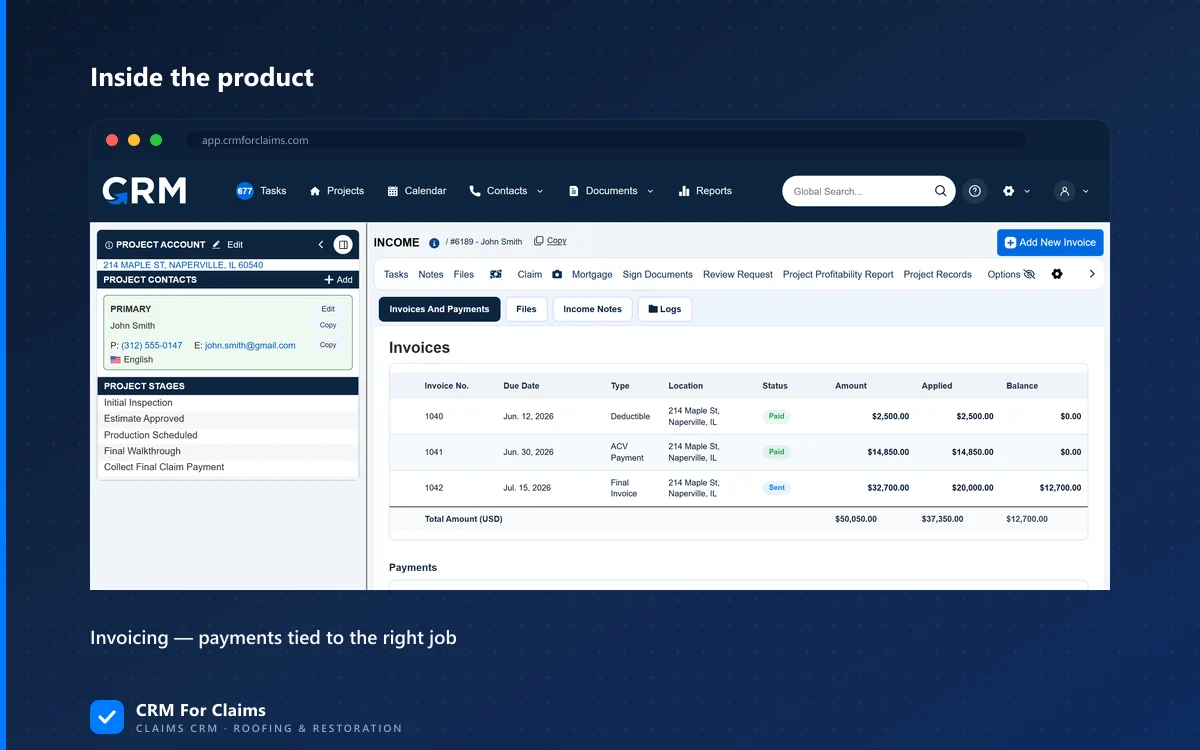
This is the part a spreadsheet or a generic invoicing tool genuinely can't do, because neither one knows what a claim is. A spreadsheet will happily total whatever numbers you put in it. A generic invoicing app will happily send whatever line items you type. Neither one checks that number against an approved scope, because that concept doesn't exist for them — it only exists inside a system built around the claim itself. Our own invoicing and online payments feature pulls from the claim's approved scope directly, so the invoice isn't a re-typed guess at what was agreed — it's the record of what was actually approved, with the ACV/RCV split and the deductible already accounted for.
How does automation actually speed up getting paid?
Automation speeds up payment by removing the delay between "the work is approved" and "the invoice goes out," and by letting the customer pay online the moment they get it, instead of the invoice sitting in an inbox waiting for someone to mail a check.
The slowest part of getting paid is rarely the carrier — it's the internal gap. A supplement gets approved on Tuesday and the invoice goes out the following Monday because whoever handles billing was on a roof all week. Stage-based automation, the kind we covered in an earlier post, closes that gap: the moment a stage like "scope approved" or "job complete" fires, the invoice for that amount is ready to send instead of waiting on someone to remember. Add online payment through Stripe — cards aren't stored on our servers — and the customer's portion of an invoice can be paid the same day it arrives, instead of waiting on a mailed check that shows up whenever it shows up.
- Invoice tied to approved scope — nothing on the bill that wasn't already agreed to.
- ACV/RCV/depreciation tracked separately — the recoverable portion doesn't get billed early by mistake.
- Deductible collected directly from the customer — never bundled into the carrier's portion by accident.
- Stage-triggered invoicing — the invoice goes out when the scope is approved, not whenever someone gets to it.
- Online payment — the customer's share can be paid the same day, no mailed check required.
When is a simple, non-tied invoice still fine?
For a small, self-pay job with no insurance company involved at all, a plain invoice is completely fine — there's no approved scope to drift from, because nobody approved a scope in the first place. This distinction only matters once insurance is actually paying part of the bill.
It's worth saying plainly: not every job needs this. A cash-pay gutter repair or a small remodel where the homeowner is paying out of pocket doesn't have an adjuster, a carrier, or a depreciation schedule to track against. A basic invoice for the agreed price does the job. The moment insurance enters the picture — even for one line item, like a partial claim on an otherwise self-pay job — that's when tying the invoice to an actual approved scope starts to matter, because that's the moment there's a second party who can dispute it.
Getting paid faster on claim work was never really about chasing payments harder. It's about removing the reason a payment gets held up in the first place — an invoice with nothing on it that a carrier didn't already agree to. See how CRM For Claims compares to a generic setup, check pricing, or book a live walkthrough and I'll show you exactly how an approved scope turns into an invoice, start to finish.