A roofing contingency agreement is a short contract a homeowner signs before the insurance decision: if the carrier approves the claim, you do the work at the approved price. It is useful because it settles who builds the roof before the adjuster shows up. It also carries rules most contractors only learn about after a dispute, starting with the homeowner's right to cancel once a denial letter arrives.
I build CRM For Claims, so I see these agreements from the paperwork side: when they were signed, what they promised, and which date somebody forgot to count. This post walks through the clauses one by one, then puts three states' actual rules side by side. I'm not a lawyer and this isn't legal advice. Have your own attorney read your agreement against your state's statute before you print another stack.
What does a contingency agreement actually commit the homeowner to?
It commits them to using you for the covered work if the claim is approved, and usually at the price the carrier approves. It does not let you act on the claim for them. It does not make them pay for anything the carrier refuses, unless they later agree in writing.
That second limit is where the trouble starts. A homeowner who signed on the driveway often believes they hired someone to "handle the insurance." A rep who wants the signature lets them believe it. Then the carrier approves less than expected, and the homeowner discovers they signed a contract, while the rep discovers that in several states he was never allowed to negotiate the claim in the first place.
So the agreement has two jobs: hold the job for you, and say in plain words what you will not do. The second job protects you more than the first.
The clauses, one at a time
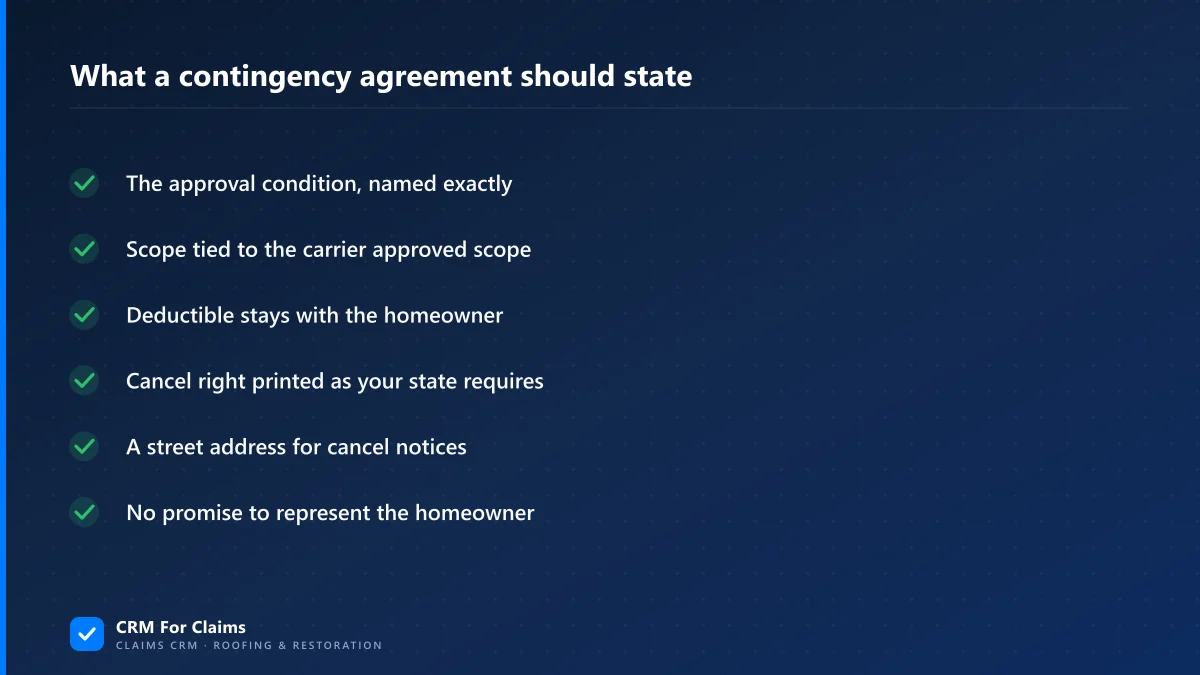
Below are six clauses most agreements need, written in ordinary words, with a note on why each one is there. Your attorney will word them for your state. Use this to check that nothing is missing, not as text to copy.
How do Illinois, Colorado and Minnesota treat these agreements?
Differently enough that one form cannot serve all three. Illinois and Colorado give the homeowner a short window to cancel after a denial. Minnesota's claim statute focuses on what the contractor may say and offer. Here is each rule as the state publishes it.
| State | When the homeowner can cancel | Money back | What the contractor may not do |
|---|---|---|---|
| Illinois | Within 5 business days after the insurer's notice that all or part of the claim is not covered, or by the 30th business day after the insurer receives a properly executed proof of loss | Payments, partial payments and deposits are returned | Represent the homeowner on the claim, file or call in a claim for them, or offer to pay any part of the deductible |
| Colorado | Within 72 hours after written notice that the roofing claim is denied in whole or in part | Within 10 days of rescission, less pay for roofing work actually performed | Advertise or promise to pay, waive or rebate the deductible (section 6-22-105) |
| Minnesota | Not set in the claim statute (section 325E.66) | Not set in that section | Offer to cover the deductible, interpret policy provisions or advise on coverage unless licensed as a public adjuster. Written notice of the section goes with the initial estimate |
Two things to notice. In Illinois the brochure lists these limits under a declared catastrophe, meaning a storm or flood that damages more than one home, which describes most of the claim work a roofer does. And none of the three windows starts on the day the homeowner signed.
When does the cancel clock start?
It starts on the day the homeowner receives the carrier's decision, a letter that is mailed to them and not to you. That is the operational trap. Your office can't count down a deadline it doesn't know has started.
Here is one Colorado claim on a calendar, using the statute's own numbers:
- Day 0The homeowner signs the contingency agreement after the inspection. Nothing can be cancelled under the denial rule yet, because nothing has been denied.
- Day 21The adjuster's estimate leaves out two slopes. The homeowner receives written notice that part of the claim is denied. The 72 hours begin here, whether or not your office has seen the letter.
- Day 24The window closes. If the homeowner sent written notice of rescission to the address in the agreement before then, the job is off.
- Day 34The last day to return deposits after a day 24 rescission, minus pay for work actually done. Ordering materials on day 22 was the expensive mistake.
In Illinois the same claim gives five business days instead of 72 hours. The fix in both states is a habit, not a form: ask every homeowner to forward the carrier's decision the day it arrives, record the date they received it, and don't order materials or schedule a crew until the window has passed.
What should a rep never say while getting the signature?
Anything that sounds like representing the homeowner against their insurer. In Illinois and Minnesota that line is in the law, and in other states it is where public adjuster licensing begins. A rep can document damage, attend the adjuster meeting and supply evidence. A rep can't promise a settlement amount or interpret coverage.
- "I'll handle the insurance for you." Say instead that you will document the damage and meet the adjuster.
- "Your policy covers this." Only the carrier decides that.
- "We'll take care of your deductible." Barred in all three states above.
- "Sign here so I can talk to your insurance company." The agreement grants no such authority, and the homeowner shouldn't think it does.
When a claim really needs someone to argue coverage, that's a job for a licensed public adjuster or an attorney. The handoff, and how to keep your file intact through it, is covered in handing a claim to a public adjuster or attorney.
Keeping the agreement and its deadline on the claim
The agreement fails quietly when it lives in a rep's truck and the denial date lives in a homeowner's mailbox. Everything above works only if the signed paper, the decision date and the cancel deadline sit on the same claim record the whole office can see.
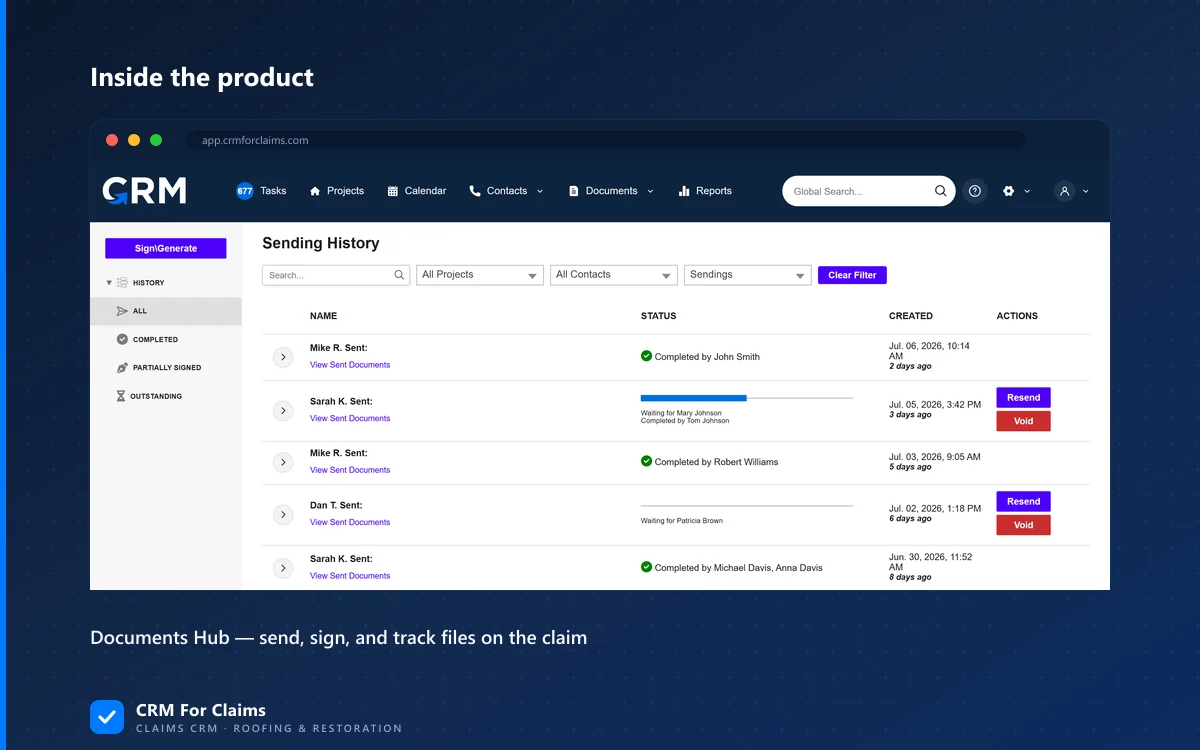
In our product this runs through the Documents Hub and tasks. When a document goes out for signature from the Documents Hub, the claim's history records that the signature request was sent. The hub also keeps track of which signers have already signed, so a two-owner house does not sit half-signed for a month. A task in CRM For Claims carries a deadline and the person it is assigned to, so the end of a cancel window can be a dated task on the claim.
What the CRM doesn't do is know your state's law or read the carrier's letter for you. Someone still has to record the date the homeowner received the decision and pick the right window. If you're weighing this against a general contractor CRM, the comparison page lays out what each kind of tool keeps on the job, and pricing is on one page.
When is a full contract better than a contingency agreement?
When the homeowner has already received the carrier's approval. At that point there is no condition left to wait for, and a full contract with the approved scope, price and schedule is clearer for both sides. The contingency agreement belongs to the gap between inspection and decision, and it should be short enough that a homeowner reads all of it before signing.
It also isn't worth using when a rep can't explain each clause in a sentence. A homeowner who doesn't understand what they signed will remember the signature, not the clauses, and that memory comes back as a complaint.
If you'd like to see how a signed agreement, a decision date and a deadline task sit together on one claim, book a live walkthrough and I'll show you on a demo job.