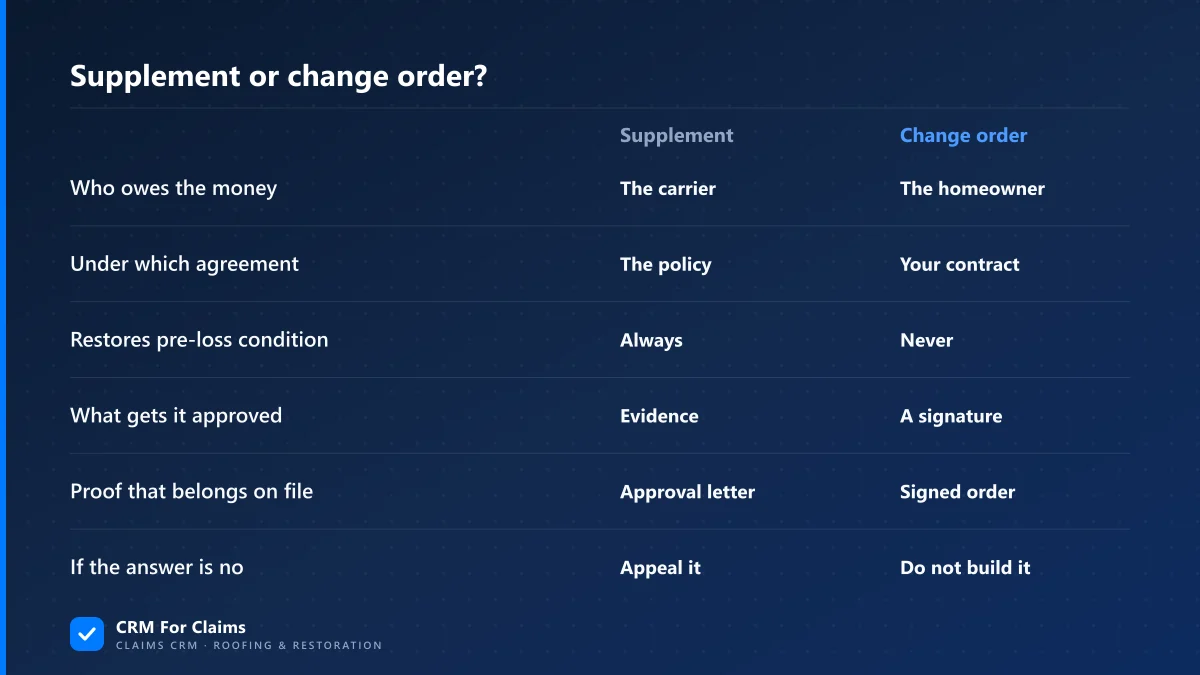
Short answer: A supplement asks the carrier for money on damage the first estimate missed. A change order asks the homeowner to buy something the loss did not cause. Same sentence — this job now costs more — addressed to two different payers under two different agreements. One test separates them: was this needed to restore the property to its pre-loss condition?
I build CRM For Claims, and the fastest way to lose money on an insurance job is not underbidding it. It is doing work nobody agreed to pay for, because a change order got filed as a supplement and the carrier said no after the crew had already built it. By then there is no good move left: go back to the homeowner for money they never agreed to spend, or absorb it. Most teams absorb it and call it the cost of doing business.
It is not the cost of doing business. It is a classification error, and it happens because the two documents feel identical from the inside. Both start with a field tech noticing something. Both end with a bigger number than the one on the contract. Everything between those two moments is different.
What is the difference between a change order and a supplement?
The counterparty. A supplement is a request to the carrier, made under the homeowner's policy, arguing that work you are about to do was always covered damage and the first estimate simply missed it. A change order is an offer to the homeowner, made under your contract with them, for work the policy was never going to cover. One is an argument. The other is a sale.
That produces a single portable test, and it is the only one you need in the field: would this work be necessary to put the property back the way it was before the loss? If yes, it belongs in a supplement, because that is what the policy owes. If no — better than pre-loss, or unrelated to the loss entirely — it belongs in a change order, because the only person who can authorise it is the person who wants it.
Note what the test does not depend on: the size of the number, whether the crew is already on site, or whether the homeowner would rather the insurance paid. A carrier reviewing a supplement answers one question — is this loss-related damage under this policy — and the honest answer does not change because the work is convenient to bundle.
Which one is it? Six situations from an ordinary week
The test is easy to state and harder to apply at 7am on a tear-off. The reasoning column matters more than the answer column, because the reasoning is what transfers to the seventh situation.
| What the crew found or was asked | Which document | Why |
|---|---|---|
| Rotten decking exposed after tear-off | Supplement | Not visible at inspection, needed to restore the roof. Photograph it before it is covered. |
| Homeowner wants a metal roof instead of shingle | Change order | Better than pre-loss. The policy owes like kind and quality, not an upgrade. |
| A second shingle layer nobody knew about | Supplement | Real additional tear-off and disposal on covered work. |
| Add gutter guards while the crew is up there | Change order | The storm did not cause a need for gutter guards. |
| Elevated moisture behind an adjacent wall | Supplement | Loss-related damage found during mitigation. Readings and dates are the evidence. |
| Pre-existing rot at a fascia, unrelated to the storm | Change order | Already failing before the loss, so pre-loss condition does not include fixing it. |
The fourth row is the expensive one, and not because of the amount. Nobody writes a change order for gutter guards. The homeowner asks, the crew lead says sure, and it happens with no document, no price and no signature — then surfaces six weeks later as an invoice line the homeowner does not recognise. That is a worse conversation than the one you avoided on the driveway.
What does filing the wrong one actually cost?
Both directions have a price, and they are not symmetrical. Filing a change order as a supplement costs you the work. Filing a supplement as a change order costs you the relationship and leaves carrier money uncollected on a job you already did.
- Change order submitted as a supplement. The carrier correctly identifies it as betterment or as unrelated to the loss, and refuses. If you waited for the answer you have lost time. If you did not wait — and the reason people bundle it into a supplement is that they did not want to stop — you have built something with no payer attached.
- Supplement charged to the homeowner as a change order. You bill a customer personally for damage their policy owed them. Some pay and never call you again. Some ask their adjuster, learn it was covered, and now you are explaining the charge. Either way that carrier money stays with the carrier, because a supplement nobody filed is a supplement nobody pays.
- Neither one written at all. The most common outcome by volume. The work gets done, the cost lands in materials and labour, and it never appears as a variance anyone can see. This version does not feel like a loss, which is exactly why it repeats.
The supplement side has its own mechanics — triggers, evidence, the seven states between finding one and being paid for it — and I wrote those up in how supplements and approvals actually work on a claim. This post is the other half: the money that was never the carrier's to pay.
Who pays when the homeowner wants an upgrade?
Both of them, on the same roof. A replacement cost policy owes like kind and quality — materials and workmanship comparable to what was there before the loss. If the homeowner wants better, the carrier still owes the approved amount for the covered scope and the homeowner pays the difference. One line of work, two payers, and that is where most paperwork falls apart.
The arithmetic is simple. Illustrative round numbers, not a quote from a real job: the carrier approves the roof scope at $18,400, the homeowner wants standing seam metal, you price it at $31,900 installed. The change order is not $31,900. It is $13,500 — the upgrade differential — and it should say so on its face, because that is the number they are agreeing to and the number they will compare against other bids.
Two consequences follow. The change order has to reference the covered scope it sits on top of, or it reads like a competing contract for the same roof. And your system has to hold two payers against one job — if the job record has a single total and a single customer, the differential either disappears into the claim total or gets invoiced to the wrong party.
Code items are the honest grey area. A code requiring ice and water shield, extra fastening, or a full deck replacement where a repair would have done is not an upgrade the homeowner chose — but it is also not damage the storm caused. Whether it can be supplemented depends on whether the policy carries Ordinance or Law coverage. Many do, usually capped at a percentage of the dwelling limit; some do not carry it at all. That fact lives on the declarations page, and the time to find it out is before tear-off.
What has to be in a change order, and where does it live?
Enough that a stranger reading it a year later can tell what was agreed, by whom, for how much. It names the contract it amends, describes the work in the customer's language, states the price and the payer, states the effect on the schedule, and carries a signature dated before the work started. Each element exists because it is what someone disputes later.
| Element | What it prevents |
|---|---|
| Reference to the original contract or claim number | Being read as a separate agreement for the same job |
| Plain description of the added or removed work | Arguments about what "the upgrade" included |
| The price stated as a differential where it is one | The homeowner thinking they are paying twice |
| Who pays it, named explicitly | The line drifting onto the carrier invoice |
| Effect on the completion date | A late finish being treated as your delay |
| Signature and date, before the work | All of the above, in the only form that holds |
There is a legal floor under this, and it is state law rather than industry practice. Illinois, where we are based, requires a written contract for home repair and remodeling above a modest dollar threshold under the Home Repair and Remodeling Act (815 ILCS 513), and the cautious reading is that changing the scope changes the contract. Several states have similar or stricter home improvement statutes, some naming change orders directly. Check the one you work in — this is not legal advice.
One thing a change order can never be: a way of handling the deductible. The deductible is the homeowner's share of a price the carrier already set, not extra work, and dressing it up as a change order for something that was not built is the exact move several states legislate against. I covered that in the deductible rules contractors actually have to follow.
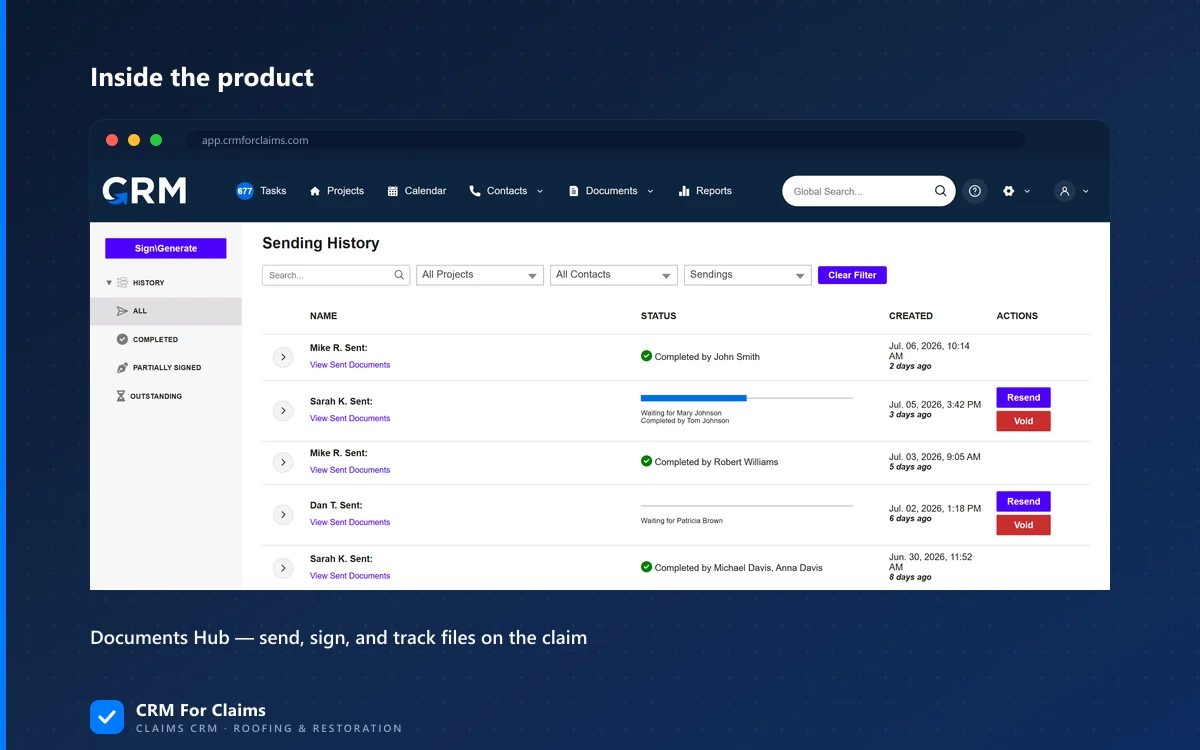
Once the claim lives in a system, the change order belongs on the claim as its own record — its own status, its own signature, its own money line. Not a note in the job description, and not an edit to the original contract total: overwrite that number and you have destroyed the only evidence the increase was agreed rather than invented.
It needs four things. A document you can generate from a template and send for signature, so the signed copy returns to the claim instead of somebody's inbox — that is what the Documents Hub in CRM For Claims does with any claim paperwork. A status of its own, because sent and signed are different states and a crew scheduled off "sent" is a crew building unpaid work. A payer, so the amount routes to the homeowner invoice rather than the carrier scope. And a link into invoicing, so the signed differential lands on the bill instead of being remembered.
None of that requires our software. It requires the four things to exist somewhere and one person not to be holding all four in their head. If you are comparing tools, the question is not "do you support change orders" — everyone says yes — but "show me a job where the carrier owes part of it and the homeowner owes the rest, and show me the invoice that comes out." How a claims-first system differs from a generic CRM is mostly a list of questions like that.
When is it not worth writing one?
When the work is genuinely trivial and you have decided to eat it as goodwill — resetting a satellite dish, replacing a couple of boards, half an hour of a crew's day. Writing a $60 change order for that costs more in friction than the $60, and pretending otherwise is the kind of process advice everyone doing the actual work ignores.
The caveat is that this is a habit, not a decision, and habits generalise. The team that skips the paperwork on the satellite dish skips it on the gutter guards, then on the $1,400 fascia run. The line I would draw is not a dollar amount but a question: if the homeowner did not remember agreeing to this, could I show that they did? If not, and the number is not trivial, it needs a document — even a two-line one signed on a phone in the driveway.
And if you are a solo operator doing a handful of self-pay jobs a year, none of this needs software. A numbered change order form and a folder is a complete system at that volume. What breaks the folder is a second person — a crew lead agreeing to something in the field that the office learns about at invoicing. That is the whole reason to keep change orders on the claim rather than beside it: so the person who says yes and the person who bills are reading the same record. If you want to see it on a mixed-payer job, book a live walkthrough and bring an awkward one. Pricing starts at $59 a month, month to month.