
Short answer: A supplement is extra scope found after the original estimate was approved, and it only turns into money once the carrier approves it in writing. The claims that lose money are not the ones with supplements on them — they are the ones where the supplement was approved on a phone call, never written down, and then billed anyway.
I build CRM For Claims, and insurance claim supplements are where I see the money side of a restoration job come apart more often than anywhere else. Not through carelessness. The crew finds rot under the shingles, calls it in, the adjuster says "send it over," someone does the extra work, and eight days later nobody can say whether that amount was ever actually approved, by whom, or for how much. The work is real. The paperwork behind it is a memory. And a memory is not something a carrier pays against.
What is a supplement on an insurance claim?
A supplement is additional scope submitted after the original estimate was approved — hidden rot, an extra layer of shingles, a code item that only applies once work starts. It is not a price increase and not a renegotiation. It is a smaller claim inside the claim, and it goes through the same review the first estimate did.
Supplements are normal. The original estimate was written from a visual inspection of a closed-up building, so the first honest look at what is actually there happens when the roof comes off or the drywall comes out. Adjusters expect that. What they do not accept is an amount appearing on an invoice with no submission behind it — and that is a records problem on your side, not a coverage problem on theirs.
| What gets found | When it shows up | What usually decides the approval |
|---|---|---|
| Rotted or damaged decking | After tear-off | Photos of the deck with the old roof off, plus a square-foot count |
| An extra layer of shingles | At tear-off | A photo of the layered cross-section at the edge |
| Hidden water damage behind walls | During demo | Moisture readings dated before drying started |
| Extra drying equipment days | During mitigation | Daily moisture logs, not one summary written at the end |
| A code item the jurisdiction requires | Once work begins | The code reference plus a photo of the affected area |
Notice what every row in that right-hand column has in common: the evidence exists for a short window, and then it is buried under new material. A supplement is won or lost in the hour the crew is standing in front of the thing, not in the phone call three weeks later.
Why do approved supplements still get lost?
Because the approval usually happens in a conversation. An adjuster says yes on a call or a text, the crew hears it, the work gets done, and nothing on the claim record changes. Weeks later the invoice carries an amount that, as far as the file shows, nobody ever approved — so the whole invoice waits.
There are three separate failure points inside that, and they fail independently:
- The verbal yes — the approval happened, but it lives in one person's phone. If that person is on a roof, on vacation, or no longer with the company, the approval effectively never happened.
- The partial approval recorded as a full one — you submit $4,200 of decking and the carrier approves $2,800. Someone marks the supplement "approved" and moves on, and the difference only surfaces when the payment lands short.
- The submission with no owner — it went out, nobody answered, and there is no date on which anyone was supposed to notice. Quiet submissions can sit for weeks purely because the file has no way to raise its hand.
That middle one is the expensive one, and it is the state most tools cannot hold. A spreadsheet column has room for "yes" or "no." Real supplement decisions come back approved, partially approved, denied, or approved pending a document — four states, and three of them mean you cannot invoice the number you submitted.
What documentation actually gets a supplement approved?
Photographs taken before the evidence is covered up, dated and tied to the property; a plain statement of why the item was not in the original scope; and the extra work written as line items in the same estimate format the carrier already approved. The decision is made on paper, by someone who was never on site.
That last part is worth sitting with. The person approving your supplement is reading a file. They cannot see the roof, they did not meet the homeowner, and they are working through a queue. Everything persuasive about standing on the job — the smell, the sag underfoot, the obviousness of it — is unavailable to them. Your photographs and your line items are the entire argument.
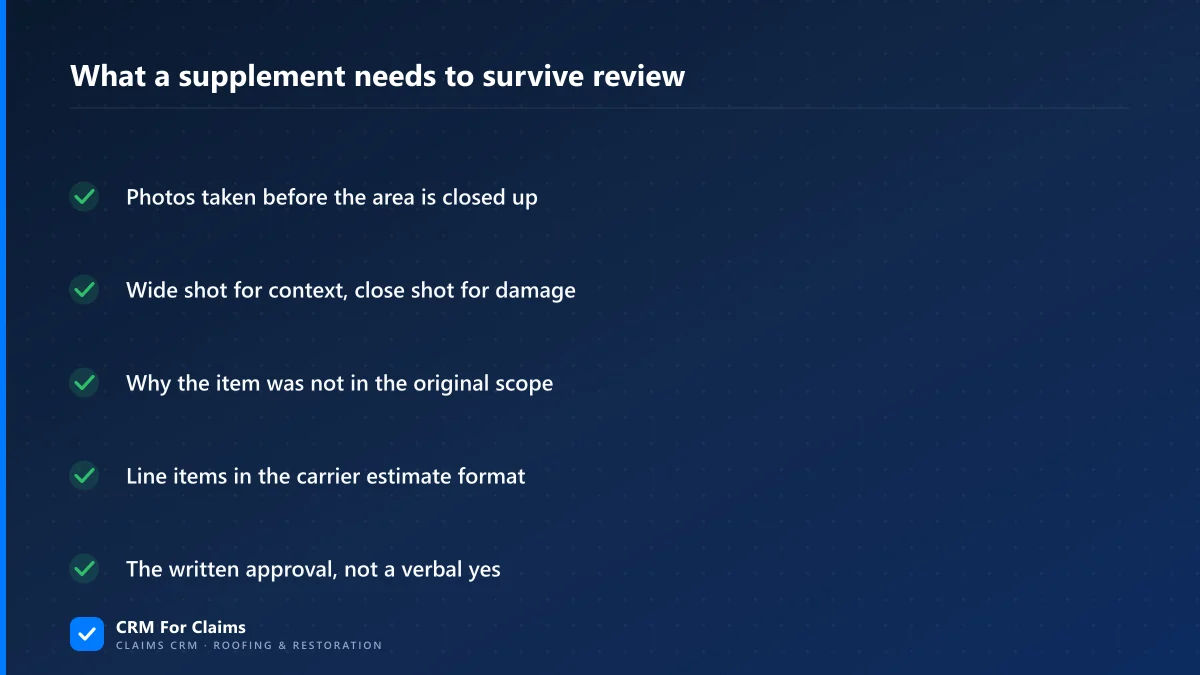
Two practical habits do most of the work here. First, photograph on the assumption that the supplement will be questioned six months from now by someone who has never heard of the job — wide shot for context, close shot for the damage, and something in frame that fixes the location. Second, write the supplement in the carrier's estimating language rather than yours. "Replace bad plywood" is a conversation. A line item with a quantity, a unit, and a code is a submission.
How should a supplement be tracked from found to paid?
As its own record with its own status, attached to the claim, moving through defined states — found, written up, submitted, decided, invoiced, paid. Each state has an owner and one piece of proof that has to exist before it moves forward. That is the whole system, and it is not complicated.
| State | Who owns it | What must exist before it moves on |
|---|---|---|
| Found on site | Crew or estimator | Photos taken before the area is closed up |
| Written up | Estimator or office | Line items in the carrier's estimate format |
| Submitted | Office | A dated record of what was sent and to whom |
| Under review | The adjuster — outside your control | A follow-up date on the calendar, not a hope |
| Decided | The adjuster | The written decision, and the approved dollar amount, filed on the claim |
| Invoiced | Office | Only the approved amount, pulled from the claim record |
| Paid | Office | The payment matched to this supplement, not to the claim total |
Two of those states are the ones teams skip. "Under review" gets skipped because it feels like waiting rather than work, so no date gets set and the file goes quiet — the same handoff gap that stalls claims everywhere else in the process, which I went through stage by stage in the claim lifecycle post. And "Paid" gets skipped because payments arrive as lump sums against the claim, so a short payment on a supplement disappears into a number that looks roughly right.
What does this look like inside a claims CRM?
The supplement is a record on the claim, not a note about the claim. It carries its own status, its own documents, its own messages with the adjuster, and its own follow-up that fires from the status rather than from someone's memory. When it is approved, the approved amount — not the submitted one — is what invoicing can reach.
Mechanically, three things have to be true. The photos and the submission live on the claim, so anyone who opens the file sees the evidence and the decision together rather than hunting through a phone gallery; that is the same reason a Documents Hub tied to the claim exists at all, and I wrote about how that plays out for signed paperwork in the documents post. Messages with the adjuster attach to the supplement, so a "yes" in a text is part of the record instead of a fact one person happens to know. And the invoice pulls the approved figure from the claim rather than a number retyped from memory — the invoicing side of this I covered separately in tying invoices to approved work.
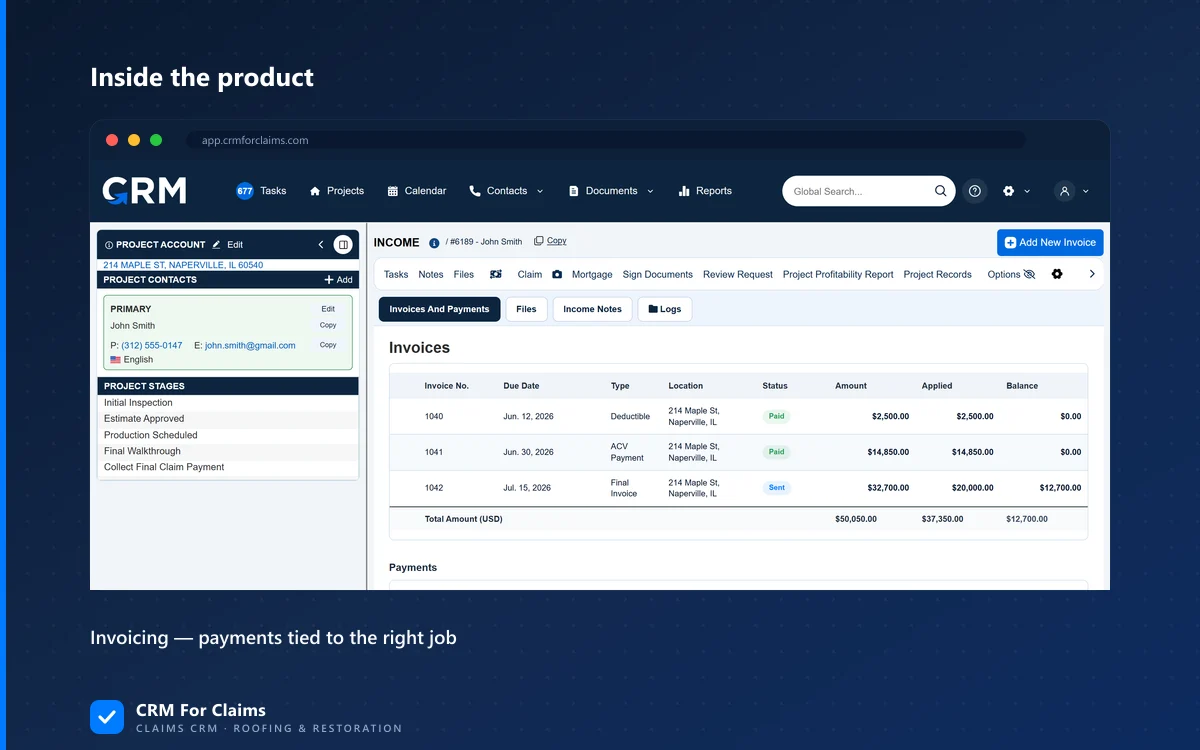
The follow-up is the part worth automating first, because it is pure memory work and memory work is what fails on a busy week. A supplement that has been sitting in "submitted" for ten days does not need a clever workflow. It needs the system to put it in front of a human being, once, with the submission attached.
When is a supplement not worth filing?
When the dollar amount is smaller than the paperwork and the delay it buys. A small item that holds up a decided claim for another review cycle can genuinely cost more than absorbing it, especially if the customer is waiting on completion to release the rest of the money. That is a business call, and it is a fair one.
I would rather say that plainly than pretend every discovered item belongs in a submission. There are three cases where filing is usually the wrong move: the amount is trivial next to the delay; the item was your own miss on the original estimate rather than something newly discovered; or the homeowner would prefer to pay for that piece directly and be done with it. What matters is that the decision gets made deliberately and written down — an item you chose not to submit and an item you forgot to submit look identical at the end of the month, and only one of them was a decision.
It is also worth saying that none of this structure is needed on self-pay work. No carrier, no approved scope, no supplement — just a change order and an invoice. This is specifically an insurance-claim problem, and it scales with how much of your revenue comes through carriers.
Supplements are not an edge case in restoration work; they are most of the difference between the estimate and the actual job. The only real question is whether the money side of them is a record or a recollection. If you want to see how a supplement moves from a photo on a roof to an approved line on an invoice, compare it against how a generic setup handles it, look at what it costs, or book a live walkthrough and I will run one end to end with you.