
Short answer: The insurance deductible is the homeowner's share of their own claim, and in a growing list of states it is illegal for a contractor to pay, waive, rebate or absorb it. You can make it easy to pay. You cannot make it disappear. The difference is worth knowing before somebody says the wrong sentence at a kitchen table.
I build CRM For Claims, and the insurance deductible is the single most reliable place I see good roofing and restoration companies do something careless. Not out of greed — out of wanting the job. A homeowner says the deductible is a problem, somebody on your side says "we'll work with you on that", and a sentence that felt like customer service just became a promise you may not be allowed to keep.
It is the rare operational detail that is a legal exposure, a margin leak and a trust problem at once. Below: what the deductible is, what the law says where it says anything, what waiving one really costs, and the words that keep the conversation honest. Standard disclaimer, and I mean it — I write software, not legal advice. Ask a lawyer licensed where you work, once, and write the answer down where your team can find it.
What is an insurance deductible on a claim, and whose money is it?
It is the amount the policyholder agreed to carry themselves, set in their policy long before you showed up. The carrier does not add it to the settlement and let you sort it out. The carrier subtracts it. Every check that leaves the insurer is already net of the deductible, which means the homeowner's portion is not extra — it is a piece of the approved price.
That single mechanic explains almost every mistake that follows. Contractors treat the deductible as a discount they control, because it is the part of the money that arrives from the customer rather than the insurer. It isn't. It is the last slice of an amount somebody else already calculated and already subtracted. If it doesn't come in, the job was underpaid by exactly that much.
Replacement cost value, actual cash value and recoverable depreciation decide when the rest of the money shows up, and I walked through that sequence in the post on tying invoices to the approved scope. The deductible is the one line in it with a legal opinion attached.
Is it legal to waive or absorb a homeowner deductible?
In many states, no — explicitly and by name. Several have written it into statute, and the direction of travel has been one way. Even where no specific statute exists, telling a carrier the homeowner paid an amount they did not pay is a false statement on an insurance claim, which is a problem everywhere.
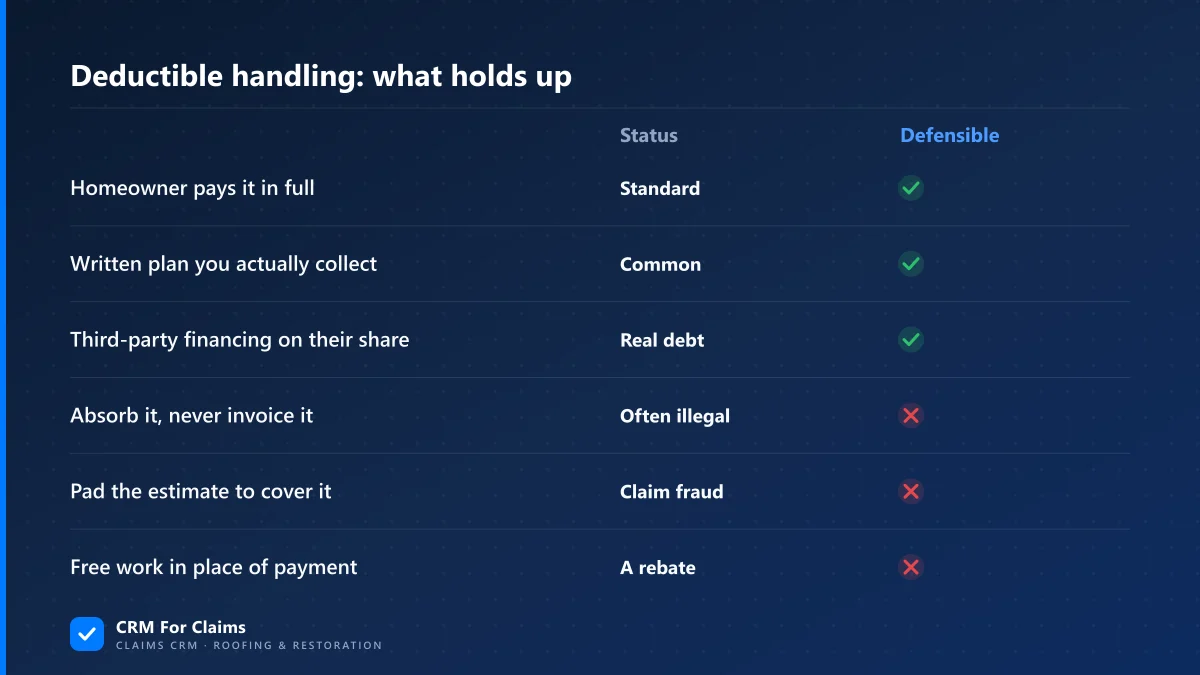
A few of the clearer examples, so you can see the shape of these laws rather than take my word for it. Texas Insurance Code Chapter 707 is titled "Consumer Protection Against Insurance Deductible Fraud" and bars a seller of goods or services expecting payment from property insurance proceeds from advertising or promising to pay or rebate any part of a deductible — plus it requires specific notice language in the contract. Minnesota Statutes § 325E.66 does the same for residential contractors, again with a required written notice. Florida Statutes § 489.147 restricts contractor inducements tied to a property insurance claim and carries its own contract-notice requirement. Colorado's residential roofing law, C.R.S. § 6-22-101 and following, sits in the same family.
Those four are not the whole list, and I am not going to publish a count of states, because that number moves and a wrong one is worse than none. The instruction is narrower: look up your own state today, and look it up again when you expand into a new one. "I never heard that we couldn't" is not a defense anybody has successfully used.
Notice what these statutes have in common: they rarely stop at the payment itself, they also go after advertising it. "We pay your deductible" on a yard sign, a door hanger or an ad is frequently the prohibited act on its own, whether or not you ever did it. That catches marketing-forward companies, because the offer was written by someone who never read the statute and it is sitting in public where anyone can screenshot it.
Then there is the quieter version, which I see far more often than a billboard: nobody waives anything out loud, the deductible simply never gets invoiced. No conversation, no policy, no decision. It falls off the end of the job because the person closing files has no field telling them it is still owed.
What does waiving a deductible actually cost you?
Exactly the deductible, straight off the bottom line, because the carrier already subtracted it. It is not a marketing expense with a return — it is a discount off a price you did not set. On a $2,500 deductible, the job has to generate $2,500 of pure margin elsewhere just to break even against the version where you collected it.
Here is an illustrative claim. The numbers are chosen to make the arithmetic clear, not taken from anybody's job:
| Line | Amount | Who pays it, and when |
|---|---|---|
| Approved replacement cost (RCV) | $18,400 | The agreed total for the approved scope |
| Less recoverable depreciation | −$3,900 | Held by the carrier until the work is done |
| Less deductible | −$2,500 | The homeowner's share, subtracted up front |
| First carrier check (ACV) | $12,000 | Arrives early, before production |
| Depreciation released at completion | +$3,900 | After the carrier sees the work finished and invoiced |
| Deductible collected from homeowner | +$2,500 | Whenever you decided to ask for it |
| Total collected | $18,400 | The approved price, in full |
Skip the last inbound line and you collect $15,900 on an $18,400 job — a 13.6% discount, decided by whoever was standing in the driveway. Run your own net margin against that percentage and the waived job is usually not a thin job. It is a losing one, subsidised by the jobs where the customer paid.
There is a second cost that is easier to miss. Many carriers release recoverable depreciation against a final invoice showing what the work actually cost. An invoice written down to $15,900 because you absorbed the deductible is no longer an invoice for the approved scope, and you have now created a reason for the depreciation release to be questioned. You gave away $2,500 and put $3,900 at risk to do it.
What can you legally do instead?
Plenty — as long as the homeowner genuinely ends up paying their share. The line the statutes draw is not about timing, convenience or friendliness. It is about whether the money is actually owed and actually collected. Every legitimate option below keeps that true.
| What you do | Does the homeowner still owe it? | Where it stands |
|---|---|---|
| Collect in full before production | Yes, and it is paid | The standard, and the cleanest |
| A written installment plan you actually enforce | Yes, over time | Fine in most places — a plan you never collect on is a waiver with extra paperwork |
| Card or ACH payment through a link | Yes | Removing friction is not a discount |
| Third-party financing on the homeowner's share | Yes, to a lender | The debt is real, it just is not owed to you |
| Genuinely optional upgrades, priced and sold separately | Yes, plus the upgrade | A separate transaction, never an offset |
| Pad the estimate so the carrier covers it | No | A false statement on a claim. Not a grey area |
| Free work or materials in place of payment | No | A rebate wearing a different hat |
| Quietly never invoice it | No | The most common version, and still the same thing |
Two cautions. A "discount that happens to equal the deductible" is the trick everybody thinks of second, and several statutes are written broadly enough to catch exactly that — the test is usually the economic effect, not the label on the line item. And writing off a genuinely uncollectable balance after real collection effort is a different animal from promising to waive it up front, but that is a conversation for your accountant and your attorney, not a policy you adopt because it was convenient once.
How do you talk about the deductible without losing the job?
Early, plainly, with the number said out loud, and framed as something that came from the policy rather than from your price. The deductible is almost never lost at the moment it is explained. It is lost when it arrives as a surprise on an invoice, after the roof is on and the goodwill is spent.
The sentence that works puts the amount where it belongs: your policy has a $2,500 deductible, which means your carrier pays the approved amount minus $2,500 and that $2,500 is your part — it would be the same with any company, because it is in your policy, not in my quote. You are not defending a fee. You are reading their own document back to them.
When they ask you to eat it — and they will, without meaning anything by it — do not lecture and absolutely do not wink. A straight answer takes six words, then move immediately to what you can actually offer.
| Do not say | Because | Say instead |
|---|---|---|
| We'll take care of the deductible | Heard as a promise to waive it, and in several states it is the prohibited act | Your deductible is $2,500 and it is due before we schedule production |
| Don't worry about that part | Ambiguous today, a dispute in six weeks | Let me show you exactly what you owe and when |
| We'll work with you on it | Means five different things to five customers | We can split it into two payments, or send you a financing link |
| Everybody does it | Even where true, it is not a defense | I can't do that — it is the carrier's money and my license |
| Silence until the final invoice | The single most common way this becomes a fight | The number, said at the first appointment and written in the contract |
The deductible is also one of the reasons homeowners go quiet mid-claim — it stops being an abstraction the week it becomes a real payment, and people avoid conversations they feel behind on. That pattern is the post on keeping a claim moving when the homeowner stops answering. Saying the number on day one is the cheapest prevention available.
Where does the deductible have to live in your system?
On the claim, as its own number with its own status — not buried inside a total, not living in a text note, not in one person's memory. You need to be able to answer three questions instantly: how much is it, has it been collected, and what did we tell the customer about it in writing.
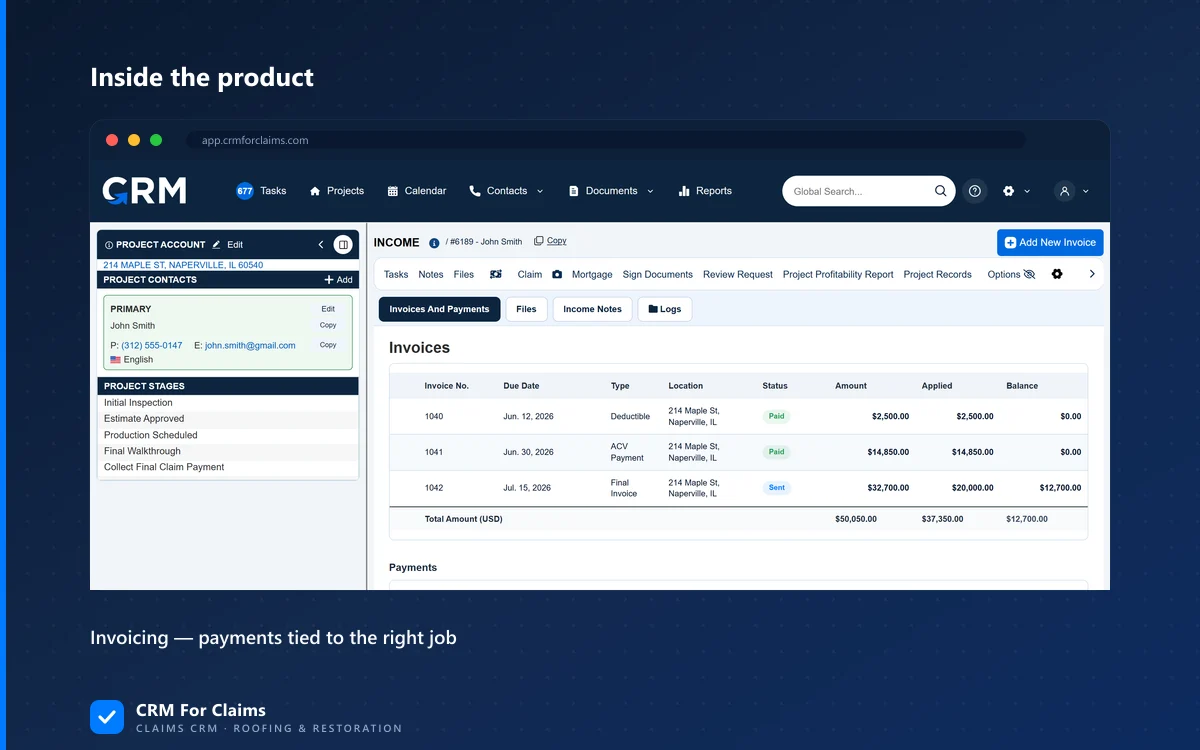
That is why in CRM For Claims the deductible sits on the invoicing side of a claim as its own row with its own status and balance, next to the carrier's ACV payment and the final invoice, instead of being folded into one figure. Small structural decision, most of the work — because the failure mode here is rarely a bad decision. It is an amount nobody could see.
- Its own field, its own status — an amount with no state of its own gets treated as collected the moment the job feels finished.
- A stage gate before production — collected, or a signed plan on file. The stage cannot advance on an assumption.
- The notice in the contract template — where your state requires specific deductible language, it belongs in the document you already send and e-sign, not in a paragraph somebody remembers to paste.
- Proof of delivery, not just of intent — a sent-and-signed record on the claim answers "we told them" far better than anybody's recollection.
- One payment link — most late deductibles are not refusals, they are people who never got a simple way to pay.
- The conversation logged — the texts and emails where the number was discussed, filed on the claim rather than in a phone that may leave the company.
Who on your team sees any of it is a separate and real question — the deductible and its payment status sit in the group of claim financials not everyone needs, which is the post on who should see the money side of a claim.
The honest limit: none of this makes anything legal. Software records what you did; it cannot fix a promise somebody made in a driveway, and I would not trust a vendor who implied otherwise. What it can do is make the amount visible, the notice provable, paying easy, and the quiet version impossible — the one where a deductible is never waived on purpose and never collected either. At one claim a month a disciplined note field genuinely does this job. Build the structure when a second person has to answer for a number they did not set.
The documents and invoicing side of the product is where the deductible, the contract notice and the payment link sit on the same claim, and the difference from a general contractor CRM is mostly this: a sales-shaped tool has one price field, while a claim has a carrier's portion, a depreciation holdback and a homeowner's share that behave nothing alike. Seats come down to the plan you pick, and stages are set in your own wording during onboarding. To see a deductible from intake to collected, book a live walkthrough — bring a claim where it went sideways, those are the useful ones.