Short answer: When a homeowner stops responding, the first job is not chasing harder — it is naming exactly what you need from them and whether anyone else on earth can supply it. Most silence is confusion about whose turn it is. Set a contact cadence, write down every attempt, and give the claim a dormant status rather than letting it rot in the middle of your pipeline.
I build CRM For Claims, and a homeowner not responding is the stall nobody plans for. Teams build a whole process around the carrier — follow-up dates on the adjuster, a queue for claims under review, an owner for every supplement. Then a customer who was texting back within four minutes in week one goes completely silent in week five, and the claim just sits there. No stage, no next action, no owner willing to admit it is theirs.
It is worth saying up front that this is rarely a customer problem. In almost every case I have seen described, the homeowner is not avoiding you. They think the ball is in your court, or in the carrier's, and they are waiting politely for someone to tell them what happens next.
Why does a homeowner stop responding in the middle of a claim?
Usually because the reason they were urgent has gone away, or because they do not know it is their turn. A loss that was an emergency in week one is background noise by week five once the water is out and the tarp is on. Silence is almost never a decision — it is the absence of one.
The causes are worth separating, because they point at different responses:
- They think they are waiting on you. The most common one by a distance. You said "we will submit this to the adjuster," they heard "nothing is required from me," and neither of you has spoken since.
- The urgency drained out. Mitigation worked. The ceiling is dry, the tarp is holding, and the remaining work is cosmetic and inconvenient rather than urgent.
- The deductible became real. The number that was abstract at the kitchen table is now a payment they have to make, and they are quietly deciding whether to go ahead at all.
- Somebody else knocked. Another contractor is in the conversation, and the homeowner would rather go quiet than have that conversation with you.
- The claim itself confused them. A partial approval, a depreciation holdback, a mortgage company on the check — anything they did not expect can produce a pause that reads as disinterest.
- Life. Illness, a death, a move, a job. Restoration work follows events that are often bad ones, and not every silence is about you at all.
Only two of those six need a sales response. The other four need information. That ratio is why "follow up harder" is usually the wrong instinct — a fifth voicemail does not answer any of the questions actually keeping that person quiet.
What are you actually waiting for the homeowner to do?
Before the follow-up, be exact about the blocker. There are only about five things a homeowner can be holding, and they differ enormously in how replaceable they are. Some can be worked around by calling the carrier instead. Others have no alternative source at all, and those are the ones worth escalating quickly.
| What you need | Can anyone else supply it? | What happens if it never arrives |
|---|---|---|
| A signature on an authorization or contract | No — only the named insured or an authorized party | Work cannot legitimately start; everything downstream is frozen |
| A copy of the estimate or loss documents the carrier sent them | Often yes — the carrier or adjuster can usually provide it | Days lost, but recoverable by calling the desk instead |
| A decision on scope, colour, or an upgrade | No, but it can often be deferred | The claim can keep moving if you sequence the undecided part last |
| Property access for the crew | Sometimes — a spouse, tenant or property manager | A scheduled crew day is burned, which is the most expensive kind of stall |
| The deductible, or endorsement of a claim check | No — and a mortgage company is frequently a second required signature | Work may proceed, but payment does not, which is worse |
That middle column is the whole trick. Half of what teams chase a silent homeowner for can be obtained from the carrier in one phone call, and getting it that way costs you nothing with the customer. Spend your escalation on the rows where the homeowner is genuinely the only source.
How long should you wait before escalating?
My rule is that the first message names a deadline, and the ladder runs about two weeks. Day zero: a specific ask with a date. Day two: a call, and a text repeating the same ask. Day five: the ask in writing by email. Day fourteen: one letter, then a status change. Fixed dates, not moods.
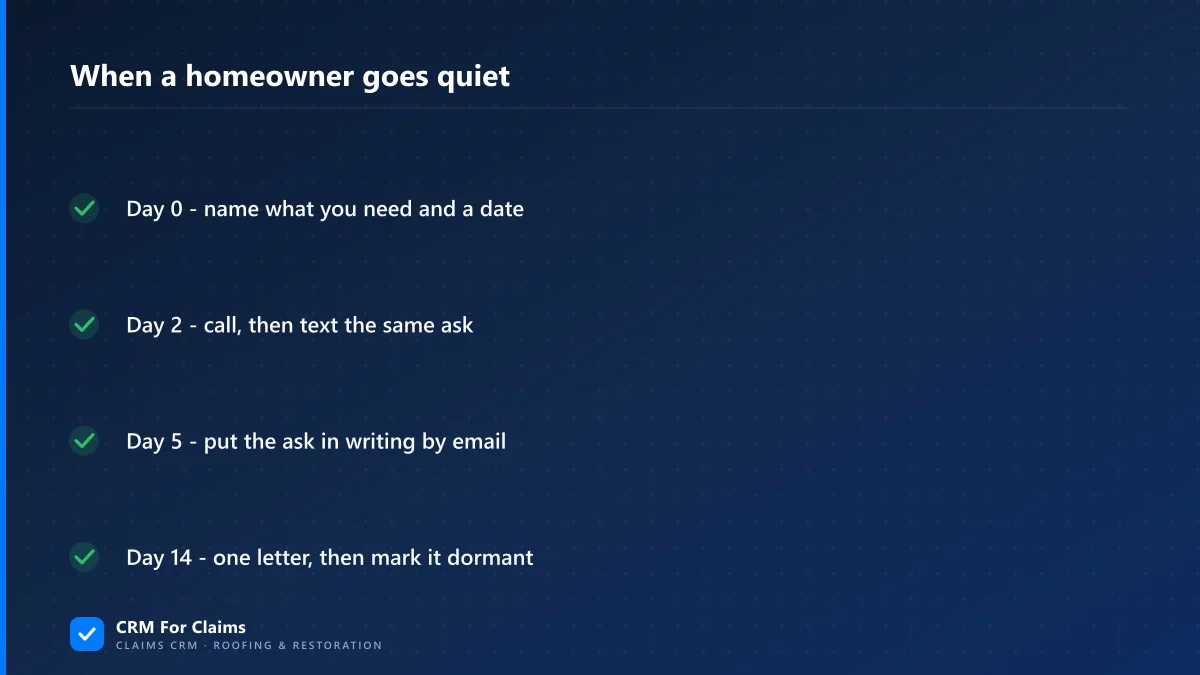
The cadence matters less than the two rules underneath it. First, every message contains exactly one ask, stated as a thing to do rather than a status update. "Just checking in on your claim" gives a person nothing to reply to; "we need your signature on the work authorization before Thursday so the crew slot on the 22nd holds" gives them a decision. Second, change the channel each time. Somebody who does not answer calls answers texts. Somebody who ignores texts opens email at work.
| Day | Channel | What the message actually says |
|---|---|---|
| 0 | The channel they last used | The one thing you need, and the date it stops being useful |
| 2 | Call, then text the same ask | A voicemail is not a contact attempt unless the text repeats it |
| 5 | The same ask in writing, plus what happens to the claim if it is not answered | |
| 14 | Letter or a final email | The claim is being moved to dormant, what that means, and how to restart it |
Between those touches, do not sit still. Everything that does not require the homeowner keeps moving — carrier follow-ups, supplement documentation, the parts of the file you control. A quiet homeowner should pause one thread of a claim, not the whole record. That distinction is the same one that keeps a storm-season board readable, and it is laid out stage by stage in the guide to where claims actually stall in the lifecycle.
What if only the homeowner can unblock it?
Then the message has to explain the consequence, not repeat the request. People do not respond to reminders about things they do not understand. They respond when they learn that a crew date is about to be released or that a payment is sitting in someone else's hands waiting on them.
Three of these come up constantly and all three are explainable in two sentences, which is exactly why they should be explained rather than chased:
- The deductible. It is the homeowner's contribution, and it does not go away because the carrier approved the work. Rules on whether a contractor may absorb, rebate or discount it vary by state and in a number of them it is prohibited outright — worth knowing your own state's position precisely, because saying the wrong thing here is a bigger problem than the silence.
- The mortgage company on the claim check. When there is a mortgage, the lender is commonly named as a payee on the property claim payment and has to endorse it, often with its own inspection or draw process. A homeowner who does not know this simply thinks the money has not arrived, and stops answering because they have nothing to tell you.
- Recoverable depreciation. The homeowner may be waiting on a second payment they do not know exists, or believe the first cheque was the whole settlement. The sequence is not intuitive, and we walked through it in the piece on invoicing the approved scope.
Almost every one of those silences ends the moment someone explains the mechanism. A homeowner who understands why their lender is holding the money will call you back; a homeowner receiving a fourth "just following up" will not.
When do you stop chasing and mark a claim dormant?
When the ladder is finished and the ask still has no answer. Dormant is not lost and it is not deleted — it is a claim removed from the active board with its history intact and a defined way back in. The point is to stop it consuming attention every morning while keeping it findable the day the homeowner reappears.
What matters is what you record on the way out. A dormant claim should carry the last contact date, every attempt with its channel, the exact thing that was being asked for, the current stage the claim was in, and any deadline that keeps running whether you are working or not. That last one is the part worth being careful about: policies and state rules put real time limits on parts of a claim, and what those are is a question for the carrier's own policy language and, if money is at stake, an attorney. It is not something a CRM vendor should be answering for you, and I am not going to.
The other half is honest self-assessment. If a homeowner goes quiet after a partial approval or a scope conversation, sometimes the silence is the answer, and continuing to push damages a relationship that might otherwise produce a referral in two years. Sending a clean final message that leaves the door open is a better ending than a sixth voicemail.
What should the software actually do about this?
Three specific things, and they are less exciting than they sound. It should make "waiting on the homeowner" a visibly different state from "waiting on the carrier", show the last contact date on the claim without anybody opening it, and log every attempt automatically so the record is not somebody's memory of what they think they sent.
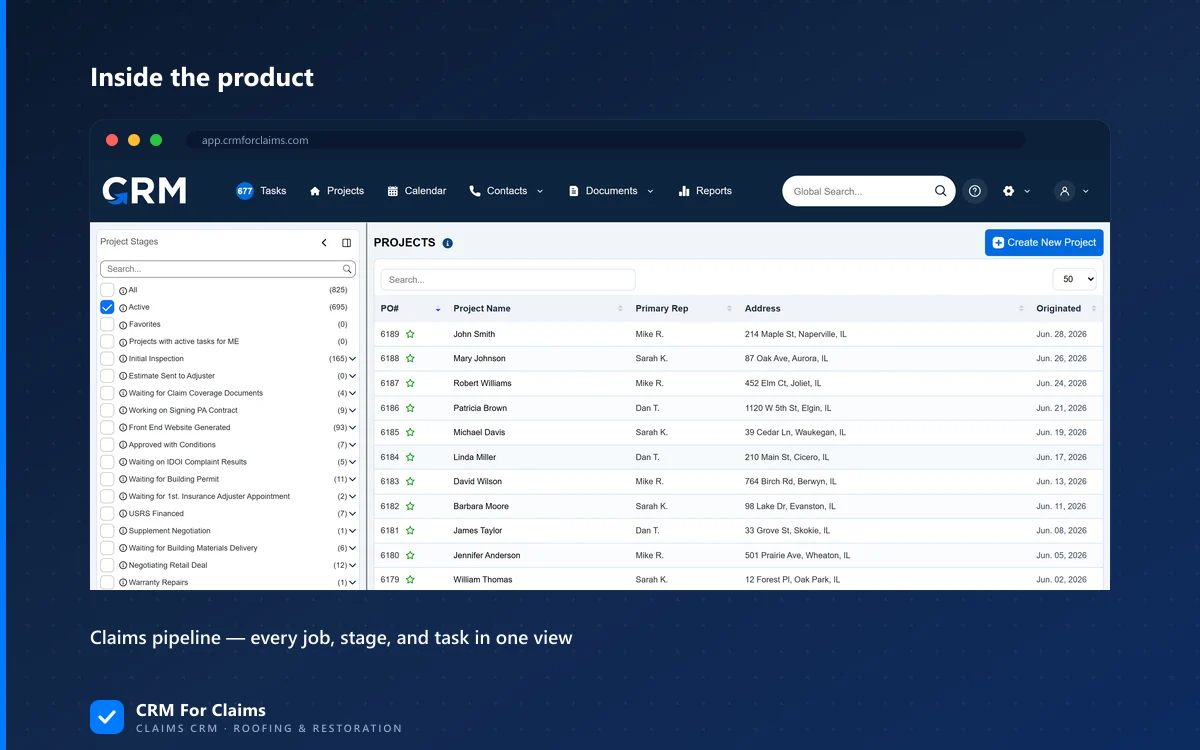
That first one changes how a morning goes. A board where forty claims are all "in progress" tells you nothing; a board that separates the ones you are blocking from the ones somebody else is blocking turns a stack into two short lists, one of which is genuinely your problem today. Stage automation can then take the mechanical part — a task on day two, a templated text on day five — while a human keeps the judgement about tone and about which customers are having a hard month. You can see how that structure is built on the features page, and where it differs from a general-purpose tool on the comparison page.
The logging half solves the argument nobody wants to have. When every call, text and email sits on the claim rather than in one person's phone, "we tried them four times" stops being a claim and becomes a record — which matters both for the internal conversation about whether to release a crew slot and for the external one if the file ever gets reviewed. The mechanism behind that is covered in messages that log themselves on the claim.
One honest warning about automation here: this is the workflow where over-automating does the most damage. Four automated nudges to somebody who lost a house in a fire reads exactly like what it is. Automate the reminder that lands on your team, and keep a person deciding what the homeowner receives.
None of this needs software if you are running six claims and you remember all six. The threshold, as usual, is the second person — the day the office cannot tell whether the estimator has already called a customer three times this week. If your board cannot answer "who is this claim waiting on, and when did we last try?" for every open job, book a live walkthrough and bring the worst example you have. That claim is a better test of the software than anything I would have picked for you.