Short answer: Handing a claim to a public adjuster or an attorney changes who argues with the carrier — it does not change what you owe the homeowner. Send a complete dated copy of your file, keep your originals and your cost lines, put the claim in a stage that says who is driving, and stop giving coverage opinions the day the handoff happens.
I build CRM For Claims, and the request that catches restoration teams flat-footed is not the denial. It is the phone call after it: “my brother-in-law says I should get a public adjuster.” Handing a claim to a public adjuster or an attorney is not the end of your involvement, which is what most people quietly assume. You still have a contract, a scope, and a crew that needs a date. What changes is who talks to the carrier — and whether the file you have been keeping for four months is something a professional can actually use.
That last part is where teams lose. Not to the carrier, not to the public adjuster, but to their own filing. A claim run out of a phone and an inbox produces a handoff package somebody has to reconstruct from memory, and it still arrives with gaps. A claim run on a system produces it from what is already there, because every document is dated, named, and attached to the job before anyone asks for it.
When does a claim actually need a public adjuster or an attorney?
When the disagreement stops being about facts you can supply. A public adjuster fits when the carrier accepts the loss but not the amount. An attorney fits when the carrier disputes coverage itself, denies, delays past the policy’s deadlines, or when the argument has moved from what the roof costs to what the policy means.
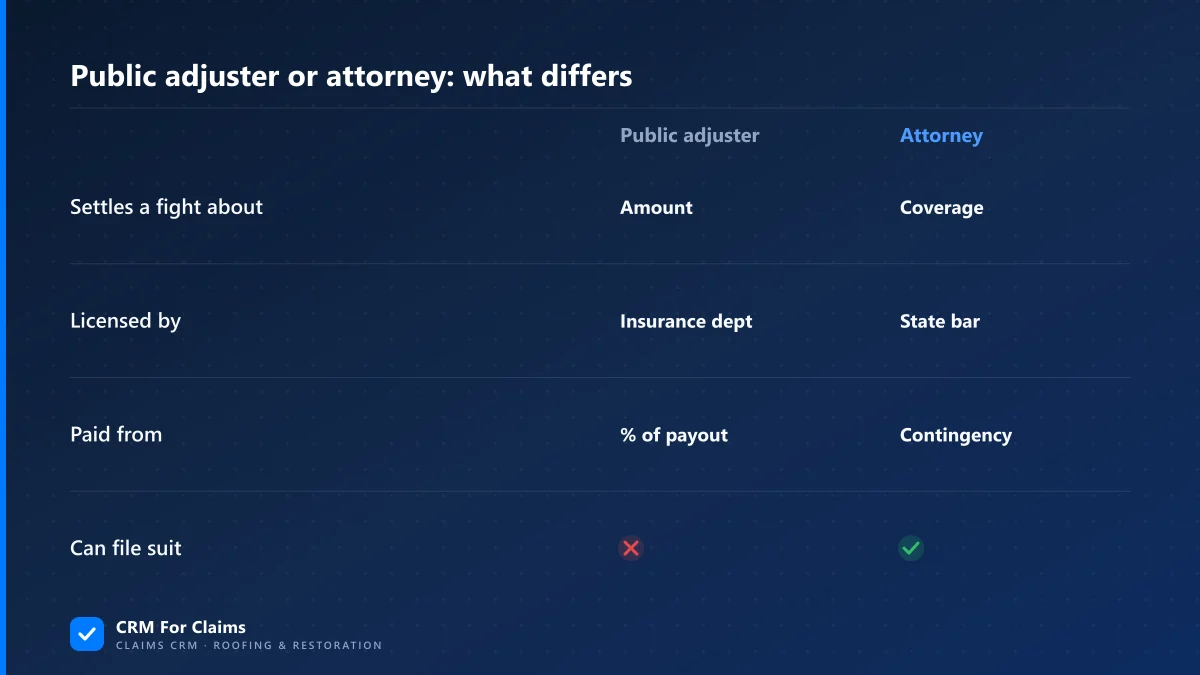
That line matters because it decides who can help. A public adjuster is licensed to prepare, complete and file the claim on the insured’s behalf — valuation and scope work. They cannot file suit. An attorney can, but a lawsuit is a slow, expensive way to settle a disagreement about shingle count. Sending the homeowner to the wrong one costs them months.
| What the disagreement is about | Who usually fits | What it will not fix |
|---|---|---|
| Scope and price — the carrier missed items, or values them low | Public adjuster, or the policy’s own appraisal clause | A coverage exclusion. No amount of re-pricing beats “not covered.” |
| Cause of loss — carrier calls it wear, you call it wind | Public adjuster first; an engineer’s report often settles it | Nothing, if the homeowner has no photos from before the tarp went on |
| Flat denial, or coverage read narrowly | Attorney | A missed proof-of-loss deadline. Read the policy’s time limits early. |
| Carrier has gone silent for weeks past its own timelines | State insurance department complaint first, attorney second | A claim that was never actually filed. Confirm the claim number exists. |
The option people skip is in the first row: appraisal. Most property policies contain an appraisal provision, and it is the cheapest route through a pure valuation fight. Minnesota’s Department of Commerce describes it plainly for consumers: “Most policies have a clause that allows you to ask for an appraisal of the loss. You will be able to select an appraiser, the insurance company will select one, and a third will be mutually agreed upon.” Appraisal settles amount, not coverage. If the homeowner’s complaint is purely “the number is too low,” it is worth mentioning that the clause exists before anyone signs a percentage agreement.
Public adjuster or attorney: what is actually different?
Licence, powers, and how they get paid. A public adjuster is licensed by the state insurance department and is paid a percentage of what the claim pays out. An attorney is licensed by the state bar, can file suit and handle bad-faith claims, and is usually paid on contingency or hourly. Both represent the homeowner. Neither represents you.
The percentage is regulated, and the caps are lower than most homeowners expect to hear. Florida is a useful reference because it writes the numbers into statute: under Florida Statutes 626.854(11)(b), a public adjuster may not charge more than “[t]en percent of the amount of insurance claim payments or settlements … for claims based on events that are the subject of a declaration of a state of emergency by the Governor,” and no more than “[t]wenty percent” for claims that are not. The National Association of Insurance Commissioners’ Public Adjuster Licensing Model Act recommends similar ceilings, which is why the numbers look familiar from state to state — but they are not identical, and several states are stricter.
Two more details worth knowing before you say anything to a homeowner. First, the contract has to be in writing for the adjuster to collect, and it comes with a cancellation window — Florida gives the insured ten days, longer after a declared emergency, with the cancellation language required in 18-point bold type above the signature line. Second, the fee comes out of the claim proceeds. That is not a criticism; a good public adjuster frequently recovers far more than their percentage. It is a fact you need in your head because it changes the money that reaches your invoice, which is a section of its own below.
You can check whether somebody is actually licensed before the homeowner signs anything. Every state insurance department publishes a licence lookup; the NAIC keeps a directory of all 56 jurisdictions if you do not know where yours lives. Verifying a licence is not a recommendation and it is not legal advice — it is the same check the carrier will run.
What do you hand over, and what do you keep?
You hand over the record of the loss and the work. You keep your originals, your internal cost structure, and anything about other customers. The practical rule: everything that documents what happened to this building goes; everything that documents how your company makes money stays. And you send copies, never the only copy.
| Goes to the public adjuster or attorney | Stays with you |
|---|---|
| Dated photo sets, in the order they were taken, with the folder names intact | Sub pricing, labour rates, material cost, your margin on the job |
| Your itemised estimate and every revision, marked which one you sent and when | Internal notes about other jobs, other customers, or crew scheduling |
| Moisture logs, drying records, equipment placement and readings | The original files. Send exports; keep the record of what you exported. |
| Every message with the carrier or the desk adjuster, with dates and names | Anything you cannot date. An undated document weakens the ones around it. |
| The signed contract, work authorization, and any change orders | Opinions about coverage you were never licensed to give |
Get the homeowner’s written direction before you send anything. One email that says “please send my file to [name] at [firm]” does three jobs: it authorises the disclosure, it dates it, and it puts on the record that the homeowner chose this person rather than you. Then log what you sent and when, in the claim, not in your sent folder. If the same file gets requested again in six months by a different party — and on litigated claims it will — you want the answer to “what did you already provide?” to take thirty seconds.
This is the point where a filing habit stops being housekeeping and starts being worth money. If your documents are already named so that a stranger can read them, the package assembles itself; the four-field naming convention I use on claim documents exists for exactly this moment. If they are named scan_0043.pdf, somebody is spending a day opening files. The internal boundary does not move either way: a representative inherits the homeowner’s view of the file, not yours.
What does the handoff do to your money and your timeline?
Both get longer and thinner, and you should say so out loud early. The public adjuster’s percentage comes out of the claim payment, so the money reaching the homeowner shrinks even when the settlement grows. An attorney adds months. Your invoice still has to match the approved scope — a handoff does not turn an unapproved supplement into an approved one.
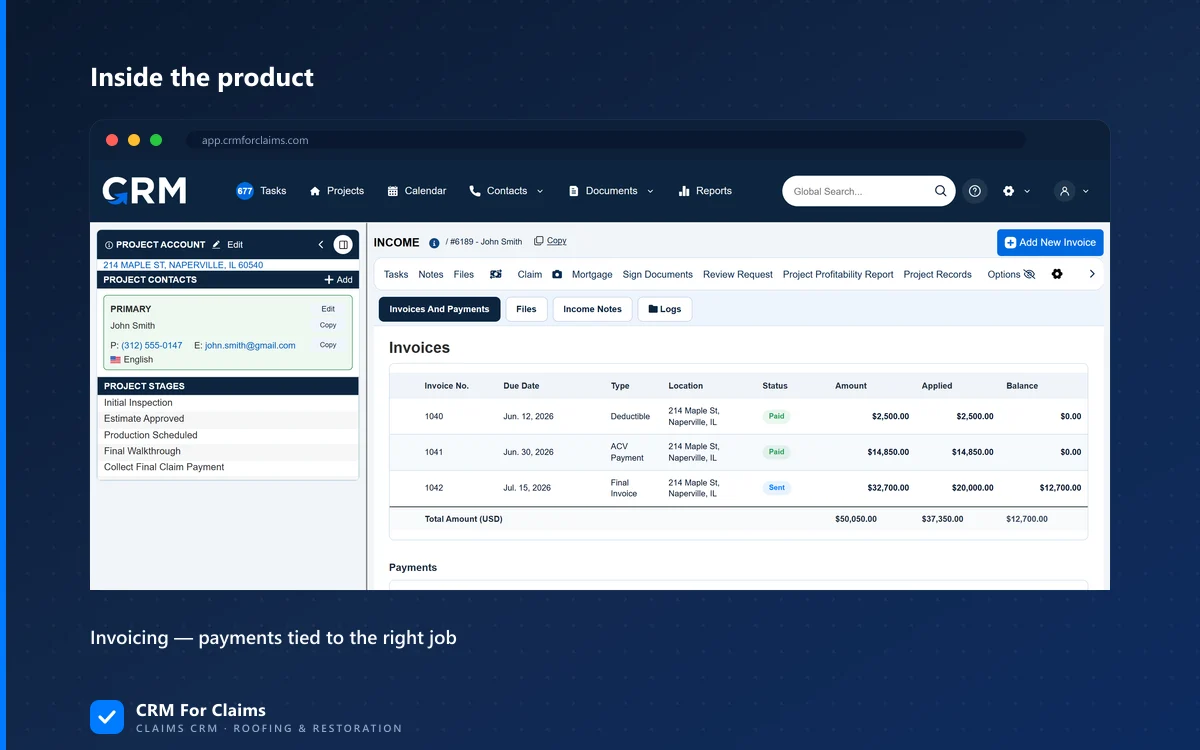
The pressure that follows is predictable, so plan for it rather than improvising at the kitchen table. Somebody will eventually suggest you trim your price to cover the adjuster’s fee. That is the deductible conversation wearing a different hat, and it carries the same exposure that discounting insurance work always carries. Your estimate was built for the work; the representation was the homeowner’s decision, and it is their cost.
On timing, three things move. Progress payments slow down because more parties now sign off. Supplements route through the representative, which adds a step but usually improves the paperwork. And if litigation starts, funds may be held or subject to a lien, so the date you get paid stops being a function of the work being finished. None of that is a reason to refuse the job. It is a reason for your invoicing to stay tied to the approved scope rather than to the expectation, and for someone to be watching the claim on a schedule instead of waiting for the phone to ring.
What must a contractor never do once a public adjuster is involved?
Three things: take a fee for the referral, adjust the claim yourself, or negotiate with the public adjuster as if they worked for you. The first two are prohibited outright in many states. The third is not illegal, just a fast way to lose a job — the adjuster represents the homeowner and answers to them.
- No referral money, in either direction. Florida’s statute bars a public adjuster from accepting referrals from anyone they do business with where there is “any form or manner of agreement to compensate the person,” and separately prohibits “[o]ffering, delivering, receiving, or accepting any compensation, inducement, or reward for the referral of any services.” If a public adjuster offers you a cut, that offer is the disqualifying fact.
- Do not perform public adjuster services yourself. The same statute is explicit that a licensed contractor “may not advertise, solicit, offer to handle, handle, or perform public adjuster services … unless licensed and compliant as a public adjuster.” Similar lines exist in other states in different wording, which is the same trap covered in the jobs worth walking away from. Read your own state’s version once with an attorney and then stop guessing.
- Give a list, not a recommendation. If the homeowner asks who to call, two or three licensed names plus the state lookup link is help. One name plus enthusiasm looks like an arrangement, whether or not there is one.
- Keep building estimates, stop interpreting policies. Pricing the work you will do is your job in every state. Explaining what the policy covers is not, and it becomes materially riskier once a licensed representative is on the file.
How do you stop the claim going cold while somebody else drives it?
Give the handoff a real stage, an owner, and a review date. The failure mode is not dramatic: the claim sits in “adjuster review” for five months, nobody is wrong, and one day it gets closed as lost. A claim under representation is still an open job with your contract on it. It just has a different next action and a longer clock.
Concretely, three things belong on the record the day of the handoff. A stage that reads “with public adjuster” or “in litigation” so it is visibly different from a claim you are actively working. A contact for the representative with their firm, role and the date they came on, so the next person to open the file knows who to call — the same reason adjusters and carriers are real contact types rather than a note. And a recurring check, every two weeks, that produces either an update or a documented attempt to get one.
That third item is the one that only works if the software does it. Nobody remembers to chase a claim that has been quiet since March. This is ordinary stage-based automation and contact structure rather than anything exotic, and it is most of the argument for running claim work on a system built for claims rather than a general CRM — a sales pipeline has no honest place to put a job that is real, contracted, and waiting on a third party.
When is bringing one in the wrong call?
When the gap is small, when the carrier has not actually said no yet, or when the missing piece is documentation you still control. A percentage of the whole settlement to recover a few thousand dollars in ridge cap is a poor trade for the homeowner, and worth saying out loud even though it is not your decision.
The most common premature handoff I hear about follows a first response that was low because the submission was thin: no pre-tarp photos, no moisture log, an estimate with three line items. The answer there is a supplement with proper documentation, not a representative. Bring the real evidence first; if it still goes nowhere, that is the point at which the argument is genuinely with the carrier rather than with the file. A denial and a claim that is merely underpaid are two different problems with two different answers.
None of this needs new software to be true. It needs the file to be complete, dated, and findable by somebody who is not you — which is the same thing that makes every other part of a claim easier. If you want to see what that looks like on real claims rather than in a feature list, book a live walkthrough and bring the messiest claim you have. Pricing is on the plans page; the walkthrough costs nothing either way.