Short answer: Turn down a claim job when what is wrong with it cannot be fixed by working harder — no coverage path, nobody with authority to sign, no reachable money, or a scope that needs a licence you do not hold. Decide before the truck rolls, because once the contract is signed the exit stops being free.
I build CRM For Claims, and the hardest thing to explain to somebody who has never run claim work is why knowing when to turn down a claim job is an operations skill rather than a character flaw. Everybody can spot a bad job at the end. The whole question is how early you can see it, and how late you can still get out without it costing more than the job was worth.
Claim work has an asymmetry that retail work does not. A retail job that goes sideways loses you the margin on that job. A claim job that goes sideways loses you the margin and a share of the only resource that is genuinely scarce in a busy month: the office hours it takes to move every other claim through adjuster review. That is the real bill, and it never shows up as a line anywhere.
When should a contractor turn down a claim job?
When the problem is structural rather than effort-shaped. Four categories qualify: there is no coverage path, nobody on the call has authority to sign, the money has no route to you, or the work needs a trade or licence you do not hold. Everything else — a difficult homeowner, a slow adjuster, awkward roof access — is a job, not a disqualifier.
That distinction is the whole article. A hard job is one you can price — difficulty is a cost, and costs go in an estimate. A disqualified job is one you cannot price, because the missing piece is not yours to supply. You cannot supply coverage, a signature from somebody who does not own the building, or a licence you do not hold. Trying anyway is not grit; it is starting a job whose success depends on somebody else changing their mind.
So most refusals should happen on the phone, before anybody drives anywhere. They mostly do not, because the questions that would settle it feel rude to ask a person who just had water come through their ceiling.
What are the red flags worth refusing a claim job over?
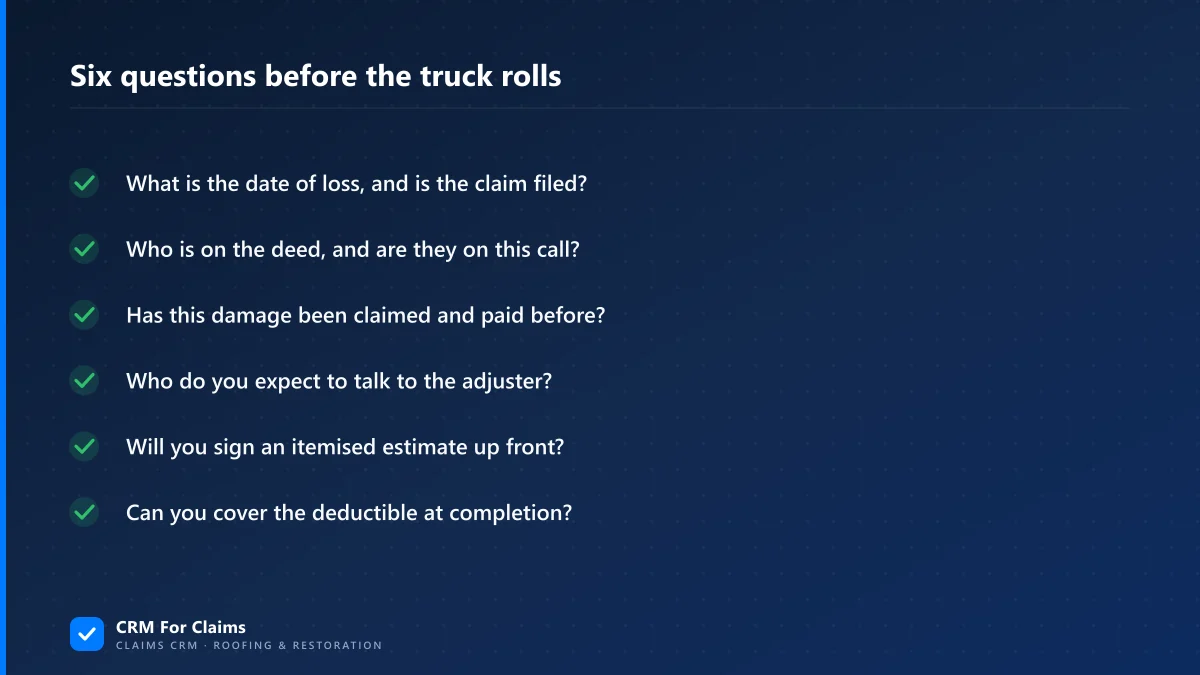
Eight, and six of them are answerable on the first call. They are not judgement calls about the homeowner — they are checkable facts about the claim: date of loss, ownership, prior claims, who is expected to argue with the carrier, and whether the work is legally yours to do. Ask them early and cheaply.
| Red flag | How you actually check it | Earliest you can know |
|---|---|---|
| Date of loss outside the policy period, or before they owned the building | Ask the date of loss and whether the claim is filed; the declarations page settles it | First call |
| The caller is not on the deed — a tenant, an adult child, an estate, a house mid-sale | Ask who is on the deed and whether they are on this call | First call |
| They want you to handle the carrier for them | Ask who they expect to talk to the adjuster | First call |
| They want an authorization signed now and a price later | Ask if they will sign an itemised estimate, not just an authorization | First call |
| The deductible is already declared unpayable, with a hint you will absorb it | Ask whether the deductible can be covered at completion | First call |
| The same damage was claimed and paid before, and never repaired | Ask about prior claims on the same elevation or the same room | First call |
| The damage does not match the reported cause of loss | Inspection — wear and mechanical damage read differently up close | Inspection |
| The scope needs a trade, registration, or licence you do not hold here | Read the scope against your registrations for that jurisdiction | Inspection |
Notice what is not on that list: rude, slow, indecisive, or poor. None of those predict a bad claim job, and screening for them is how companies quietly end up refusing work for reasons they would not say out loud. The eight above are questions the carrier is going to ask anyway. You are only asking them earlier, while they are still cheap.
Is it legal to just handle the carrier for the homeowner?
Often, no. Several states draw a hard line between building the estimate for the work you will do and adjusting the claim on the homeowner’s behalf, and crossing it without a public adjuster licence is prohibited rather than merely risky. This is the single most common reason a job should be refused as offered and re-accepted with different terms.
Minnesota states it about as plainly as a statute can. Under Minnesota Statutes 325E.66, a residential contractor being paid from insurance proceeds shall not “interpret policy provisions or advise an insured regarding coverages or duties under the insured’s policy, or adjust a property insurance claim on behalf of the insured, unless the contractor has a license as a public adjuster.” The same subdivision also prohibits providing “an agreement authorizing repairs without also providing a good faith estimate of the itemized and detailed cost of services and materials.”
The part contractors miss is the consequence written into the next paragraph: if the contractor violates the section, “the insurer to whom the insured tendered the claim shall not be obligated to consider the estimate prepared by the residential contractor.” That is not a fine. That is your estimate becoming inadmissible on the job you were trying to win. Minnesota is one state and the wording varies elsewhere, so read your own state’s version once with an attorney — but the shape of the rule is common enough that “you talk to my adjuster for me” deserves a rehearsed answer, not an improvised one.
How late can you walk away from a claim job?
There are three windows and they are not equally priced. Before a contract, leaving costs a phone call. After a contract but before work, it costs whatever your contract says plus some goodwill. After work has begun — especially mitigation, where you have opened the building up — leaving stops being a business decision and starts being a legal one.
| Window | What leaving costs | What is no longer yours to decide |
|---|---|---|
| Before the contract | A call, and sometimes an inspection you already paid for | Nothing. This is the only free exit you get. |
| Signed, work not started | Your cancellation terms, plus a homeowner telling the story | The homeowner’s own cancellation rights, which are not symmetrical with yours |
| Work started | Materials, mobilisation, and an argument about what was completed | Whether “we stopped” is read as abandonment; lien and warranty exposure attach here |
The asymmetry in the middle row is worth understanding, because it surprises people. The homeowner’s exit is written in regulation; yours is written only in your own paperwork. The FTC’s cooling-off rule, 16 CFR 429.0, defines a door-to-door sale to include one where “the buyer’s agreement or offer to purchase is made at a place other than the place of business of the seller” at “a purchase price of $25 or more if the sale is made at the buyer’s residence” — and it expressly covers sales “in response to or following an invitation by the buyer.” A signature at a kitchen table is inside that definition even when the homeowner called you first.
The restoration-specific twist is in the exclusions. The rule carves out an emergency, but on terms most people would not guess: the buyer must have initiated the contact, and must furnish “a separate dated and signed personal statement in the buyer’s handwriting describing the situation requiring immediate remedy and expressly acknowledging and waiving the right to cancel the sale within 3 business days.” Handwriting. On a 2 a.m. water call, a checkbox in an app does not do what that sentence asks for. Many states layer their own home-solicitation rules on top with longer windows, so treat the federal text as a floor and have your contract packet looked at once.
What does a bad claim job actually cost?
Less than you think in direct loss, and far more than you think in attention. The margin you lose on one disputed job is a number you can see. The office hours it eats over four months are invisible, unbudgeted, and drawn from exactly the same pool of hours that moves your other claims through adjuster review.
| Where the cost lands | How it shows up | Who ever notices |
|---|---|---|
| Direct loss on the job | A number in the profit and loss | You, at month end |
| Office hours spent re-explaining the same claim | Nothing at all | Nobody |
| The claims that sat still while you were on this one | Nothing at all | Nobody |
| Reputation | A review, or a referral that quietly stops | Months later |
| The precedent | The same lead source sends the same job again | Nobody, because nothing was written down |
That last row is the one worth fixing, and it is the cheapest of the five. Everything above it is spilt milk. The precedent is a system problem, and system problems are the kind you can actually solve.
How do you say no without burning the referral?
Say it the same day, say it once, and give the reason. The refusals that damage a referral relationship are almost never the direct ones — they are the soft ones that leave the job technically alive: “we’re slammed right now,” “let’s circle back,” or the silence people call being polite.
| What not to say | Why it backfires | Say this instead |
|---|---|---|
| “We’re too busy right now.” | Invites them back in three weeks with the identical unfixable job | “This one is not a fit for us. Here is why, and here is what would change it.” |
| “I don’t think that’s covered.” | That is a coverage opinion, which in several states you are not licensed to give | “Your carrier decides coverage. Send me their decision in writing and I will price what they approved.” |
| “We’ll work with you on the deductible.” | It is regulated in many states, and it is a straight discount off a price you did not set | “The deductible is set by your policy and I collect it in full. Here is what I can do on timing.” |
| “Maybe later.” | Creates a lead that never closes and never dies, and clutters every report you run | “Not this one. Call me on the next one — genuinely.” |
| Nothing at all | Reads as being dropped, which is the version that gets repeated to neighbours | One message the same day, even if it is three sentences |
The deductible line has more teeth than most people expect, and I wrote about the mechanics separately in what you can and cannot do with an insurance deductible. For the purposes of this article, treat “we’ll take care of that for you” as a sentence that turns a normal job into a disqualified one, because it changes what the job is.
What should your system record when you decline a job?
The outcome, the reason, and the source — and it has to be a different outcome from “lost.” Declined and lost are opposite events. One is a decision you made on purpose and want to repeat; the other is a failure you want to fix. Give them the same status and every report you run afterwards is meaningless.
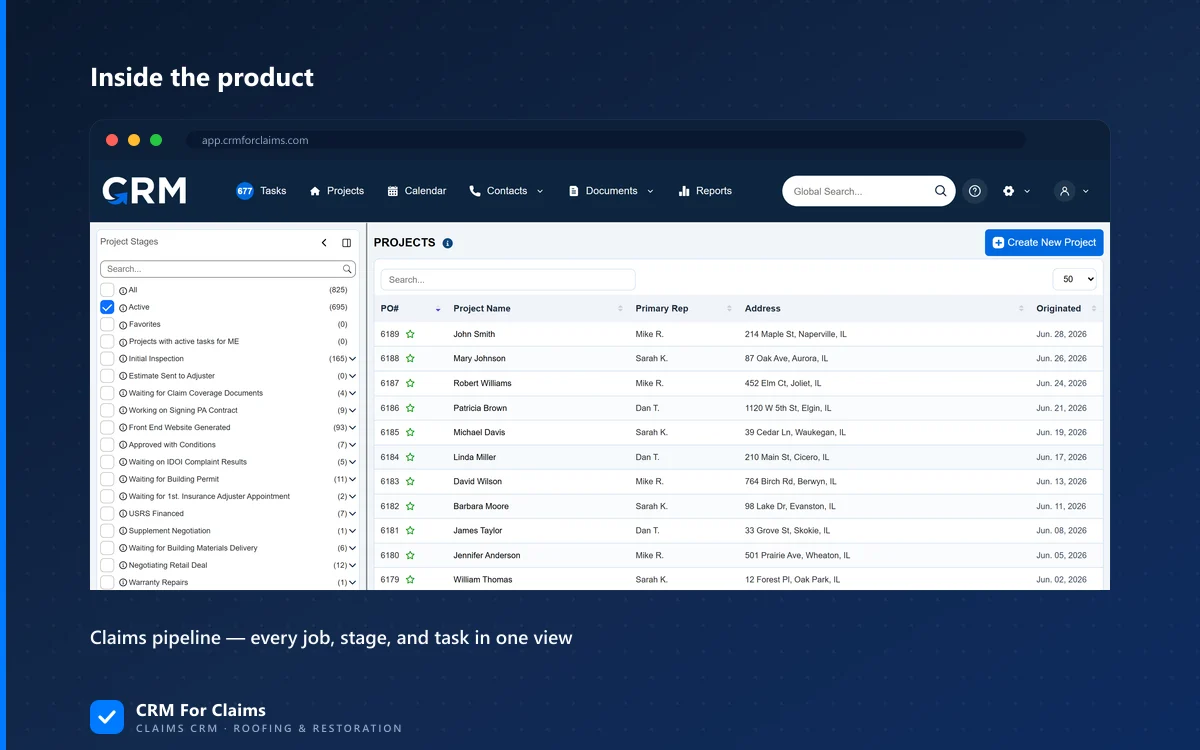
This is the part I actually built, so I will keep it short and honest. In the claim pipeline in CRM For Claims, an outcome is a stage on the record rather than a note somebody may or may not have typed. What matters is not the software — it is these four fields existing anywhere at all:
- Outcome: Declined — its own status, never folded into Lost or Closed.
- Reason, from a closed list — six to eight options, chosen not typed. Open text turns into eight spellings of the same reason within a month.
- The lead source, kept on the record — because the useful report is not how many you declined, it is which source keeps sending them. I made that case at length in tracking lead sources for claims work.
- The contact, not deleted — a house mid-sale is a real customer in six weeks, and an estate is a real customer once probate clears.
If you run one or two claims a month, a column in a spreadsheet does this perfectly well and I would not switch tools over it. It starts mattering when a second person is taking calls, because then the pattern lives in two heads and gets compared in neither. That is the same threshold I use for most of this — the honest version of it is on the comparison page, and the seat maths is on pricing.
When is walking away the wrong call?
More often than the tone of an article like this suggests. Refusing work is a tool with a narrow blade, and the failure mode is using it on jobs that are merely inconvenient. Four things get mistaken for disqualifiers and are not: a difficult homeowner, a small scope, a slow adjuster, and a denial.
A difficult homeowner is a cost, and costs get priced. A small scope from a source that repeats is a relationship, and relationships compound. A slow adjuster is the job — that is what claim work is. And a denial is not a dead job at all; a denial classified correctly is very often a supplement or a reconsideration conversation, which is why it got its own article on what to do when a carrier denies the claim.
There is one more, and it is the uncomfortable one. If you are refusing a lot of jobs for the same reason, the reason may be your process rather than the jobs. If every no is “they wanted us to deal with the carrier,” the fix is probably a single page you hand over at the inspection explaining what you do, what the adjuster does, and what the homeowner does — not a stricter screen. A pattern in your refusals is data about you.
None of this is a software problem, and I would rather say that plainly than pretend otherwise. Knowing when to turn down a claim job is judgement, and the questions above just make the judgement cheaper and earlier. What software is genuinely good for is the fifth row of that cost table: making sure the same job does not arrive from the same place next month and get accepted by somebody who was not on the call. If you want to see how that looks on a real claim rather than in a feature list, book a live walkthrough and bring a job you turned down — those are the more interesting demos anyway.