Short answer: An insurance claim denied in writing is a document with a stated reason, not a final verdict. Read what was actually refused — coverage for the loss, specific line items, or just the amount — answer that exact reason with evidence, and remember the policyholder, not the contractor, is the party who can dispute it.
I build CRM For Claims, and the phone call that starts this article always sounds the same: they denied it. What arrives ten minutes later, when somebody finally forwards the letter, is almost never what that sentence implied. An insurance claim denied outright — no coverage, nothing owed — is one of five different documents that get described with that one word, and the other four have completely different answers.
That distinction is not semantics. Every move you might make next — a reinspection, more photographs, a scope rebuttal, an appraisal demand, a complaint to the state — answers exactly one kind of problem. Classify the letter wrong and you spend two weeks arguing about the amount of a loss the carrier has already said it does not cover. And one thing decides who can make any of those moves: this is not your claim. It is a contract between the homeowner and their carrier, and you are not a party to it.
Is it actually a denial, or something that looks like one?
Usually it is one of five things, and only the first refuses coverage. The rest are a partial exclusion, a valuation disagreement, or an open file waiting on somebody. Read the letter for what it names — the loss, a list of line items, a number, or a missing document. The response follows from that, not from the phone call.
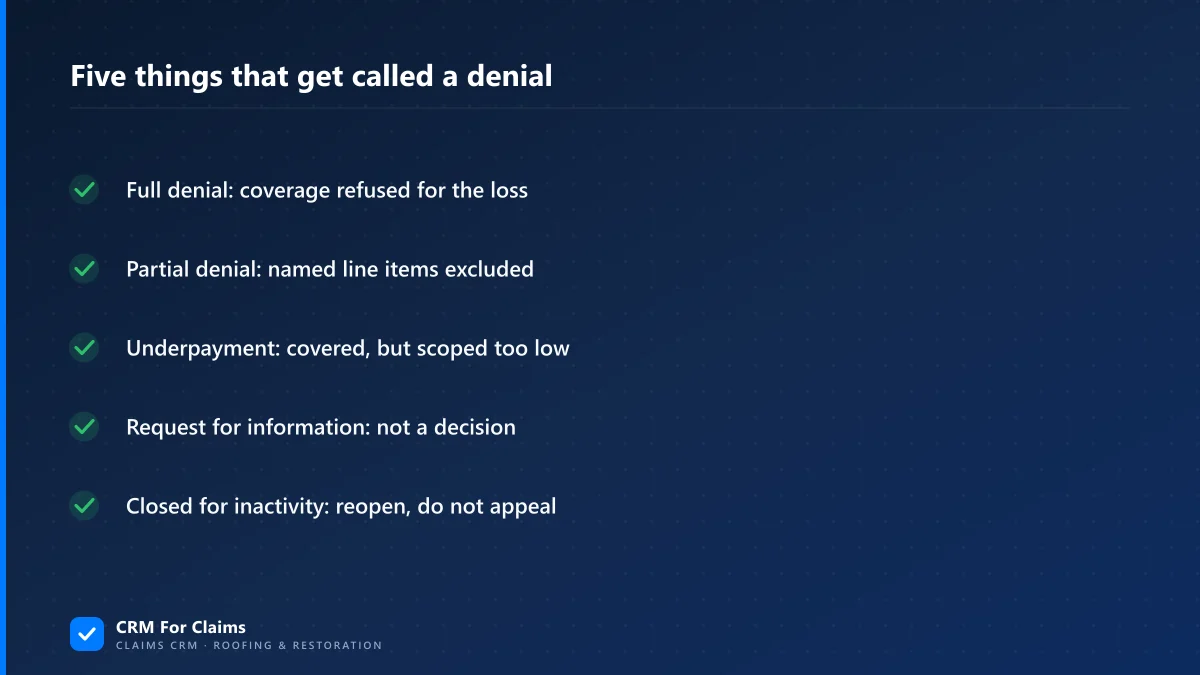
| What arrived | What it actually means | What it responds to |
|---|---|---|
| Full denial of the loss | The carrier says the policy does not respond at all, normally citing a cause or an exclusion | Facts about cause and date of loss. Scope arguments are irrelevant here |
| Partial denial | Coverage is accepted. Specific items, a specific elevation or a specific room are refused | Evidence tied to those items only, not a re-argument of the whole claim |
| Underpayment | Not a denial. Everything is covered and the approved amount is lower than the work | A line-by-line comparison, a supplement, and appraisal if it stalls |
| Request for information | Not a decision at all. The file is open and waiting on one document | Send it, then confirm in writing that it was received |
| Closed for inactivity | An administrative status, not a refusal — usually nobody answered a request | Ask what is outstanding, supply it, ask for the file to be reopened |
The partial denial and the underpayment are the easiest two to confuse, because both arrive as a number that is too small. A partial denial is a coverage decision about named items, argued with facts about those items. An underpayment is a valuation disagreement on items everyone agrees are covered, and it has a different escalation path — one written into the policy itself, which I get to below.
What does a denial letter have to tell you?
More than most people read it for. A denial that names no reason is not a finished denial, and in states with claims-handling regulations it may not be a compliant one. The letter is the document every later step runs on, so the first job is to get it in full, in writing, with the specific provision it relies on — not a summary relayed by phone.
California is the clearest published example. Under the state's Fair Claims Settlement Practices Regulations (10 CCR 2695.7), an insurer must accept or deny a claim within forty calendar days of receiving proof of claim, must deny in writing, and where the denial rests on a statute, law, policy provision, condition or exclusion, the written denial has to reference it and explain how it applies to this claim. Not "wear and tear" as a phrase — the provision, and its application.
Every state writes its own version and the deadlines differ, so read your own; the NAIC keeps a directory of state insurance departments. The part that travels everywhere: a denial citing a specific provision can be answered, a vague one cannot, so the first request is always for the specific one.
Ask for the rest of the file at the same time. If an engineer or a third-party inspector was sent, their report exists, and it — not the letter — is what the desk adjuster actually decided from. You cannot rebut reasoning you have never seen.
Who is actually allowed to dispute the denial?
The policyholder. It is their contract, their claim, and their decision to challenge it. In many states, negotiating or adjusting a claim on a policyholder's behalf is regulated activity that requires a public adjuster licence, and some states restrict contractors specifically. That is not a technicality you can work around by being helpful.
What that leaves you is still the part that changes outcomes. A contractor can document, measure, photograph, write up findings, attend a reinspection, explain in plain language what the letter says, and supply the evidence the homeowner then submits. Most of what wins a reconsideration is evidence, and evidence is exactly what you are allowed to produce. The call that argues policy language is somebody else's — the homeowner's, a licensed public adjuster's, or an attorney's.
What actually answers the reason the carrier gave?
Only evidence aimed at that specific reason. A denial citing wear and tear is not answered by more photographs of a damaged roof; it is answered by evidence that an event occurred and that its damage differs from age. Read the stated reason, then produce the one category of proof that addresses it and nothing else.
| Stated reason | What the carrier is saying | What answers it |
|---|---|---|
| Wear, tear and deterioration | This is age, not an event | Dated event evidence, plus a comparison of the damaged elevation against an undamaged one on the same building |
| No qualifying event on the date of loss | The weather did not do this on the day claimed | The NOAA Storm Events Database record for that county and date — or a corrected date, because homeowners frequently guess |
| Pre-existing or previously paid damage | This was already broken, or somebody already paid for it | Pre-loss photographs, listing photos, prior invoices, roof age documentation |
| Maintenance or neglect | The loss was preventable, or was allowed to spread | Dated mitigation records and a timeline of when you were first called |
| Cosmetic damage endorsement | Appearance is excluded while function is intact | Read the endorsement first, then evidence of functional damage rather than appearance |
| Reported too late | The delay itself is the problem | The real first-notice date and what happened between the loss and the report |
The date of loss is the quietest killer on that list. A homeowner who says "the spring storm, I think April" and is wrong by three weeks has handed the carrier a clean denial that has nothing to do with the roof. The storm record is free and searchable by county and date, and checking it belongs at intake — one of several reasons the first 48 hours of a claim decide arguments that surface months later. Photographs work the same way: a denial is where you find out whether your inspection set can carry a decision made by somebody who was never at the building. That is the case for treating photo documentation as evidence handling rather than as a habit.
How does a reconsideration actually work?
It is a written response with new information attached, not a complaint. The carrier reopens a decision when it is given something it did not have — a report, a dated photograph, a measurement, a corrected date — tied to the specific reason it gave. Requesting a reinspection without new material generally produces the same answer, more slowly.
A response that works tends to contain the same handful of things:
- The claim number and the exact denial being answered — by date and by the reason quoted from the letter, so it lands on that decision rather than the whole file.
- One category of evidence per reason — labelled, dated and referenced in the text, not attached as an undifferentiated folder of forty images.
- A reinspection request where the evidence is physical — with an offer of access and somebody on site to point at the thing in question.
- A named contact and a date you will follow up — a reconsideration with nobody owning the follow-up is functionally a submitted nothing.
Keep the tone flat. The reviewer reading it did not make the original decision personally, was not at the property, and is deciding from paper. Paper is the only thing you can improve.
When is escalating past the adjuster worth it?
When the file has stopped moving and the disagreement is clear enough to state in a sentence. There are three routes past the adjuster, they cost different amounts, and none of them is the contractor's decision to make — all three belong to the policyholder.
The first is free: escalate inside the company. The Insurance Information Institute's guidance on trouble settling a claim starts with the claims department head or the company's own complaint department, then the state insurance department, where a consumer services representative documents it. A state complaint costs nothing and often produces a written answer where a phone queue did not.
The second is written into the policy itself, and it is the one most people have never heard of. Where the disagreement is about the amount of the loss rather than whether it is covered, homeowners policies generally contain an appraisal clause. The III describes the mechanism plainly: both sides hire independent appraisers who choose a mediator, the decision of any two of the three is binding, and each side pays for its own appraiser and shares the rest. But note what it settles. Appraisal resolves a number. It does not resolve a coverage denial, which is why classifying the letter correctly at the start is not a filing detail.
The third is an attorney, and that is a decision made by the homeowner with information you do not have about their finances and their appetite for a fight. Say so, and stay out of it.
What should the CRM do with a denied claim?
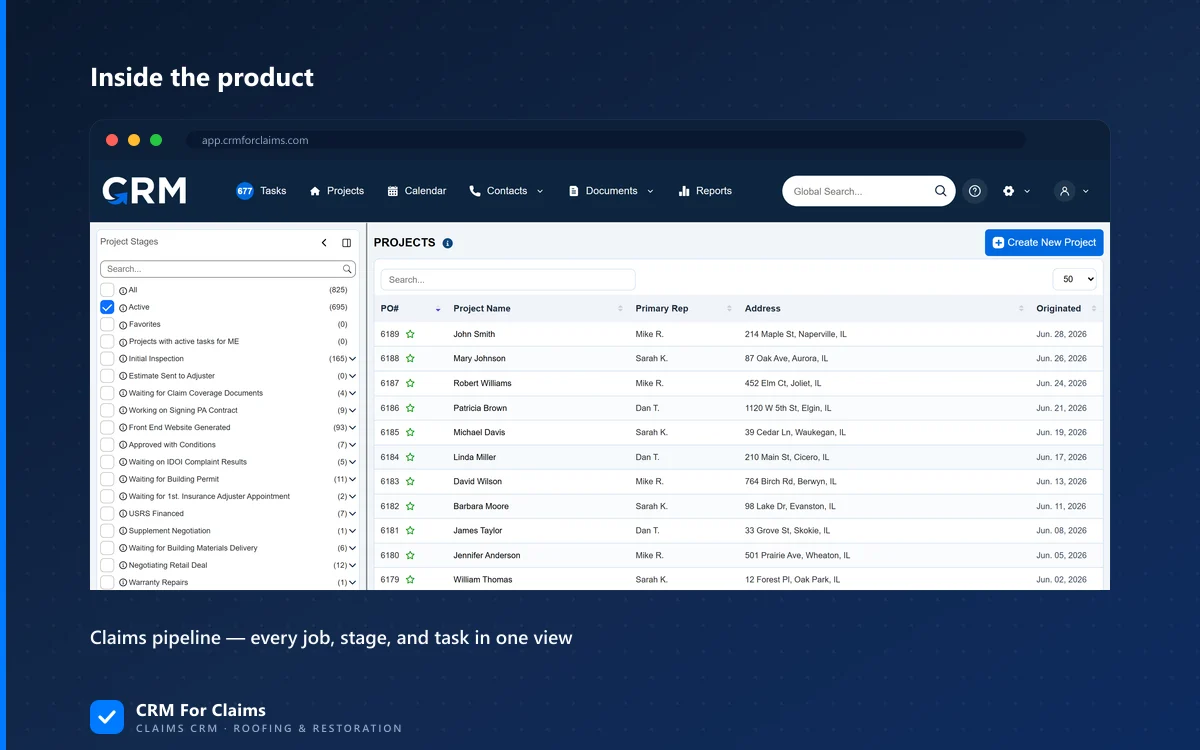
Keep it alive and visible. A denial is a state a claim can be in, not the end of one, and the common software failure is that "denied" gets treated as a synonym for "closed" — so the file leaves the board, loses its owner, and the reconsideration that was going out on Tuesday is never sent by anyone.
Four unglamorous things do most of the work:
- Denied is a stage, not a graveyard. With an owner and a next action date, like any other stage. A claim awaiting a reconsideration is waiting on the carrier, which is a different queue from waiting on you.
- The letter lives on the claim. The denial, the engineer report, everything you submitted and the date you sent it — in the file, not in the inbox of whoever happened to receive it.
- The reason is a field, not a note. This is the one that pays for itself. A note says "denied, wear and tear". A field lets you sort last year by reason, and if most of them turn out to cite an unestablished date of loss, that is an intake problem you control rather than a carrier problem you do not.
- Reopened claims keep their history. When a file comes back six weeks later, whoever picks it up needs the original scope, the photographs and the record of what was already argued.
That third point is the difference between a system and a filing cabinet: a denial reason recorded as structured data turns a bad month into a diagnosis. It is the same discipline as tracking supplements as their own records with their own status, and it is why CRM For Claims is built around insurance claim work rather than around deals. The pipeline, document and reporting features assume a claim can be denied and come back; the comparison against a general-purpose CRM is mostly a list of places where a generic tool has no opinion about any of it.
When is the right answer to accept the denial?
More often than anyone selling you software will say. Some denials are correct: the roof is worn out, the event did not happen, the policy genuinely excludes it. Chasing a correct denial costs the homeowner months, costs you a crew slot you could have sold, and ends with the same letter.
The test I use is whether you can name the specific fact the carrier got wrong and the specific document that proves it. If you can, respond — that is a real reconsideration with something new in it. If the honest answer is "the number feels low" and everyone agrees the loss is covered, that is a valuation disagreement: a supplement or the appraisal clause, not an argument about coverage. And if you can name neither, tell the homeowner the claim is finished and here is what the repair costs without insurance. That conversation is worse for ten minutes and better for everything after it.
Every step above is a fact somebody has to find later — what the letter said, what was sent back, on what date, by whom, and what finally happened. That is what a claims-shaped system is for, and what a spreadsheet quietly stops doing the first week two people work the same file. To see it on a real claim rather than in a feature list, book a live walkthrough and bring your worst denied file.