A roofing deposit on an insurance job should be the smaller of two numbers: what your state lets you collect before work starts, and what the money already in the homeowner's hands can cover. In practice that is usually the deductible plus the cost of materials you have to order, and almost never the whole first insurance check on the day the contract is signed.
I build CRM For Claims, and the deposit is the first money question on almost every claim file I see. It looks simple because on a retail roof it is simple: one price, one payer, a third down. On a claim the price can still move, the money arrives in pieces from different people, and some of it is held by a bank you have never spoken to. This post covers the state limits I could read from official sources today, the order the money actually shows up in, and what to put in the contract. I'm not a lawyer, so treat the state rules as a starting point for a conversation with yours.
How much can you legally take before work starts?
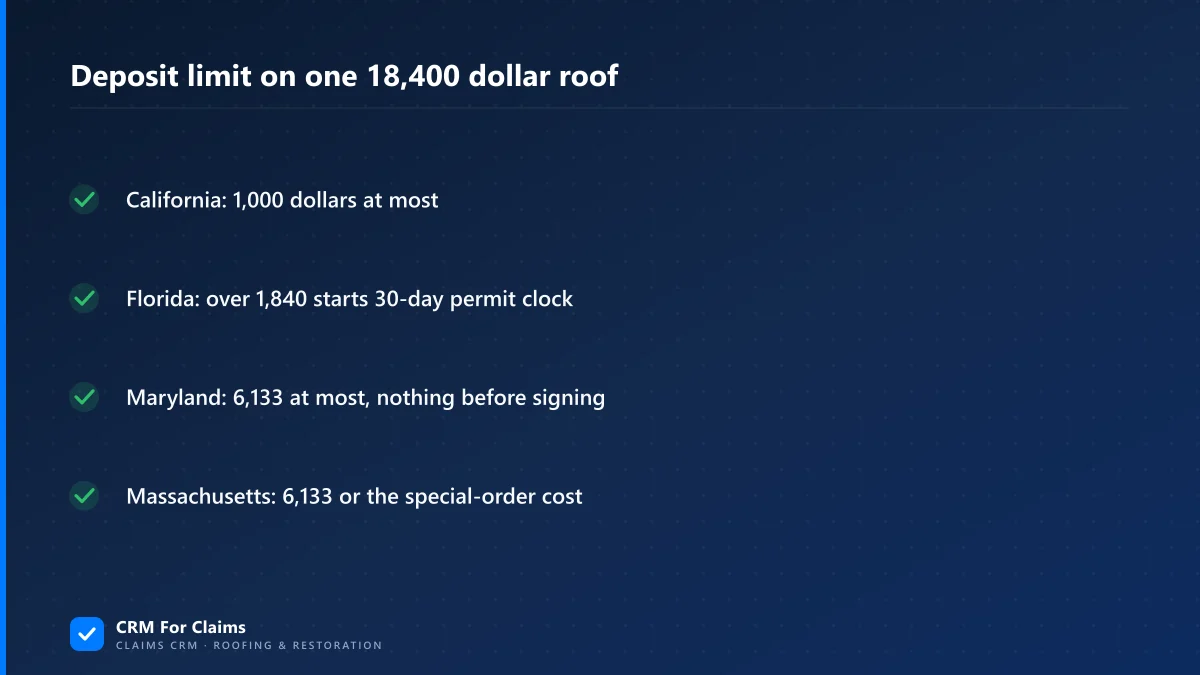
It depends entirely on the state where the house is. Some states cap the deposit in dollars, some cap it as a share of the contract, some attach deadlines to a large deposit, and many have no statewide cap at all. Here are four that show the range, each applied to the same $18,400 roof replacement.
The down payment cannot be more than $1,000 or 10 percent of the contract price, whichever is less. The licensing board says there are no exceptions for special-order materials, and later payments cannot run ahead of the work done.
No fixed cap, but a contractor who takes more than 10 percent as the first payment has to apply for permits within 30 days and start work within 90 days after the permits are issued.
A contractor cannot accept more than one third of the contract price as a deposit, and cannot accept any payment at all until the contract is signed.
The deposit may not exceed the greater of one third of the contract price or the actual cost of special-order or custom materials. Final payment cannot be demanded until the job is finished to both sides' satisfaction.
Two things stand out. The same roof allows a deposit anywhere from $1,000 to over $6,000 depending on the address, so a company working across a state line cannot use one contract form. Two of the four rules also reach past the amount: Florida cares about what you do after you take the money, Maryland about when you take it. If your state is not on this list, look up its home improvement or residential contractor statute, or ask your licensing board directly. A rule on a blog (this one included) is not the rule in your state.
Where does the deposit money come from on a claim?
From whatever has already been paid, which on a claim is less than the contract total for most of the job. The homeowner owes the deductible no matter what. The carrier usually pays the actual cash value first and holds the recoverable depreciation until the work is done. A deposit that asks for more than those two pieces is asking the homeowner to fund the job from savings.
This is where a retail habit hurts. On a cash roof, a third down is a third of money the customer has already decided to spend. On a claim, a third of the contract may be more than the homeowner has received, especially when the adjuster's scope is still lower than yours and a supplement is pending. Here is the usual order on a roof claim:
| Money | Who pays it | When it usually arrives | Who may be holding it |
|---|---|---|---|
| Deductible | The homeowner | Whenever your contract says, often at signing or at material delivery | The homeowner |
| Actual cash value (ACV) | The carrier | After the adjuster's estimate is approved, often before work starts | The homeowner, or the mortgage company if it is named on the check |
| Supplement | The carrier | After you document what the first scope missed, sometimes mid-job | The carrier until approved |
| Recoverable depreciation | The carrier | After the work is complete and proof of completion is sent | The carrier |
The last row is the one that should shape your deposit thinking. The depreciation holdback can be a large slice of a roof claim, and it does not exist as money until you have finished. Our post on recovering depreciation after the work is done covers that packet. The deductible has its own rules too, and waiving or absorbing it is illegal in a number of states; the deductible rules for contractors post goes through them.
When the mortgage company is on the first check
If the homeowner has a mortgage, the ACV check often comes payable to both the homeowner and the lender. Until the lender endorses it, nobody can deposit it, and on larger claims the lender may put the money in a restricted account and release it in stages after inspections. A deposit that depends on that check is a deposit you will be waiting weeks for, with materials already on order. Ask on the first visit whether there is a mortgage and which servicer, then read what happens when the mortgage company is on the insurance check before you promise a start date.
What to write into the contract about the deposit
The amount, what it pays for, and what happens to it if the job stops. A homeowner reading the deposit line should be able to answer all three without calling you. Before the next storm season, I would check these six lines on any contract form:
- Write the deposit as a dollar figure, not "a third" or "the first check".A share of a contract price that can still change with a supplement is a number nobody can check. California requires the actual amount under its own heading.
- Say what the deposit buys.Materials ordered for this house, the permit, a place on the schedule. In Massachusetts a deposit above one third has to match the real cost of special-order material, so keep that supplier invoice in the file.
- Tie it to a signed contract and a date.Maryland forbids taking anything before both sides have signed. Even where that is not the law, a payment with no signed contract behind it is a dispute waiting for a reason.
- State what is refunded if the homeowner cancels inside the right-to-cancel window.Our post that reads a roofing contingency agreement clause by clause shows how the cancel window and the refund deadline line up, and why ordering material on the wrong day costs you.
- Put your permit and start dates where a large deposit triggers them.In Florida, a first payment over 10 percent means a permit application within 30 days. Put that date on your own calendar the day the money clears.
- Never make the deposit equal to the deductible "so the homeowner pays nothing else".That sentence reads like a deductible waiver to a carrier, even when you meant something else by it.
Notice what is not on the list: a percentage that "most roofers" use. The right deposit for a claim job is the one you can defend against the statute and against the money actually in play, and that changes from file to file.
Keep track of which money exists and where it is
Most deposit trouble starts in the office, not on the roof. Someone sees a contract total of $18,400, assumes the first check is in, orders material, and two weeks later learns the check is sitting with the mortgage company waiting for an inspection. The fix is to record each payment as its own thing, with who owes it and where it is right now.
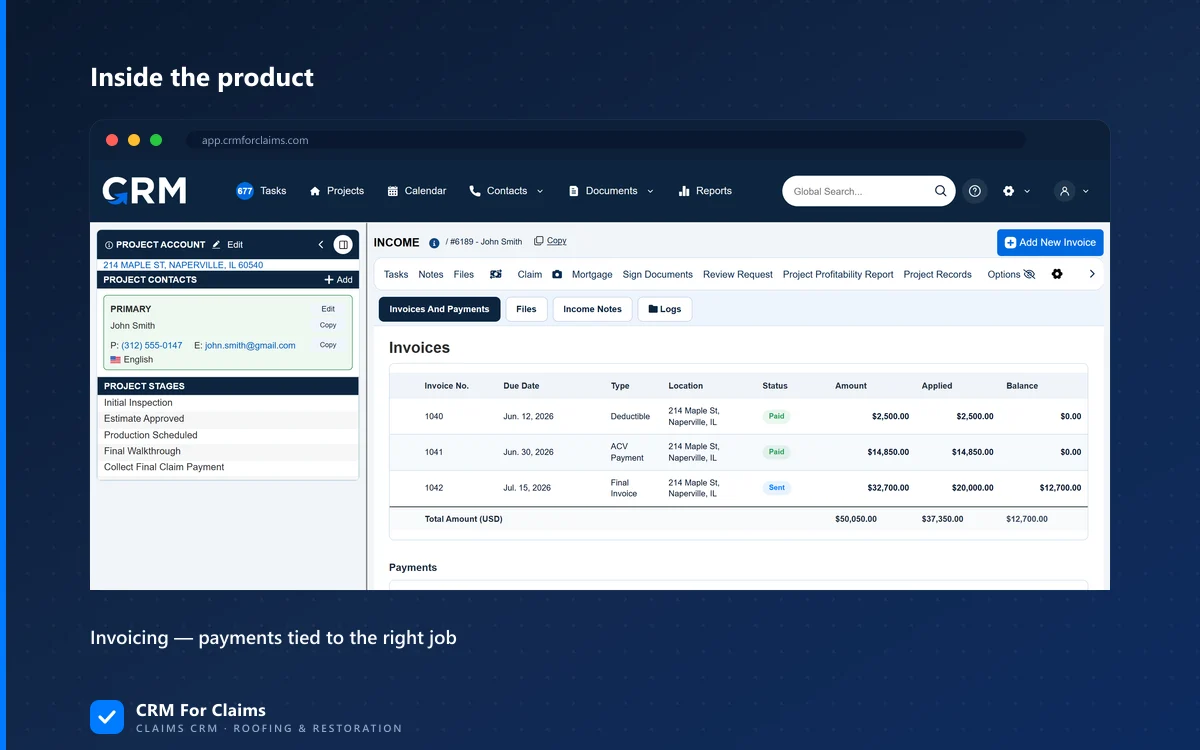
In CRM For Claims every invoice carries a payment type, and the list holds Actual Cash Value (ACV) and Deductible next to Retail Down Payment and Retail Progress Payment for the part the homeowner pays outside the claim. Each invoice also records where that money is: held by the insurance company, held by the customer, held by the mortgage company, or in your office and not deposited yet. A check that has reached your bank but has not cleared shows as Deposited - Not Cleared, so nobody orders a roof against money that can still bounce.
That turns the deposit question into something you can look up instead of something you guess. The estimates and invoicing page shows how claim invoices are split, and loss draft tracking covers the checks a lender is holding.
If your deposit line still says "33% at signing" on every claim, it is worth an hour this month to rewrite it state by state. And if you want to see how the payments on one claim look side by side, book a live walkthrough and bring a job where the first check took longer than you planned.