The date of loss on a hail roof claim is the day the storm hit that house, not the day anyone noticed a leak, and it has to be a date you can prove reached that address while the policy was in force. Get it right at the first call and the carrier argues about scope. Get it wrong, or let it drift, and the carrier never has to argue about the roof at all.
I build CRM For Claims, so I mostly see this field from the office side: the box someone fills in on day one and nobody looks at again until a denial letter quotes it back. This post is about filling it in properly. Which evidence ties a storm to one address, what to ask the homeowner before you write anything down, and how to keep twenty claims from the same storm carrying the same date. I'm not a lawyer, and none of this is legal advice about a specific claim.
Why does one date sink an otherwise good claim?
Because the insured has to show the loss happened during the policy period, and the date is how that gets shown. If the office cannot name the storm, the carrier does not need to prove the roof was worn out. The claim fails a step earlier.
The clearest recent example is Cutchall v. Chubb Lloyds Insurance Company of Texas, decided by the Fifth Circuit on March 5, 2026. A Houston couple claimed a hailstorm breached their roof and caused interior water damage. Over the claim and the lawsuit, the people on their side offered five different storm dates. Laid against the policy period, they look like this:
- May 18, 2021A news article about wind and hail in Houston, attached to the public adjuster's photo surveyBefore policy
- Jun 15, 2021A new affidavit filed with the response to summary judgment, after the expert deadlineInside
- Aug 16, 2021The independent adjuster's third date, given at his depositionInside
- Sep 7, 2021The lawsuit and the adjuster's first reportInside
- Apr 29, 2023The same adjuster's second report, later withdrawnAfter policy
Three of the five dates sit inside the policy. That did not help, because no single date had weather evidence for that neighbourhood behind it, and the one that came closest arrived after the deadline. The adjuster on their side also agreed, under oath, that a meteorologist would be more trustworthy than he was on whether hail fell at a given place and time. Nobody in that file decided the date first and then collected proof for it. They kept collecting dates.
Most contractor files never get near a courtroom, but the same weakness shows up much earlier, in a denial that says the carrier found no qualifying weather event on the reported date. If you have read our post on what to do when a carrier denies the claim, this is the denial that is cheapest to prevent and hardest to fix after the fact.
Which evidence ties a storm to one address?
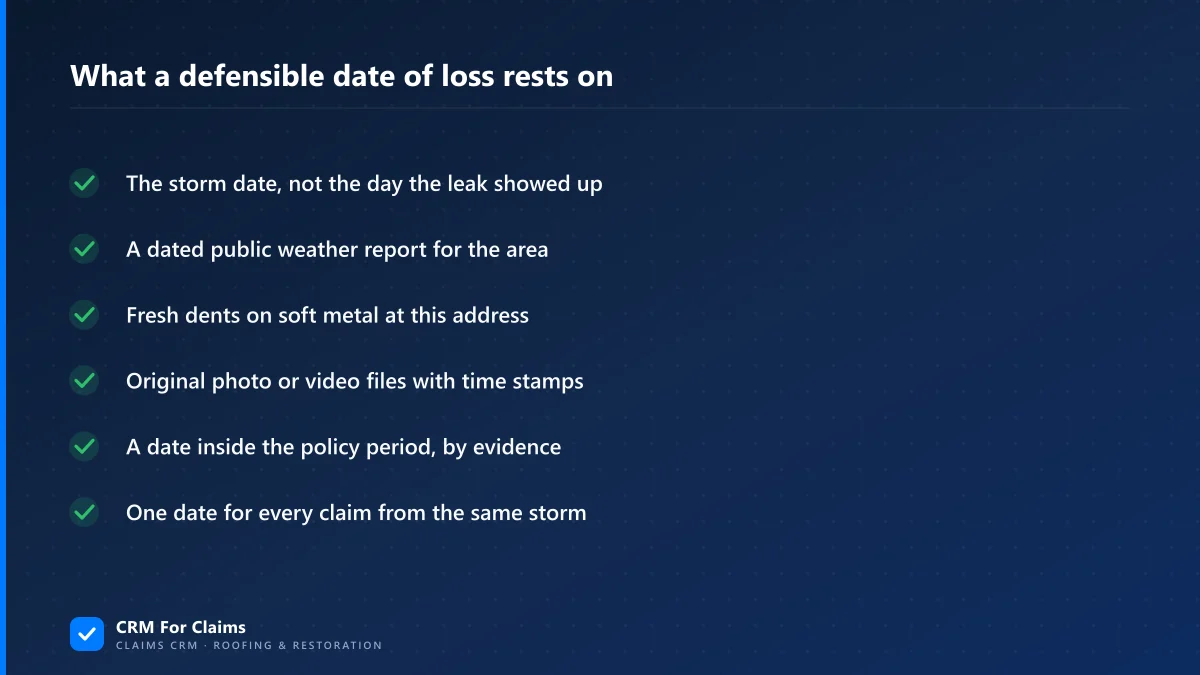
No single source does it alone. Public weather records prove a storm crossed the area on a date. Physical marks prove hail struck this property. Dated photos and witnesses connect the two. A file is solid when at least one item from each group points at the same day.
| Source | What it shows | Where it falls short |
|---|---|---|
| Homeowner photos or video of the hail falling | The event at this address, with the time stamped in the original file | A screenshot forwarded from a group chat loses that time stamp. Ask for the original file. |
| Dents on soft metal: gutters, downspouts, vents, AC fins, a mailbox | Hail struck this property, and roughly how big it was | Says nothing about when. Old dents and new dents look alike in a photo without a scale and a date. |
| Storm Prediction Center daily storm reports | Dated hail and wind reports with size, place and coordinates | The page itself says all reports are preliminary, and a report six miles away is not your street |
| NOAA Storm Events Database | The official federal record of storm events, searched by state, county and date | Works at county level, so it supports the area, not the house |
| CoCoRaHS observer reports | Hail measured by a volunteer observer at a fixed point | Observers are sparse. Often there is nobody close enough to count. |
| A meteorologist's report for the address | Whether hail of a given size fell at that location on that date | Costs money, so it is usually kept for disputed claims. In Cutchall it carried the day. |
The marks on soft metal matter more than they look. Shingles age and blister on their own, and an adjuster can argue about them for an hour. A fresh dent in an aluminium downspout with a tape measure next to it is hard to argue with, and if the same dent pattern shows on the neighbour's gutters, you have the beginning of a storm footprint. Our post on what to photograph on a claim and when covers how to shoot those so the date survives.
What should you ask the homeowner on the first call?
Ask about the storm before you ask about the damage. People remember the leak; they rarely remember the weather unless you walk them back to it. Write their answers down word for word, including "I'm not sure".
- When did you first notice something wrong?This is the discovery date. You want it on file, clearly labelled, so it never gets copied into the date of loss by mistake.
- Was there a storm before that? Do you remember the day, or what you were doing?"The night of my daughter's game" can be checked against a calendar. "Sometime in spring" cannot.
- Did you or anyone nearby take photos or video while it was happening?Ask for the original files. Neighbours with dash cams and doorbell cameras count.
- Has anyone else on the street had a roof, siding or car claim, and which date did their adjuster use?If the carrier already accepted a date for the house next door, yours had better match it or explain why it does not.
- When did your current policy start, and did you switch insurers in the last few years?A storm the week before a policy began belongs to the previous carrier, if it belongs to anyone.
- Has this roof had a claim before, or been repaired since?Damage from an earlier storm that was paid and never fixed is the first thing an adjuster will look for.
- Do you still have the declarations page?It confirms the policy period and the deductible in one sheet, which saves a call later.
Discovery date or storm date: which one goes on the claim?
The storm date, every time. The discovery date goes in your notes, labelled as such. Hail damage often shows up months later as a stain on a bedroom ceiling, and the homeowner will naturally give you that day. Putting it in the date-of-loss field tells the carrier a storm happened on a day when, according to the public record, nothing happened at all.
When you cannot name the exact day, say so and show the range. "On or about" a date, with the reports and photos that support it, is honest. A precise date with nothing behind it looks careful and falls apart the first time somebody checks.
When two storms hit the same roof
Storm seasons stack. A roof in a busy hail state can take two events a few weeks apart, sometimes one under the old policy and one under the new. Do not choose the date because it falls inside the policy. Choose the one the evidence supports, and if both did damage, document each separately with its own photos and its own weather record. A misstated date is worse than a weak one: it gives the carrier grounds to question everything else in the file.
Record the storm once, not on every claim
After a big hail day the office opens a dozen claims in a week, and each person types the date the way they heard it. That is how one storm turns into three dates in your own system before the carrier has seen anything.
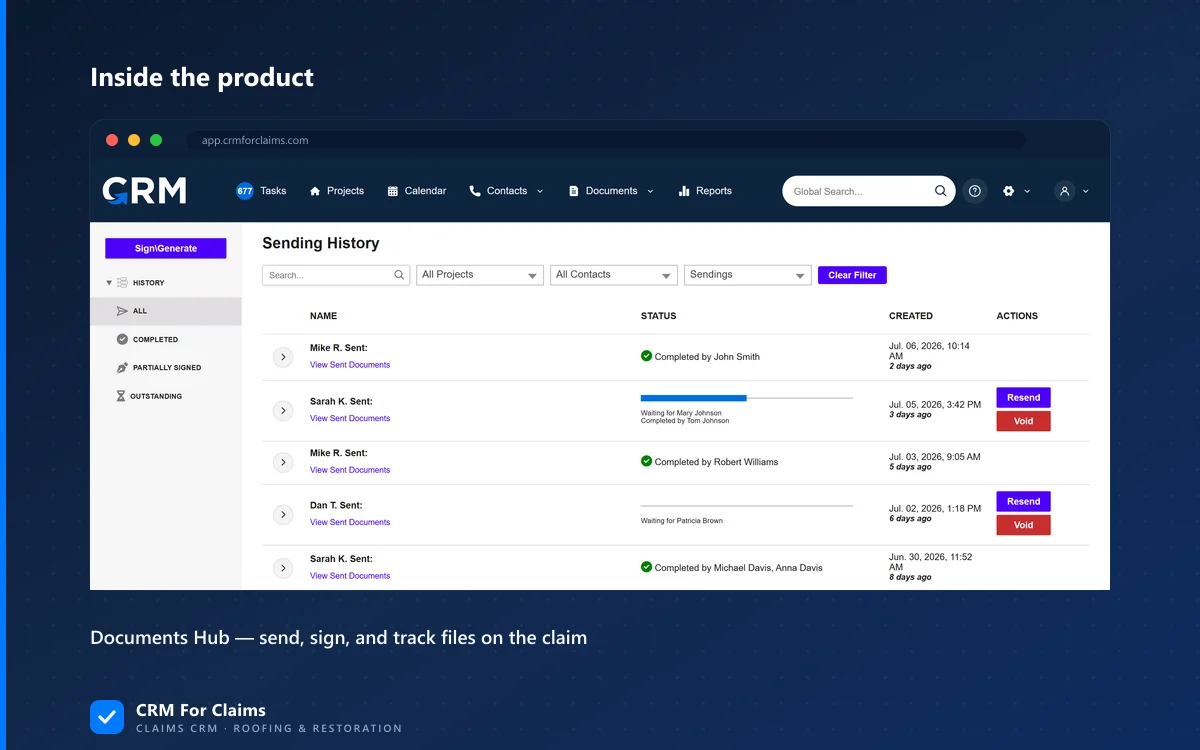
In CRM For Claims a storm is a record on the Loss Dates screen: type of loss, date and time, the cities or ZIP codes it hit, and, if you have them, the largest hail size and wind speed. The storm record also holds files, so the weather report you pulled sits with the storm. On the claim, Date Of Loss is a required field chosen from that list, not typed. Someone with the permission can add a new storm from the claim itself with Add New Date of Loss. The list filters by type of loss and by active or inactive, so last spring's storms stop cluttering this week's intake.
The point is boring and that is why it works: the date gets decided once, by someone who looked at the evidence, and every claim from that storm inherits it. The CRM for roofing contractors page shows the storm record field by field, and the same storm sits behind each job as it moves through the claims pipeline.
If your office still keeps storm dates in someone's head or in the subject line of an email, I'm happy to show you how the storm list and the claim fit together on a real screen. Book a live walkthrough and bring the date you were least sure about this season.