
Short answer: Recoverable depreciation is released when the carrier receives proof the job was finished and paid for — a final invoice that matches the approved scope, a dated certificate of completion, photos of the completed work, and in some states proof the homeowner paid the deductible. The roof being done releases nothing on its own.
I build CRM For Claims, and recoverable depreciation is the money I see abandoned more often than any other line on a claim. It is rarely disputed and rarely denied. It sits in a carrier’s file, already approved, waiting on a packet that nobody at the contractor’s office was ever assigned to send. The work is complete, the crew has moved on, the homeowner is happy, and several thousand dollars earned months ago is still unpaid.
This post is about that packet: what goes in it, what makes a carrier hand it back, and the policy deadline that quietly limits it. It is not a repeat of the closeout checklist, which treats the release as one gate among six, and it does not redefine RCV, ACV and depreciation — the invoicing post covers those.
Why does withheld depreciation get lost more often than any other money on a claim?
Because nobody is chasing you for it. Every other outstanding amount on a claim has a counterparty with a reason to call: the homeowner wants their deductible receipt, the subcontractor wants paying, the adjuster wants your supplement documents. The depreciation holdback has no one on the other side who benefits from reminding you.
It is also the rare outstanding amount on a claim where the delay is entirely yours. Adjuster review is somebody else’s queue. A mortgage company holding proceeds runs on its own inspection schedule. The homeowner answers the phone when they feel like it. With the depreciation release the amount is already agreed, the work is already done, and the only missing item is a document you produce.
The third reason is structural. Every internal signal says the job is over: production has closed it out, the crew is on next week’s work, the salesperson has been paid, and the claim has drifted to the bottom of the board. The packet is the only task left on a job everyone has agreed is finished, so it depends on one person remembering an errand with no deadline attached to it.
What goes in a recoverable depreciation release packet?
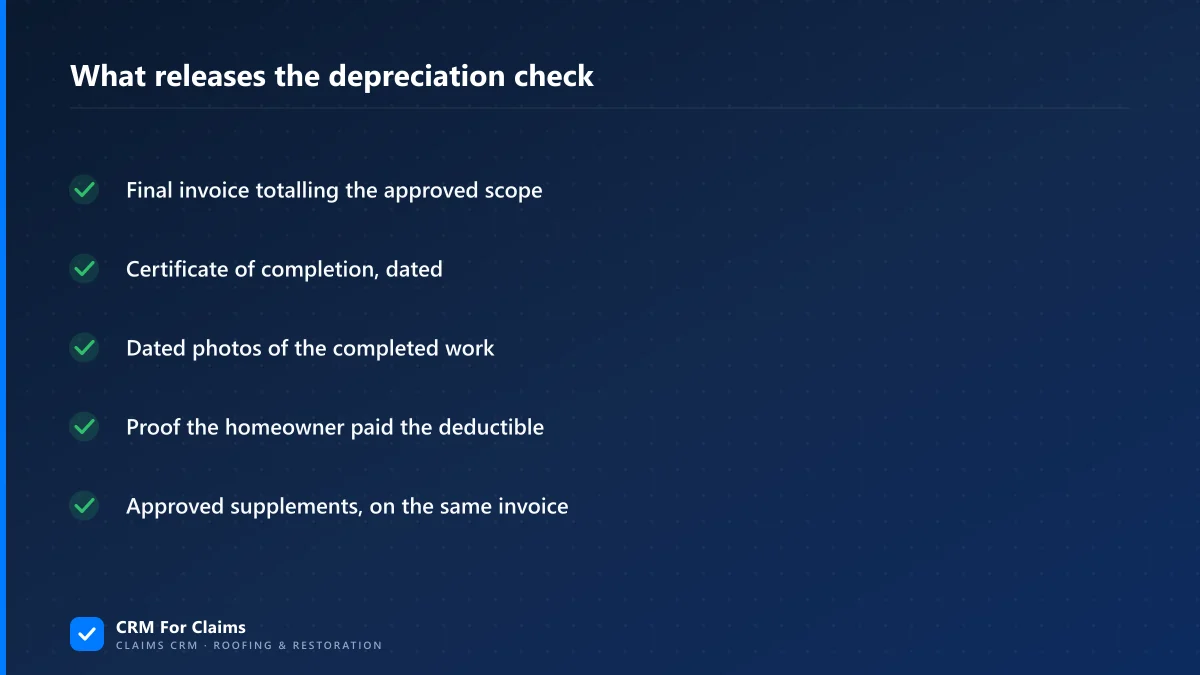
Five things, and each one answers a specific question the carrier has to close before it can pay: was the work completed, when, for how much, was it the work they approved, and did the insured pay their own share. Anything that leaves one of those questions open is what turns a release into a round trip.
| Item | What it proves | What happens without it |
|---|---|---|
| Final invoice totalling the approved scope | The amount actually incurred | The release is measured against a smaller number, or held entirely |
| Certificate of completion, dated | The work is finished, and when | The file stays open and the policy window keeps running |
| Dated photos of the completed work | The approved scope was actually performed | A reinspection gets scheduled, which adds weeks |
| Proof the homeowner paid the deductible | The insured bore their share of the loss | In some states the carrier may lawfully refuse to release |
| Approved supplements, on the same invoice | Your total matches the total in their file | The supplement drops into a separate cycle, or gets forgotten |
Two details matter more than the list itself. The packet goes in as one submission with one date: sent in pieces over nine days, it is treated as incomplete until the last piece lands, and those nine days are yours rather than theirs. And the completion date on the certificate should be the real one, because several clocks are measured from it.
Photos are the item most often skipped, because a completion set feels redundant to the crew who just built the thing. It is not redundant to a desk adjuster who has never seen the property, and a set that matches the approved line items is the cheapest way to keep a reinspection off your calendar.
Why can a carrier hold the depreciation over the homeowner’s deductible?
Because in some states the law explicitly lets it. Texas is the clearest example: an insurer may refuse to pay withheld recoverable depreciation until it receives reasonable proof that the policyholder actually paid the deductible. That makes the homeowner’s payment method a precondition of your final payment, not just a collection problem.
The Texas statute is worth reading in full because it also defines what counts. Under Texas Insurance Code Sec. 707.004, an insurer “may refuse to pay a claim for withheld recoverable depreciation or a replacement cost holdback under the policy until the insurer receives reasonable proof of payment by the policyholder of any deductible applicable to the claim,” and “reasonable proof of payment includes a canceled check, money order receipt, credit card statement, or copy of an executed installment plan contract or other financing arrangement that requires full payment of the deductible over time.”
Read that list again as a list of documents. Every acceptable form of proof is something that leaves a paper trail in a system that is not yours. Cash handed to a crew lead is the one payment method that produces none of it, and it is the method a homeowner is most likely to offer on the last day. Take it and you are the one who has to manufacture the evidence afterwards.
The financing line is the part most teams miss. An executed installment contract counts as proof even though the deductible has not been fully paid yet, so a homeowner who cannot write a single cheque does not have to hold up your release — provided the arrangement is in writing and requires full payment over time. What you can and cannot do about a deductible varies enormously between states, and a number prohibit absorbing it outright, so treat the deductible rules as a question for your own state and your own attorney.
Can your own final invoice cost you the holdback?
Yes, and it is the hardest failure to reverse. Replacement cost indemnifies what the repair actually cost, so your final invoice is the evidence of the amount incurred. If it totals less than the approved replacement cost, the difference is money you did not incur, and the release commonly shrinks to match what you billed.
The arithmetic is easier to see with numbers. These are illustrative, not a customer’s claim:
| Line | Amount | Note |
|---|---|---|
| Approved replacement cost | $24,600 | The scope the carrier agreed to |
| Depreciation withheld | $5,400 | Held back until completion |
| Deductible | $2,500 | The homeowner’s share |
| First payment received | $16,700 | Replacement cost less depreciation and deductible |
| Final invoice, if discounted to $22,100 | $22,100 | Now $2,500 below the approved total |
In that last row the job was quietly discounted by the amount of the deductible. The claim looks settled, but the invoice now says the repair cost $22,100 while the approved scope said $24,600. Work it through: the carrier pays the incurred cost less the deductible, which is $19,600, and $16,700 of that has already gone out. The second cheque is $2,900 instead of $5,400. The discount came out of the holdback, not out of the deductible.
The same mechanism bites more quietly when work is descoped on site — a slope that did not need replacing, a room the homeowner decided to leave. That is legitimate, and the answer is not to bill for work you did not do; it is to tell the carrier before the packet goes in, so the two totals are reconciled deliberately rather than found by a reviewer.
Is there a deadline to claim replacement cost after the work is done?
Usually yes, and it is set by the policy rather than by the carrier’s goodwill. Most replacement cost policies require the work to be completed and claimed within a defined window, and several states legislate a floor underneath that window. The clock generally starts at the first payment or the date of loss, not at completion.
California writes the floor down. Insurance Code section 2051.5(b) states that “a time limit of less than 12 months from the date that the first payment toward the actual cash value is made shall not be placed upon an insured in order to collect the full replacement cost,” extends that to “less than 36 months” where the loss relates to a declared state of emergency, and requires additional six-month extensions “for good cause” where delays are outside the insured’s control. Note what the clock is measured from: the first actual cash value payment. A claim that spent five months in supplement negotiation has already spent part of its window before a crew arrived.
Where no statute sets a floor, the standard is looser. A New York Department of Financial Services counsel opinion describes the ordinary replacement cost mechanic as an insurer that “will pay for the complete repair or replacement cost if the damaged item is repaired or replaced within a reasonable time,” and will otherwise “pay only the actual cash value of the property.” A reasonable time is not a date you can plan around. California illustrates the shape rather than setting a national rule, so the only reliable answer is the one on the declarations page in front of you.
The practical consequence: diarise the release on the day the first payment lands, not on the day the job finishes. If the window is twelve months from that payment, the follow-up date belongs a long way before month eleven.
What actually stalls a depreciation release, and who has to fix it?
Five causes cover almost all of it, and only one of them belongs to the carrier. That is the useful part: four of the five are fixable inside your own office this week, without a phone call to anyone who can say no.
| Cause | Who has to act | The fix |
|---|---|---|
| Nobody owns the packet after production closes | You | A named owner and a due date on the claim, set at completion |
| The packet went in over several days | You | Assemble first, send once, record the send date |
| Deductible payment cannot be evidenced | You, with the homeowner | Take payment in a form that produces a receipt |
| Invoice and approved scope disagree | You | Reconcile before sending, not after the query comes back |
| Lender endorsement on the second cheque | The servicer | Expect a second endorsement and often a completion inspection |
That last row is the one genuine outside dependency. Depreciation on the dwelling is still Coverage A money, so a lender named on the policy normally appears on that cheque too, and the loss draft desk often wants its own completion inspection. Plan the final invoice as the start of that step.
What does a claims CRM do about this, and what does it not?
It makes the release an unavoidable step instead of an errand. The packet is assembled from the claim itself, the submission carries a date and a named owner, and the claim cannot reach a closed stage while a depreciation line is still open.
Concretely, in CRM For Claims the final invoice is generated from the approved line items rather than retyped, so the reconciliation above is visible instead of hypothetical, and the certificate and completion photos live in the Documents Hub attached to the claim rather than in the phone of whoever took them. Ask any vendor to show you three things live: a claim that will not close with depreciation outstanding, an invoice built from approved line items, and a follow-up date that survives the person who set it. The comparison page covers where claims-specific structure earns its place against a general contractor tool, and the figures are on the pricing page — $59 or $99 a month, plus $39 per additional user.
It will not decide anything for you. It cannot make a carrier answer, it cannot produce a deductible receipt for cash handed over on a driveway, and it will not tell you whether a discount you already gave was a good idea. A person still has to send the packet and follow up on it.
If you want to know whether this is a real problem in your own company, the test takes ten minutes and needs no software: pull every claim you completed more than ninety days ago and check which ones have a depreciation release recorded as received. Every claim you cannot answer for is a claim nobody is chasing. If the list is longer than you expected, book a live walkthrough and bring one of those claims — it is a better demo than anything I would have picked.