Short answer: Closing a claim is a reconciliation, not a status change. Production finishing, the money fully landing, and the file being closeable are three different dates. Close on the first one and you walk away from withheld depreciation, an uncollected deductible or a supplement nobody answered — because a closed claim is a claim nobody reads again.
I build CRM For Claims, and closing out an insurance claim is the step almost nobody has a written process for. There is a process for intake. There is a process for the inspection, the scope, the adjuster meeting, the build. Then the crew loads out, the homeowner is happy, somebody drags the job to Complete, and everyone moves on to the next storm. Two months later a bookkeeper asks why a $9,400 job collected $6,100, and the answer is in a file nobody has opened since the day it was closed.
The problem is not laziness. It is that “done” feels like one event and is actually three, and only the first one is visible from the driveway.
What does closing out an insurance claim actually mean?
It means three separate finish lines have all been crossed: the work is physically complete and accepted, every dollar owed by every payer has either arrived or been formally written off, and the file contains enough to answer a question a year from now without you in the room. They rarely land on the same day.
Production is the loud one. It has a crew, a truck and a homeowner watching, so it never gets forgotten. The money is quiet and slow, and it arrives from at least two directions — the carrier and the homeowner — on clocks you do not control. The file is silent entirely; nothing in your day goes wrong if it is thin. So the natural failure is to close on production, because production is the only one that announces itself.
| Finish line | Who decides it is crossed | What goes wrong if you close on this one alone |
|---|---|---|
| Work complete — crew done, punch list cleared, homeowner accepts | Your production lead and the homeowner | Everything below is still open, and nobody is now assigned to it |
| Money reconciled — all payments in, or the shortfall is a decision on paper | Whoever owns the invoice, against the approved scope | Nothing — this is the one worth closing on |
| File closeable — documents, dates and photos complete | Nobody, unless you make it somebody | The warranty call in month 14 gets answered from memory |
What money is still open when the work looks finished?
Usually more than one thing. On a replacement cost claim the carrier deliberately holds back part of the money until you prove the work happened, the homeowner still owes a deductible that no cheque ever covers, and any supplement filed late in the build may still be sitting unanswered on an adjuster’s desk. None of that resolves itself.
The holdback is the one that quietly costs the most, because it looks like a payment you already received. The Texas Department of Insurance describes the mechanic for homeowners in plain language: “If you have a replacement cost policy, most companies pay with two checks… The insurance company will give you a check for the amount it kept for depreciation after it gets the bill for the finished job.” Read that last clause again: after it gets the bill for the finished job. The second cheque is not automatic and it is not triggered by the roof being finished. It is triggered by paperwork you have to send.
| Open item at production complete | Who owes it | What releases it |
|---|---|---|
| Recoverable depreciation (the holdback) | Carrier | Final invoice plus proof of completion, submitted by you |
| Deductible | Homeowner | You asking, with an invoice that shows it as a line |
| Supplement filed during the build | Carrier | An approval, a denial in writing, or your decision to withdraw it |
| Mortgagee endorsement on a claim cheque | Homeowner and their lender | The lender’s inspection and release process, which is not fast |
| Change order signed but never invoiced | Homeowner | Someone noticing it is not on the final invoice |
Four of those five need a person to initiate something. That is the whole argument for a closeout gate: the money side of a claim does not fail because people are dishonest, it fails because the last 5% of a job has no urgency attached to it and no customer chasing you for it. If you want the mechanics of tying the final number back to what was actually approved, I wrote about that separately in tying invoicing to the work that was approved.
What is on the closeout checklist?
Six gates, and a claim does not move to closed until all six are answered — answered, not necessarily satisfied. “Supplement denied, we are eating it” is a valid answer. “We never heard back” is not an answer, it is an open item wearing a closed status.
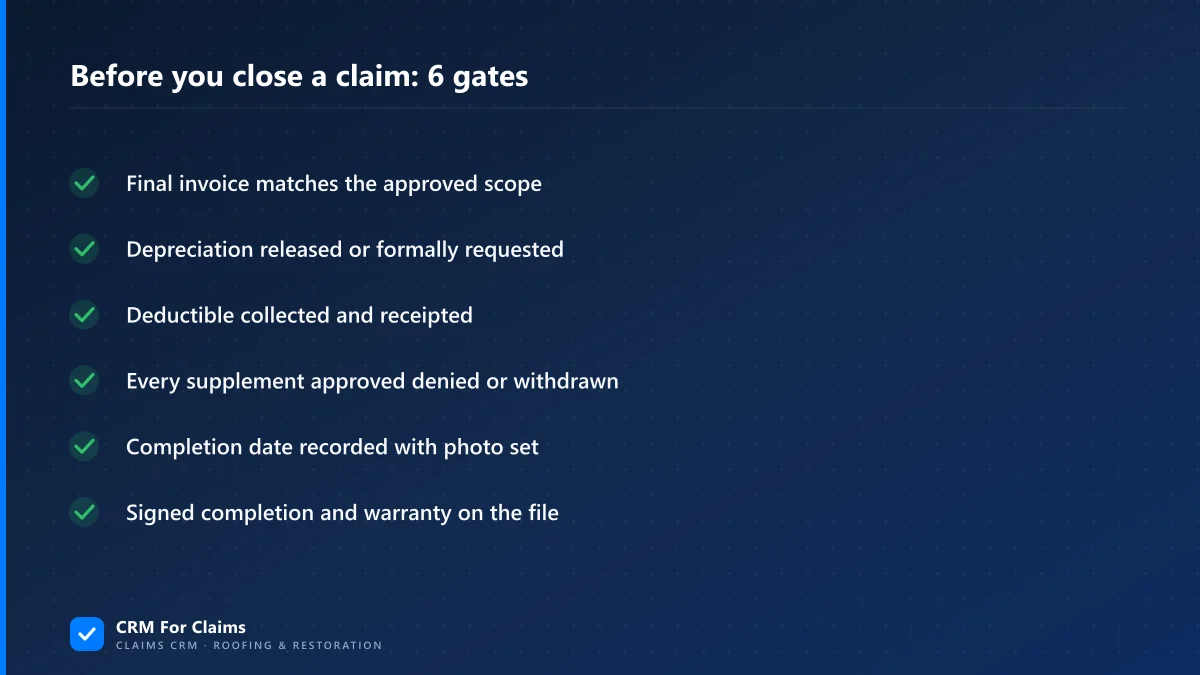
- Final invoice matches the approved scope — line for line, including the deductible as a visible line rather than a mental subtraction. If your invoice total and the carrier’s approved total disagree, that gap is either a supplement, a write-off, or an error, and you need to know which one before you close.
- Depreciation released, or formally requested — with the date you sent the completion package. If it is still outstanding, the claim is not closed; it is waiting, and waiting needs an owner and a follow-up date.
- Deductible collected and receipted — and recorded as collected, because how it was handled is a question you may have to answer later. State law on absorbing or rebating a deductible varies and several states prohibit it outright, so this line is worth being boringly precise about.
- Every supplement approved, denied or withdrawn — each with a written carrier response attached, or a note saying you chose to drop it. A supplement that was never resolved either way is the most common reason a closed job collected less than it should have.
- Completion date recorded, with a dated completion photo set — see the next section, because this field does more work than any other on the form.
- Signed completion, warranty document and product details on the file — make, colour, lot, crew lead. This is the set that decides whether a call fourteen months from now is a diagnosis or a guess.
Notice what is not on the list: customer satisfaction, review requests, referral asks. Those matter and they belong in your process, but they are not gates. A claim with a delighted homeowner and an unreleased depreciation cheque is not closed. A claim with a grumpy homeowner and every dollar reconciled is.
Why is the completion date the most expensive field on the closeout?
Because at least three clocks start from it and none of them are yours. It is the date the carrier measures your completion package against, the date most workmanship warranties run from, and in many states the date that starts the countdown on your mechanics lien rights. Guess it, backdate it, or leave it as the day the file was touched, and you have quietly moved deadlines you cannot see.
The lien one is worth being concrete about, because contractors routinely discover it too late. Illinois measures from completion, not from when payment went bad. Under the Mechanics Lien Act, a claim for lien is enforceable against third parties only if recorded “within 4 months after completion, or if extra or additional work is done… within 4 months after the completion of such extra or additional work,” while as to the owner it “may be filed at any time after the contract is made and within 2 years after the completion of the contract.” Four months sounds generous until you notice that a claim waiting on a carrier can burn three of them without anyone feeling late.
Every state writes this differently — different windows, different notice requirements, different definitions of completion — so treat Illinois as an illustration of the shape, not as your deadline, and get your own state’s rule from your attorney or your state’s statutes. The transferable point is structural: the day you type into that field is the day a legal clock starts, so it should be the real day the last work was performed, recorded when it happens rather than reconstructed at closeout.
How long do you keep a closed claim file, and what does keeping mean?
Longer than most people assume, and “keeping” means retrievable by someone who was not there. A file you technically still possess but cannot find in five minutes is not a record, it is a rumour with attachments.
The tax floor is the easy part. The IRS instruction for business records is to “keep records for 3 years” in the ordinary case, and to “keep employment tax records for at least 4 years after the date that the tax becomes due or is paid, whichever is later.” That is the floor for the money paperwork, and it is shorter than the exposure that actually matters on construction work: your written workmanship warranty, the manufacturer’s material warranty, and your state’s statute of limitations and statute of repose for construction defect claims, which are set by state law and vary widely. Practically, the warranty you sold is usually the longest clock in the room, so retention should follow it rather than the tax rule.
What makes a file retrievable is not storage, it is naming and attachment. A signed completion certificate in someone’s inbox is not on the claim. A photo set in a phone gallery is not on the claim. This is the whole reason I am fussy about naming conventions that survive a second person: the closeout package is written by whoever finished the job and read by whoever answers the phone two years later, and those are almost never the same person.
What does a CRM actually do at closeout, and what does it not?
It makes the gates unavoidable and it makes the file automatic. It does not decide whether to eat a denied supplement, and it will not chase a lender for a mortgagee endorsement. Software turns a discipline problem into a structural one; it does not turn a judgement call into a rule.
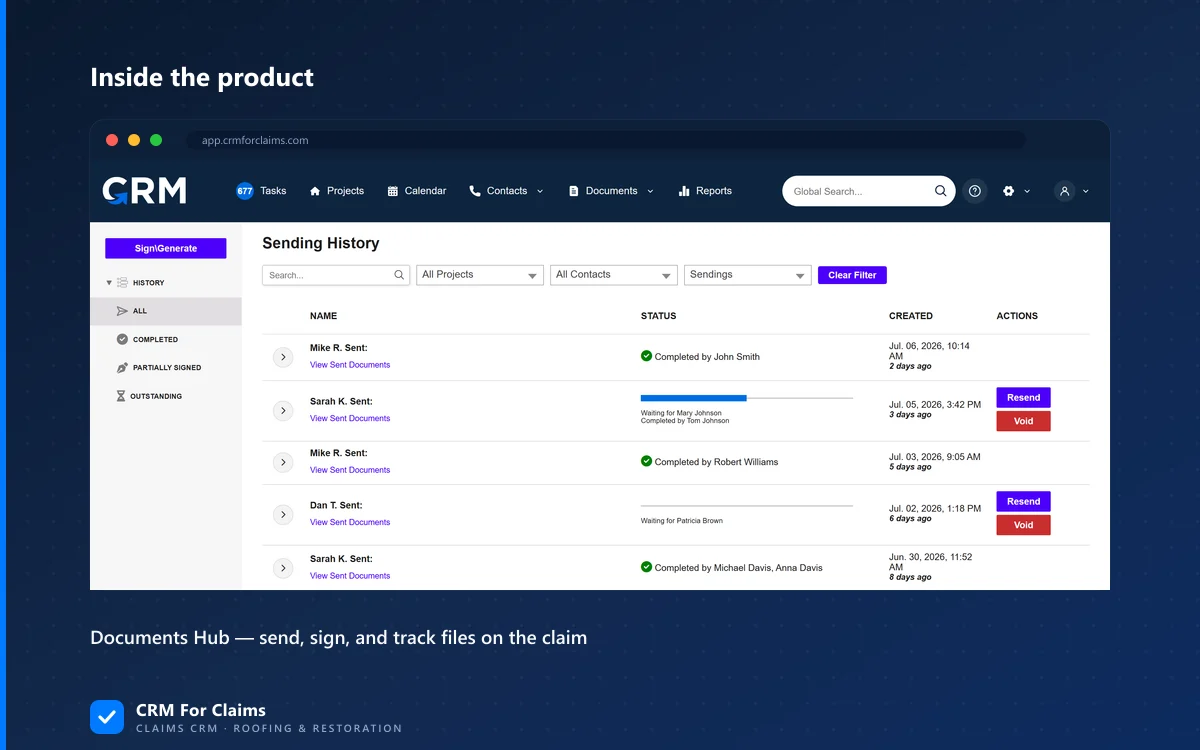
Concretely, in CRM For Claims the closeout is a stage, and a stage can carry required fields and triggered tasks: a claim does not reach Closed with an unreleased depreciation line, an unanswered supplement or a missing completion date, because the stage will not let it. The final invoice is generated from the approved line items rather than retyped, so the “does our total match theirs” check is visible instead of hypothetical. The completion package — certificate, final invoice, photo set, warranty — lives in the Documents Hub attached to the claim, so sending it to the carrier is a two-click job rather than an archaeology project. And the record that is left behind is the one your team reads when the callback arrives after the claim is closed.
Where it does not help: none of this manufactures a carrier response. If an adjuster has gone quiet on a supplement, the CRM will keep the item visible and keep reminding somebody, which is genuinely most of the battle, but the phone call is still yours to make. And if your team’s honest answer is that closeout works fine on a whiteboard because you run four jobs at a time, that is a legitimate answer — the pain starts at the volume where nobody can hold every open item in their head. That is the same threshold I use in the comparison between a claims-first tool and a generic CRM: buy the structure when the structure is what is failing, not before.
The version of this I would want on my own jobs is unglamorous. One gate, six questions, answered out loud before anyone types “closed” — and a file that a stranger could pick up cold. If you want to see what that looks like running on real claim stages rather than described in a blog post, book a live walkthrough and bring one of your messiest finished jobs; that is the one worth testing it against. Pricing, if you want the number before the call, is on the plans page.