Storm canvassing rules for roofers come in three layers, and they bite in a fixed order. Your state roofing license has to exist before anything else. The village or city where you knock usually wants its own solicitor permit, and that permit can take days you do not have after a hailstorm. Then the moment a homeowner signs at the kitchen table, a federal clock starts: they can cancel until midnight of the third business day, and you should not tear off a shingle before it runs out.
I build CRM For Claims, a CRM for roofing and restoration teams that live on insurance work, so I see the canvassing step from the other end: the claim file that starts with a knock. When that knock was done without a permit, or the cancellation notice was missing from the packet, the problem shows up weeks later on a claim that looked fine. Below is the order I would clear things in before a crew goes out, the cancellation count worked on real 2026 dates, and the few sentences a rep should never say at a door. I am not a lawyer, and local rules change, so treat this as the checklist you take to your attorney and the village clerk.
What has to be cleared before the first knock?
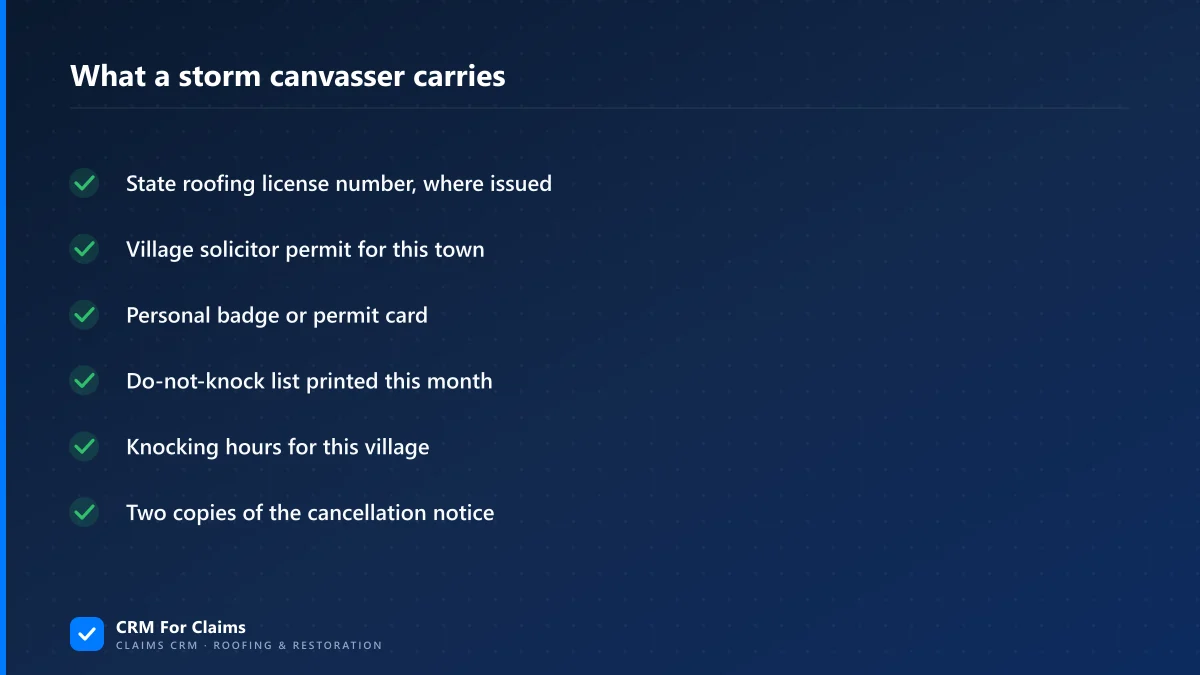
Five things, in this order: the state license, the village solicitor permit, a badge for every rep, the village's do-not-knock list for this month, and the hours you are allowed to knock. Skip one and the whole street can be lost, because a village that tickets one rep tends to tell residents to call the police on the next.
- Your state contractor or roofing license, where your state issues oneVillage permit forms often ask for it, and homeowners now check it on the state lookup while the rep stands on the porch.
- The solicitor permit of each village you will workThis is the one that stops a storm crew. Apply the day the storm path is known, village by village, before you rent the hotel rooms.
- A badge or permit card for every person who knocksA permit for the company does not cover the new hire you added on Tuesday. Count heads before you count streets.
- The village do-not-knock registry, printed this monthStrike those addresses off the route before the rep sees it. A no-soliciting sign on the door ends the visit even when the address is not on the list.
- The hours you may knockEvening is when homeowners are home, and it is often exactly when knocking stops being legal.
Why the village permit is the step that sinks storm crews
Because it is local, slow, and enforced hardest right after a storm. Each village writes its own ordinance, so a permit in one town means nothing across the street in the next, and the towns that got hit are the ones whose police are watching for unfamiliar trucks.
A few examples I read today. The Village of Sugar Grove, Illinois, says on its storm scam page that every door-to-door solicitor must hold a permit from its police department, that the village does not endorse anyone who holds one, and that re-roofing needs a building permit too. After a hailstorm in March 2026, the City of Darien, Illinois, told residents that it had no active solicitor licenses, that nobody should be selling door to door, and that issuing a license can take up to 10 days, as Patch reported. The Town of Collierville, Tennessee, spells out its rules on its resident page: a permit with a criminal background check, a town ID badge worn while knocking, knocking only from 9:00 a.m. to half an hour before sunset, and a No Knock Registry that commercial solicitors print at the start of each month.
Ten days is most of the window in which a hail market is worth working. So the permit application belongs in the same hour as the storm map, and the canvassing plan should start with the towns whose permit you already hold. If you are planning the rest of a surge, my earlier piece on running a storm season without dropping claims covers the office side.
How do you count the three business days after a door sale?
Under the FTC Cooling-Off Rule, a business day is every calendar day except Sunday and federal holidays, so Saturday counts. The homeowner can cancel until midnight of the third business day after the day they signed. The rule covers sales of $25 or more made at the buyer's home, which is every roof you will ever sell on a porch.
The text is short and worth reading once: the business-day definition is in 16 CFR 429.0, and the duties are in 16 CFR 429.1. The contract must state the right to cancel, the rep must also tell the homeowner out loud when they sign, and if they cancel you have 10 business days to refund what they paid. Here is the count on real dates this fall. Holidays are where crews get it wrong.
| Signed on | Day 1 | Day 2 | Day 3 | Can cancel until | What was skipped |
|---|---|---|---|---|---|
| Fri, Oct 16, 2026 | Sat, Oct 17 | Mon, Oct 19 | Tue, Oct 20 | Midnight Tue, Oct 20 | Sunday |
| Sat, Oct 10, 2026 | Tue, Oct 13 | Wed, Oct 14 | Thu, Oct 15 | Midnight Thu, Oct 15 | Sunday and Columbus Day (Mon, Oct 12) |
| Tue, Nov 10, 2026 | Thu, Nov 12 | Fri, Nov 13 | Sat, Nov 14 | Midnight Sat, Nov 14 | Veterans Day (Wed, Nov 11) |
| Wed, Nov 25, 2026 | Fri, Nov 27 | Sat, Nov 28 | Mon, Nov 30 | Midnight Mon, Nov 30 | Thanksgiving (Thu, Nov 26) and Sunday |
Two warnings. Your state can be stricter than the federal rule: some states count only Monday to Friday or give a longer window, and the longer rule wins. And if the notice was never given, the clock never really starts, which turns a three-day risk into an open one. That is one more reason to read your contingency agreement clause by clause before the season, because the cancellation notice usually rides on the same paper.
The tarp the night of the storm is the exception, and it is narrow
The federal rule does not apply when the homeowner needs the work to meet a real, immediate emergency and gives you a separate statement, written in their own hand, dated and signed, that describes the emergency and gives up the right to cancel. A pre-printed waiver box in your contract does not count. Use it for the emergency repair that keeps water out tonight, and keep the full roof replacement on the normal three-day clock.
What a rep should never say at the door
The Cooling-Off Rule makes it a deceptive practice to misstate the homeowner's right to cancel in any way, and village permits are usually lost over complaints, not over paperwork. These are the lines I would ban in training, out loud, with the reason:
- "The city sent us to check the roofs on this street." A permit does not mean the village sent you, and several villages say on their own pages that a permit is no endorsement.
- "This signature just lets us look, it isn't a contract." If the paper commits them to anything once the claim is approved, it is a contract, and it carries the cancellation notice.
- "You can't cancel once the insurance company is involved." That misstates the right to cancel.
- "We'll start tomorrow morning so you don't lose your spot." Starting inside the window, without the handwritten emergency statement, puts the labor at risk if they cancel.
- "I'll come back after dark when everyone is home." Check the hours first, and make the second visit an appointment the homeowner asked for.
How the knock should land on the claim file
The rep's job ends at the signature. The office has to be able to answer, months later, where that claim came from, which village permit covered the street, when the cancellation window closed, and whether anyone started work before it did. If those answers live in a rep's phone, they leave with the rep at the end of the season.
In CRM For Claims, the company keeps its own list of lead sources in Settings and can add one for each storm it works. The KPI reports then show the lead sources of the projects in a report, so you can see what a storm's canvassing turned into after the claims are paid. The contract is prepared from a template and sent for signature from the CRM, and its status is tracked there. A project stage can also create a task from a task template when a claim enters it, so the stage for a signed contract can hand the production lead a task to hold the start date until the window closes. The stage automations and tasks page shows how stages and tasks fit together, and the documents and e-signature page covers the signing side.
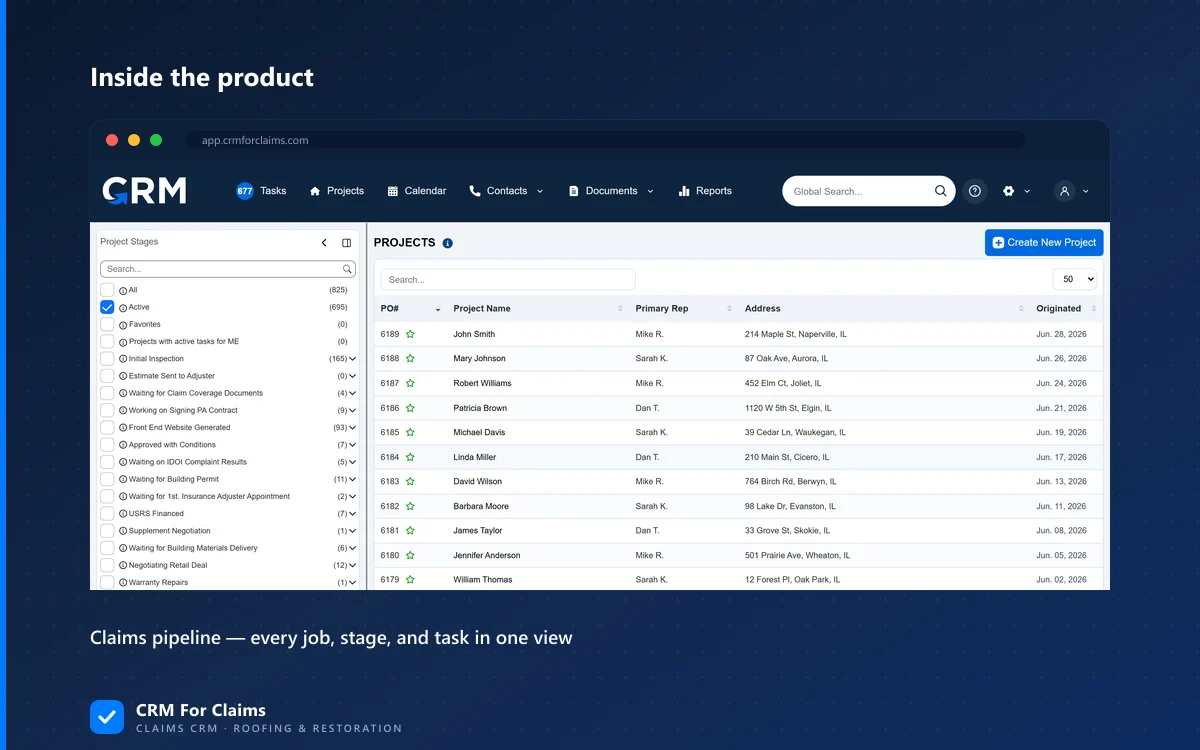
Lead sources are only useful if every rep picks the same one, so name them by storm and date instead of by rep. My older post on which lead sources are worth tracking on claims work goes into how to keep that list short enough that people actually use it.
The permits, the notices and the clock are your homework, and no software does them for you. What a CRM can do is make sure the answers are written down on the claim the day they happen. If you want to see how a signed contract from a storm canvass moves through the pipeline in CRM For Claims, book a live walkthrough and bring one of your own storm weeks to test it on.