A direction to pay tells the insurance company to put your name on the check for your part of the work. An assignment of benefits hands you ownership of part of the homeowner's claim, so you can bill the carrier, demand appraisal and sue in your own name. Most roofing and restoration contractors who say "we take an AOB" are holding the first one, and in Florida the second one has been void on new policies since 2023.
I build CRM For Claims, and the work authorization is one of the first papers a roofer sends on a claim. It is also the paper people understand least, because the two documents sound alike and often sit in the same paragraph of the same form. Below I put them side by side, walk through what changed in Florida and what the 2025 appeals decision says about labels, list the wording that turns one paper into the other, and show how to keep the paper and the money on the same claim file. I'm not a lawyer. Use this to ask your lawyer better questions about your own form, not as a form.
What is the difference between a direction to pay and an assignment of benefits?
A direction to pay is an instruction from the homeowner to the carrier: include the contractor as a payee. Nothing about the claim changes owner. An assignment of benefits transfers the homeowner's right to those insurance proceeds, in whole or in part, to the contractor, who then stands where the homeowner stood for that part of the loss.
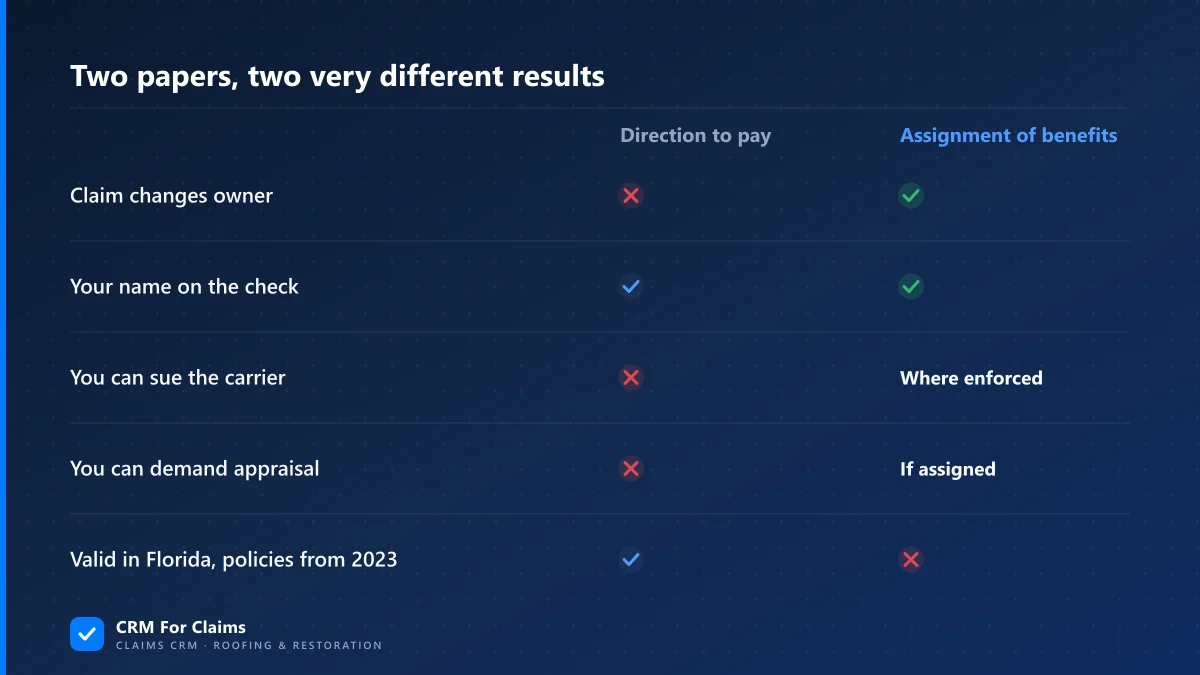
The attorney Ed Cross put it bluntly in a 2021 interview for the Restoration Industry Association: a typical restoration work authorization that asks the carrier to name the contractor on the check is "merely a direction to pay", because it does not transfer ownership. The two cards below answer the same five questions that come up on an actual job, one card per document.
Direction to pay
An instruction about where the money goes.
- Who owns the claim afterwards
- The homeowner, unchanged.
- Who the carrier names on the check
- The homeowner, the lender if there is one, and you.
- Who can sue the carrier over the amount
- Only the homeowner.
- Who can demand appraisal
- Only the homeowner, under the policy's own appraisal clause.
- Florida, policies from 2023
- Allowed, as long as it really only directs payment.
Assignment of benefits
A transfer of part of the claim itself.
- Who owns the claim afterwards
- You own the assigned part.
- Who the carrier names on the check
- You, for the assigned part, plus any lender with an interest.
- Who can sue the carrier over the amount
- You, in your own name, where the state enforces assignments.
- Who can demand appraisal
- You, if the assignment carries that right.
- Florida, policies from 2023
- Void, invalid and unenforceable.
Why bother with a direction to pay if it gives you no rights?
Because it solves the problem that actually costs roofers money most often: a check that goes out with only the homeowner's name on it. When the carrier has a signed instruction on file, your company's name goes on the check next to the homeowner's, and the check cannot be cashed without your endorsement. That is a practical lock, not a legal claim, and it is often all you need.
It also keeps you on the right side of a line that many states draw hard. With a direction to pay, the homeowner stays the party to the claim and the one who negotiates it. You document the damage, send your estimate and answer the adjuster's questions about your work. If you want a refresher on where that line sits, I went through it clause by clause in the post on roofing contingency agreements.
What it will not do: if the carrier ignores the instruction and pays the homeowner alone, you have a collection problem with your customer, not a claim against the carrier. And if there is a mortgage on the house, the lender's name goes on the same check, which brings its own release process. I covered that in the post on loss drafts and the mortgage company.
Florida: the state where the label stopped mattering
Florida is where most of the AOB fights happened, and it is where the rules are now clearest. Three dates tell the story.
- 2019Section 627.7152 sets rules for AOB agreementsWritten agreement, an itemized estimate, and a homeowner's right to cancel within 14 days of signing, among other conditions. A non-compliant agreement is invalid.
- January 1, 2023Assignments banned on new residential and commercial policiesUnder subsection (13) of the statute, an attempt to assign post-loss benefits under a policy issued on or after that date is "void, invalid, and unenforceable".
- January 3, 2025The Fifth District Court of Appeal looks past the labelA homeowner signed a direction of payment with his roofer, then a separate assignment with a company that promised to pass any recovery to that roofer. The court held the assignment fell under 627.7152 because of that mandatory pass-through, so the company had no standing (Roofing Contractor's report on the decision).
The lesson for anyone writing their own paperwork is in that last entry. The court did not care what the document was called. It asked what happened to the money and who was trying to collect it. The statute's own definition works the same way: it covers any instrument by which post-loss benefits are "assigned or transferred, or acquired in any manner" by a person providing repair or mitigation services.
Wording that moves a form from "pay me" to "I own part of your claim"
If your work authorization was written years ago, or copied from someone else's, read it for phrases like these. Each one points toward a transfer rather than an instruction, and in Florida any of them on a policy issued since 2023 is a reason to call your lawyer before you send the form again.
- "assign", "assignment", "transfer" or "convey" next to the words benefits, proceeds or claim
- "all rights, title and interest" in the claim or the policy
- the contractor may "pursue", "negotiate" or "settle" the claim
- the right to invoke appraisal handed to the contractor
- the right to sue the carrier, or to recover attorney's fees, handed to the contractor
- payment owed to the contractor "regardless" of what the carrier pays
A plain direction to pay usually reads more like: the homeowner instructs the carrier to include the contractor as a payee on any payment for the work the contractor performs. Ask your lawyer to confirm the exact words for your state.
What about the other 49 states?
There is no single answer, and I would rather send you to a lawyer than guess. What I can point to is the same RIA interview: Cross said Texas and Oregon generally refuse to enforce assignments of benefits but allow the assignment of a legal claim, and that most other states allow assignments. That was 2021, before Florida's 2023 ban, so treat it as a starting point and check what your state has done since.
Separately, a lot of states limit how far a contractor may go in negotiating a claim at all, whatever paper they hold. An assignment does not make a roofer a public adjuster. If your plan for a stubborn carrier depends on an assignment, that plan needs a lawyer in your state, not a better form.
Keeping the paper and the check on the same claim file
Whichever document you use, the failure I see most is not legal. It is the signed paper living in one inbox, the carrier's payment letter in another, and nobody checking that the check that finally arrives has the right names on it. That is a record-keeping job, and it is the part CRM For Claims was built for.
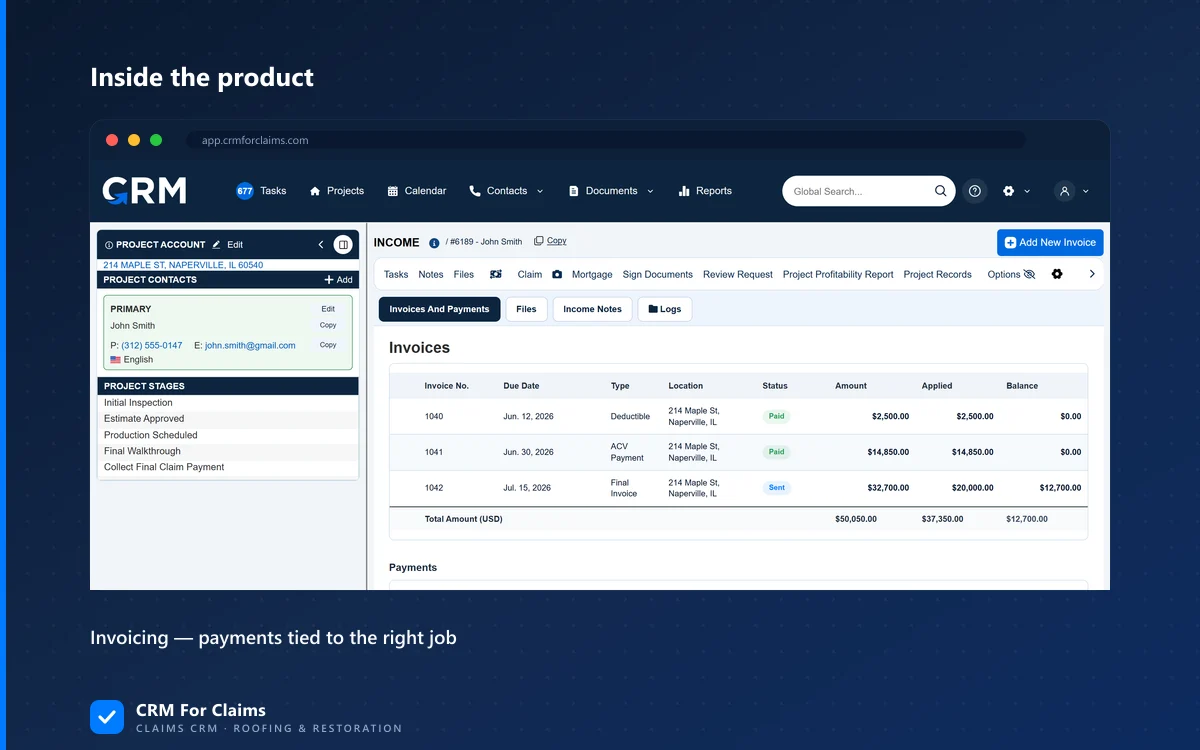
In CRM For Claims, a project can carry the mortgage company next to the homeowner and the carrier, so the lender is on the file before the first check shows up. Document templates in the Documents Hub can pull the policy number, claim number and mortgage loan number straight from the project, and the hub shows which sendings are still only partially signed. When a payment comes in, the payment form asks who the check is payable to and records the payment method, so the office can see at a glance whether the check matched what the paper said. The rest of the product is on the features page, and the plans start at $59 a month on the pricing page.
Your lawyer decides what your form says. Making sure every signed copy and every check lands on the right claim is a job your system should do for you. If you want to see how that looks with your own paperwork, book a live walkthrough and bring the form you use today.