
Short answer: A lead source is worth tracking only if you can repeat it deliberately and follow it all the way to a paid claim. Most systems record how somebody reached you, which is a different fact. Keep six or seven real sources, capture the label at intake, and count approved claims per source rather than leads.
I build CRM For Claims, and every conversation about lead sources for claims work seems to start in the same place. Somebody opens the report, sees that sixty percent of last quarter arrived under “Referral,” and asks what they are supposed to do with that. Nothing, is the honest answer. You cannot buy more Referral. You cannot schedule another one. It is a label describing how a phone rang, and a label is not a source.
That gap — between what gets typed into the field and what a person could actually go and do again on Monday — is why most lead source tracking quietly dies about four months in. The field is still there. Nobody reads the report.
What actually counts as a lead source?
A lead source is the repeatable act that produced the lead. Not the channel it arrived through, not the device, not the person who happened to answer. The test is one question: what would I have to do to get another one of these? If the answer is a real action with a cost attached, you have a source. If the answer is a shrug, you have a label.
Run a few through it. “Google” fails — you cannot do Google again. “Our map listing, for hail repair searches in the north suburbs” passes, because the repeatable act is maintaining that profile and those pages. “Word of mouth” fails. “We call every customer six months after the job closes and ask” passes, because somebody has to make the calls and you can count them. “Website” fails so badly it is almost funny; a website is a door, and nobody builds a plan out of a door.
So a good source list reads slightly awkwardly, because each entry names an activity rather than a medium. That is the point: a list of mediums is a list of things nobody owns.
Why do lead counts mislead on claim work?
Because a lead is not a claim, and a claim is not an approved claim. On ordinary contracting work those three things move roughly together, so counting leads is a reasonable shortcut. On insurance work they come apart, and the source that produces the most leads is regularly not the source that produces the most money.
The mechanism is not mysterious. A lead from knocking doors after a hail event is a lead about a roof a stranger looked at from the ground: some have covered damage, some have wear, age, or the kind of cosmetic marking a carrier will decline all day. A lead from a past customer calling about a stained ceiling has already passed a filter — something happened, inside, to somebody who trusts you enough to call. Both count as one lead. They are not one lead.
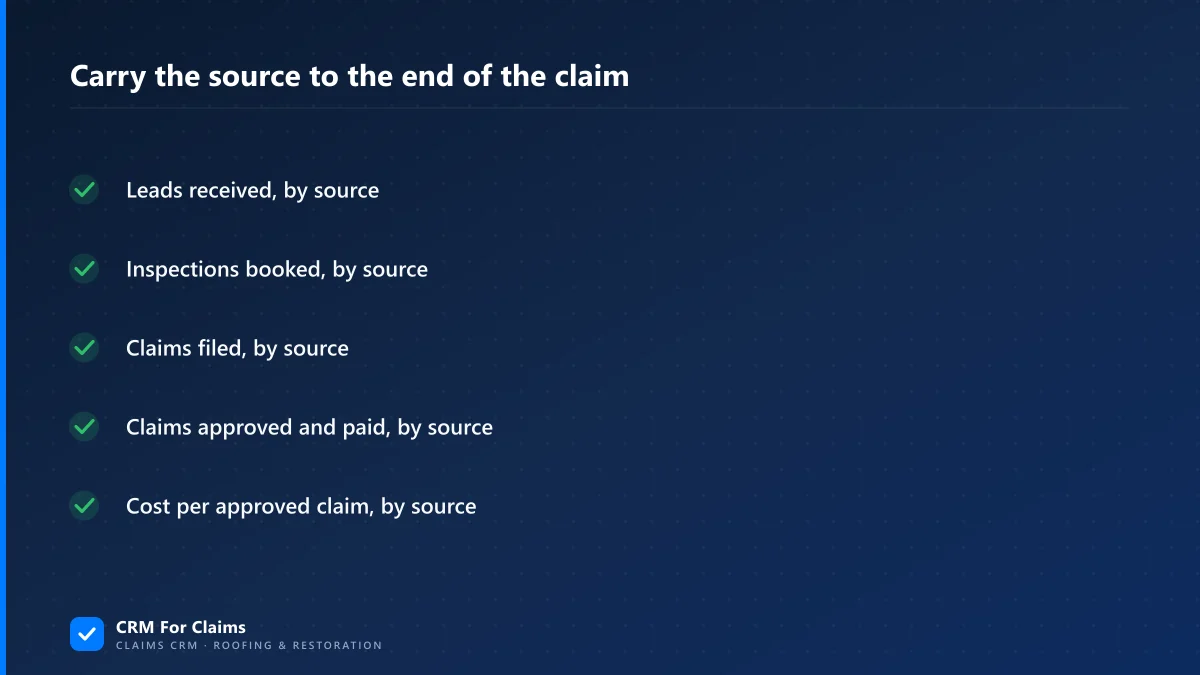
So the count that matters is further down. Carry the source label from intake through to the end and you get four numbers per source instead of one:
| Count | Where it comes from | The question it answers |
|---|---|---|
| Leads received | Intake | How much attention this activity buys |
| Inspections booked | First scheduled site visit | Whether the interest is real |
| Claims filed | Claim number recorded | Whether there was damage worth a carrier looking at |
| Claims approved and paid | Payment received | Whether the activity produces revenue |
The interesting figure is the drop between rows three and four, by source. That is a denial rate with a marketing cause attached, and it is invisible if you only ever count what arrived. A source that fills the pipeline with claims that die at carrier review is not a cheap source. It is an expensive one, paid for in inspection time, drive time and the specific misery of telling a homeowner the carrier said no after you told them it looked promising.
None of this requires new software. It requires the source label to still be attached at the point money arrives, which is the part generic tools tend to lose: the source sits on a contact record, the money sits somewhere else, and nobody joins them back up.
Which lead sources are worth tracking for claims work?
The ones you can act on, which is fewer than most source lists contain. Below is the set worth separating for a roofing or restoration team running insurance work, with the repeatable act named and the thing most likely to go wrong beside it.
| Source | What you would repeat | Watch this |
|---|---|---|
| Past-customer referral | Asking, on a schedule, after a job closes | Capped by how many jobs you actually finished |
| Repeat customer | Nothing, until it stops | Do not merge this with referral — different act |
| Trade referral (plumber, mitigation, agent) | One relationship, maintained by one person | Whether it is the firm or one individual |
| Canvassing after a storm | Streets walked, in a defined area, in a defined week | Denial rate — this is where it hides |
| Organic search and the map listing | Pages and a profile somebody maintains | Which query, not just “Google” |
| Paid search or paid social | Budget, live, today | Cost per approved claim, never cost per lead |
| Bought or shared lead services | A subscription | Shared leads go to several contractors by design |
| Property manager or HOA relationship | A contract, or one very good relationship | Concentration — one call can end it |
Two of these deserve a caution rather than a tip.
Bought leads. Speed to first contact is the whole product, because the same enquiry is usually with your competitors as well. That is not a scandal, it is the stated model. Just cost it honestly: a shared lead is priced as a lead and consumed as a race. And if any part of your follow-up involves calling or texting a purchased list rather than somebody who contacted you, the telemarketing rules are real — 47 CFR 64.1200 requires prior express written consent for telemarketing calls and texts, and requires do-not-call requests to be recorded and honoured. Buying a list does not buy consent.
Insurance agent referrals. These are among the best claim leads that exist, and also the ones with legal edges. State insurance codes restrict rebating and compensation involving licensed producers, and several states regulate contractor referral arrangements directly. I am not a lawyer and the answer genuinely varies by state, so if you want anything formal with an agency, ask an attorney in your state first. An informal relationship where an agent tells a policyholder you do good work is a different thing entirely, and it is worth its own row in your source list.
How do you make the source field survive real people?
By making it small, mandatory at intake, and impossible to edit later. Every failure I have seen comes from breaking one of those three. A forty-option dropdown gets answered with whatever is at the top. An optional field gets skipped by the person taking a call in a truck. An editable one gets quietly changed by whoever is closest to the commission.
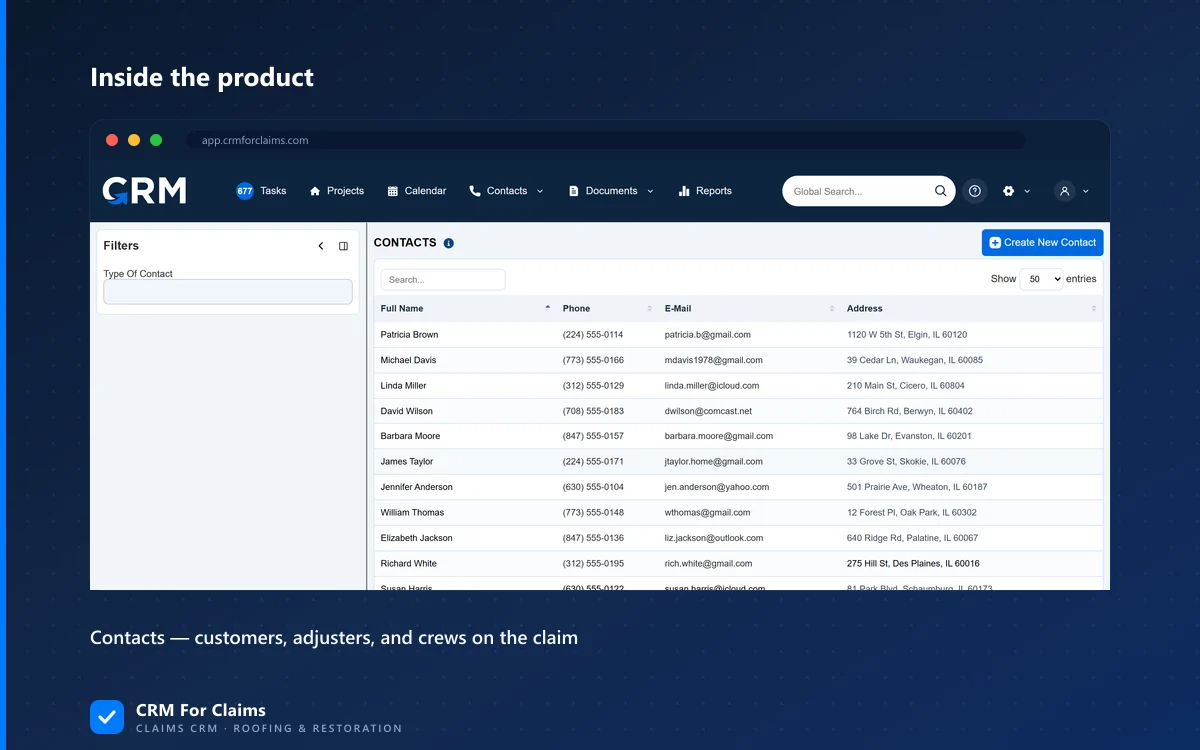
What works is a closed list of six to eight options plus one short free-text box for “who or where, specifically.” The dropdown gives you a report; the free text gives you the name of the plumber, the street, or the search term, which is the part you can actually go and do more of. Set it up like this:
- Required at creation — captured when the lead is created, before anyone has an opinion about whether it will close.
- Closed list, six to eight entries — if a ninth is genuinely needed, add it deliberately and tell everyone.
- One free-text detail field — the specific person, street or campaign. No structure required, just a sentence.
- Locked after intake — a source that can be rewritten in month three is a source you cannot report on.
- Carried onto the claim — the label has to still be readable when the payment lands, or steps three and four of that funnel do not exist.
That last point is the one that decides whether any of this works, and it is a structural question about your tools rather than a discipline question about your people. In CRM For Claims the source rides on the record from the first call through to invoicing, so the report is a by-product of ordinary work rather than a monthly reconstruction. You can see how the pieces connect on the features page, or how that differs from a general-purpose tool on the comparison page.
Which lead numbers actively mislead?
Four of them. They are not wrong numbers exactly — they answer a question nobody asked, while looking like they answered the important one.
- Cost per lead. Optimising it pushes you toward whatever is cheapest to generate, which on claim work is usually whatever is least qualified. Cost per approved claim is the number with a business attached.
- The single Referral bucket. Past customers, trade partners and agents are three different activities with three different costs and three different ceilings. Merged, they produce a big satisfying wedge in a pie chart that instructs nobody.
- Last-touch attribution. The homeowner heard about you from a neighbour in March, searched your name in June, and clicked a paid ad because it was at the top. Recording that as paid search means you will happily pay for traffic that was already yours.
- Lead volume during a storm week. Everything spikes and every source looks brilliant. Judge sources on ordinary months and use surge weeks for capacity planning instead.
The general filter here is the same one I would apply to any operating metric: it is worth watching only if it could change a decision you make this month. I went through that test in more depth in the five numbers worth watching in a claims business, and lead source reporting fails it more often than any other report on the list — not because the data is bad, but because it is usually reported at the wrong depth to act on.
When is tracking lead sources not worth the effort?
When you have one source. A one-crew operation running entirely on repeat work and neighbours does not need a dropdown to know where the work comes from, and adding one buys a field that everybody resents. The honest answer for that shop is to write down the referral names in whatever they already use and get on with the job.
It starts paying at the point where you spend money to create leads — the first ad budget, the first canvasser on payroll, the first subscription — because that is the moment the question changes from “where does work come from” to “which of these should I do more of next month.” It pays again when a second person starts taking calls, because their memory of March is not your memory of March.
Until then, the field is overhead. After that, it is one of the few reports that changes what you actually do.
If you want to see what this looks like when the source is attached to the claim rather than parked on a contact record, that is a fifteen-minute conversation rather than a signup. Book a live walkthrough and bring your current source list — the first useful thing is usually cutting it in half. Plans and what is included are on the pricing page.