
Short answer: Five are worth watching every week: how long each open claim has gone without movement, the split between claims waiting on you and claims waiting on the carrier, approved dollars not yet invoiced, invoiced dollars not yet collected, and completed jobs where withheld depreciation was never recovered. Averages, pipeline totals and close rates mostly mislead.
I build CRM For Claims, and once the workflow questions are done, the next request is almost always a dashboard. Claims business metrics are easy to produce and easy to produce badly, because a claims business generates an enormous amount of countable activity — calls, inspections, estimates sent, jobs signed — and almost none of it tells you what to do on Monday morning.
The numbers below are the ones I would put on a wall. They have one thing in common: each of them points at a specific claim, with a specific person who has to do something. That is the whole test.
What makes a number worth watching in a claims business?
A number is worth watching if it changes a decision this week and can be traced back to named claims. If it only goes up or down and nobody can act on it, it is a report, not a metric. The useful ones are all lists wearing a total as a disguise.
That is a stricter filter than it sounds. Most of what gets reported in contractor businesses passes the first half and fails the second: revenue booked is real, it moves, and no one can do anything with it on a Tuesday. Whereas "four claims have not moved in eleven days" is a slightly annoying sentence that puts four names on somebody's list.
The second filter is honesty about what you control. A claims business spends a large share of its calendar waiting on someone else — a desk adjuster, a carrier, a homeowner deciding about a deductible — so any metric that blends your delay with theirs has destroyed the only distinction that matters.
Which five numbers should you actually watch?
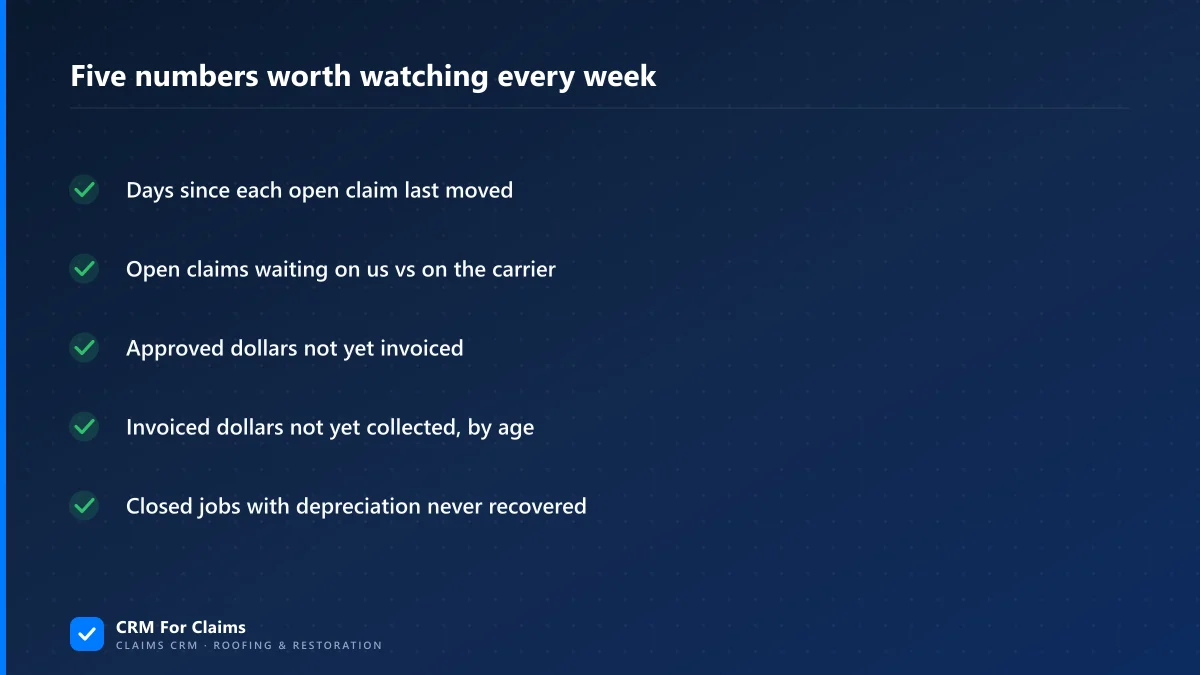
Days since last movement on each open claim; the waiting-on-us versus waiting-on-them split; approved dollars not yet invoiced; invoiced dollars not yet collected; and completed jobs with depreciation never recovered. The first two protect the work in flight. The last three are money you have already earned.
| The number | What it tells you | What you do with it |
|---|---|---|
| Days since last movement, per open claim | Which jobs have quietly gone still | Work the list from the top, oldest first |
| Open claims waiting on us vs on the carrier | Whether the backlog is yours or theirs | Clear your side; chase theirs by name and date |
| Approved dollars not yet invoiced | Work the carrier already agreed to pay for | Invoice it, or find out what is blocking it |
| Invoiced dollars not yet collected, by age | Where cash is sitting and for how long | Split by which payment you are waiting on |
| Completed jobs, depreciation never recovered | Money left behind after the work was done | File the completion documents and claim it |
1. Days since last movement, not days since intake
Days open tells you almost nothing on a claim, because a legitimate claim can be six weeks old and perfectly healthy. Days since anything last happened is the number that separates a claim that is waiting from a claim that has been forgotten.
The distinction matters because the two look identical in a list sorted by intake date. A claim sitting in adjuster review for nine days is a normal week in most markets; the same claim at thirty days, with no call logged and no follow-up scheduled, is a stall nobody chose. Pair this with the stage-by-stage view of a claim lifecycle, because the acceptable wait differs in every stage and one threshold across all of them will nag you about claims that are fine.
2. The waiting-on-us versus waiting-on-them split
Take every open claim and put it in one of two buckets: the next action is ours, or the next action belongs to the carrier, the adjuster or the homeowner. Then count both. That single split changes how the week gets planned more than any other number here.
A backlog that is 80% waiting-on-us is a capacity or a process problem, and it is entirely within your control. A backlog that is 80% waiting-on-them is a follow-up problem, and the fix is completely different — every claim in that bucket needs a named owner, a date it will be chased, and a record of the last contact. That two-queue habit came out of running a spike in claims during storm season, but it earns its keep in a quiet month too.
3. Approved dollars not yet invoiced
This is the gap between what a carrier has approved on your open claims and what you have actually billed against it. In most shops nobody has ever calculated it, and in most shops it is larger than expected — not because of dishonesty, but because invoicing is somebody's fifth priority on a busy week.
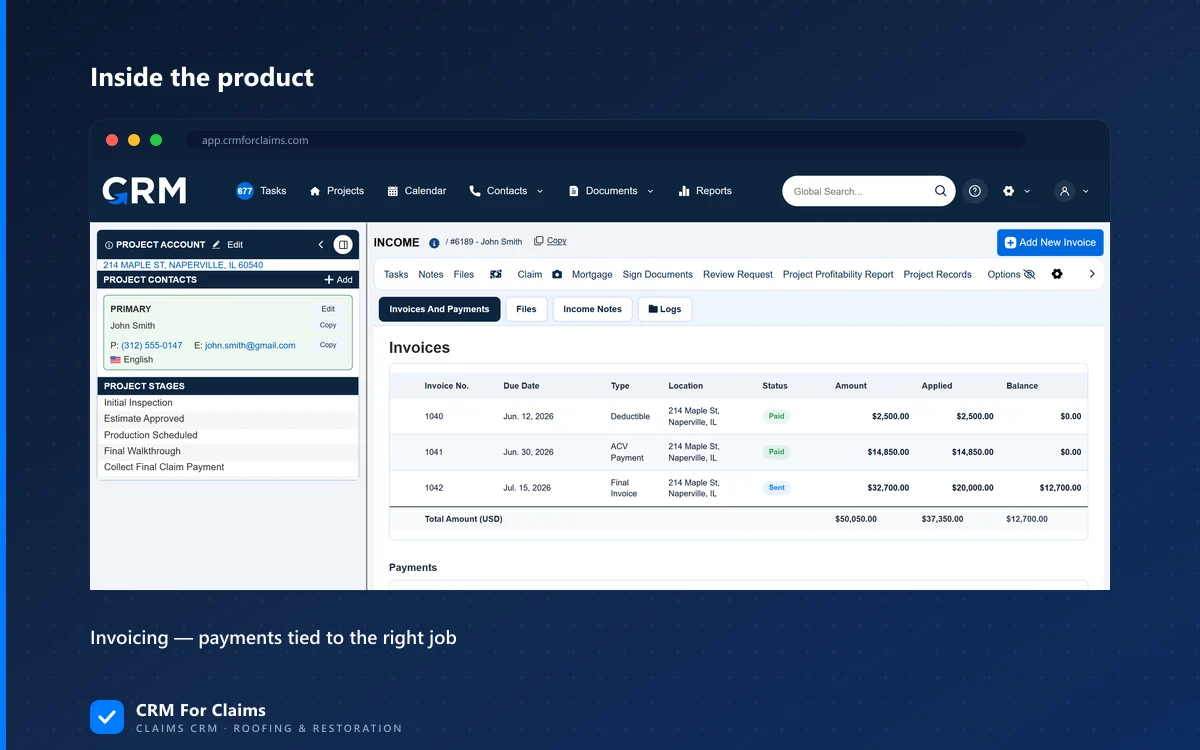
The number is only meaningful if your invoices are tied to the approved scope rather than to a total someone typed in, which is the case for invoicing against the approved scope. Once that link exists, the gap is computable rather than a matter of opinion, and every dollar in it is attached to a job you can name. Watch for the two honest causes before assuming neglect: work genuinely not finished yet, and supplements still under review that will change the total.
4. Invoiced dollars not yet collected — split by which payment
Ordinary accounts receivable aging is fine as far as it goes, and on insurance work it goes about half the distance. One approved estimate routinely becomes three separate payments: the actual cash value release, the deductible from the homeowner, and the recoverable depreciation after completion. Those three are owed by different parties, arrive on different schedules and get chased in completely different ways.
An aging report that lumps them together produces a number nobody can act on, because "sixty days out" means one thing when a carrier is processing a release and something else entirely when a homeowner has stopped answering the phone. Split the column. Note too that a mortgage company is frequently named as a payee on the carrier's check, which adds an endorsement step where a claim can sit for weeks with every party behaving normally.
5. Completed jobs where depreciation was never recovered
On a replacement cost policy the carrier typically holds back depreciation and releases it once the work is complete and documented. That release is not automatic. Somebody has to submit the completion paperwork and ask for it, and on a job that finished during a busy stretch, that somebody was busy.
This is the number I would check first in a company I had never seen before, because it is the only one on the list where the money has already been earned, the work is already done, and the file is closed in everybody's mind. Run it as a list, not a total: completed jobs from the last twelve months where depreciation was withheld and no corresponding payment was ever received. If that list is empty, good. It usually is not.
Which numbers quietly mislead you?
Four of them, mostly because they are averages, or because they add together things that are not the same kind of thing. None of them is fake — they are all accurate arithmetic on real data, which is precisely why they are convincing.
| The number | Why it misleads | Watch this instead |
|---|---|---|
| Total pipeline value | Adds estimated and approved figures, and counts replacement cost as if it were all collectable now | Approved dollars not yet invoiced |
| Average days to close | The mean hides the tail, and it blends your delay with the carrier delay | Days since last movement, as a list |
| Close rate on leads | Depends entirely on what you count as a lead and what counts as closed | Inspections that produced a filed claim |
| Revenue booked | Three different totals get called revenue: signed, approved, collected | Collected, aged by payment type |
Total pipeline value is the one I would remove first. It sums numbers at completely different levels of certainty — an estimate written yesterday, a scope approved last week, a supplement under review — and presents them as one figure with a dollar sign. It also counts full replacement cost on claims where only actual cash value has been released, so a healthy-looking pipeline can hold a lot of money that arrives only after the work is finished and filed.
Average days to close fails the ordinary way averages fail. A handful of claims sitting at 200 days barely moves the mean when the rest close in 40, so the number stays reassuring while a few files rot. A median plus a count of everything past a threshold you chose deliberately is more honest — but the list of stalled claims beats any summary statistic, because it comes with names attached.
Close rate is the most argued-about number in contracting and the least comparable, because it changes meaning depending on whether a lead is a phone call or a booked inspection, and on whether "closed" means a signed contingency agreement or an approved claim with work scheduled. A signed agreement is permission to pursue a claim on someone's behalf. It is not a job, and counting it as one is how a strong-looking month turns thin two months later.
Revenue booked is the same problem with a bigger dollar figure. Signed, approved and collected are three separate totals, and on insurance work the distance between them is measured in weeks. Pick one, name it out loud, and never let the three get quoted interchangeably in the same meeting.
How often should you look, and who should look?
Weekly, in a meeting, with the claims open in front of you. Not a monthly report and not a dashboard nobody has opened since it was built. The five numbers above take about twenty minutes to walk through when they are lists, and the output is a short set of assignments rather than a discussion.
Who attends matters more than the format. Whoever owns follow-up on stalled claims has to be in the room, and so does whoever raises invoices, because three of the five numbers are theirs. The owner reading a report alone on Sunday night produces frustration and no assignments — I have watched that pattern more than once, and the numbers were always correct.
What has to be true in your records before any of this works?
Six fields, kept honestly: current stage, date of last activity, who owes the next action, approved total, amount invoiced, amount collected. Every number on this page is a query over those six. If they live in three systems and one person's memory, no dashboard will save you.
- Stage, in your own wording — not "in progress". A stage that does not distinguish waiting-on-carrier from waiting-on-homeowner cannot produce the split in number two.
- Last activity, written automatically — if the date only updates when somebody remembers to update it, the stalled-claim list will show you the claims of the people who are conscientious about admin. Which is the opposite of what you need.
- Approved total as its own field — separate from the estimate, separate from the invoice, and re-checked when a supplement is approved.
- Invoiced and collected as separate fields — the gap between them is number four, and it cannot exist if they are the same box.
- A named owner per claim — a list with no owner is a discussion. A list with an owner is a task.
That is roughly the argument for a claims-shaped system over a general one: a generic CRM will happily store all six, but it has no opinion about them, so it cannot tell you that a claim has not moved or that approved money has not been billed. The side-by-side comparison of a claims CRM and a generic CRM covers where that difference actually shows up, and what the claim record holds is the shorter version.
When is a dashboard the wrong answer?
When you run few enough claims to recite them. If a company handles a couple of dozen insurance jobs a year and one person touches all of them, a Friday review of an open-claims list on a single screen beats any reporting layer. The numbers here are all still worth asking — they just do not need software to answer.
The threshold is not really volume, though. It is the first week you cannot answer "which claims have not moved?" out loud without opening anything. That is also roughly the point at which the record has to hold the answers rather than a person, which is the same threshold that decides when a second seat is worth paying for.
If you take one thing from this: build the lists before you build the totals. Every number worth watching in a claims business is a list of specific jobs with specific people attached, and the total on top of it is just a convenient way to notice the list got longer. Want to see what these five look like against your own open claims? Book a live walkthrough and bring the oldest job you have that nobody has touched in two weeks — that one usually explains the rest.