Insurance claim matching is the argument you have when the storm hit two slopes of a roof, the other four are untouched, and the shingle on the house has not been made for years. The carrier's scope pays for two slopes. You know that two slopes of a new color beside four slopes of the old one will look like a patch from the street, and so does the homeowner. Whether the undamaged slopes get included is not decided by how strongly anyone feels about it.
I build CRM For Claims, and matching is one of the few disputes on a claim where the outcome depends almost entirely on what is already in the file before you ask. The rule you are relying on, the product you are trying to match, and proof that it cannot be matched. This post covers where the obligation actually comes from, what evidence moves a carrier, and the cases where the right call is to drop it.
It is not the same job as reading an insurance scope line by line. That post checks the carrier's document for what is missing. This one is a single argument about what should be on it at all.
What does "matching" mean on an insurance claim?
Matching is the question of whether a carrier must replace undamaged material next to damaged material, so the repaired area does not visibly differ in quality, color or size. It applies to roofs and siding most often, but also to flooring, cabinets and any finish that runs continuously through a damaged and an undamaged area.
The three words do separate work. Color is the obvious one: a discontinued blend, or a current one that weathered differently. Size is the one people miss: older three-tab shingles were commonly made at a 5-inch exposure, and many current shingles are metric with a 5-5/8-inch exposure, so the courses physically do not line up. Quality covers a product line that no longer exists at the same grade.
Interiors raise the same question in a different form. Hardwood that runs through a doorway without a threshold is one continuous floor, and replacing the half that got wet produces a seam down the middle of a room. Kitchen cabinets where two boxes were destroyed and the door style is no longer made are the same argument with a different trade.
Where does a matching obligation actually come from?
It comes from three places: a state regulation or statute, the wording of the policy itself, and court decisions in that state. No single national rule applies. Some states have a written matching standard, some have none, and some policies carry endorsements that limit matching. Which of those applies decides how the argument is built.
The text most state rules descend from is a model regulation written by the National Association of Insurance Commissioners. A model regulation binds nobody on its own; it matters where a state adopted it or something like it. Its matching language reads:
"When a loss requires replacement of items and the replaced items do not match in quality, color or size, the insurer shall replace all items in the area so as to conform to a reasonably uniform appearance. This applies to interior and exterior losses."
NAIC Unfair Property/Casualty Claims Settlement Practices Model Regulation, Section 9 (standards for policies with replacement cost coverage)
Here is how that looks in two states that wrote it down, next to the other sources you will meet in practice:
| Source | What it says | What it means for your request |
|---|---|---|
| Kentucky, 806 KAR 12:095, Section 9(1)(b) | If replaced items do not reasonably match in quality, color and size, the insurer replaces all items in the area to a reasonably uniform appearance | Close to the model text. Your job is proving the mismatch, not arguing the principle |
| Florida Statutes section 626.9744(2) (homeowner policies) | Where replaced items do not match, the insurer makes reasonable repairs or replacement in adjoining areas, weighing cost, the uniformity achievable, remaining useful life and other factors | "Adjoining" and "reasonable" leave room. Expect a fight over how far the area extends |
| The policy's replacement cost wording | Repair or replacement with material of comparable kind and quality; exact phrasing varies by form | Read the actual form on this claim. Quote it, with the page, in the request |
| Endorsements limiting matching or cosmetic damage | Some policies narrow or exclude payment for undamaged material replaced only for appearance | Check the declarations page and every endorsement before promising the homeowner anything |
| States with no written standard | The answer depends on the policy and on that state's case law | Evidence matters even more, because there is no rule text to point to |
One caution I will not soften. I build software, I am not a lawyer, and the table above is a starting map rather than an opinion on your state. In many states only the policyholder or a licensed public adjuster may negotiate the claim itself. A contractor can document the building and explain the repair; whether you can do more than that is a question for your state's rules and your attorney.
What evidence actually wins a matching request?
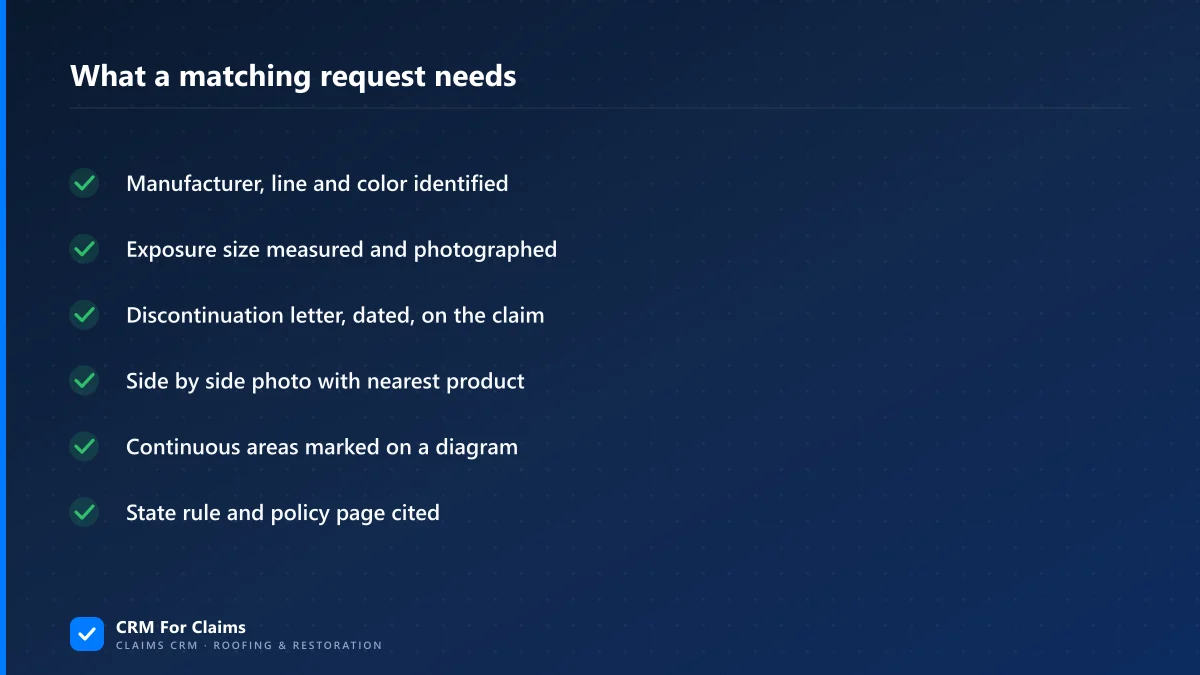
Evidence that turns "it will not look right" into a fact someone else can check. Identify the exact product on the house, prove it is no longer available or no longer the same size, show the nearest available product next to it, and mark which areas are continuous. Opinion loses; a dated letter from a manufacturer or distributor rarely does.
- Identify what is on the house. Manufacturer, product line and color name. For shingles, a wrapper left in the attic or a bundle tag in the garage is gold. Without one, a sample sent for identification is the usual route.
- Measure and photograph the size. A tape across the exposure of one course, photographed square to the camera, settles the 5-inch versus 5-5/8-inch question in a single image.
- Get the discontinuation in writing. A dated letter or email from the manufacturer or a distributor stating the line or color is no longer produced. Save it as a document on the claim, not as a forwarded email in someone's inbox.
- Shoot the nearest available product beside the old one. In daylight, at the same angle, at arm's length and from the ground. If the closest match is visibly different, the photo says so better than any sentence.
- Mark the continuous areas. A roof diagram with the damaged slopes shaded and the slopes visible together from the street noted. For interiors, a floor plan showing where the flooring runs without a break.
- Cite the rule and the policy wording. The section number of the state rule if one exists, and the page of the policy form. A request that names its basis gets read differently from one that asks for a favour.
Roofs and siding
The useful question is what a person sees from one viewpoint. Two slopes that cannot both be seen from anywhere make a weaker case than a front slope beside a garage slope facing the same street. Siding is easier to reason about by wall plane: a run that continues around a corner without a trim break reads as one surface.
Interiors
Continuity is the whole argument. A threshold, a change of room or a change of material is a natural stopping point; a floor flowing through an open-plan kitchen and living room has none. Photograph the transitions, not just the damage.
Why do carriers deny matching, and what can you answer?
Most denials fall into a handful of predictable reasons: a substitute is called close enough, the areas are said not to be seen together, an endorsement limits matching, or the request arrived with no proof. Each one has a specific answer, and each answer is a piece of evidence you either collected or did not.
| The reason given | What it usually means | The evidence that answers it |
|---|---|---|
| "A comparable product is available" | Someone picked a current line with a similar color name | Side-by-side photo of that exact product beside the existing material, plus the exposure measurement |
| "The areas are not visible together" | The adjuster judged sightlines from the scope, not the street | Ground-level photos showing the slopes or walls in one frame, with where they were taken from |
| "Weathering differences are expected" | An argument that any new material looks new for a while | Proof the difference is product or size, not age: the discontinuation letter and the measurement |
| "Matching is limited by the policy" | An endorsement on this policy may apply | The policy itself. If the endorsement is there, this may genuinely be the end of it |
| No reason, no reply | The request is sitting unread in a queue | A dated record of when it was sent and to whom, and a follow-up on a fixed date |
The last row is the most common and the least discussed. Matching requests usually travel as a supplement, and they stall the way supplements and approvals stall: nobody owns the follow-up, and three weeks later the crew is scheduled against the original scope.
How should a matching dispute live in the claim file?
On the claim record, as one package with a status and a date. The product photos, the measurement, the distributor letter, the request as sent, and the carrier's reply belong together, under the claim, visible to whoever picks it up next. Scattered across a phone, an inbox and a shared drive, the evidence exists but cannot be produced.
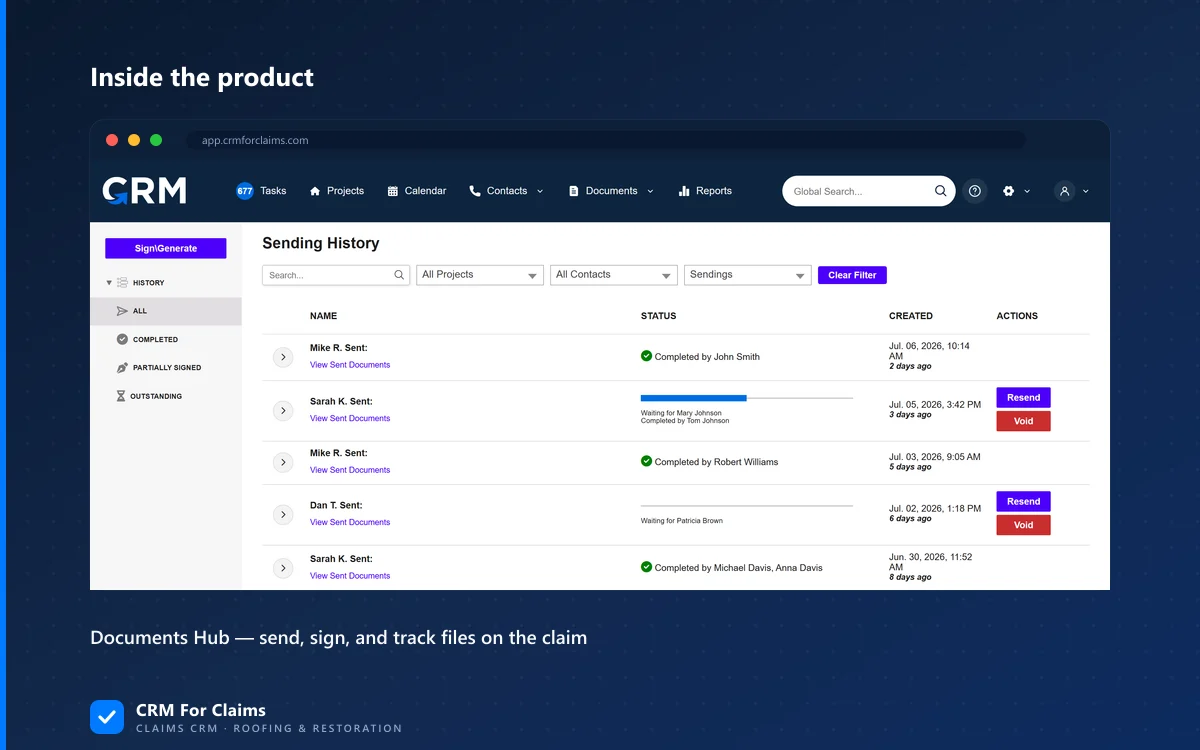
That is the part I can actually help with. In CRM For Claims the claim moves through stages you define, so "matching request sent" can be its own stage that creates a dated follow-up task the moment the claim enters it. The Documents Hub keeps the letter, the photos and the request on the claim, and emails and texts to the adjuster log themselves to the same record, so the sent date is a fact rather than someone's memory. Photos taken at the first inspection are already there, which matters, because the shots that prove continuity are the ones that are easiest to take before anyone climbs a ladder (the claim photo documentation guide covers what to shoot).
A generic CRM can hold the same files if somebody builds the folders, the stage and the reminder, and keeps everyone using them. That is a fair option for a team with the patience to build it. The side-by-side comparison of a claims CRM and a general one lays out what you would be building yourself.
When is it better to let a matching request go?
When the difference will not be seen, when an endorsement clearly excludes it, or when the homeowner has decided they can live with it. A matching fight costs weeks of carrier time and your follow-up, and it is only worth that when the result is visible and the evidence is strong.
- The back slope nobody sees. If the mismatched area faces a tree line and the rest of the roof is not visible with it, the case is weak and the homeowner may not care.
- The policy says no. A clear endorsement limiting matching is not a negotiating position. Tell the homeowner early, in writing, and stop.
- The homeowner chooses. It is their house and their claim. Explain what it will look like, show the side-by-side photo, and record their decision on the claim.
- Never promise the full roof first. Selling a homeowner on a complete replacement before the carrier agrees turns a coverage question into your problem when the answer is no.
Matching is won or lost on preparation that happens at the first inspection, long before anyone writes a request. If your team keeps that preparation in one place per claim, the request almost writes itself. If you would like to see how a claim, its documents and its follow-ups sit together, book a live walkthrough and bring a real matching dispute; it is the fastest way to see whether the setup fits how your office works. Plans and per-user costs are on the pricing page.