Short answer: An insurance scope is a priced list of line items, not a bill and not a ceiling on the work. Read it in three passes: quantities against your own measurements, structural add-ons like overhead and profit, sales tax and waste, then the summary math. Most of the money that goes missing is a line that is not there at all.
I build CRM For Claims, and the single most expensive habit I see in roofing and restoration offices is treating an insurance scope like a quote from a supplier — read the total, decide if it is survivable, sign. The total is the last thing worth looking at. A carrier scope is an argument about what the loss requires, written in the carrier's own format, and the useful information is in the structure rather than the number at the bottom.
Nobody teaches this. You learn it by losing a few thousand dollars on a roof where the drip edge was never written, and then you check for drip edge forever. This post is an attempt to shortcut that.
What is an insurance scope, and what is it not?
A scope is the carrier's itemised description of the repair: every task, its quantity, its unit price from a regional price list, and the arithmetic that turns those into replacement cost, depreciation and actual cash value. It is produced by the adjuster or an independent contracted by the carrier, usually in Xactimate, and it is the format the negotiation happens in.
Three things it is not:
- Not a bill. It is what the carrier currently believes the loss requires, and it gets revised. The revision process is called a supplement, and it exists precisely because first estimates are written fast — often from the ground, sometimes from a drone image.
- Not a limit on the work. The building needs what it needs. If the scope omits a step the manufacturer or the code requires, that step still has to happen; the only open question is who pays for it and under which document.
- Not your estimate. Yours is what the job costs you to do properly. Theirs is what the policy owes. When the two agree it is a coincidence, not a validation.
The header is worth ten seconds before anything else: date of loss, claim number, policy number, deductible, and the adjuster's contact. A scope written against the wrong date of loss quietly turns storm damage into wear and tear, and no amount of careful line-item review fixes that.
How do you read a single line item?
Every line item is the same six pieces of information, and only one of them is the price. Read them in order: what the task is, how much of it, at what rate, and then what the carrier is willing to release now versus later. The quantity column decides more arguments than the price column ever does.
| Field | What it holds | What goes wrong here |
|---|---|---|
| Category / selector code | Trade grouping — RFG for roofing, DRY for drywall, PNT for paint, WTR for water mitigation | Work written under the wrong trade gets missed when someone reads only their own section |
| Description | The task, including modifiers such as detach and reset, or remove and replace | Remove-only when the line should have been remove and replace |
| Quantity and unit | SQ (100 square feet of roof), SF, LF, EA, DA for daily equipment, HR for labour | The most common underpayment on the document, and the easiest to disprove |
| Unit price | Rate from the regional price list for that ZIP code, on an update cycle you do not control | Arguing the rate is usually the least productive fight available |
| RCV | Quantity times unit price — the full replacement cost of that line | Mistaken for what will be paid |
| Depreciation / ACV | Age-and-life reduction on that line, and what is left after it | Assumed to be permanent when much of it is recoverable on completion |
Two notes that matter more than they look. First, units are not interchangeable: a roofing square is one hundred square feet, so a scope listing 28 SQ describes 2,800 square feet of roof, and if your measurement report says 3,140 the gap is roughly three and a half squares of shingle plus everything attached to them. That is a provable disagreement, and a provable one beats a subjective one every time.
Second, depreciation is applied per line, not to the job. Whether labour can be depreciated at all — as opposed to only materials — is decided by state law and genuinely varies. Know the answer for the states you work in; on a large loss it is not a rounding error.
What is overhead and profit, and when is it actually owed?
Overhead and profit — O and P, or "ten and ten" — is a general contractor's margin for coordinating a job: ten percent overhead and ten percent profit added on top of the trade costs. It is not a bonus and it is not padding. It is the recognised cost of somebody managing multiple trades, ordering, scheduling, warrantying and standing behind the result.
The usual carrier standard is complexity: O and P is owed when the job is complex enough that a reasonable homeowner would hire a general contractor to run it, which in practice is commonly framed as three or more trades. There is no federal rule setting this. It is carrier practice, shaped in some states by insurance-department guidance, and it varies. If you work in more than one state it is worth reading what your own department of insurance has published rather than taking the adjuster's word or mine.
What to actually check on the summary page:
- Is it there at all? On a roof-plus-gutters-plus-interior-paint job it usually should be. On a single-trade shingle replacement, often not, and saying so honestly buys you credibility for the arguments you do need to have.
- Is it applied to the whole job or one section? A scope with three trades and O and P calculated on only one of them is an arithmetic issue, not a coverage dispute, and arithmetic issues get corrected quickly.
- Is it in the actual cash value release or held back? Some carriers treat O and P like recoverable depreciation and release it on completion. That is a cash-flow fact you need before you schedule crews, and it also moves the net claim figure the homeowner will read and quote back to you.
What is usually missing from a scope?
This is the part worth slowing down for. In my experience the money that disappears on claim work is rarely a price that was too low — it is a task that the estimate never mentioned, so nobody argued about it, so it was never approved, so somebody ate it. Missing lines are invisible by nature. You have to go looking for them on purpose.
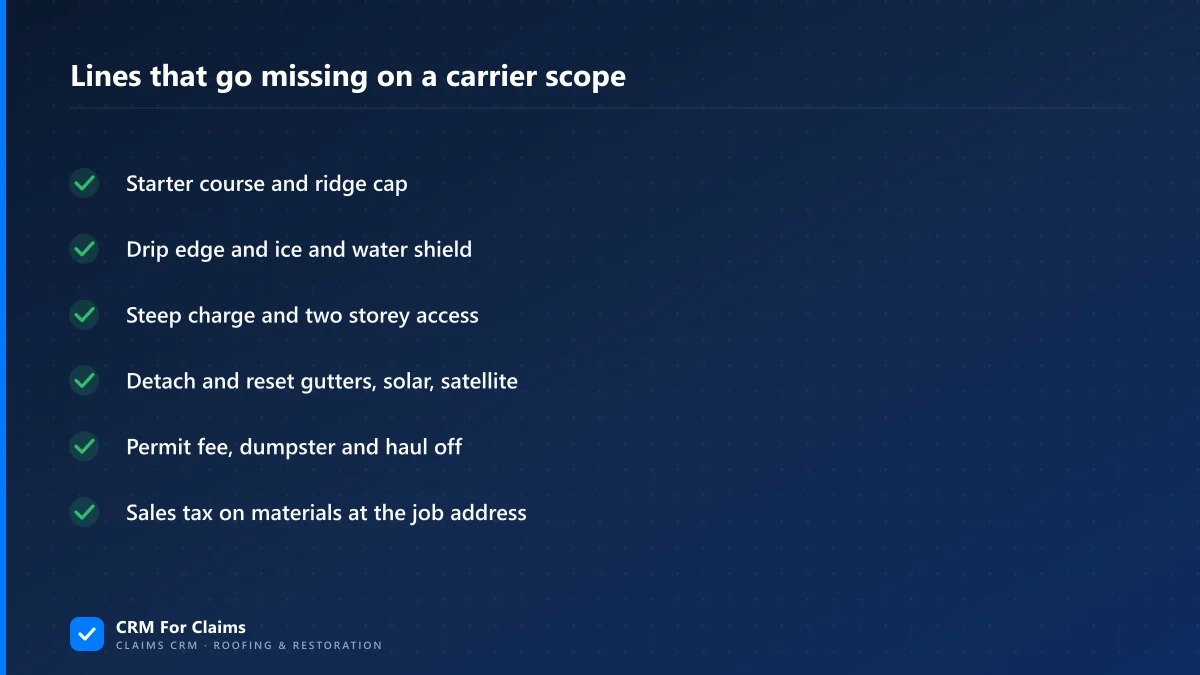
None of these are automatically owed on every job. They are the places to look, grouped by the trade you are checking.
| Trade | Commonly absent | Why it gets missed |
|---|---|---|
| Roofing | Starter course, ridge cap, drip edge, ice and water shield, waste on a cut-up roof | They are implied by the shingle line rather than visible in a photo, so a desk review never sees them |
| Roofing access | Steep charge, two-storey or high-roof charge, tear-off of a second layer | Not knowable from a ground-level or aerial inspection |
| Attached items | Detach and reset of gutters, solar panels, satellite dish, HVAC line sets | Written as a single roof line without the modifiers the actual work requires |
| Water mitigation | Containment barrier, HEPA air scrubber days separate from air mover days, monitoring visits, equipment setup and takedown, antimicrobial | Priced as a lump for drying rather than as dated daily equipment lines |
| Interior finishes | Stain-blocking seal before paint, second coat, texture matching, floor protection and masking, baseboard detach and reset | Paint is written as one line for one wall when the finished surface is continuous |
| Job-level | Permit fee, dumpster and haul-off, final cleaning, sales tax on materials at the job address | They belong to no single trade, so no trade section prompts anybody to add them |
Two of these are worth raising first because they are arithmetic rather than opinion. Sales tax is charged at the rate for the property, not the rate at your office, and on a re-roof with materials in the five figures that line is real money for zero argument. Waste is the other: a simple gable roof and a roof with six valleys and three dormers consume very different amounts of shingle for the same measured area, and waste is a calculated figure in the estimating platform — checkable, not debatable.
How do you check a scope in fifteen minutes?
Do it in a fixed order, the same way every time, before the crew is booked. The order matters because each pass rules out a class of problem, and because a checklist you can finish is worth more than a thorough review you keep postponing.
- Header. Date of loss, deductible, coverage type, adjuster contact. Wrong date of loss stops everything else being worth doing.
- Quantities against your measurement report. Roof area, linear feet of eave and rake, number of squares. This is the pass with the highest hit rate and the least argument.
- Count the trades. Three or more, and you are looking for overhead and profit on the summary. Note whether it is released now or on completion.
- Tax and job-level lines. Sales tax, permit, haul-off, final clean. Ten seconds, frequently productive.
- The missing-lines pass, against your own photos. Walk the trade table above with the inspection photos open. This is where a documented inspection stops being paperwork and starts being leverage.
- Summary math. Replacement cost, less depreciation, less deductible, equals the net claim. Confirm you can reproduce that number, and note which part of the depreciation is recoverable.
Anything the pass turns up is not yet a supplement. It is a list of candidates with evidence attached, and it becomes a supplement only when you have decided which ones are worth documenting and submitting. We wrote about that decision separately in the guide to supplements and approvals, including when the honest answer is not to file one.
Where does the scope live after you read it?
The review is worth as much as it is retrievable. Whoever reads the scope — usually an estimator or a production manager — finds things that four other people need weeks later, and the standard place to put that knowledge is in the reviewer's head, which is not a place.
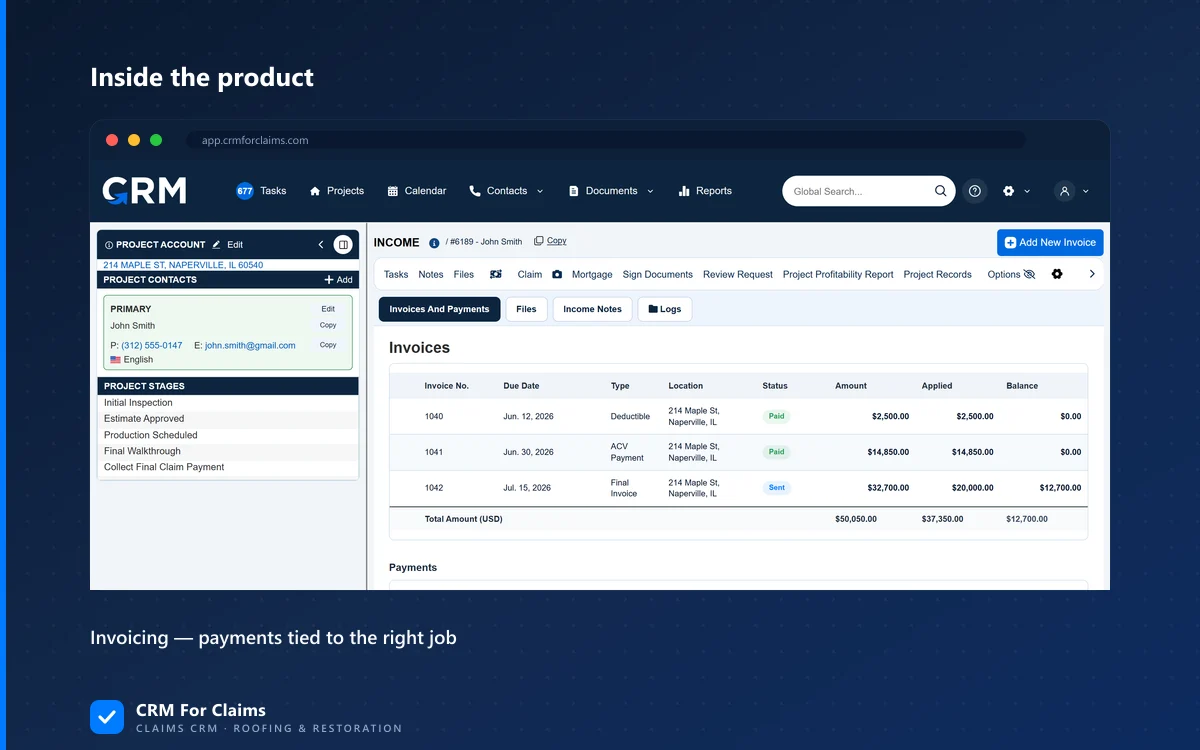
Three things have to survive the review. The document itself, versioned by date and what it is, because a carrier scope gets revised and building to last month's version is a silent failure — nobody reports reading the wrong file, they just install to it. The four numbers that leave the document and drive everything downstream: approved replacement cost as the billing ceiling, actual cash value as what has actually been released, the deductible as the only figure the homeowner personally owes, and the dates that reveal a stall. And the findings list, so the person filing the supplement is not re-deriving what the reviewer already worked out.
That is the job a claims CRM is for — holding the claim record, its documents and its money fields in one place rather than in an estimator's inbox. Where the boundary sits between the estimating platform and the CRM is its own question, and I have written the full argument for which system owns what, including why we do not build estimating and do not intend to.
None of this requires our software. A dated folder and a written findings note in a shared drive is a complete system for one person, and it stops being one at the second person — which is the difference a claims-specific tool is actually paid for, at a cost you can read on the pricing page before talking to anyone.
When the scope is fine and you should just build it
Plenty of them are. A single-trade loss with quantities inside a percent of your measurement, tax and permit present, no access complications and a deductible the homeowner already understands — read it, file it, schedule it. There is no prize for finding something.
Manufacturing a supplement out of a clean scope costs more than it returns. It burns the adjuster relationship you will need on the next genuinely underwritten file, it delays a job that could have been finished and invoiced, and reviewers remember which contractors send noise. The credibility you spend arguing about a two-hundred-dollar line is not available later for the four-thousand-dollar one.
The point of reading a scope carefully is not to find money. It is to know, before you commit a crew, exactly what has been agreed, what has not, and which of the two categories each open question belongs in. Most jobs that go wrong went wrong at that moment, quietly, weeks before anybody noticed. If you want to see how the claim record, the documents and the approved numbers fit together in practice, book a live walkthrough and bring a real scope with you — it is a better conversation than a feature list.