Short answer: A week makes a new hire useful and safe, not independent — anyone promising independent is selling something. The week works when you teach from finished claims you chose rather than whatever walks in the door, when the vocabulary comes before the software, and when the edge of their authority is written down instead of assumed.
I build CRM For Claims, and training a new hire on your claim process is the week almost every company improvises. There is a plan for the interview and a plan for the payroll paperwork. Then Monday arrives, somebody says “sit with Dave for a few days,” and the new person spends a week watching a stranger work at full speed while quietly building a private, wrong theory about what an ACV cheque is.
This is a different job from getting the software configured. That one is a setup problem, and I have written separately about what real claims CRM onboarding should include. Assume the system is already built around your process. This post is about the human who arrives afterwards.
What should a new hire be able to do after one week?
Four things, and none of them is “run a claim.” They should be able to open a claim record and say what stage it is at and what it is waiting on, write down what a phone call produced without inventing fields, make a routine outbound call from a script, and recognise the moment a question is above their authority and hand it off. Useful and safe. That is the target.
Writing the target down matters, because otherwise “trained” quietly comes to mean “has stopped asking questions.” Those are not the same state. Someone who has stopped asking after five days has either learned the job or learned that asking is expensive, and on a Friday afternoon the two look identical from the outside.
| Competence | What it looks like on Friday | How you actually check it |
|---|---|---|
| Reads a claim | Opens a record and states the stage, the owner, and what the claim is waiting on | Hand them three open claims and listen |
| Records what happened | Notes are dated and factual, and the facts are in fields rather than one long paragraph | Read what they typed on Wednesday |
| Runs a routine call | Follows the script, sets expectations, improvises nothing about coverage or money | Sit in on two of them |
| Knows the edge | Names the things they escalate, without pausing to think about it | Ask them to list the things they escalate |
Why does shadowing usually fail as a training plan?
Because the curriculum gets set by the weather. Shadowing teaches whatever happened to arrive that week. If no denial letter comes in, the new hire finishes the week never having seen one, and nobody notices, because the week felt busy and productive the entire time.
The second problem belongs to the teacher rather than the plan. An experienced person performs dozens of small steps and narrates a handful of them, and the ones they skip are exactly the ones that have become automatic — which is precisely the set a beginner cannot see. Ask a good estimator why they photographed the ridge before the elevation and you often get “that is just how you do it,” a true answer that teaches nothing.
The third problem is the expensive one. Shadowing transmits confidence faster than competence. The new hire watches Dave tell a homeowner “we will get that handled,” a sentence Dave can back because he has read the file and knows what the carrier already agreed to. She hears the sentence, not the file behind it, and she will use it in week two on a claim where it is not true.
None of that makes ride-alongs useless. Standing in a wet basement is the only way to learn what a wet basement looks like, and hearing a homeowner at hour six of a loss teaches something no document contains. Shadowing is an excellent supplement and a poor spine.
What is the fastest way to teach the claim process?
Closed claims. A finished claim is the only teaching object you already own where the ending is known, the whole sequence is visible in one sitting, and nothing the trainee touches can break. Pick five of them, spread across your real loss types, and have the new hire read them end to end before going near a live one.
The known ending is the entire point. A live claim is a mystery in progress, and a beginner watching one learns to imitate uncertainty. In a closed claim you can see that the supplement filed on day 40 was approved on day 61 and read the two emails that made the difference, and you can see that the job sat still for three weeks in March because a mortgagee endorsement went unchased. The cause and its consequence are both on the page, which is what makes it teachable.
Choose the five deliberately. At least one should be a claim that got denied and came back, and at least one should be a job that went sideways in production, because the shape of trouble is most of what you are actually teaching. Five clean claims teach a new hire that this work is clean.
It doubles as an audit of your own filing. If a stranger cannot follow one of your finished claims from intake to final payment, you find that out on the new hire’s first day rather than in month fourteen, when a warranty call arrives and nobody can reconstruct what was installed.
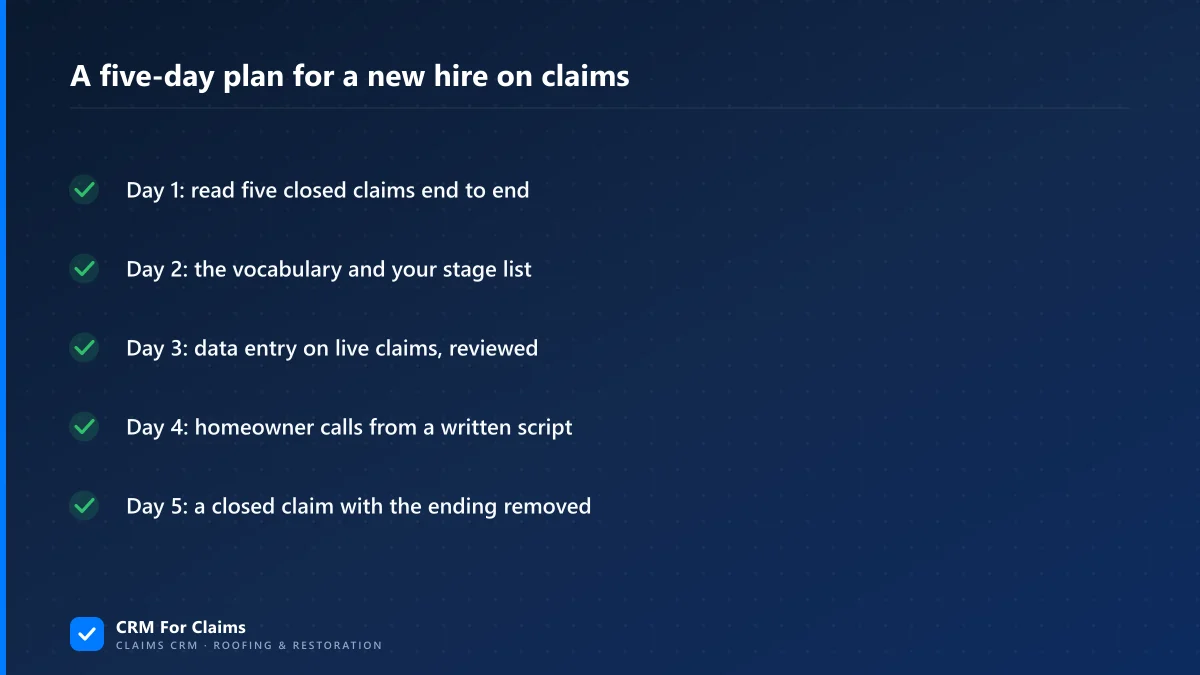
The week that comes out of it looks like this:
- Day 1 — read. Five closed claims, a page of notes on each, questions collected rather than asked. You answer twenty at four o’clock instead of twenty interruptions.
- Day 2 — words and stages. An hour on the vocabulary below, then a walk through your own stage list in your own wording. If you want the underlying shape first, the claim lifecycle stage by stage is the version I would hand someone.
- Day 3 — data entry, reviewed. Real claims, real notes, and somebody checks every entry before end of day. Reviewed work is training; unreviewed work is just work.
- Day 4 — calls from a script. Listening first, then the routine ones: appointment confirmations, status updates, document chasers.
- Day 5 — the test. A closed claim with the ending removed.
Which claim words do they have to know by Friday?
The dozen that carry money. A new hire who nods along at ACV, recoverable depreciation, deductible, scope and supplement will be using those words in front of a homeowner by week two, and using one of them wrongly on the phone is not a small mistake. It is a promise the company then has to either keep or take back.
The reason this goes wrong is social, not intellectual. Nobody asks what ACV means on day three, because on day one everybody said it eleven times and asking now would reveal that they did not understand it then. The window for asking closes within about forty-eight hours, so teach the words on purpose, in an hour, and give them a page to keep at their desk.
| Term | What it means | Why it matters in week one |
|---|---|---|
| Date of loss | The date the damage actually happened, as recorded on the claim | Wrong by three weeks and storm damage becomes wear and tear |
| Actual cash value (ACV) | The NAIC glossary puts it as replacement cost minus depreciation | It is the first cheque, not the whole price — and homeowners hear “the cheque came” as “this is finished” |
| Replacement cost | The NAIC glossary: the cost of replacing property without a reduction for depreciation | What the job is worth if the work gets done and proven |
| Recoverable depreciation | The withheld difference between the two, released after completion is proven | The reason a finished job is not yet a paid job |
| Deductible | The policyholder’s share, subtracted by the carrier before any cheque is issued | The single most dangerous number for a new hire to discuss |
| Scope | The carrier’s line-item list of what they have agreed to pay for | Not the same document as your estimate, and beginners conflate them daily |
| Supplement | A request for more money on a claim everyone already agrees is covered | Not an appeal, and not a change order — three different documents |
Take the value definitions from a neutral source rather than from the office. The NAIC glossary of insurance terms is the one I hand people, and a new hire who has read the regulators’ own wording once is much harder to talk in circles later.
What should a new hire never do in their first week?
Four things: give an opinion about what the policy covers, say anything at all about the deductible, promise a date they did not get from the person who controls it, and speak to the adjuster unsupervised. Each of those is a sentence that binds the company, spoken by somebody who has worked here for four days.
The coverage one is not only a judgement problem. Several states restrict this directly — interpreting policy provisions or advising an insured about their coverage is public adjusting activity, and doing it without a licence is prohibited for contractors in those states. It is worth having your own attorney answer that question for your state once, and then putting the answer into the training rather than into folklore.
| Do not | Why | What to say instead |
|---|---|---|
| Interpret coverage | Regulated activity in several states, and an opinion the company then owns | “That is a policy question and I want the right person answering it. I will have someone call you today.” |
| Discuss the deductible | A legal exposure in several states, and a discount off a price you did not set | “Your deductible comes from your policy, not from us. Let me get you the exact figure and how it shows on the invoice.” |
| Promise a date | The adjuster’s calendar, the carrier’s approval and the supplier’s truck are all outside your building | “I do not want to guess at that. I will find out today and text you either way.” |
| Call the adjuster alone | First impression of your company on a person whose decisions cost you money | Nothing — they are on the call to listen this week |
The sentence to ban outright is “we will take care of that.” It is warm, it is helpful, and it commits the company to something the speaker cannot describe. New hires reach for it precisely because they cannot answer the question.
One thing that is not about claims at all, and gets forgotten because it belongs to a different manager: if this hire is going on a roof, fall protection training is a legal requirement with a paperwork requirement attached. The federal rule is explicit that the employer “shall verify compliance… by preparing a written certification record” containing the employee’s name, the dates of training and a signature. A claim-process training week that does not also produce that record has left an obligation open.
How do you know the week actually worked?
Not by asking how they feel. Give them a closed claim with the ending removed — the intake, the photos, the scope and the first carrier response, and nothing after that — then ask three questions. What stage is this at? What is it waiting on? What would you do next? You already know the real answer, because the claim is finished.
The reason this test is better than a software quiz is that it measures judgement against a real file rather than recall of a menu. It takes twenty minutes, it needs no preparation beyond choosing the claim once, and it is repeatable: every hire after this one gets the same file, so for the first time you can compare people on something other than impressions.
It also tests you. If three hires in a row all miss the same thing on the same claim, that is not three weak candidates — it is a hole in how the process is explained, and the new people found it for free. Keep the claims you use. Six of them is a curriculum.
A fail on Friday is information, not a firing. The usual cause is a week that was too passive — a lot of watching, very little producing — and the fix is to move the reviewed data entry earlier and cut a day of shadowing, rather than to extend the programme by a month.
What does the training week need from your software?
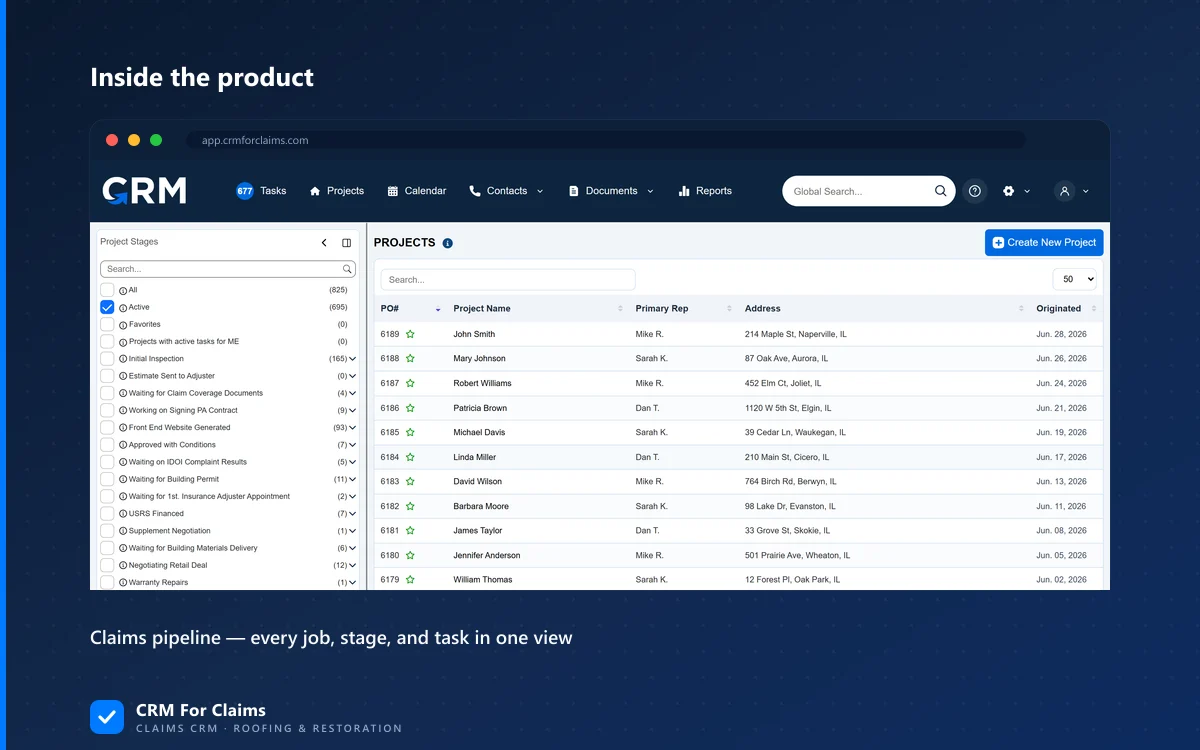
Four things, and none of them requires our product specifically. Finished claims a stranger can read end to end. A read-only week that is a real permission rather than a promise. Scripts and document templates living on the record instead of in somebody’s head. And one named owner per claim, so the new person always knows exactly who to ask.
The read-only week is the item people skip, and it is the one that changes the tone of the whole week. If “look at anything, change nothing” is enforced by the permissions on the account rather than by trust, you can hand a brand-new person the entire claim history on Monday morning without a nervous conversation. Trust-based read-only means supervising every click, which nobody has time for, so in practice the new hire gets shown three claims and told about the rest.
Worth being straight about the cost, since it is a real line in the decision: on our plans an extra person is $39 per month per additional user, and a read-only training week costs exactly the same as a working week. If you are evaluating vendors, the question I would ask in a demo is narrow and hard to dodge: show me how somebody hired on Monday reads a claim that closed last year. Most tools can show you a shiny pipeline; fewer can show you a legible history, which is what the comparison actually turns on.
What software will not do is decide what your stages mean, write your scripts, or tell you whether Friday’s test was passed. And if you are one person hiring your first employee, you do not need a training programme at all — you need five closed claims printed out, an hour on the vocabulary, and the same Friday test. The plan above is the same plan; it just fits on one page.
The honest summary is that a week buys you a colleague who is useful on the routine work and safe on the rest, and that is a good week. Independence takes months, and it arrives claim by claim rather than on a date. If you want to see what the reading half of that week looks like on a real claim record, I am happy to walk you through a live claim file and you can judge whether a stranger could follow it.