A roof claim appraisal is worth it when the carrier agrees the roof was damaged, disagrees with you on how much it costs to fix, and the gap between the two numbers is big enough to pay for two appraisers and half an umpire with money left over. It is the wrong tool when the carrier says there is no storm damage at all, because appraisers decide the amount of a loss, not whether the policy covers it. And the roofer who holds the contract is not the person who should sit on the panel.
I build CRM For Claims, a CRM for roofing and restoration companies that work insurance claims, so I see the files that end up here: the reinspection did not move the number, the supplement came back short, and somebody says "let's go to appraisal" as if it were free. It is not free, and it can go below the carrier's own figure. The homeowner makes the demand and pays for it. Your job is to help them decide with real numbers and to hand their appraiser a file that holds up.
Is the roof fight about the amount or about coverage?
Appraisal settles the amount. The Texas Department of Insurance says it in one line in its home insurance guide: the process is for disputes about the amount of a claim, not about whether the policy covers a loss. Most roof disagreements are a mix, so sort them line by line before anyone signs a demand.
| What you disagree on | Which kind | What to do with it |
|---|---|---|
| Number of squares, waste factor, ridge and starter footage | Amount | Appraisal fits. Bring the measurement report and the slope photos. |
| Price per square, steep and high charges, tear-off layers | Amount | Appraisal fits well. This is the kind of gap a panel resolves fastest. |
| Repair a few slopes or replace the whole roof | Usually amount | Often argued both ways. Carriers call it coverage, policyholders call it scope. Expect a fight about whether the panel may decide it. |
| Matching the undamaged slopes | Depends on the state | Settle the rule first, as in the post on matching undamaged areas on a claim. |
| Drip edge, ice barrier and other code items | Coverage first | Read the ordinance or law limit before arguing the price, see who pays code items on a roof claim. |
| "No hail damage", wear and tear, manufacturing defect | Coverage | Not an appraisal question. That is a denial, and it goes to a reinspection, a public adjuster or an attorney. |
If the carrier never sent anyone back up the roof, ask for that first. A second visit costs the homeowner nothing, and the post on getting the adjuster back on the roof covers how to ask for one. Appraisal is the step after the conversation has stopped working.
One roof, worked through: the gap minus the cost
The numbers below are made up to show the arithmetic. Your estimate for the roof is $19,400. The carrier's estimate is $11,900. The gap is $7,500. The homeowner's appraiser quotes $1,800, and an umpire, if one is needed, bills $2,400, split in half. Each side pays its own appraiser and half of the umpire, which is the split the Texas guide describes and the one most policies carry.
| How it ends | Amount of loss | Above the carrier | Homeowner pays | Left over |
|---|---|---|---|---|
| The two appraisers meet in the middle | $15,650 | $3,750 | $1,800 | $1,950 |
| Umpire agrees with your side | $19,400 | $7,500 | $3,000 | $4,500 |
| Umpire agrees with the carrier | $11,900 | $0 | $3,000 | minus $3,000 |
| Umpire lands below both | $10,900 | minus $1,000 | $3,000 | minus $4,000 |
Deductible and depreciation are left out on purpose: they apply the same way in every row.
Two rows out of four lose money. On a $7,500 gap the homeowner is betting $1,800 to $3,000 to win it back, and the bet only makes sense when the gap is in the lines that sort as amount in the table above and your file proves each one. On a $2,500 gap the fees eat the win in almost every row. Do this sum with the homeowner, on paper, before anyone writes the word "demand".
The last row comes from a real Texas roof.
An award is very hard to undo. Texas Insurance Code Chapter 1813, added by Senate Bill 458, makes it binding except for fraud, accident, material mistake or an award made without authority. Treat the decision to appraise as final, because it usually is.
What the rules let a roofer do in an appraisal
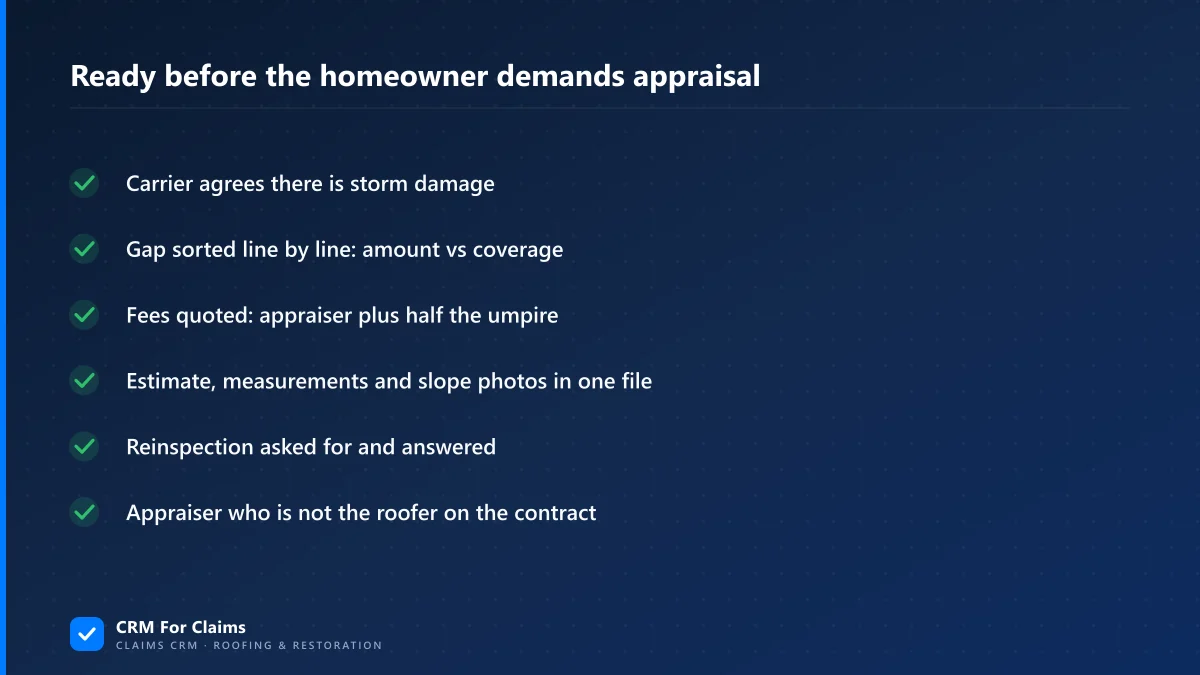
The roofer supplies the evidence; somebody independent argues the number. The Texas proposed rules, published in the Texas Register on May 8, 2026, require every appraiser and umpire to be competent for the type of loss, independent from the parties and disinterested in the outcome (proposed 28 TAC 5.9804). The company that signed the contract to replace the roof has an interest in the outcome by definition. Outside Texas, the wording on who may serve is in the appraisal clause of the homeowner's own policy, so read that paragraph before anyone is named.
That leaves plenty of real work for you. The homeowner's appraiser will ask for your estimate line by line, the measurement report, dated photos of every slope, the test squares, the carrier's estimate, the reinspection notes and anything in writing from the adjuster. If those live in six places, the appraiser bills hours to collect them, and the homeowner pays for those hours out of the same gap. In states that limit what a contractor may say about a claim, keep to facts about the roof and leave the negotiating to the appraiser or a licensed public adjuster.
Texas put a clock on it for policies from September 1, 2026
Most appraisal clauses never said how long anything takes, which is why files sat for months. Since January 1, 2026 every Texas residential policy issued or renewed must carry an appraisal clause, and the proposed rules attach deadlines to policies delivered or renewed on or after September 1, 2026. Counting from the carrier's written decision on the claim:
- Up to 1 yearEither side may demand appraisal in writing within one year of the carrier's notice accepting or rejecting the claim.
- 20 daysAfter the demand, each side hires its appraiser and sends the other side the name and contact details in writing.
- 15 daysThe two appraisers choose an umpire together. If they cannot, either side can ask a court in the county where the house is to appoint one.
- 120 daysFrom the demand, the appraisers try to agree on the amount of loss between themselves.
- 240 daysFrom the demand, the award with an umpire has to be issued. Past that, the umpire's engagement ends and a new one is chosen within 15 days.
The hearing on these rules was held on June 2, 2026, so check the final text on the TDI site before you quote a deadline to a homeowner. The 20-day and 15-day steps are the ones that slip, because nobody owns them.
Keeping the appraisal on the claim file
An appraisal adds people and money to a file that was already busy, and the worst outcome is someone in your office sending a fresh supplement to the adjuster while the amount sits with the appraisers. CRM For Claims marks the claim so that does not happen.
The Appraisal tab on the claim screen appears once a claim number is saved. Press Start Appraisal and the public appraisal company becomes a required pick. After it is saved, everyone who opens the claim reads "This Project has started APPRAISAL!" in the claim information, so nobody misses that the amount is out of your hands. Once an appraisal company is chosen, an Umpire tab appears next to it. The carrier's appraiser goes in a list of its own, Carrier Appraisal Companies. The record of the homeowner's appraiser can hold an hourly rate, which is the number you need for the sum above.
For the deadlines, a task on the claim takes a due date in one click, with buttons for the same day, 3 days, 5 days or a month, or any date from a calendar. Give the 20-day and 15-day steps a name and a date the day the demand goes out.
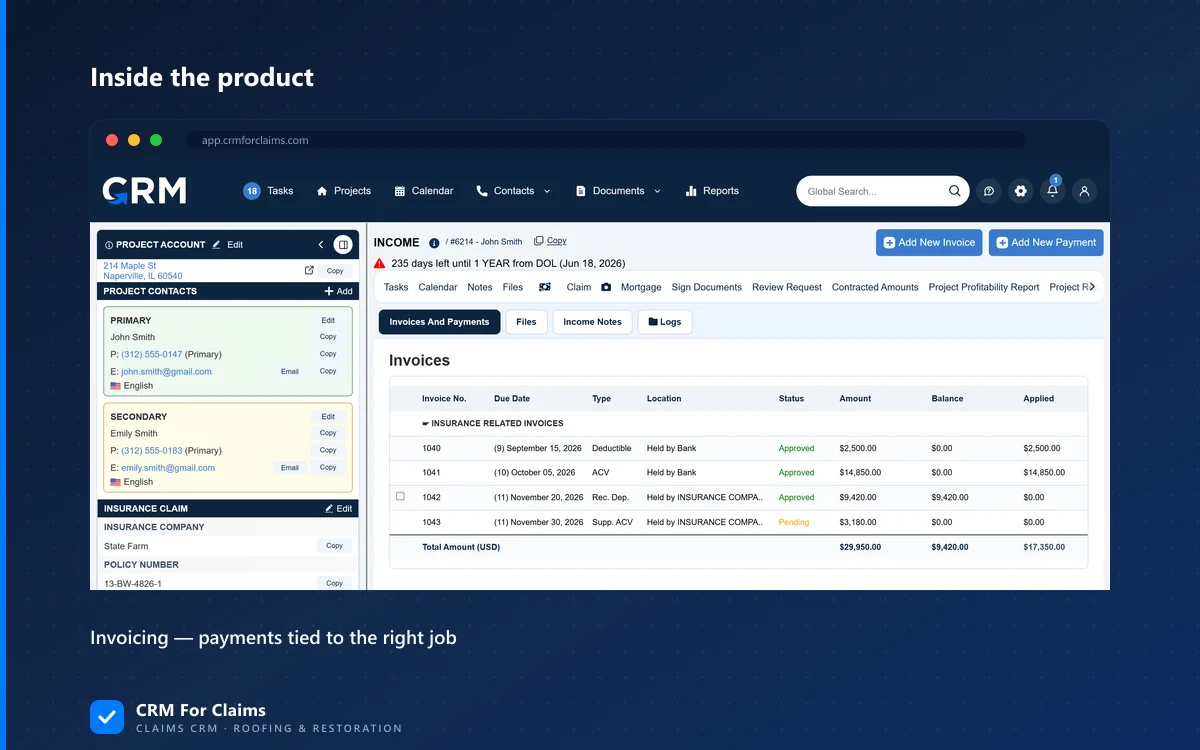
When the award comes in, it is invoiced under its own types, such as Appraisal ACV and Appraisal Recoverable Depreciation, kept apart from the first approval and the supplements. The appraiser's bill is a project expense with the type Appraisal/Arbitration Fee. The Master Report shows an Appraisal approvals line next to the initial and supplemental ones, so a month with one big award does not pass for a month of good estimates. The insurance appraisal tracking page walks through each screen, and the supplement tracking page shows how the same split works for supplement money.
If a claim on your desk is heading toward appraisal and you want to see it set up on a real screen, book a live walkthrough and bring the two estimates. The pricing page lists the plans, billed monthly with no contract.