A roof claim reinspection is a second visit by the insurance company, usually with a different adjuster, to look again at damage the first visit missed or measured wrong. You get one by asking in writing, naming each item that was missed and attaching the proof for it, and then by being on the roof when the adjuster comes back. A phone call that says "the number is too low" rarely brings anyone back. A dated list of five missed items with photos usually gets a calendar slot.
I build CRM For Claims, and the second visit is where a lot of roof claims are actually decided. The first inspection is often short, sometimes done from a ladder at the eave, sometimes done before the contractor was even hired. This post is the contractor's side of the do-over: when to ask, how to word it, and what to show the adjuster in what order.
When is a reinspection worth asking for?
Ask when you can point at something specific the first visit did not see or did not count, and you hold proof of it. Do not ask because the total feels light. The carrier decides whether to send someone back, and a request built on items is much harder to set aside than a request built on a feeling.
Before you ask, read the estimate the way an adjuster wrote it. The post on how to read an insurance scope walks through line items, overhead and profit and what tends to go missing. Then sort what you found:
| What the first visit got wrong | Proof you should already hold | Ask? |
|---|---|---|
| Adjuster never walked the roof | Your own test-square photos per slope, with chalk marks visible | Yes |
| A slope or a detached garage left off | Overview photo of that slope or building plus close-ups of the hits | Yes |
| Layers counted as one when there are two | Photo of a lifted edge or a core cut showing both layers | Yes |
| Wrong pitch, so wrong steep charges | Pitch gauge photo on the slope in question | Yes |
| Collateral damage ignored (gutters, vents, screens) | Dated photos tying the dents to the same storm | Yes |
| Missing line items only (drip edge, ice and water) | The estimate itself and your measurements | No, supplement |
| You disagree with the unit prices | Your own estimate | No, pricing |
The last two rows matter. A missing drip edge line does not need anyone to climb a ladder again; it needs a written supplement with the measurement attached. Asking for a reinspection over pricing just burns the adjuster's patience on a visit that cannot change the number. If the carrier has already denied the claim outright, start with the post on what to do when a claim is denied, because the order of steps there is different.
Writing the request so it cannot get lost
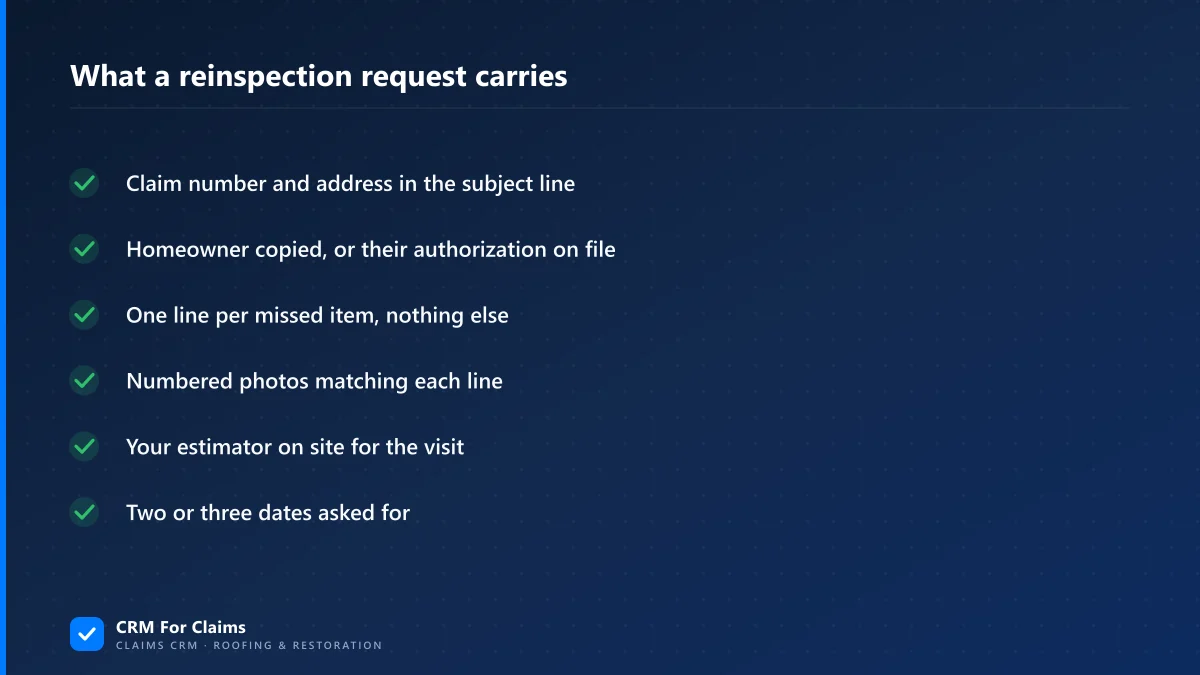
Send it by email to the desk adjuster or the claim inbox named on the carrier's letters, with the homeowner copied, and put the claim number in the subject line. The homeowner owns the claim, so either the request comes from them or it comes from you with their written authorization already on file. Keep it short. Each missed item gets one line and one attachment.
Subject: Claim [number], [property address]: request for reinspection of roof
Hello [adjuster name],
On behalf of [homeowner name], who is copied here, we are asking for a reinspection of the roof at [address]. The inspection on [date] did not include the following:
1. The rear slope over the family room (photos 1 to 4, test square marked).
2. The detached garage roof (photos 5 to 7).
3. A second layer of shingles across the main roof (photo 8, lifted edge).
4. Dented gutters and downspouts on the north elevation (photos 9 to 12).
Our estimator will be on site for the visit. Please send two or three dates that work for you.
Thank you,
[name, company, phone]
Notice what is not in it: no adjectives, no complaint about the first adjuster, no total. You want the person reading it to forward it, not to defend a colleague.
Then watch the clock. In Illinois, the insurance regulation defines "reasonable promptness" in answering a claimant as at most 15 working days from a communication that is materially related to the claim (50 Ill. Adm. Code 919.40). Other states set their own standards, so check yours. Put a follow-up date on the claim the day you send the request. If nothing has come back by then, send the same email again with "second request" at the front of the subject. Two dated requests on the file are worth a lot more than five phone calls nobody wrote down.
The roof walk, in the order you want the adjuster to see it
The adjuster decides where to go, but you can make the obvious route the one that covers your list. Have a ladder up and footed before they arrive, your photos on a tablet in the same numbering as the email, and a printed copy of the request in your hand. Then walk it in this order:
- 1Start where the request starts
- Take them to item one first, the slope they did not walk. It sets the tone: the visit is about the list, not a fresh debate about the whole roof.
- 2Test squares, slope by slope
- Leave your chalk marks in place from your own inspection so they can count hits inside the same square. If they draw their own, photograph theirs next to yours.
- 3Layers and decking at an edge
- Show the lifted shingle or the core cut. If the deck under it is spaced boards or visibly soft, show that here too, because decking changes the tear-off.
- 4Pitch on the steep slopes
- Put the gauge on the slope in front of them. Steep and high charges depend on a number nobody should be guessing from the yard.
- 5Edges and penetrations
- Drip edge, flashing at chimneys and walls, pipe boots, vents. Whether these are present and what condition they are in feeds both the reinspection and any supplement afterwards.
- 6Collateral on the ground
- Gutters, downspouts, window screens, the mailbox, the fence cap. Soft metal dents are the adjuster's own evidence that hail of a certain size fell on this property.
- 7The other buildings
- Detached garage, shed, pergola. These are the items most often left off a first visit, and they are on a different coverage line, so name them out loud.
Write down what the adjuster says on the roof, in their words, with the time. "I'll add the garage" said at 10:40 is a fact you can quote back in an email the same afternoon. The same sentence remembered a week later is a disagreement.
What goes on the claim file after the second visit
The revised estimate usually arrives days or weeks after the visit, and by then the details are fuzzy unless they were written down on the claim. In CRM For Claims, each project has a roof inspection checklist screen. It records up to four roof layers with the material of each, from 3-tab or architectural shingles on top down to the layers underneath. It records damaged decking as 10%, 25%, 50%, 100% or spaced boards. It records the slope from 1/12 up to 12/12 or mansard. Ice and water, drip edge and detach-and-reset gutters are each marked Present, Absent or 50/50, and picking 50/50 opens a description field for the details. Those are the same facts you argue on the roof, kept on the project instead of on a notepad in the truck.
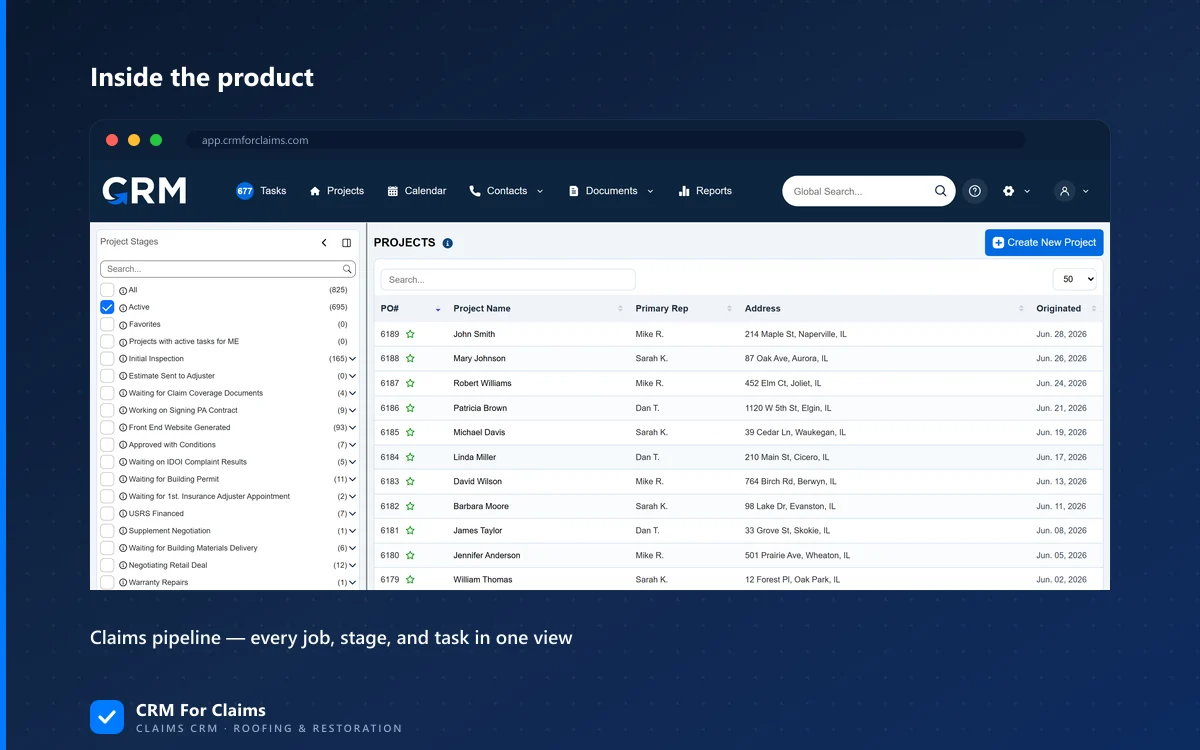
The claim screen links a field adjuster and an inside adjuster to the claim, picked from your contacts. When the reinspection is done by someone new, you add that adjuster to the claim, and the next person in your office who opens the file knows who walked the roof and who wrote the revised estimate. The photos belong on the same claim, named and dated the way the post on claim photo documentation describes, so photo 8 in your email is still photo 8 a month later.
When the revised estimate lands, compare it with the request item by item. Anything added goes into the scope you build from. Anything still missing becomes a supplement with the reinspection date on it, since you now have two visits that saw the same roof.
The claims pipeline page shows how a claim moves from inspection to approval, and the full feature list covers the claim and project screens. If you want to see a roof claim with a reinspection set up from the first visit to the revised estimate, book a live walkthrough and bring a file where the first adjuster never got on the roof.