On a hail roof claim with a roof payment schedule, the insurance company pays a fixed share of the roof estimate, and that share is set by the age and the material of the roof. The rest of the price belongs to the homeowner. It is not a depreciation holdback you collect after the work is done, and it is not something you can quietly absorb. If you find out on the day the check arrives, you find out about a hole in your own contract.
I build CRM For Claims, and this endorsement now sits on a lot of the hail files I see. The pages that explain it are written for people buying insurance. This one is for the roofer standing in the driveway, who has to know what the check will be before the homeowner signs.
What does a roof payment schedule actually pay?
It pays the carrier's own estimate for the roof multiplied by a percentage from a table printed in the policy. A new roof gets 100%. An older one gets less every year, down to a floor that depends on the material. The schedule applies to wind and hail damage to the roof, and the rest of the house is settled the way the policy normally settles it.
Most explanations online use made-up round numbers. Farm Bureau Financial Services published its real dwelling schedule in a two-page sheet (form 720-299, effective June 23, 2026), so I'll use that. Here is part of it, every fifth year:
| Age | Class 3/4 | Shingle | Wood | Metal |
|---|---|---|---|---|
| New | 100% | 100% | 100% | 100% |
| 5 years | 92% | 90% | 87.5% | 95% |
| 10 years | 82% | 80% | 75% | 90% |
| 15 years | 72% | 70% | 62.5% | 85% |
| 20 years | 60.5% | 60% | 50% | 80% |
| 25 years | 50% | 50% | 37.5% | 75% |
| 30 years | 40% | 40% | 25% | 75% |
Source: Farm Bureau Financial Services, Roof System Payment Schedule for dwellings. Class 3/4 means UL Class 3 or 4 impact-rated composition, wood or other shingles (metal has its own column); Shingle means composition shingles that are not impact rated; Wood means wood shingles or shakes that are not impact rated. The full sheet lists every year and eight materials. It does not apply in New Mexico.
Three things in that sheet matter more than the numbers. It is one carrier's schedule, and the next carrier's table will differ. The same sheet says roofs 15 years old or newer may qualify for full replacement cost, so two neighbors with the same carrier can be on different terms. And it says plainly that the current copy is in the policy documents. The homeowner's declarations page is the only schedule that counts for their claim.
One $21,600 roof at three ages
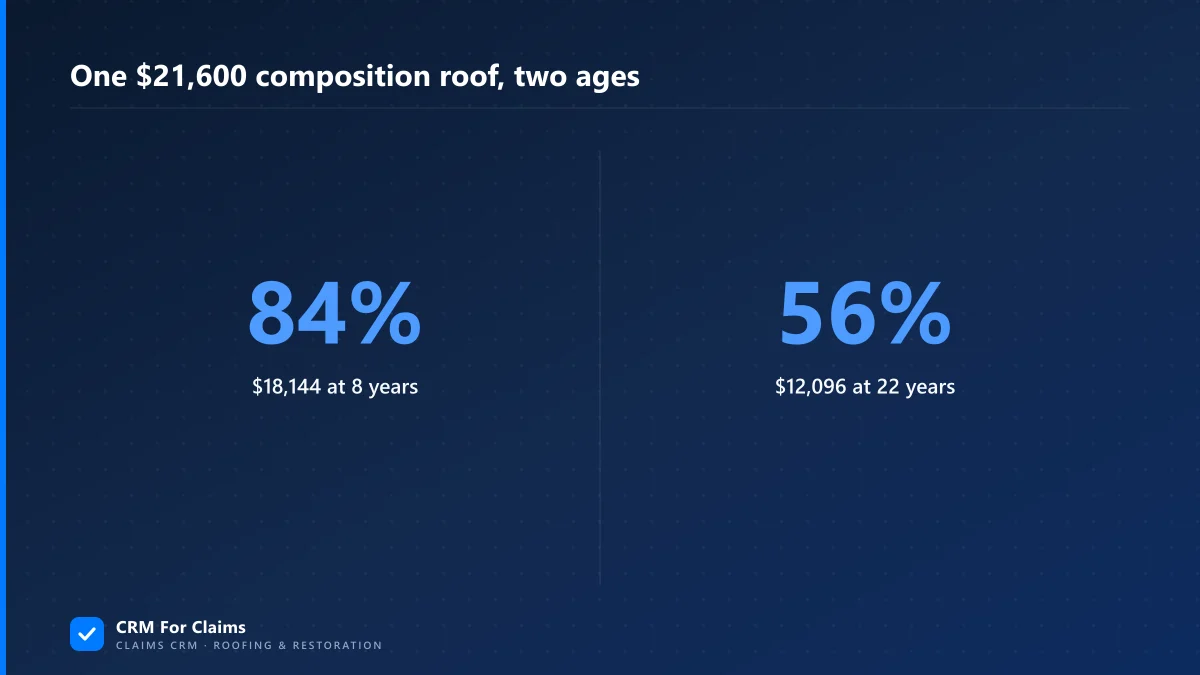
Take a composition shingle roof, not impact rated, that the adjuster agrees will cost $21,600 to replace. Same storm, same house, same scope. Only the age on the policy changes.
Those are amounts before the deductible. The deductible still applies, and many hail policies carry a separate wind and hail deductible, sometimes a percentage of the dwelling limit instead of a flat figure. The endorsement and the declarations say how the two are combined, so read them or ask the adjuster for the math in writing. Do not guess the order on a homeowner's behalf.
Now the uncomfortable part. On a replacement cost policy, a homeowner with a 22-year-old roof would get the ACV check first and the held-back depreciation after you finish, which our post on recovering depreciation after the work is done walks through. Under a schedule, one form quoted in trade press says the carrier "will pay no more than the percentage," and nothing in that wording promises a second check for the roof the way a replacement cost holdback does. Plan as if that $9,504 is real money from the homeowner's savings, a loan or financing, and it should be agreed before you order a single bundle.
The impact rating barely helps at these ages on this sheet. At 15 years a Class 3 or 4 roof gets 72% instead of 70%, which on this roof is $15,552 instead of $15,120. Metal is where the curve stays high: 85% at 15 years and never below 75%.
How is the roof's age worked out, and what if it's wrong?
Usually from a date on paper, not from the roof. In the endorsement wordings collected by Rough Notes in January 2026, age is the policy year minus the installation year shown on the declarations or on a separate roof age notice. One form uses that year even when it is wrong. Another uses the replacement year instead if a licensed contractor replaced the whole roof and the homeowner sent proof.
That makes the install year on the declarations page worth checking at your first visit. On the sheet above, every year of age costs a composition roof two percentage points, so a roof listed as 2011 that was really replaced in 2016 is ten points of the estimate. If your file, a permit or the homeowner's own invoice shows a newer roof, the homeowner should take it to their agent. What the carrier accepts after a loss is up to the policy, and you should not promise the outcome.
The same rule works in your favor on every roof you replace. Give the homeowner the final invoice, the material and the completion date in one document, and tell them to send it to their agent. Under forms like the one above, that paper is what resets the age on their next policy.
What to read on the policy before the homeowner signs
The declarations page and the endorsement list, both of which the homeowner can download from their carrier's site or get from the agent in a day. Ask for them at inspection, the same visit you take photos. These are the six things I would pull out:
- Any endorsement with "roof payment schedule", "roof surfaces" or "roof system" in its title. No such form usually means the roof is settled like the rest of the house.
- The roof material and installation year the carrier has on file, compared with what you see on the roof and in any permit record.
- Whether the hail and wind deductible is separate from the main one, and whether it is a dollar figure or a percentage.
- Any endorsement that excludes or limits roof surface or cosmetic damage, because that can take the roof out of the claim entirely.
- What the schedule's percentage covers. One form quoted by Rough Notes applies it to materials, labor, overhead and profit, and taxes together.
- The homeowner's estimate of their own share, in dollars, written down. If they have no way to pay $9,504, you want to know on day one, not on delivery day.
Putting the homeowner's share into the contract
Write it as its own line with its own dollar figure: the insurance proceeds on one line, the homeowner's scheduled share on another, the deductible on a third. A homeowner who sees three lines knows what they owe and why. A homeowner who sees one contract total and an insurance check thousands short will think you overcharged.
Never close the gap by pricing the estimate up until the percentage covers your number. The adjuster's scope is the scope. Inflating it to make the homeowner's share disappear is the same problem as absorbing a deductible, and our deductible rules for contractors post explains why carriers and several states treat that as fraud. If the scope is short, that is a supplement with photos, and it moves the scheduled payment up by the same percentage.
The deposit follows from this too. If the scheduled share is large, the money already in the homeowner's hands at signing is smaller than on a replacement cost job, so the post on roofing deposits on insurance jobs applies with even less room.
Keeping the schedule visible on the claim
The office needs to know a file is on a schedule before anyone orders material, and the person who reads the policy is rarely the person who books the crew. So it has to live on the claim, not in somebody's head.
The claim screen in CRM For Claims asks whether the policy has a roof payment schedule, with Yes, No and Unknown (TBD) as the answers. Next to it, the same screen records a roof surface exclusion and a hail/wind deductible amount separately from the main deductible. Unknown is the honest answer on day one, and it tells the next person on the file that nobody has read the policy yet.
Invoices carry a payment type called Roof Payment Schedule (RPS) - Customer's Portion, so the homeowner's share is billed as its own invoice instead of hiding inside a total. When a supplement or an appraisal changes the amount, there are separate Supplement and Appraisal versions of the same payment type. Insurance-related invoice types cannot be picked until the claim information is filled in, so nobody bills a carrier share on a file with no claim number.
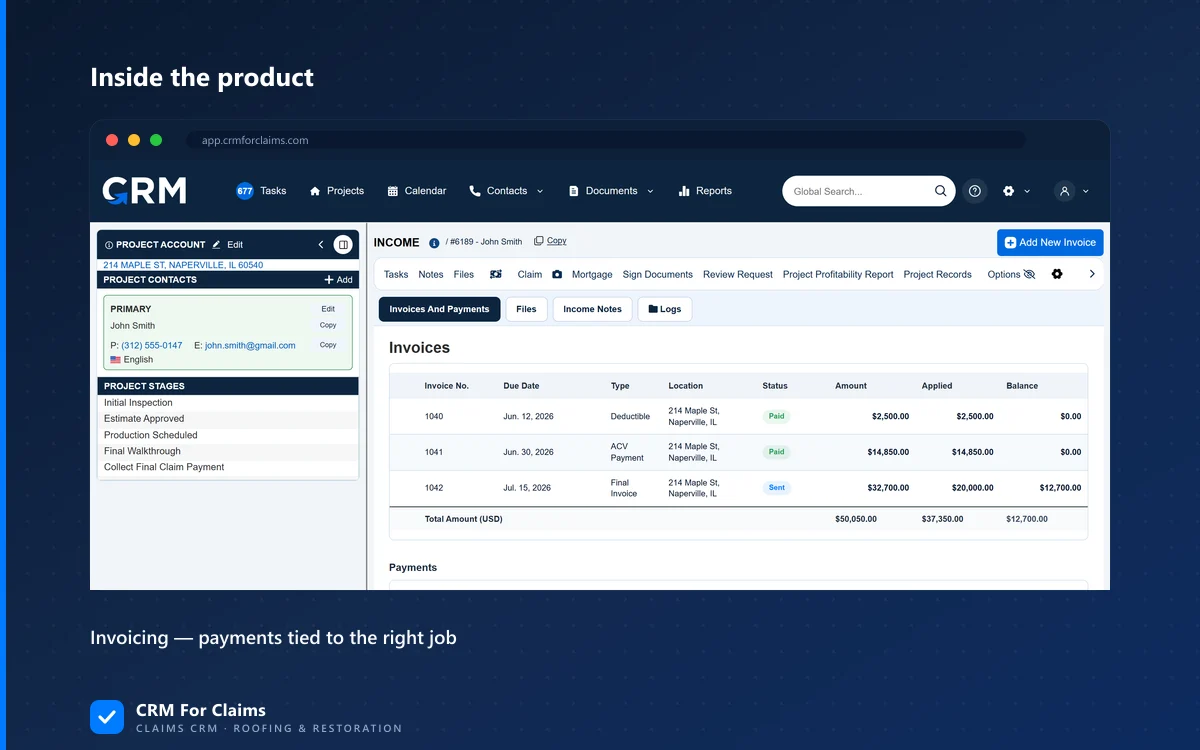
The estimates and invoicing page shows how a claim's payments are split, and the full feature list covers the claim screen. If you want to see a scheduled roof set up from inspection to final invoice, book a live walkthrough and bring the declarations page of a job that surprised you.