A roofing crew schedule has two kinds of gates, and they behave differently. Weather gates you read the evening before: temperature, frost, rain on a day you plan to tear off. Permit inspection gates you can know the day the permit is issued, because the village handout says whether an inspector has to see the ice and water shield before shingles go on and how much notice they want. Plan the inspection gates first, then let the forecast move the days between them.
I build CRM For Claims, a CRM for roofing and restoration companies doing insurance work, and the week a crew loses is rarely lost to one storm. It is lost to a tear-off started on a 34 degree morning, a ladder up on the day the inspector also had to come out, or a homeowner who heard about the change from the crew in the driveway. Below is the way I would lay out the week for a roof in the northern suburbs of Chicago, where all three show up in November.
What decides whether a crew goes up tomorrow?
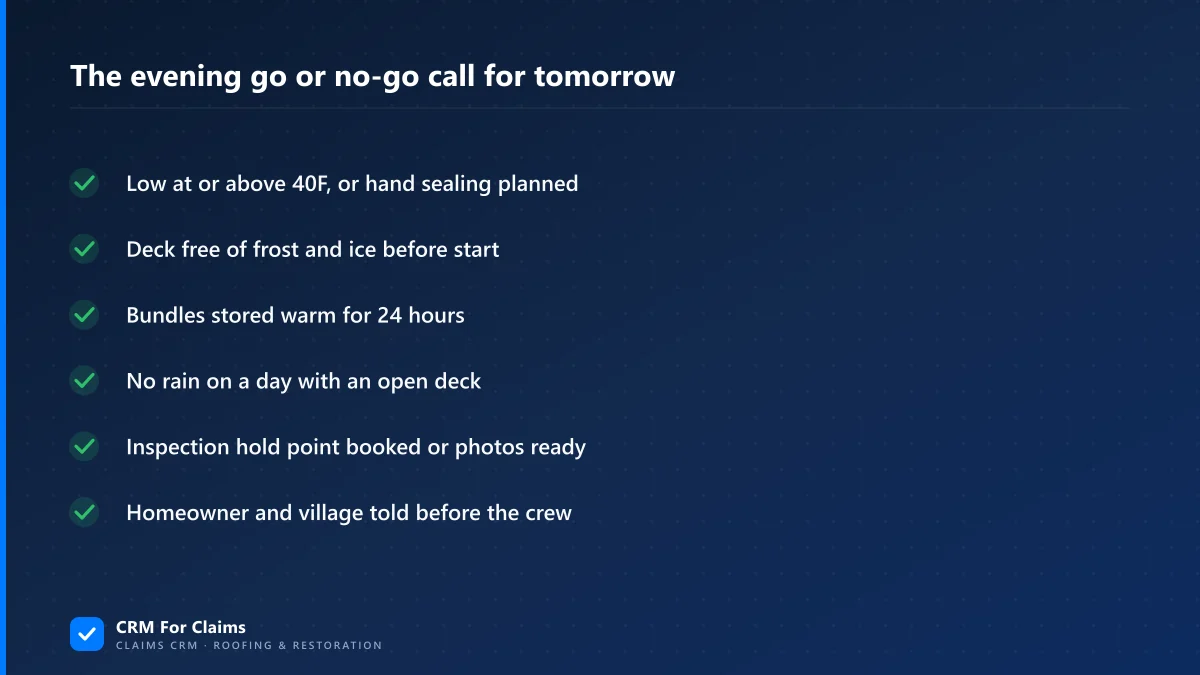
Four things, checked at the same time every afternoon, and only one of them is rain. The others are the temperature the shingles need, frost on the deck, and whether the job is sitting in front of an inspection it cannot pass yet. If any of the four says no, the job moves before the crew is told where to drive.
- The low and the high. GAF's official recommendation, in its cool weather installation post, is to install shingles at 40°F or warmer. Below that the seal strip will not activate on its own, so every tab gets hand sealed with cement, which is slower and needs to be in the crew's day before it starts.
- Frost and ice on the roof. The Asphalt Roofing Manufacturers Association advises waiting until the surface is free of ice and frost in its cold weather recommendations. On a north slope in November that can mean a 10 o'clock start, not 7.
- Where the bundles slept. GAF asks for shingles stored at 70°F for at least 24 hours before a cool install, and ARMA warns that cold bundles crack when they are bent, thrown or dropped. A delivery straight to the driveway the night before a cold start breaks that rule.
- Rain on an open deck. A tear-off you cannot dry in by evening is the one job you do not start on a maybe. Shingle day can slip a day; an open roof cannot.
Write the answer down as a decision on the job, with the reason, before you text the crew. "Moved to Wednesday, frost and 34 at 8 a.m." on the file is something the office can repeat to the homeowner word for word.
Three villages, three different hold points
Inspection rules are set by each municipality, and neighbouring villages do not agree. I read three current residential roofing handouts from the western and northern suburbs today. Same state, same kind of house, three different weeks.
| Village | Before the crew starts | In the middle of the job | At the end |
|---|---|---|---|
| Wayne | Permit; every inspection needs 24 hour notice, booked by the applicant | Ice and water protection checked before roofing material goes on; photographs are accepted | Final inspection |
| Lincolnwood | Contact the village at least one business day before any roof repair or replacement starts | Spot inspections may happen | Final inspection after the contractor asks for it; the contractor need not be there |
| Lombard | Permit when repairs cover more than 25% of the roof | Nothing listed for a pitched roof | Optional for pitched roofs; flat roofs need a final |
Sources, read on 2026-10-24: Village of Wayne roofing checklist, Lincolnwood roof requirements and inspections handout, Lombard residential roof permits handout. Handouts change, so read the current one for each job.
The Wayne row is the one that shapes a schedule. A mid-job inspection is a hold point: nothing goes over the ice and water shield until it is signed off. Because Wayne accepts photographs, you can choose at permit time whether that hold point costs you a visit or just a set of clear, dated pictures sent the same afternoon. Decide it then, not with the crew standing on the deck at noon. Lincolnwood moves the work to the front: the call has to happen a business day before the start, so a rain day that pushes the start also pushes the notice. Lombard asks almost nothing of a pitched roof, which is exactly why a crew that works there all summer forgets the call in Lincolnwood.
One example week, drawn out
Take a made-up week for a two-day reroof in a village that wants the ice and water shield seen before shingles, with an invented November forecast. The point is where the gates land, not the numbers.
Permit in hand. Choose photos for the ice and water check. Bundles go into a heated shop, not the driveway.
34°F and frost at 8. Crew starts at 10. Tear-off, decking, ice and water, then the dated photos go to the village before the crew leaves.
Roof is dried in, so nothing is at risk. Crew goes to the next job's ground work. Shingles wait.
High of 44°F. Shingles go on in the warm middle of the day; north slope last, hand sealed if it drops under 40.
Clean-up, and the final inspection is requested with the notice the handout asks for.
The tear-off went on the coldest day on purpose. It needs no seal strip, only a dry afternoon, and the shingle day got the warmest one. That swap is the most useful habit in a cold month, and it only works if the hold point was planned on Monday instead of found on Tuesday. For crews that are not your own employees, the post on scheduling subcontractors on claims covers how to hold a sub to the moved day.
Moving the job without losing the homeowner or the inspector
A moved day is one note on the file and three messages, and the order matters. When the decision is made in the afternoon:
- Change the job's date and write the reason on the claim, so whoever answers the phone tomorrow tells the same story.
- Tell the homeowner the new day and the reason in one line. On an insurance job they are watching for the crew because the adjuster, the mortgage company or their own calendar is waiting on it.
- Move the inspection request if one was booked, inside the notice window the village wants.
- Only then send the crew the new address for tomorrow.
The homeowner and the inspector are outside your company, and they are the two people a reschedule usually forgets. A storm week, when every job slides at once, is the worst case; the post on storm season claims readiness covers running that surge without dropping files.
In CRM For Claims, a calendar event can be tied to a project when you create it. Each project also has its own Project Calendar page, so the install days, the inspection and the adjuster's visit for one roof sit together instead of in three people's phones. An event can carry guests, added through the Add Guest field. When you move or delete an event that has guests, the CRM asks whether to send invitation emails: to everyone, only to guests outside the company, or to nobody. That middle choice is the one a rain day needs: the homeowner gets the new date, and your own crew list is not flooded with updates. The events are written to a Google calendar you connect, so the crew lead who lives in their phone calendar sees the change there.
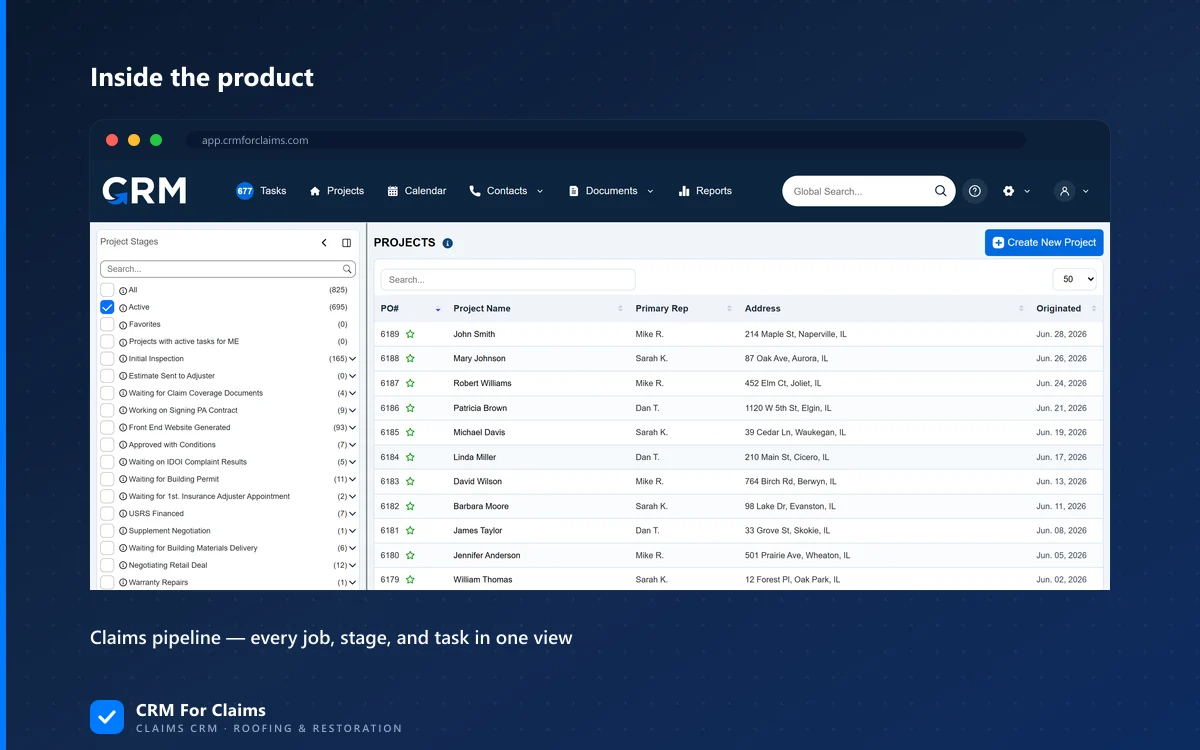
The schedule is still yours to decide; the forecast and the handout do not care which software you use. What a CRM changes is that the decision and its reason are on the job, where the next person can read them. The scheduling and calendar page shows the calendar in more detail, and the full feature list covers the claim and project screens around it. If you want to see a roof job with its inspection and a rained-out day set up end to end, book a live walkthrough and bring a village whose handout surprised you.