Short answer: You can direct an employee's hours. With a subcontractor you can only buy a defined result inside a window. Scheduling subcontractors on claim work means booking a scope and a finish date instead of a shift, saying plainly whether a date is a hold or a commitment, and pushing everything they need at the moment you book.
I build CRM For Claims, and scheduling subcontractors is the part of restoration work that looks like a calendar problem and is really four problems in one coat: a legal one, a sequencing one, an information one and a cash one. Most teams solve all four by texting harder, which holds up right until the week a storm doubles the job count and the drywall sub stops answering.
A crew you employ is easier to schedule for one reason: you are allowed to tell them what to do at 7am on Tuesday. With a sub that same sentence is operationally useless — they have three other generals with the same Tuesday — and, repeated in the wrong form, a genuine legal exposure. The method has to be different, not just more insistent.
What actually changes when the crew is not on your payroll?
Control changes, and control is the whole thing. An employee sells you time and you direct it. A subcontractor sells you a completed result and directs their own time to produce it. Everything downstream — how you book them, what you can demand, who is liable on site, when you pay — follows from that one line, not from preference.
The IRS sets the test out in three buckets on its independent contractor or employee guidance: behavioral control (do you direct how the work is done), financial control (who owns the tools, who can take a loss, are they free to work for others) and the type of relationship. The Department of Labor runs its own separate economic reality test under the Fair Labor Standards Act. Neither one cares what your contract calls the person.
| On a sub, you can reasonably | You are on thinner ice when you |
|---|---|
| Specify the scope, the standard and the finish date | Set their daily start time and break schedule |
| Require site rules, safety compliance and photo documentation | Tell them which of their people works which day |
| Sequence them behind another trade | Require them to be exclusive to you |
| Reject work that does not meet the agreed standard | Supply all tools and materials and pay by the hour |
Two site-level facts follow that most scheduling conversations skip. First, OSHA's multi-employer citation policy can cite a controlling employer — usually the general — for a hazard it could reasonably have been expected to prevent or detect, even when a sub created it. Not employing someone does not move the hazard off your job. Second, a certificate of insurance proves coverage existed on the day it was issued and nothing more; policies lapse quietly. In most states an uninsured sub also turns up as payroll at your workers compensation audit, so a missing certificate becomes a premium bill months later. Ask your own carrier — this one genuinely varies by state.
How do you schedule work you cannot direct hour by hour?
You stop scheduling people and start scheduling scopes. The unit is not "Dave, Tuesday" but "this defined piece of work, startable no earlier than X, finished no later than Y" — and then you say which of those dates is real. A sub can absorb a moving start. What ruins them is a finish date that moved and nobody said so.
The distinction worth adopting formally is hold versus commit. A hold means: I think this lands next week, do not turn down other work for it. A commit means: this is yours, I am telling the homeowner, turn other work down. Both are legitimate. Mixing them up is how you lose good subs — not because you ran late, but because they blocked out three days for a job you never actually promised, and nothing in your texts told them the difference.
Then there is the dependency chain. Mitigation finishes before demo, demo before the trades, and the trades run in an order that is not negotiable. When one link slips a day, the person who most needs to hear it is not the homeowner — it is the sub three steps down who was starting Thursday and now cannot. In practice that is the message that never gets sent, because whoever is handling the slip is busy with the customer in front of them.
What does a subcontractor need to know at the moment you book them?
Everything they cannot get by walking down the hall. A sub is not in your morning meeting, cannot see the claim file, and has no idea what the adjuster approved. If it is not in the booking message it does not exist — and the price of that is a truck outside a locked gate at 7am, billing you for the trip.
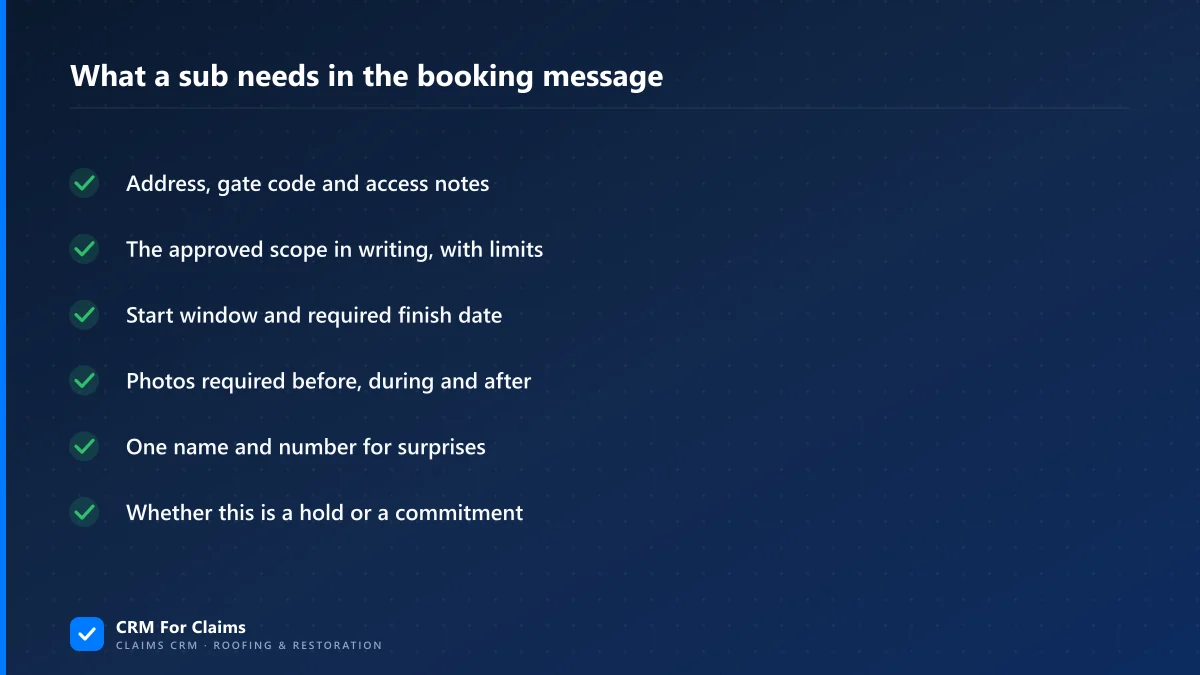
- Address and access — gate code, lockbox, which door, whether the homeowner will be there, whether there is a dog.
- The approved scope, in writing — what is covered, and explicitly what is not. On a claim this is a boundary, not a suggestion.
- Start window and required finish — with the hold-or-commit status attached to it.
- Photo requirements — before, during and after, because on insurance work their photos become your evidence.
- One name and number for surprises — a sub who finds something outside scope needs a person to call, not a group chat.
- What triggers payment — completion evidence, sign-off, and the actual timeline. More on that below.
The scope boundary is the expensive one. A sub who finds extra damage and helpfully fixes it "while we were in there" has created work nobody approved, and on a claim there is no obvious payer for it. That is a supplement conversation with the carrier, and it has to happen before the work — the same mechanics as in the piece on supplements and approvals on a claim. Subs doing this are not being difficult. They are being tradesmen who were never told where the line was.
Why is scheduling subs on a claim harder than on a retail job?
Because roughly half the schedule belongs to someone outside your company. On a retail job you and the homeowner agree a date and it happens. On a claim, the start date is downstream of an adjuster's inspection, an approval, sometimes a supplement, and materials that may or may not be sitting in a yard. You are dispatching against dates you do not own.
| Schedule input | Who controls it | What that means for booking a sub |
|---|---|---|
| Approval of the estimate | The carrier | Holds only, until it lands. Never commit a sub against an unapproved scope |
| Supplement approval | The carrier | Split the booking — book the approved part, hold the rest |
| Material availability | Supplier | Confirm delivery before you convert a hold into a commit |
| Homeowner access | The homeowner | The most common same-day cancellation. Confirm the day before, in writing |
| Preceding trade finishing | You | The one link you fully own — so it is the one that has to be right |
The honest read of that table: a claims business runs on conditional scheduling, and that only works if the conditions are visible. When approval status lives in one person inbox, nobody else can tell a hold from a commit, and every booking becomes a guess made by whoever answered the phone.
When do you pay a sub on a claim the carrier has not paid yet?
This one is structural rather than solvable. Your sub wants paying in a fortnight. The claim pays in stages — an ACV cheque early, recoverable depreciation once completion is documented — and the gap between those two facts is financed by you. Pretending otherwise at booking time is how the relationship ends.
Two things make it survivable. Say the terms out loud before the first job, not after the first invoice — a sub who assumed fourteen days and finds out at day twenty-five is a collections problem attached to a half-finished roof. And make the payment trigger a document rather than a mood: photos in, sign-off recorded, then paid. That is the same discipline as invoicing from the approved scope — payment follows evidence in both directions, or it follows argument in both directions.
Collect the W-9 before the first payment rather than in January, while you still have their attention. Nobody enjoys chasing a tax form from a sub who finished four months ago.
What belongs in the CRM, and what does not
The CRM's job here is the claim-side half: who the sub is, which claim they are booked on, what scope they were given, what they sent back, and whether anyone chased them. It is not a dispatch product. I would rather say that plainly than let someone buy it expecting route optimisation.
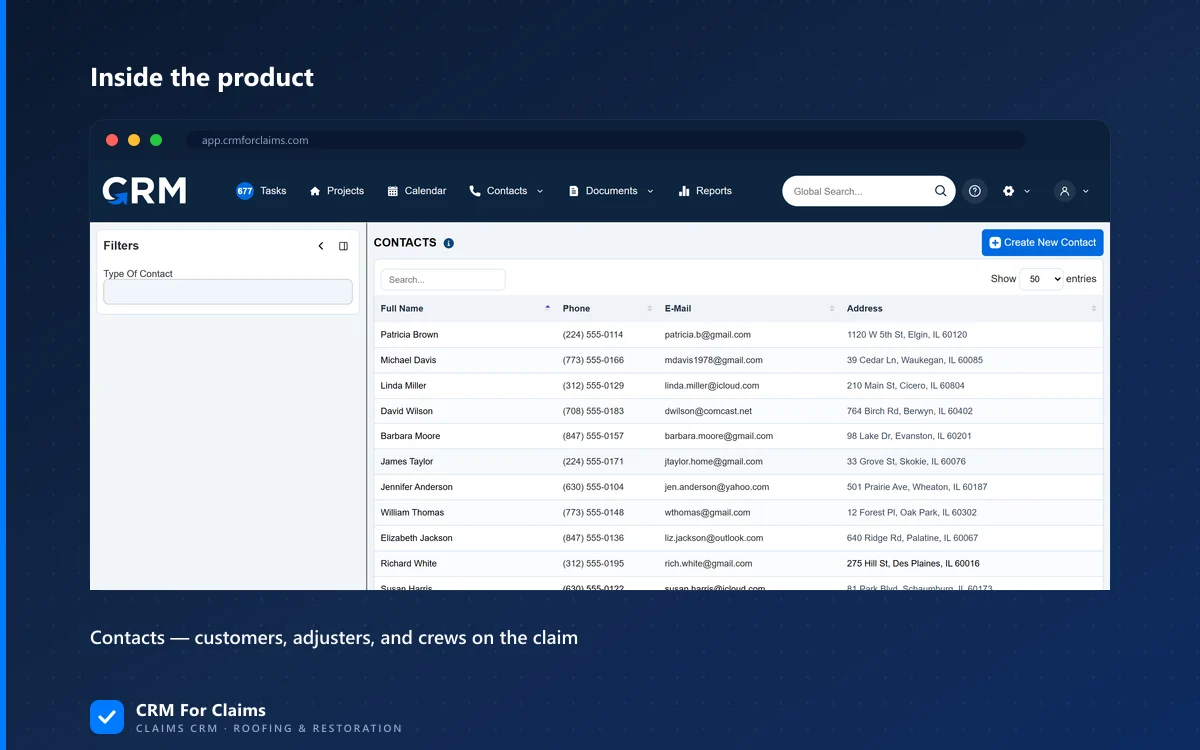
Concretely, in what CRM For Claims actually does: crews and subs are a real contact type alongside customers, adjusters and carriers, so a sub is attached to the claim rather than to a phone. Work is scheduled against that claim, so the booking and the job are one record. Stage automation fires the task and the message when the claim reaches a stage that needs a trade. And texts and emails sent from the claim log themselves on it, so the hold-or-commit conversation is readable by the next person.
What it is not: no GPS dispatch, no route planning, no crew time tracking, no sub payments or 1099 filing. If you are genuinely a dispatch business — dozens of crews, routed daily — you want dedicated field service software, possibly alongside this. A side-by-side of claims-first versus generic tools is the honest place to start.
One access question comes up every time: does a sub need a paid seat? Usually not. A sub who receives work, gets the scope and sends photos back is a contact you message from the claim. A sub lead who updates status and marks work complete needs a login, which on our plan and per-seat pricing is $39/month on top of the plan. Decide it by what they write, not by how important they are, and scope what they can see. A framing sub does not need the settlement figures.
The honest version of all this
If you use the same two subs every week, they have your gate codes memorised, and you are the person who books them, you do not need a system. A phone and a shared calendar are genuinely fine, and anyone telling you otherwise is selling something.
The break point is not job count. It is the first time the person booking the sub is not the person who knows the job — a coordinator, an office manager, a second lead during a storm week. From then on, everything the booker cannot see gets guessed, and guesses arrive as trucks on unapproved scopes and finish dates nobody promised. That is when the claim has to hold the schedule instead of it living in somebody's head.
If that sounds like your last busy month, book a live walkthrough and bring a real job with three trades on it. Better test than any feature list, including mine.