Ordinance or law coverage on a roof claim pays the extra cost of building the new roof the way today's code demands, when the old roof was put on under an older code. The ordinary dwelling coverage pays to put back what was there. If the town now wants drip edge, an ice barrier or solid decking the old roof never had, those lines come from this separate coverage, up to its own limit, or from the homeowner.
I build CRM For Claims, a CRM for roofing and restoration companies doing insurance work, and code lines are where a lot of roofing money quietly goes missing. Not because the coverage is rare, but because nobody on the job asked whether the policy has it, the estimate mixed code items into the damage items, and the adjuster's scope came back paying for like kind and quality with nothing else. The fix is mostly sorting and paperwork, done at the right moment.
What does ordinance or law coverage pay on a roof?
It pays for work that a state or local rule requires during the repair, and only that work. United Policyholders, the nonprofit that publishes claim guidance for homeowners, puts it this way in its page on building code, ordinance or law compliance: the limit applies only to the cost of work you are required to do by regulation. The same page notes it usually sits under Additional Coverages, is sized as a percentage of the dwelling limit (commonly 10, 25 or 30 percent), and that some policies exclude code upgrades outright.
On a roof, that means the drip edge the village now requires, an ice barrier at the eaves where the local code calls for one, decking the code wants under the new shingles, or flashing details the current edition spells out. It does not mean a nicer shingle line because the homeowner liked the colour, and it does not mean anything the code merely allows. If no rule demands it, it is not a code item.
One roof bill, sorted into three payers
The most useful thing an office can do is sort the bill before it goes anywhere. Every line on a replacement belongs to one of three payers, and each one needs a different kind of proof. Here is a typical hail replacement on an older asphalt roof, sorted the way I would sort it.
| Line on the bill | Who pays it | What has to be in the file |
|---|---|---|
| Tear off and replace the hail-damaged shingles | Dwelling coverage | Inspection photos of the hits, the date of loss, the adjuster's scope |
| Felt or synthetic underlayment, as on the old roof | Dwelling coverage | Part of the same scope; replaced because the shingles are |
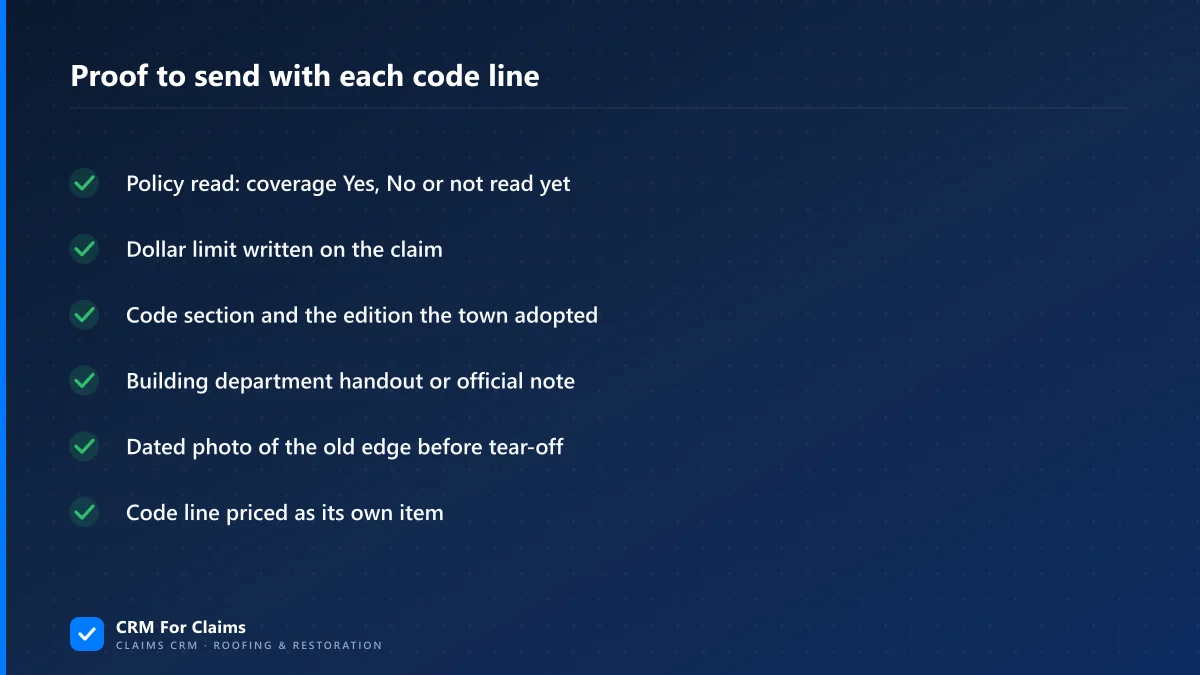
| Drip edge at eaves and rakes, where the old roof had none | Ordinance or law | Code section, the edition the town adopted, a pre-tear-off photo of the bare edge |
| Ice barrier at the eaves, required by the local code | Ordinance or law | The building department handout or code section that requires it at that address |
| Solid decking over old spaced boards, if the code requires it for the new roof | Ordinance or law | Photos of the spaced boards, the code section, ideally a note from the building official |
| Upgraded designer shingle the homeowner chose | Homeowner | A signed change order with the price difference |
| Skylight the homeowner asked to add | Homeowner | A signed change order; never on the insurance invoice |
The bottom two rows are the ones that cause trouble when they are mixed in. A homeowner upgrade on the insurance invoice makes the whole bill look padded, and it drags the honest code lines down with it. That is the difference between a supplement and a change order, which I covered in the post on change orders versus supplements on insurance jobs. United Policyholders gives the same advice from the homeowner's side: break code upgrade costs out as their own line items, because that is often what it takes to reach agreement with the adjuster.
Why drip edge is the code line you will argue most
Because it has a date. The International Code Council's summary of the significant changes in the 2012 International Residential Code lists it as an addition: a roof drip edge is now required for asphalt shingles. A roof shingled before the town adopted that edition may have no drip edge at all, and the new one has to have it. That makes it the cleanest example of a code line: the old roof lacked it, the current code demands it, and the cost exists only because of the code.
Two details decide whether it gets paid. The first is which edition your town actually adopted, and whether it amended the section. Codes are adopted locally, and neighbouring towns are not always on the same edition, so the citation has to be the one in force at that address, not the latest one you have heard of. The second is proof that the old edge was bare. Once the crew tears off, that evidence is in the dumpster. One clear photo of the eave and the rake before tear-off, dated and on the claim, is worth more than any argument later. The post on what to shoot on a claim and when has the full shot list.
When the adjuster says the code is not enforced here
It is a common reply: the town does not inspect reroofs, so the item is not required, so it is not owed. At least one state regulator has answered that argument in writing. On June 27, 2025, the Oklahoma Insurance Commissioner sent a special notice to property and casualty insurers repeating the instruction of its Bulletin PC 2016-02:
"You shall consider all building codes as being strictly enforced."
Oklahoma Insurance Department, Special Notice, June 27, 2025, quoting Bulletin PC 2016-02
That instruction applies to the additional coverage for code costs, and it is an Oklahoma rule. Outside Oklahoma, it is still a useful thing to know exists, but your own state's rules and the policy wording are what decide the claim. What every office can do anywhere is put the code question in writing: send the section, the edition, the photo, and ask the adjuster to give the reason in writing if the line is refused. A refusal with a stated reason is something the homeowner, their agent or their own representative can act on. A refusal on the phone is nothing.
Keep your own role in mind while you do it. You are documenting what the code requires on a roof you are building. Telling a homeowner what their policy covers, or negotiating the claim for them, is a different job, and many states license it separately. The post on handing a claim to a public adjuster or attorney covers where that line sits.
Does the policy have it? Find out before the contract
The answer changes the conversation with the homeowner, so it belongs at the start of the job, not on the final invoice. Ask the homeowner for the declarations page and the policy, and look for Ordinance or Law, Building Code Coverage or Code Upgrade in the additional coverages and endorsements. There are only three possible answers, and each one sends the office down a different road.
The most expensive answer, because it looks like a yes. Nobody can promise the homeowner anything about the code lines.
Ask for the full policy, not just the declarations page, before the code items are priced into the contract.
The code lines are still required. The town does not care who pays.
Show the homeowner those lines separately before signing, so the amount they owe is a number they saw first, not a surprise on the last invoice.
Write the dollar limit down where the person building the invoice will see it.
Price the code lines separately, keep a running total against the limit, and send the proof with each line.
Policies word this coverage differently, and some pay code items only once the cost has actually been spent. Read the wording on each policy rather than assuming it works like the last one.
The order of work for a code line
- At inspection, photograph the edges, the decking where you can see it and anything the current code will change.
- Before the contract, read the policy for the coverage and its limit, and record the answer on the claim.
- Find the code edition the town adopted and the sections behind each code line. Keep the handout or the link on the file.
- Write the estimate with the code lines as their own items, each with its section, never blended into the damage items.
- Before tear-off, take the dated photos that prove what the old roof lacked.
- Send the code lines with their proof, and ask for any refusal and its reason in writing.
- Invoice the code lines against the limit, and send the homeowner's share as its own line they already agreed to.
If the adjuster's scope still leaves code lines out after all that, the post on reading an insurance scope line by line shows how to find exactly which ones, and when it is worth asking for a reinspection of the roof.
Where the answer lives in CRM For Claims
When the insurance policy is uploaded to a project in CRM For Claims, the upload form asks the Building Code Coverage / Ordinance and Law Coverage question, and it starts at Unknown (TBD), so a policy nobody has read never looks like a no. On the claim, the same question has three answers: Unknown, No and Yes. When the answer is Yes, a field for the limit in dollars opens under it. When the answer is No, a warning sits across the top of the project saying the policy does not provide Ordinance and Law or Building Code Coverage, so the person writing the contract sees it before the homeowner signs.
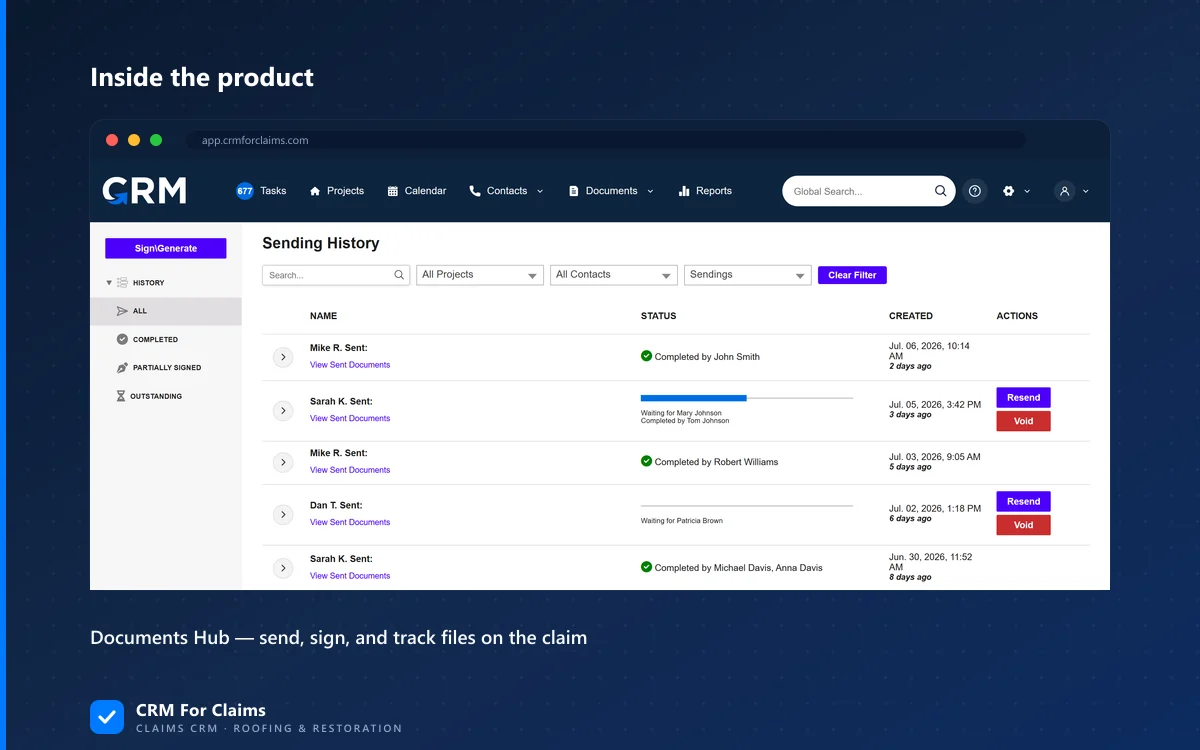
That answer sits next to the other policy terms that decide the money on a roof, which the insurance claim tracking page lays out field by field, and the invoices built from them are on the estimates and invoicing page. The code is still yours to read and the policy is still the homeowner's; the CRM keeps the answer where the next person on the job will find it. If you want to see a roof claim with its policy terms set up end to end, book a live walkthrough and bring a code line an adjuster refused you.