An emergency roof tarp on an insurance claim is paid by the homeowner's own policy, as part of the same claim, when the storm damage itself is covered. The money goes to the homeowner, it counts inside the dwelling limit and it sits under the same deductible as the roof. So your tarp invoice is a bill to the homeowner, and whether the carrier reimburses it depends on the claim, not on how fast your crew got there.
I build CRM For Claims, software for roofing and restoration companies that work insurance claims. On November 8, 2026 I read the pages that rank for this question. They tell homeowners that tarps are "usually covered" and stop there. None of them quotes the policy, and none of them looks at the tarp from the roofer's side: who you bill, what you photograph, and how the line reads to the desk adjuster. So I opened a filed homeowners form and a federal release and worked from those.
What does the homeowners policy say about a tarp?
The common homeowners form calls it Reasonable Repairs. It pays the reasonable cost of measures taken only to stop further damage after a covered loss. This is the wording in a homeowners form built on ISO HO 00 03 that sits on file with the Maine Bureau of Insurance:
"In the event that covered property is damaged by an applicable Peril Insured Against, we will pay the reasonable cost incurred by you for necessary measures taken solely to protect against further damage." Reasonable Repairs, Additional Coverages, in a homeowners policy form filed in Maine (HO 00 03, edition 04 91)
Your customer's policy may be a newer edition or a carrier's own form, so read theirs. The idea is the same in every version I have seen, and each part of that sentence changes something about your bill:
damaged by an applicable Peril Insured Against
The tarp rides on the claim. If the carrier decides the hole came from wear, not wind or hail, the tarp is not reimbursed either, and the homeowner owes you for it out of pocket.
incurred by you
"You" is the insured. The cost is the homeowner's, so the invoice is addressed to them, and they sign for the work before your crew goes up.
solely to protect against further damage
A tarp, battens and the labor to put them on fit. Replacing a few shingles "while we were up there" is a repair of the loss, and it belongs in the roof estimate, not on the tarp invoice.
reasonable cost
The desk compares your bill with what that work normally costs in that area. An itemized invoice with sizes, hours and the time of the call is easy to accept. A single round number invites a cut.
Two more lines in the same form matter. The clause says it "does not increase the limit of liability", so the tarp is paid out of the same dwelling coverage as the roof. And it does not relieve the homeowner of their duties after a loss, one of which, in Section I Conditions, is to "make reasonable and necessary repairs to protect the property" and "keep an accurate record of repair expenses". That record is mostly yours to produce.
Who ends up paying the tarp bill?
The homeowner pays you, and the carrier pays the homeowner if the loss is covered, after the deductible. Below, one tarp invoice of $640 and a $1,000 deductible run through three outcomes. The figures are an example to show the arithmetic, not prices from a real claim.
Roof replacement approved
- Roof on the carrier's estimate
- $16,800
- Tarp added as reasonable repairs
- $640
- Less the deductible
- $1,000
- Carrier pays the homeowner
- $16,440
The tarp is reimbursed in full. The deductible is the same $1,000 the homeowner already owed on the roof.
Small repair, covered
- Shingle repair on the estimate
- $700
- Tarp added as reasonable repairs
- $640
- Less the deductible
- $1,000
- Carrier pays the homeowner
- $340
Covered, but most of both bills lands under the deductible. The homeowner pays $1,000 of $1,340 themselves.
Claim denied
- Cause found by the carrier
- Wear and tear
- Reasonable repairs
- Not triggered
- Less the deductible
- Not applied
- Carrier pays the homeowner
- $0
The homeowner owes you the full $640 with no insurance money behind it.
The middle card is the one that surprises homeowners. Say it before the tarp goes on, in one sentence: the tarp is part of the claim and the deductible applies to the claim as a whole. If the deductible conversation is already tense, I covered what a contractor can and cannot do about a deductible in an earlier post.
The limit point bites on big losses. On a house where the dwelling coverage barely covers the rebuild, every dollar of temporary work is a dollar that is not there for the permanent roof. That is one more reason to keep the tarp bill tight and itemized.
What should the crew record on the tarp visit?
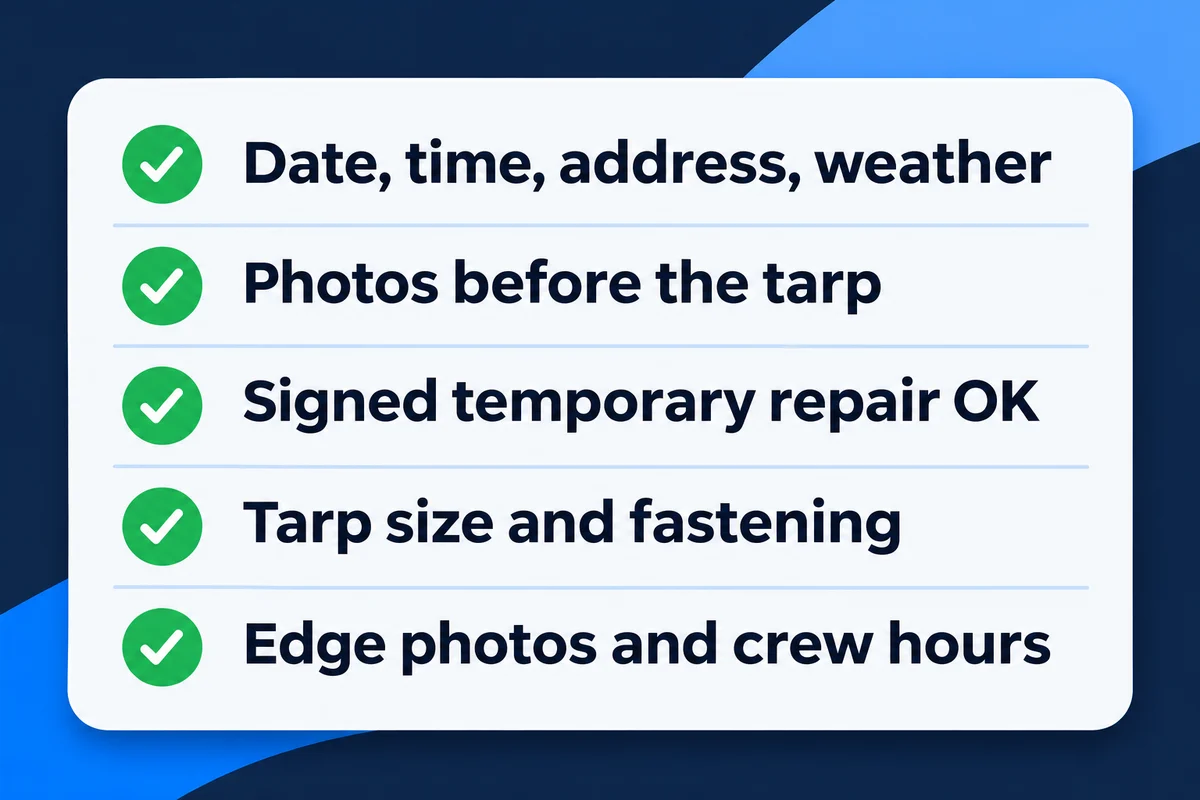
Enough that someone who never saw the roof can tell what was damaged, what was protected and what it cost. Your photos are often the only record of the opening before it was covered, and the adjuster may not arrive for days. Work through the visit in this order:
- Note the date, the time, the address and the weather as soon as you pull up, and take one wide photo of the house from the street so every later shot has a place.
- Before anything is touched, shoot close and wide photos of each opening, lifted area or tree strike, and of water inside if the homeowner lets you in. Once the tarp is down, nobody can photograph this again.
- Have the homeowner sign a work authorization for temporary repair only, with how the price is worked out, before the crew climbs. It keeps the tarp separate from any roof contract and puts the "incurred by you" part on paper.
- While the tarp goes on, write down its size and material, how it is fastened, and whether debris had to come off first. If a tree has to be cut away, that is its own line and its own photo.
- Photograph every edge and the tarp from the ground before you leave, along with who was on the roof and for how long. The invoice is written from these notes the same day.
The rest of the first days of a claim, from the first call to the adjuster meeting, is in the first 48 hours of an insurance claim. The tarp visit is usually the first thing on that clock.
How do you write the tarp invoice so the desk accepts it?
Write each piece of work on its own line with a quantity, and keep anything that is permanent repair off it. Desk adjusters compare line items against their own pricing. A lump sum gives them nothing to compare, so they price it themselves.
| Line | What to write on it | What the desk looks for |
|---|---|---|
| Tarp material | Size and type of each tarp used | That the size matches the covered area in your photos |
| Battens and fasteners | Lengths of lumber, number of fasteners or sandbags | That the tarp was secured, not just laid on |
| Labor | Crew size and hours on site | Hours that make sense for the area tarped |
| After-hours call-out | Only if it applied: the time you were called and the time you arrived | The timestamp, matched to the date and time on the photos |
| Debris removal | What had to be cleared before tarping, with its photo | That it was in the way of the tarp, not general yard cleanup |
| Return visit | Date and reason, such as wind lifting a corner | A second set of photos showing why the trip was needed |
Address the invoice to the homeowner, put the claim number on it, and send it with the photos as one package. If your contract has the carrier paying you directly, the tarp still starts as the homeowner's cost; the paperwork just changes who the check is made out to.
When should a homeowner hear about the free Blue Roof program?
After a federally declared disaster, when the homeowner cannot pay for a tarp now and wait for the claim. Operation Blue Roof is run by the U.S. Army Corps of Engineers for FEMA, and in its announcement after Hurricane Milton the Corps listed its rules:
- It is a free service to homeowners, with fiber-reinforced sheeting put on by contracted crews.
- It covers primary residences and permanently occupied rentals with less than 50 percent structural damage. Vacation rentals are not eligible.
- The roof has to be shingles or something similar that a tarp can be nailed to. Flat roofs and metal, clay, slate or asbestos tile do not qualify, with metal roofs and mobile homes considered case by case.
- The homeowner signs a Right of Entry form, and removes large debris like a fallen tree themselves. The crews remove tarps the homeowner put on.
It only runs in the counties named for that disaster and only during the sign-up window, so check that it is open before mentioning it. Telling a homeowner about it costs you a tarp job. It also tends to make you the roofer they call when the permanent work is approved.
What if the tarp fails before the roof is replaced?
Then you have a second loss on top of the first, and the record decides whose problem it is. The duty in the policy is to take reasonable steps. Your after photos showing a tarp that was fastened properly, and a dated return visit when wind lifted a corner, are what show that the steps were taken. Without them, water damage inside after a failed tarp can be argued as damage the homeowner should have prevented.
Set a date to look at every tarp you have up, especially before the next forecast storm. A tarp that has been on for weeks while the claim drags is the one most likely to fail, and nobody notices until the ceiling does.
Keeping the tarp on the claim in CRM For Claims
The tarp is a small bill that gets lost easily. It is paid before anything else on the job, often by someone's company card, and by the time the roof is done nobody remembers it was a separate cost.
In CRM For Claims a project's expenses have a Type Of Expense field, and Temporary Repair Fees (such as tarp) is one of its values, so the tarp cost is kept apart from the labor and materials of the main job. The expenses part of the KPI report gives that type its own row with its share and total, and opens to a list of PO#, project, payee, date and amount. The return visit to check the tarp goes in as a task, and every task has a required Task Due Date.
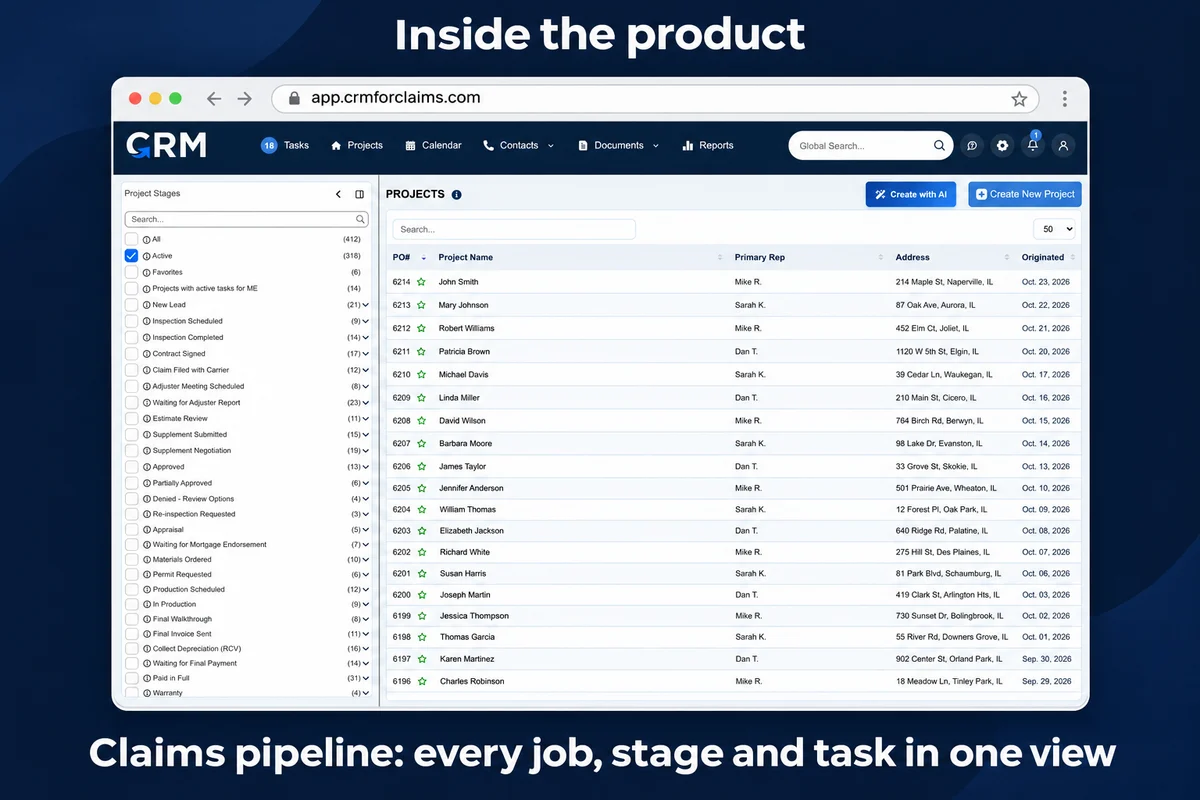
If you want to see how much of last storm season went into tarps, the reporting and KPIs page shows what the reports cover, and the features page has the rest of what sits on a claim. Plans start at $59 a month on pricing. If you would rather walk through it with one of your own storm jobs, book a live walkthrough.