The roof waste factor on an insurance claim is the extra shingle material the adjuster's estimate pays on top of the measured roof, written as a multiplier on the squares of the shingle line. To check it, you need three numbers from the estimate: the measured squares, the multiplier, and whether starter course and ridge cap sit inside that percentage or on lines of their own. Most short shingle lines come from one of those three, and only one of them is a matter of opinion.
I build CRM For Claims, software for roofing and restoration companies that run insurance claims, so I read a lot of carrier estimates next to the measurement reports they were built from. Today I read the pages that come up for this question. They are calculators for ordering material on a retail job. None of them shows where the waste lives on the carrier's estimate, so that is what this post does.
Where does the waste sit on an Xactimate roof estimate?
On the shingle line itself, as a multiplier on the squares. Xactware's own help page on calculating roof waste describes two ways an estimator sets it: per item, through a Waste row in the Item Property Editor, or automatically, through a preference that calculates roof waste for every roofing item.
The per-item route is the one you can read. When the percentage the estimator wants is not in the drop-down, Xactware's instruction is to change the item's calculation from SQ to SQ*1.07 for 7%. So a shingle line carries the roof area and the percentage together. Taken apart, one line on an example roof looks like this:
Two things follow. The first number should equal the roof area on your measurement report, slope by slope. If it does not, the argument is about measurement, not waste, and you fix it with the report and slope photos. The second number is the waste. It is the only figure on the line that two honest estimators can disagree on.
Which roof lines take waste, and which stay on the measured area
Waste belongs on material you cut and lose. Labour and work that follow the roof surface stay on the measured squares. When a line on the estimate is in the wrong column, the error is usually in yours or theirs before anyone argues percentages.
| Line on the estimate | Quantity it should use | What to check |
|---|---|---|
| Tear off composition shingles | Measured area | You remove what is on the roof. Plus one line per extra layer, at the same area. |
| Shingles, installed | Area x waste | Squares match the report, and the multiplier is written down. |
| Steep and high roof charges | Measured area | Charged on the slopes that qualify, never on the waste-loaded number. |
| Starter course | Own line or in the waste | If there is no starter line, ask whether the waste setting includes it. |
| Hip and ridge cap | Own line or in the waste | Linear feet from the report's hips and ridges, unless the waste covers it. |
| Drip edge | Eaves and rakes, LF | Footage from the report, not a guess from the squares. |
The starter and ridge rows are where most confusion starts. Xactware's page on XactScope roof prompt dependencies says the starter course card and the ridge cap card appear only when they have not been included in the auto roof waste calculator. In plain terms: an estimate with no starter line may have left it out, or may have paid it inside the percentage. Those two cases need different answers, and you cannot tell them apart from the printout alone. The steep rows are covered in more detail in the post on steep and high roof charges, which walks through a sample estimate where the shingles carry waste and the steep lines do not.
One roof, two percentages, worked through
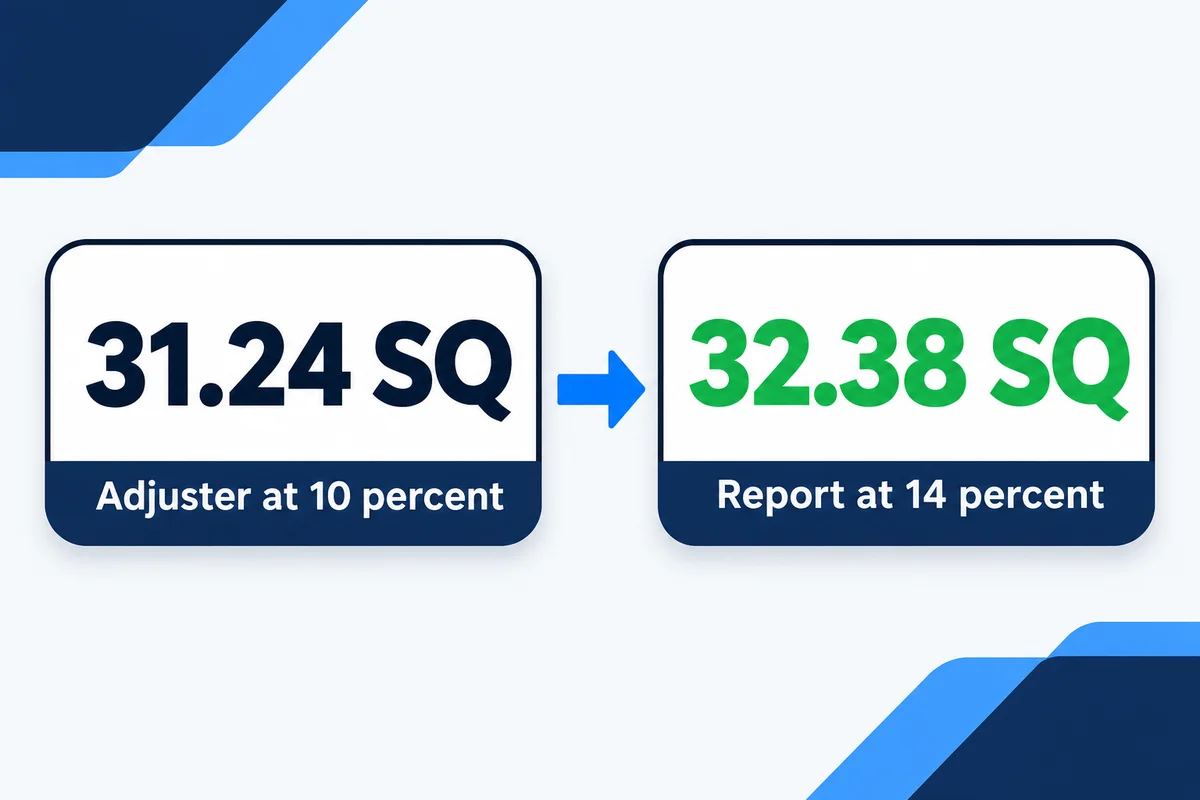
Here is a made-up hip roof with valleys, measured at 28.40 squares. The adjuster's estimate uses 10%. The measurement report the roofer ordered suggests 14%. The arithmetic of the gap:
Measured roof area, from the report28.40 SQ
Adjuster's shingle line at 10% (28.40 x 1.10)31.24 SQ
Report's suggestion at 14% (28.40 x 1.14)32.38 SQ
Difference on the shingle line1.14 SQ
In bundles, for a shingle sold three bundles to the square3.42, so 4 bundles
Tear-off line, unchanged in both versions28.40 SQ
A bit over one square on a roof this size. That is real money once it is priced, taxed and carried through overhead and profit, and it is also small enough that a desk adjuster will not reopen the file for it without a clean reason. Your reason is the roof's geometry: the hips and valleys that produce off-cuts nobody can reuse.
Now the trap. Suppose the adjuster's 10% came from the automatic setting with starter and ridge folded in, and your supplement asks for 14% plus separate starter and ridge lines. You have asked for the starter and ridge twice. The desk adjuster strikes the starter and ridge lines, and often trims the percentage too, because the request now looks padded. Ask what the percentage covers before you add a single line, and if your own number includes starter and ridge, say so in the request.
A note to send the desk before you write the supplement
Waste is easy to argue in the abstract and hard to argue without the adjuster's own numbers. United Policyholders, in its guide to reviewing adjusters' and contractors' estimates, puts it in one line:
"Waste factors are hidden in other line items."United Policyholders, Guidelines for Reviewing Adjusters' and Contractors' Estimates
So ask first. A short written note gets you the facts you need, in writing, on the claim:
Before I send a supplement on this roof, could you confirm four things from your estimate?
- The roof area you started from, in squares, and the measurement source it came from.
- The waste percentage on the shingle line.
- Whether that percentage was set by hand or by the automatic roof waste setting.
- If automatic, whether starter course and hip and ridge cap are included in it.
Our measurement report shows 28.40 squares with a suggested waste of 14% for this roof's hips and valleys. I will attach it with the supplement.
The answer to the third and fourth questions decides what your supplement looks like. If starter and ridge are inside the waste, you argue the percentage only. If they are not, you ask for the starter and ridge lines with footage from the report, and the percentage becomes a smaller second request. The full order of a supplement, from the first ask to the approved check, is in supplements and approvals on a claim.
Why the measurement report carries the argument
An adjuster can wave off a roofer's percentage as a sales number. It is harder to wave off a third party's. Eagleview added a Suggested Waste Factor to its residential 3D roof reports in 2019, calculated from the measurements of that one roof, and pitched it to carriers as a benchmark for supplement discussions as much as to contractors for ordering. When the carrier and the roofer are reading the same report, the waste conversation gets much shorter.
Attach the whole report, not a screenshot of the waste box. The adjuster needs the facet diagram to see the hips and valleys that justify the number, and the area to confirm the first figure on the line. Add a few photos of the cut-up sections. Then keep the percentage you ask for to the one in the report. A round 15% with no source behind it reads as a guess, while a printed figure from the report reads as a measurement.
If the measured area itself is wrong, deal with that first and separately. A missing slope or a garage left off the sketch changes every line on the estimate, and folding it into a waste request hides the bigger error. Reading the rest of the estimate line by line is covered in how to read an insurance scope.
Keeping the waste supplement on the claim it belongs to
A waste supplement is small, and small requests are the ones that get lost: the note in one inbox, the report in another, and the approved check deposited without anyone matching it to the request. Put all of it on the claim.
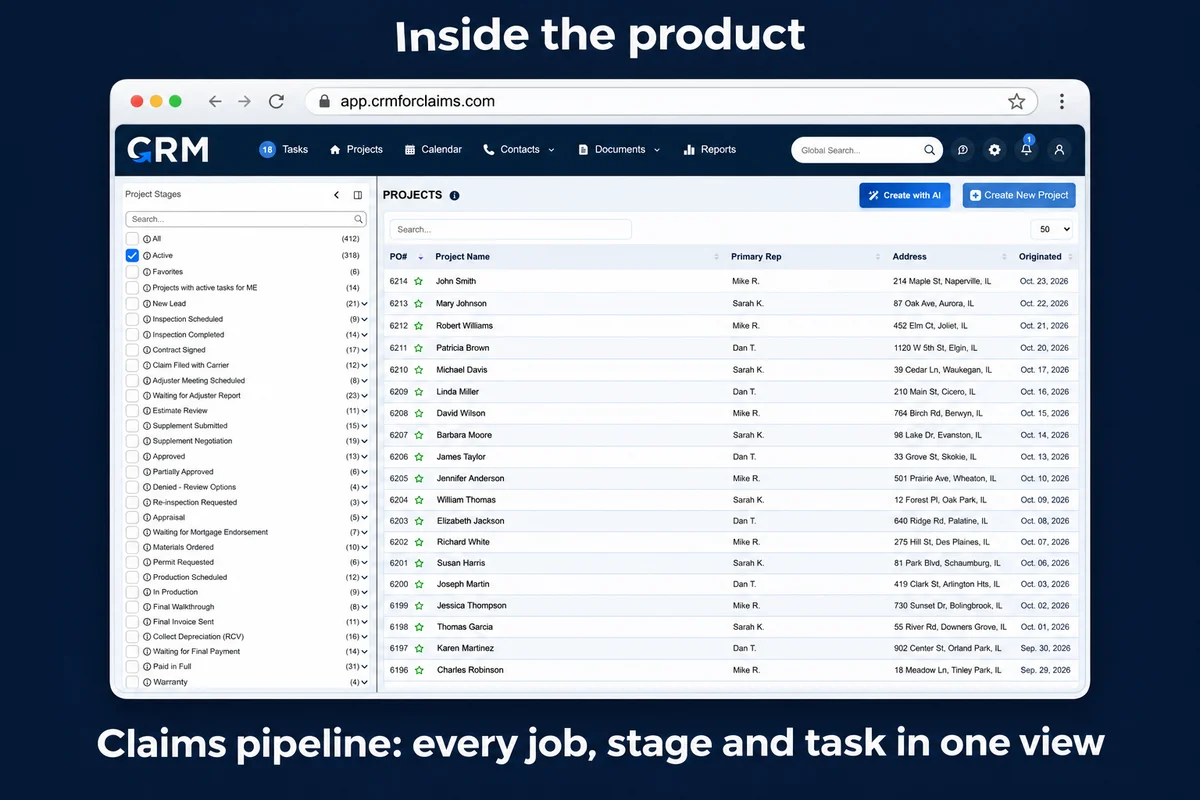
In CRM For Claims every invoice on a project has a payment type, and Supplemental ACV and Supplemental Recoverable Depreciation are types of their own, listed next to the first Actual Cash Value (ACV) check and the first Recoverable Depreciation (RC) release. The insurance payment types only open once the claim number has been filled in on the claim, so a supplement check cannot be booked on a job with no claim behind it. The claim screen also asks whether the policy is a replacement cost value policy, which matters here: the waste squares are part of the shingle line, so they are depreciated with it, and on a replacement cost policy that part comes back with the depreciation release.
How the supplement itself is tracked from request to approval is on the supplement tracking page, the invoice types are on estimates and invoicing, and the rest of the claim is on the features page. If you want to see a supplement check booked against its claim on a demo project, book a live walkthrough.