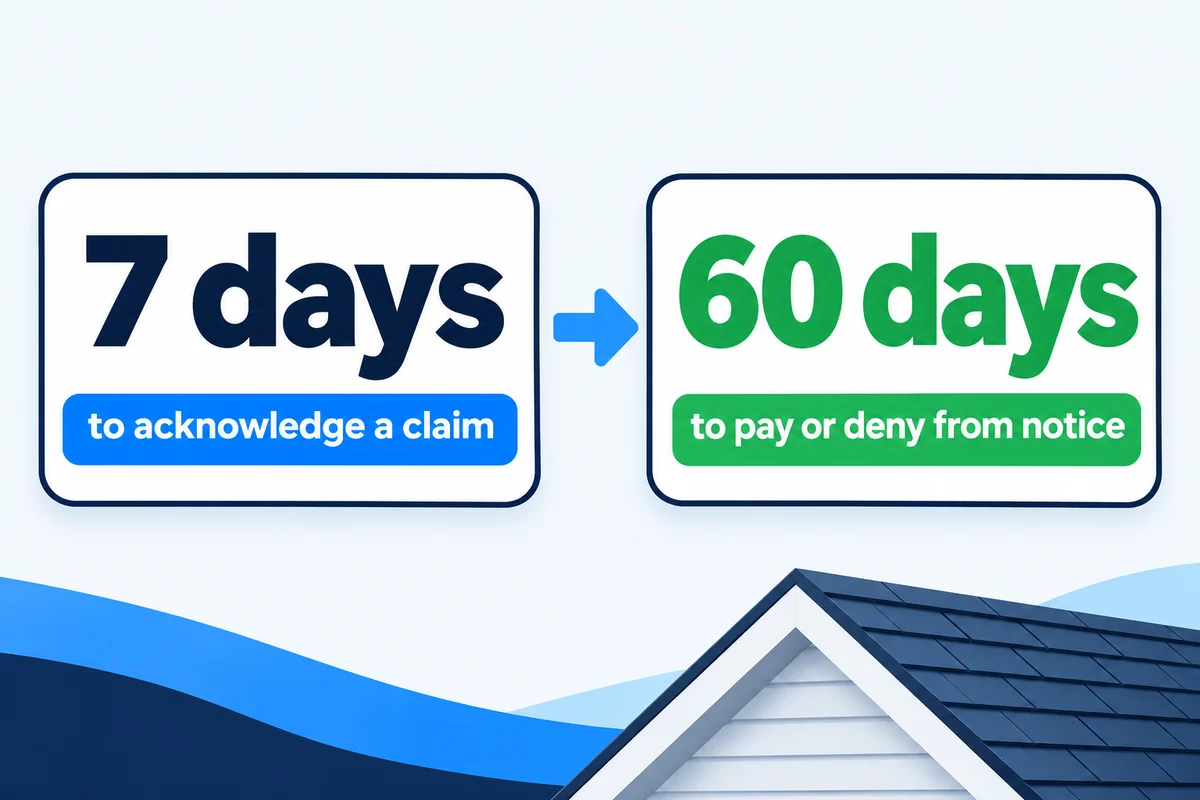
How long an insurance company has to respond to a roof claim depends on the state, and there is never one number. Texas gives the insurer until the 15th day after notice to acknowledge the claim, then 15 business days after it has every item it asked for to accept or reject it. Florida gives 7 calendar days to acknowledge and 60 days from notice to pay or deny. Each of those clocks starts on a different event, so the useful question for a roofing office is which dates you have written down.
I build CRM For Claims, software for roofing and restoration companies that work insurance claims. Today I read the pages that answer this question first. They list states for the homeowner, a couple still print Florida's old 90-day rule, and none of them says what a contractor should put on the calendar. So this post reads the two statutes I opened today and turns them into follow-up dates.
Which event starts each clock?
Four events, and most missed follow-ups come from writing down the wrong one. A day count means nothing until you know its start date, and on a roof claim the start dates fall weeks apart.
- Notice of the claim
- The day the carrier first hears about the loss, usually the homeowner's call or online report. Acknowledgment deadlines run from here. Write down the date and the claim number the homeowner was given.
- A communication about the claim
- Any letter, e-mail or call about the claim after it is open. Florida's 7-day rule covers these too, so a supplement sent by e-mail starts its own short clock.
- Proof of loss, or the last item requested
- Texas counts its decision deadline from the day the insurer receives all the items, statements and forms it asked for. Florida counts the start of the investigation and the inspection from proof of loss. Keep the date each document went out and how.
- The decision
- Payment deadlines run from the written acceptance. In Texas, if the acceptance depends on something the claimant has to do, the clock starts when that thing is done.
Texas and Florida, day by day
These are the deadlines in the two statutes, in the order a roof claim meets them. Other states set their own numbers in their own rules, so check your state insurance department before you copy these onto a claim outside Texas or Florida.
Texas: Insurance Code, chapter 542
Source: sections 542.055 to 542.060
- By the 15th day after notice, the insurer acknowledges the claim, starts the investigation and asks for every item, statement and form it expects to need.
- Within 15 business days after the last of those items arrives, it accepts or rejects in writing, and a rejection gives the reasons.
- It can take up to 45 more days only if, inside that first period, it tells the claimant why it needs more time.
- Five business days after the acceptance, the claim or its accepted part is paid.
- After a weather-related catastrophe or major natural disaster defined by the commissioner, every one of these deadlines gets 15 extra days.
- An insurer that misses them owes interest on the claim amount at the rate of 18 percent, on top of the claim.
Florida: section 627.70131, 2026 statutes
Source: Florida Statutes 627.70131
- Within 7 calendar days of any communication about a claim, the insurer acknowledges it, and for a new claim that means forms, instructions and a phone number.
- Within 7 days of receiving proof of loss, it begins the investigation.
- Any physical inspection happens inside 30 days of proof of loss, and the adjuster hands the homeowner a name and state license number.
- A copy of any detailed estimate the adjuster writes goes to the policyholder within 7 days.
- Within 60 days of notice, the insurer pays or denies the claim, or the part in question, and explains why in writing.
- A payment made after day 60 carries interest from the day the insurer got notice of the claim.
Two details are easy to get wrong. The Texas statute says the 15th day for the acknowledgment, while the Texas Department of Insurance consumer page describes it as 15 business days. Put the earlier date on your calendar and you are covered either way. And in Florida the 60 days apply to an initial claim, a reopened claim and a supplemental claim alike, so a roof supplement filed in month three gets a fresh 60 days of its own.
The Florida rule that stops the clock when your side is slow
Florida's deadlines pause when the homeowner's side sits on a request. The statute tolls them, which means the days stop counting, if the policyholder or a representative does not send material claim information within 10 days of the insurer's request:
"Upon the failure of a policyholder or a representative of the policyholder to provide material claims information requested by the insurer within 10 days after the request was received."Florida Statutes 627.70131(8)(b). The pause ends when the insurer receives the information.
There is a limit on the insurer's side too: the pause counts only for requests sent at least 15 days before the pay-or-deny date. Mediation and any dispute process in the policy pause the clock as well.
For a roofing office this is the rule that matters most, because the requests often land with you. The adjuster asks for the measurement report, the itemized invoice for the tarp, or photos of the decking, and the homeowner forwards the e-mail to your office manager. If that e-mail waits two weeks under a pile of permits, the 60-day clock has quietly stopped and the check is later than anyone planned. The fix is boring: every request from the carrier becomes a task with a due date shorter than 10 days, owned by one person.
Turning the deadlines into follow-up tasks
Here is the calendar I would set for a Florida roof claim, counted from the dates on the claim. Each line is one task for one person. Most of them end with "nothing happened", and that is fine: the task exists so the silence gets noticed on day 8 and not on day 40.
- Day 0The homeowner reports the claim. Record the date, the claim number and who made the report. If you inspected before the report, your inspection date and photos go on the same claim.
- Day 8Has the acknowledgment arrived, with forms and a phone number? If not, the homeowner follows up in writing and you note the date.
- Request + 7Any document the insurer asked for has gone out. Seven days leaves three days of margin before the 10-day pause would start.
- POL + 31Did the inspection happen inside 30 days of proof of loss? Record the adjuster's name and license number from the visit.
- Visit + 8Ask the homeowner for the adjuster's detailed estimate, due to them within 7 days of being written. Your supplement starts from that document.
- Day 55Payment or a written decision expected within five days. Check with the homeowner before the deadline passes, not after.
- Day 61No payment and no denial: a written follow-up from the homeowner naming section 627.70131(7), with the dates from this list.
For a Texas roof the same list works with different numbers: a check on day 16 for the acknowledgment and the list of requested items, a task 15 business days after the last item went out, and a payment check five business days after the acceptance letter.
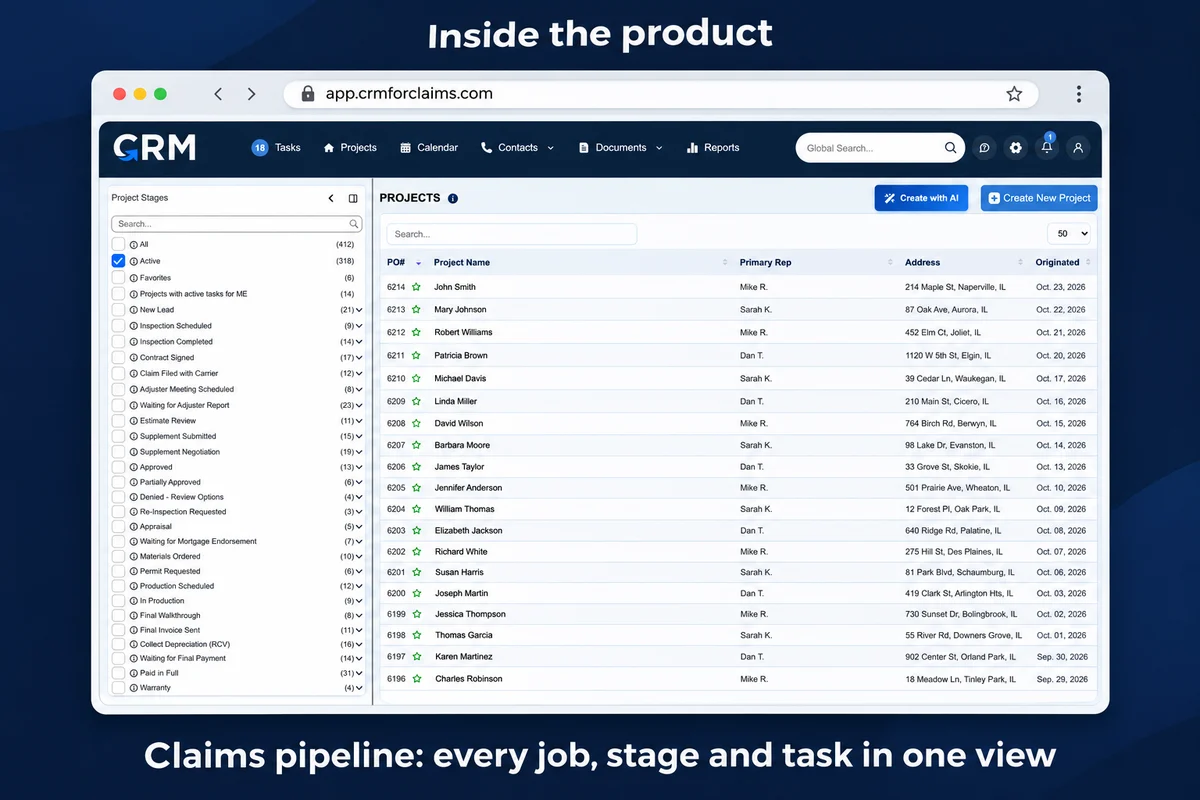
Written on a whiteboard, this list survives until the second storm. In CRM For Claims I build it into the stages of the claim instead. A stage can run actions On entry, and one of those actions is Create task, which makes a task from a task template and assigns it to someone. The template carries the due date in days: the same day, 1, 2, 3, 5, 7 or 14 days, a month, or any other number up to 365. So a stage called "Claim filed" can create "Check for the carrier's acknowledgment" due in 8 days, assigned to whoever handles insurance follow-up.
A task template can also carry answers, and each answer can send the project to its own stage when the task is completed. "Acknowledgment received" moves the claim on to waiting for the inspection; "Nothing yet" can move it to a follow-up stage that creates the written reminder. A stage can also repeat an action while the project stays in it, which suits the long wait for a decision: a check every 7 days until the claim leaves the stage. You can read more about how this is set up on the automations and tasks page, and why I care about it in my older post on stage automation for restoration claims.
Once the date of loss is set on the claim, the claim screen shows a bar that counts down a year from that date. That is a different clock from the carrier's, but it sits on the same screen as the claim number, and it keeps the oldest claims visible to everyone who opens them. Tying claims to the storm that caused them is covered on the storm and date of loss tracking page.
Who sends the reminder: you or the homeowner?
The homeowner, in almost every case. Both statutes write their deadlines in favor of the claimant or the policyholder, and the homeowner is the one with a policy. Your office keeps the calendar and drafts the facts; the homeowner signs the follow-up or makes the call. What a contractor may say to the carrier depends on the state and on the paperwork you hold, and I went through that in can a roofer talk to the insurance adjuster.
When the homeowner is the one who goes quiet, the deadlines above stop helping, and that problem has its own playbook in keeping a claim moving when the homeowner goes quiet.
If you want to see the follow-up stages built on a claim like yours, book a walkthrough and bring the state you work in. The full feature list is there if you would rather read first.