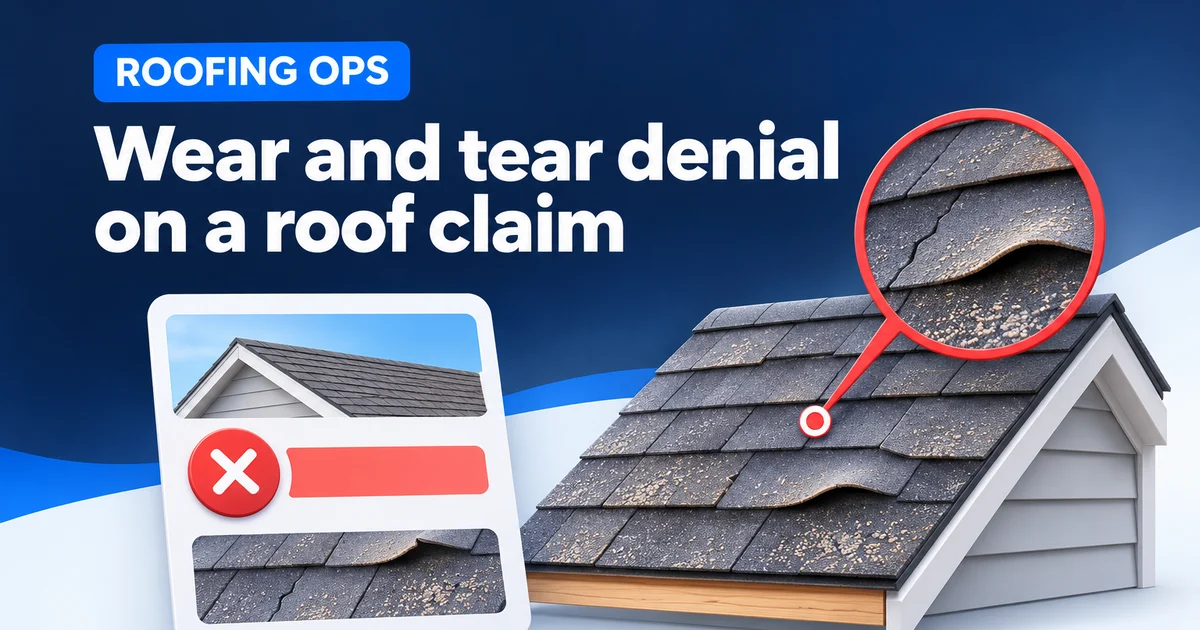
A wear and tear denial on a roof claim means the carrier decided the damage came from age, not from the storm. Wear and tear is excluded in homeowners policies, but hail that hits an old roof is still hail. So the question is never "is this roof old?" It is "what did the storm do to it?", and the roofer is usually the only person holding the photos and notes that answer that.
I build CRM For Claims, software for roofing and restoration companies that work insurance claims. On November 9, 2026 I read the pages that rank for this denial. They are written for the homeowner, and most of them end with "hire us". This one is for the roofer who has the letter on the desk and has to decide whether the claim is worth fighting and what to send. I worked from two state insurance regulators' own pages, not from anyone's sales pitch.
Does an old roof mean the hail damage is not covered?
No. Age changes how much the policy pays and gives the carrier a reason to look harder, but the wear and tear exclusion takes out the ageing, not the hail. Two state regulators describe the line from opposite sides:
"Homeowners policies do not provide coverage for 'maintenance.' Therefore, repairing damage due to wear and tear or deterioration of your roof over time generally will not be paid for by the insurance company." Maryland Insurance Administration, Consumer Advisory: Roof Replacement
"Hail damage will result in a random pattern of strike marks in various sizes. If you see a pattern to the damage, it was not caused by a random phenomenon like hail." Nebraska Department of Insurance, Hail Damage: Does My Roof Need Repair?
Put together, the carrier does not pay to fix a roof that was wearing out, and the way to tell storm from age is the pattern. Maryland adds the part that causes most of these letters: when hail damages a roof "that is already in need of maintenance due to wear and tear or deterioration", the policy may not cover "all or part" of the claim. "Part" is the word to hold on to. A worn roof with real hail hits is a claim about which part is which, and that is decided by evidence, not by the roof's birthday.
The same Maryland page warns homeowners about contractors who "misrepresent wear-and-tear as storm damage". Carriers read every roof claim with that warning in mind. Your file has to look like the opposite of it: dated, specific and honest about what is old.
What is the denial letter actually claiming?
Each phrase in these letters means something narrower than it sounds. Before you answer, write down which of these the letter uses, because each one is answered with different evidence:
- "Wear and tear" or "deterioration"
- The carrier says the damage you reported is ageing. Your answer is a photo set that separates the two: the aged areas you agree are aged, and the hits that are not.
- "Lack of maintenance" or "neglect"
- The carrier says the owner let the roof go. Ask what maintenance was missing and what it would have prevented. A worn sealant line does not explain a fractured shingle on the slope that faced the storm.
- "Granule loss consistent with age"
- Nebraska says it plainly: "granule loss does not prove damage." That cuts both ways. Loose granules in the gutter are not your evidence either. Hits with a bruised or fractured mat under them are.
- "No functional damage"
- This is a different argument from wear and tear, often tied to a cosmetic damage exclusion. I took that one apart in the post on cosmetic damage on metal roofs.
- "Pre-existing" or "prior damage"
- The carrier says the hits came from an earlier storm. Now the date of loss is the fight, and your storm record and the photo dates matter more than the shingles.
Also ask for the denial in writing with the policy language it relies on, if the homeowner did not get it. A letter that names the exclusion tells you exactly what you have to answer. A phone call that says "it's just old" tells you nothing.
How do you tell hail damage from ageing, part by part?
Look for randomness and for the storm's direction. Ageing follows the sun and the shingle's own structure, so it repeats across a slope. Hail lands where it lands. Nebraska lists what weathered asphalt does as it hardens and turns brittle: cupping, craze cracks, cracks and blisters. Lay those next to the hail signs for each part of the roof:
| Roof part | Ageing usually looks like | Hail usually looks like | Photograph |
|---|---|---|---|
| Shingle surface | Even dulling and granule thinning across a whole slope, worst where the sun hits longest | Scattered dark spots with sharp edges, some shingles hit and their neighbors not | A chalk-circled hit next to a tape measure, then a wide shot showing the scatter |
| Shingle mat | Craze cracks and splits that follow the shingle's grain, repeated on many tabs | A soft or bruised spot under the hit, or a crack that starts at the impact point | The hit before and after a gentle press, and the underside if a tab is lifted |
| Shingle shape | Cupping and curled edges across wide areas at once | Torn or missing pieces at the impact, not a change of shape | The tab edge in profile, with the slope's direction noted |
| Blisters | Raised or popped bubbles in clusters, often near poor ventilation | Craters pushed in, not burst out | A close shot at a low angle so the depth reads |
| Slopes | The sunniest slopes worst | The slopes that faced the storm worst, the sheltered ones lighter | One test area per slope, labelled with its compass direction |
| Soft metals | Paint fading and corrosion | Fresh dents in vents, gutters, downspouts, flashing and the AC unit | Each dent with a tape measure, plus the same items on a neighbor's house if they allow it |
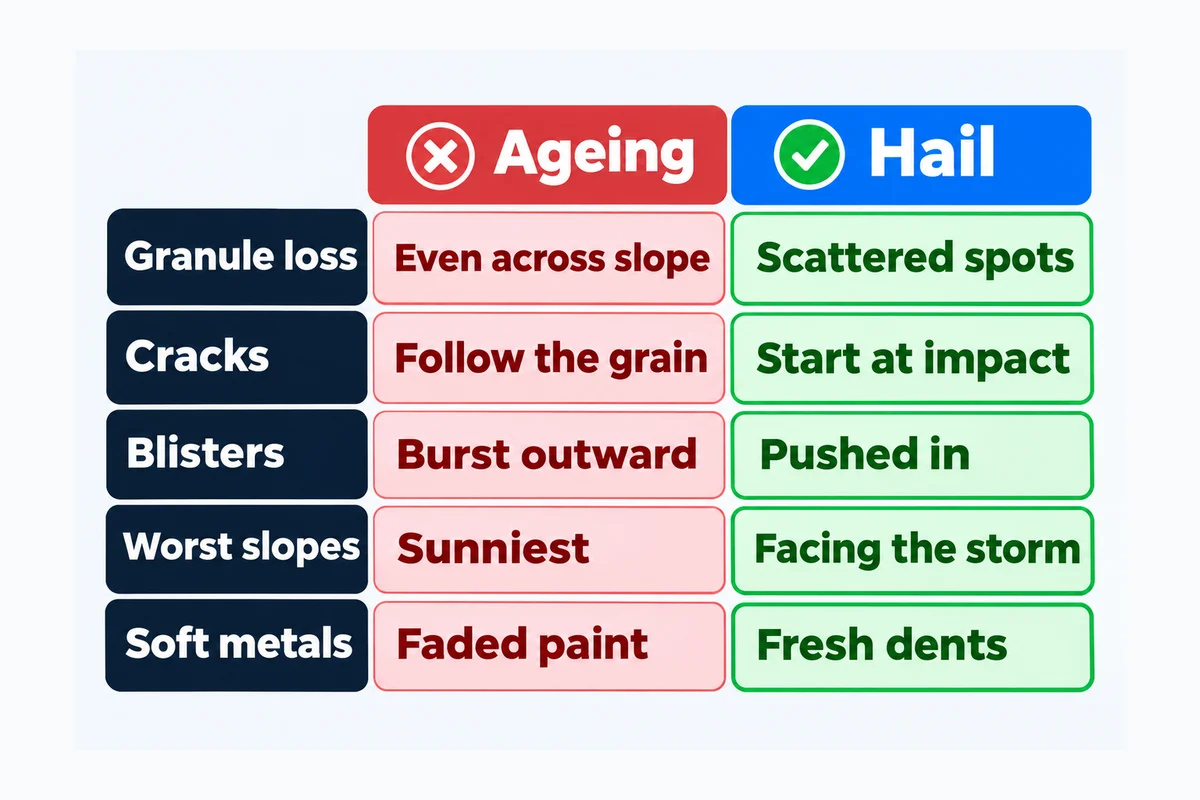
Two habits make this table work in front of an adjuster. Photograph the old stuff too: the cupped tabs and worn ridge you are not claiming. It shows you can tell the difference, which is the whole question. And count, do not describe. "Twelve hits in the test area on the west slope, three on the east" is evidence. "Heavy hail damage throughout" is an opinion. What each test area and count should look like on paper is in the roof inspection report post.
What goes in the reply to a wear and tear denial?
A short packet the desk adjuster can follow from top to bottom, built around the exact words of the letter. Send it through the homeowner or with their written okay, since the claim is theirs. In this order:
- A cover page that quotes the denial sentence and states, in one line, what you disagree with. "The letter calls the fractures on the west and north slopes wear and tear. They are storm hits from the date of loss below."
- The storm: date and time, hail size and wind reported for that area, and where that report came from.
- One page per slope: its compass direction, the test area count, and three or four labelled photos with the date on each.
- The collateral damage on soft metals, with measurements, because a dented gutter does not age into a dent.
- The aged areas you are not claiming, so the reader sees you separated them.
- Anything from before the storm: an earlier inspection, a sale listing with roof photos, a repair invoice. A roof photographed in good shape last year answers "neglect" faster than any argument.
- The request: what you want done next, usually a reinspection with you on the roof.
Keep your opinions about the adjuster out of it. The packet is going to be read by someone deciding whether to reopen a file, and anger reads as weakness. How to ask for that second visit, and what to have ready on the day, is in getting the adjuster back on the roof.
What if the carrier still says no?
Then the homeowner has the paths the policy and the state give them, and your job is to keep the file ready for each. Many policies have an appraisal clause, which can settle what the loss is worth when the parties disagree about the amount. Whether it can also decide cause depends on the policy and the state, so read the clause before you count on it. I weighed the costs in when appraisal is worth the fees.
The state insurance department is the other door, and it helps to know where that door stops. Nebraska's department says it "is not able to decide questions of fact like whether or not damage to your roof was caused by hail or other factors." What it can do is "review the company's handling of your claim". So a complaint works best when it is about how the claim was handled: an inspection that never looked at the slopes that faced the storm, evidence that was sent and never answered, a letter with no policy language in it. That is the part your dated file can show.
And sometimes the honest answer is that the roof was worn out and the storm did little. If your own test areas come back nearly empty, tell the homeowner that before anyone spends money on a fight. It keeps your name clean with the carrier for the next claim that is real.
Keeping the storm record before anyone argues
The roofers who win these have one thing in common: the storm was written down the week it happened, not reconstructed after the denial. By then the notes are in three phones and the gutter guy has repainted the dents.
In CRM For Claims each date of loss is its own record with the storm date and time, the maximum hail size and maximum wind speed, the cities or ZIP codes it hit, and a storm note. Every claim has a required Date Of Loss picked from those records, so every roof hit by the same storm points to the same storm facts. The claim itself has a Claim Status of Claim Needs to be Filed, Filed, Approved, Denied or Closed, so a denied claim stays visible as denied instead of fading into the closed pile.

The storm and date of loss tracking page shows how those records work across a whole season, and the features page has the rest of what lives on a claim. Plans start at $59 a month on pricing. If you have a denial letter on your desk right now and want to see how the file would look, book a live walkthrough.