
A roof inspection report for an insurance claim has one job a sales report doesn't: it holds the counts, sizes and layers the estimate will be written from, recorded before anything is torn off. Photos prove the damage. The report proves the quantities, and quantities are what the scope pays for.
I build CRM For Claims, software for roofing and restoration companies that work insurance claims. On November 6, 2026 I read the roof inspection templates that come up first in search. They are good condition reports. None of them connects a box on the form to the line of an insurance scope it ends up paying for, so that is what this post does.
What makes a claim report different from a sales report?
A sales report persuades a homeowner that the roof needs work. A claim report has to survive a second reader, the adjuster or the desk estimator, who is pricing the roof from it and will drop any line the report can't back up. Same roof, same walk, two different documents.
The inspection report you hand the homeowner
It answers "what's wrong and what do you recommend?" Condition, age, a few strong photos, a recommendation and a signature.
Its reader decides yes or no. A missing vent count costs you nothing here.
The inspection report the claim runs on
It answers "how much of everything is up there?" Layers, slope, every penetration counted and sized, what is present and what is missing at the edges.
Its reader prices the job line by line. A missing count is a missing line, or a supplement you'll argue about for weeks.
It's tempting to write the first one and hope it doubles as the second. It doesn't, mainly because the second one has to be filled in before tear-off. Once the old roof is in the dumpster, nobody can count the layers again.
One example roof, filled in the way the estimator needs it
This is a made-up roof I use for training, not a real job. It's a two-story house with a single chimney, one skylight and an older roof that was covered over once. Read it as a sheet, the way it would look clipped to the file.
Nothing on that sheet is an opinion. Each row is either a count, a size, a material or a yes or no, and that's deliberate. An adjuster can disagree with "the roof is in poor condition". It's much harder to disagree with "two layers, 6/12, four box vents" when the photos match.
What does each line of the report pay for?
Every row above turns into one or more lines on the estimate. If you've ever read an insurance scope line by line, you'll recognize them. The right column is what happens when the row is blank on the day it mattered.
| What you record | The scope line it feeds | What a blank costs |
|---|---|---|
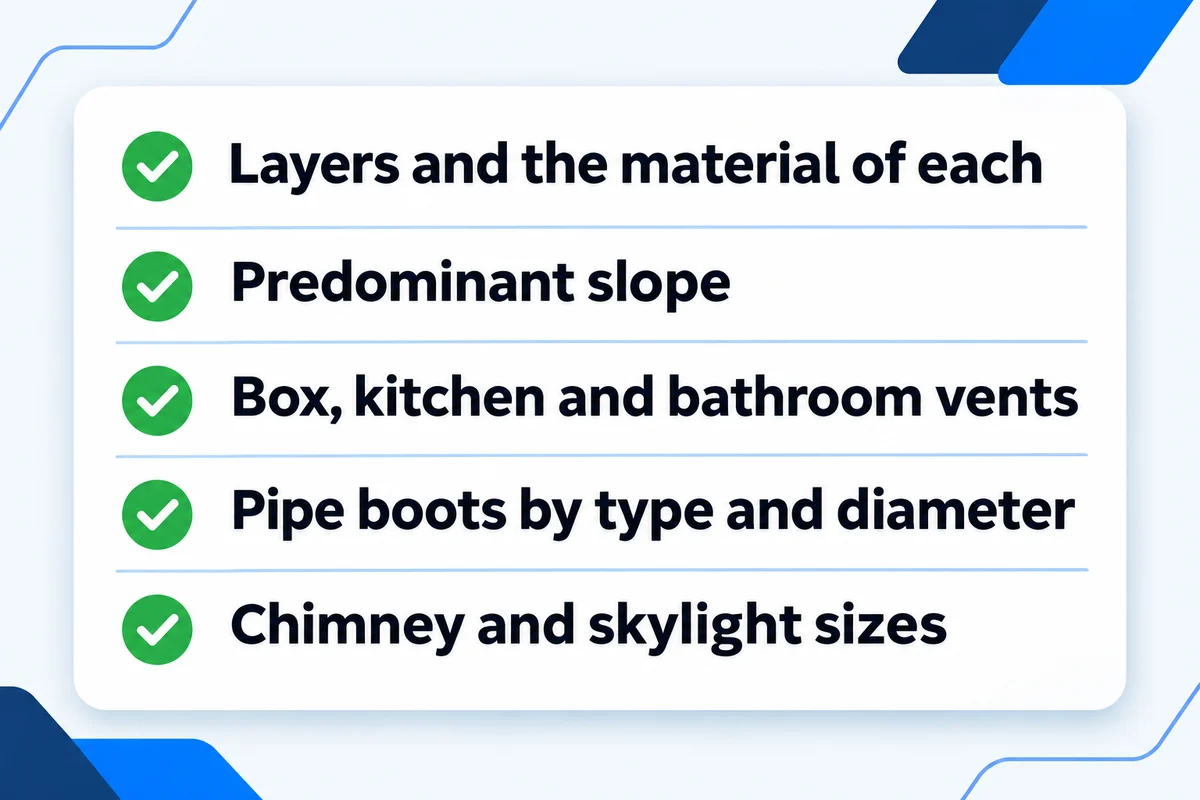
| Number of layers and the material of each | Tear-off of each additional layer | The scope prices one layer, and the second layer comes off at your expense |
| Predominant slope | Steep charges and the labor rate on the roofing lines | The estimate defaults to the walkable rate |
| Chimney size and flashing condition | Chimney flashing, sized by the chimney | Flashing gets "reset" instead of replaced, or a small chimney price |
| Skylight brand and size | Skylight flashing kit or the unit itself | A generic line that doesn't match the kit you have to buy |
| Box, kitchen and bathroom vents, counted | One line per vent type, by count | You install six and get paid for the four in the photos |
| Plumbing stacks by type and diameter | Pipe jacks or boots, by size | Lead boots priced as plain rubber ones |
| Ice and water, drip edge, gutters | Membrane at eaves and valleys, edge metal, detach and reset of gutters | No record that they were missing, so nothing to claim later |
| Satellite dish and power vents | Detach and reset, or replace | The crew does it for free on install day |
The pattern is the same in every row. The estimator can only price what the file shows, and the file can only show what someone wrote down while it was still on the roof. Decking is the one exception you can't count in advance, which is why it deserves its own plan for rotted decking found at tear-off.
Why "absent" is worth writing down
A missing part is a finding. Edge metal and eave membrane are the two that come up most, because codes added them over time and older roofs often went on without them.
The International Code Council's summary of the significant changes in the 2012 International Residential Code lists drip edge for asphalt shingle roofs as a new requirement in that edition. A roof shingled before a town adopted it may have none.
Ice barrier at the eaves is required where ice dams have a history, and village building departments spell out the widths. I covered those numbers in the post on ice dam roof leaks and insurance.
Whether the policy pays for an item the old roof never had is a coverage question, and the answer usually sits in the ordinance or law coverage. The report's job is narrower: show that the item was absent on the first day, with a photo of the bare edge. Without that, the conversation never starts.
Blank, absent and "partly": three answers that mean different things
A form that only has a text box invites people to skip what they didn't look at. A form with fixed answers makes them pick, and each pick tells the estimator something different.
- Present
- The item is there along the whole run. The estimate prices removal and replacement, if the roof is being replaced.
- Absent
- You looked and it isn't there. This is the answer that opens the code conversation, so it needs a photo of the edge or the eave.
- Partly there
- On some edges and not others, like the rakes-only drip edge on the example roof. Add a short note of where, so nobody has to guess the length.
- Left blank
- Nobody knows. An estimator reads a blank as "not there" or "not checked", and neither gets you paid. If something truly doesn't apply, write N/A so the next person knows you checked.
Keeping the report on the claim in CRM For Claims
The report is only useful if the estimator can find it on the claim instead of in someone's truck. In CRM For Claims the roof inspection checklist is a screen on the project itself, saved with that project, so it sits next to the photos, the documents and the adjuster on the same claim.
The checklist has the fields from the sheet above: structure, damaged decking, chimney flashing condition and chimney sizes, skylight brand and size, box, kitchen and bathroom vent counts, the material of up to four layers, the predominant slope, plumbing stacks by type of product and diameter, satellite dish, power vent covers and free notes. Ice and water, drip edge and D&R gutters each take Present, Absent or 50/50, and a Description box opens next to them for the detail.
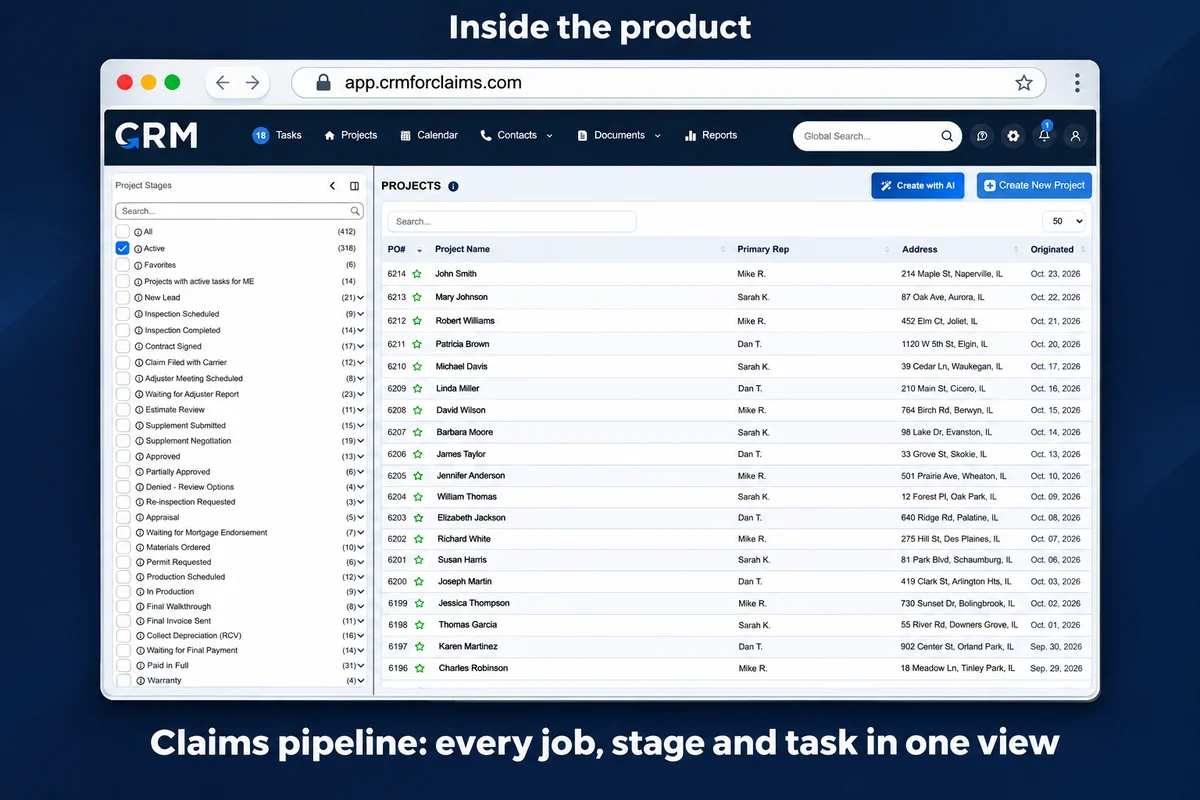
Fill it on the first walk, and the person writing the estimate in the office works from the same numbers the inspector saw. You can see the rest of what a project holds on the CRM For Claims features page, and how it differs from a general contractor CRM on the comparison page.
If you want to see the checklist on a real project screen before your next storm, book a live walkthrough and I'll show you where every count goes. Plans start at $59 a month, listed on the pricing page.