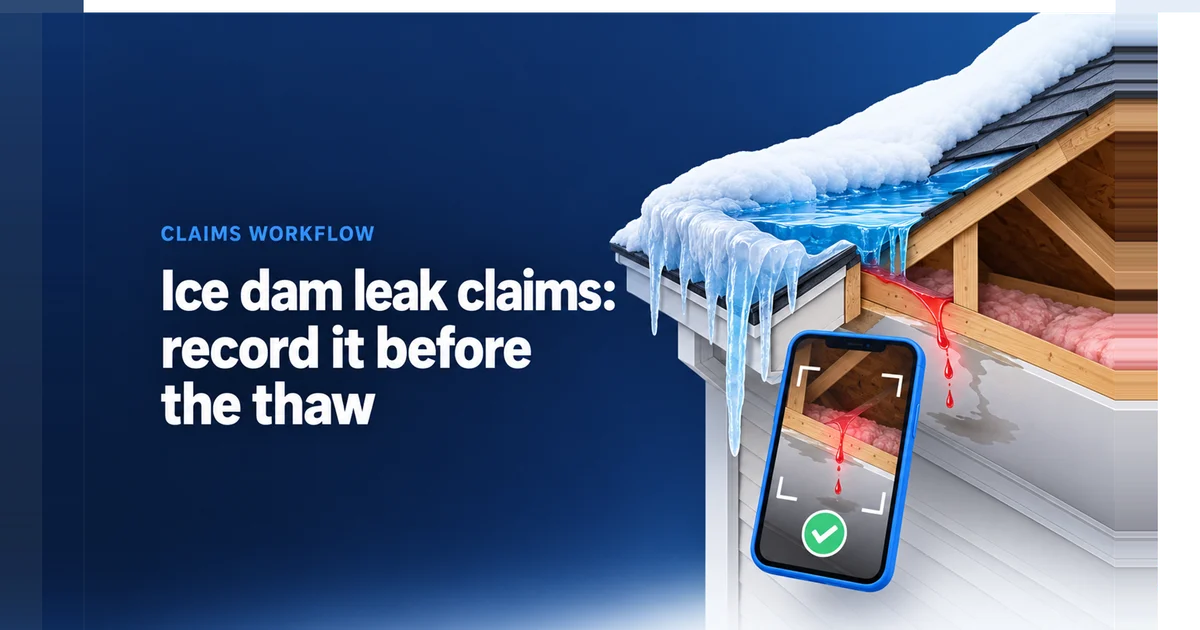
On an ice dam insurance claim, the water that came through the ceiling is usually covered and the ice on the roof usually is not. The argument with the carrier is rarely about whether ice dams exist. It is about two other things: whether the leak was sudden or had been seeping for weeks, and whether the roof was already in bad shape. A roofer who gets the first call can settle a lot of that before the thaw, simply by recording what is on the roof and when the homeowner first saw water.
I build CRM For Claims, a CRM for roofing and restoration companies that work insurance claims. Ice dam calls arrive in a bunch after the first hard freeze and thaw, and the files that go badly look alike: a stained ceiling, a roof that is bare by the time the adjuster comes, and nobody who can say when the dripping started.
Why do carriers push back on ice dam leaks?
Because the cause can be read two ways. Water forced under the shingles by a ridge of ice in one cold week is a sudden event. A roof that has leaked a little every winter for years is wear and maintenance, and most homeowners policies exclude that. United Policyholders, the consumer group, puts the line plainly: the damage is covered with timely notice when "it is reasonably clear it was not solely due to known and pre-existing roof damage." Its ice dam guidance is worth sending to homeowners who ask.
So the record has to show a path from the weather to the ceiling. Follow the water and photograph each stop:
- Warm attic under the upper roofHeat from the house melts the snow above it, even on a day well below freezing.Attic photo of the underside of the deck and the insulation, with the date on the file.
- Snow on the upper slopeThe melt runs down under the snow toward the eave.Wide shot of the whole slope from the ground, snow line visible.
- Cold overhang at the eaveThe eave sits over open air, so the water refreezes there and the ridge of ice grows.Ground shot of the ice ridge and icicles, with the gutter in frame.
- Pool behind the iceNew melt backs up behind the ridge and sits on the shingles.From a ladder at the eave only if it is safe: the standing water or slush behind the ice.
- Under the shinglesShingles shed water running down, not water standing still, so it works up and under them.Later, at tear-off or repair: staining on the underlayment and deck near the eave.
- Top plate and wall cavityThe water reaches the deck above the exterior wall and runs down inside it.Attic shot over the wall line: wet insulation, frost, drips on the plate.
- Ceiling and wall insideThe stain shows up where the outside wall meets the ceiling, usually below the ice.Room shot with a tape or a phone date stamp, and a close-up of the stain edge.
Shots two, three and seven have to be taken while the ice is still there. Nobody can photograph an ice dam in March. If the homeowner already took pictures on their phone, ask for the originals, not screenshots, because the originals carry the date. The post on claim photo documentation covers naming and storing them so they survive the trip to the carrier.
The 14-day clause and the date the stain appeared
Many homeowners policies carry a version of an exclusion for slow leaks. A Florida appeals court quoted one in 2018:
"We do not insure . . . for loss . . . [c]aused by . . . [c]onstant or repeated seepage or leakage of water . . . over a period of 14 or more days."
Policy wording quoted in Hicks v. American Integrity Insurance Co. of Florida, Florida Fifth District Court of Appeal, case 5D17-1282, opinion filed February 23, 2018 (read the opinion)
That case was a leaking refrigerator line, not a roof, and the court held that such wording does not clearly exclude the first thirteen days of a leak. Courts in other states read it their own way, and carriers write their own versions. The point for a roofer is simpler: on a slow leak, the carrier will want to know how long the water had been coming in. A winter of ice dams on the same eave looks like seepage. One week of ice after one storm looks like an event.
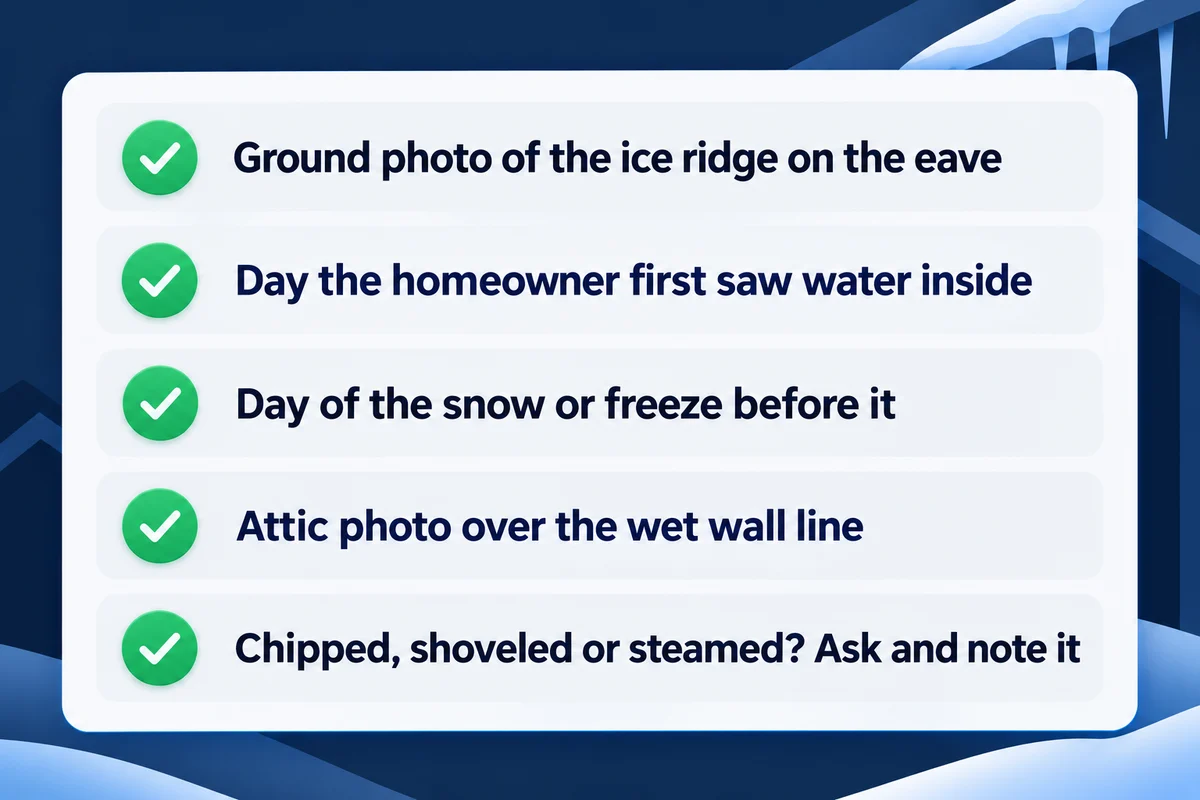
That makes three dates worth writing down on the first call: the day the homeowner first saw water inside, the day of the snow or freeze before it, and the day they reported it to the carrier. Write them in the homeowner's words, before anyone has had time to tidy the story. Water claims split from wind and hail claims on exactly this kind of detail, as the post on water damage versus wind and hail claims explains.
The intake call, question by question
The person answering the phone in January does not need to know insurance law. They need six questions and the reason behind each, so they ask them every time and write down the answers.
- "When did you first see water or a stain inside?"
- The single most important date in the file. Ask for the day, not "a while ago". If they are unsure, ask what else happened that week.
- "Is the ice still on the roof right now?"
- If yes, someone goes out today for the ground photos. Tomorrow it may be gone.
- "Has anyone chipped, shoveled or steamed it?"
- Damage from a shovel or an axe is not storm damage, and it will be found. Better to hear about it now.
- "Has this spot leaked in an earlier winter?"
- An honest yes changes how the claim reads, and the adjuster will ask anyway. Write the answer down as given.
- "When was the roof put on, and has anyone worked on it since?"
- Age and past repairs tell you whether the eave has an ice barrier at all, which matters for the next section.
- "Have you called your insurance company yet?"
- The homeowner reports the claim, not you. Note the date and the claim number when they have one.
Keep the answers in the claim, not on a sticky note. When the adjuster calls three weeks later, the office reads them back instead of guessing.
Removing the ice: who pays and how to bill it
Taking the ice off the roof is usually the homeowner's cost. It is treated as upkeep, and most policies do not pay to prevent damage that has not happened yet. Once water is coming inside, steaming a channel through the dam can be damage control instead, and some carriers will pay for it as part of the claim. Do not assume either way. Have the homeowner ask their adjuster before the steamer arrives, get the answer in an email, and put the steaming on its own invoice line so it can be paid, or not, without holding up the rest of the claim.
United Policyholders gives homeowners one blunt instruction: "Do not use a snow blower, shovel or blowtorch to try to chip, break or melt ice dams." Torn shingles and burned underlayment from a weekend of chipping turn a covered leak into a mess nobody will pay for.
When the eave gets reroofed, the code decides the membrane
If the claim ends in new roofing along the eaves, the building code requires an ice barrier where ice dams have a history, and a house with an ice dam claim plainly has one. Village building departments publish this in plain language. The Village of Orland Park, Illinois, sends a one-page summary:
From the Village of Orland Park Building Division summary of ice barrier requirements for roofing, which cites the 2018 International Residential Code adopted by the village on July 1, 2019.
The 24 inches are measured inside the wall, level with the floor, not along the roof. Up the slope that distance gets longer, so one 36 inch roll of membrane laid along the eave often falls short. Fine Homebuilding worked out the distance for a house with a 12 inch overhang and 2x6 walls:
| Roof pitch | Membrane needed up the slope from the drip edge | One 36 inch course enough? |
|---|---|---|
| 6 in 12 | 47 in | No |
| 8 in 12 | 50-1/2 in | No |
| 12 in 12 | 59-3/8 in | No |
Distances from Fine Homebuilding, ice-dam protection: how far up the roof slope? A deeper overhang pushes them further.
Price the eave with two courses where the numbers say so, and mark the second course as the code item it is. If the old roof had no ice barrier, that line may be paid under ordinance or law coverage rather than the main dwelling limit. The post on ordinance or law coverage on a roof claim walks through how that separate limit works, and the village handout goes in the file next to the estimate.
Running an ice dam claim in CRM For Claims
Ice Damming is one of the built-in types of loss on the claim tab. Pick it, and the Date Of Loss list offers only the dates recorded for that type of loss, so a February freeze never gets mixed up with last summer's hail. A date of loss is recorded once, on the Loss Dates screen, with its own area of impact, and every claim from that cold snap points to the same entry. The date of loss tracking page shows how that list works across many claims.
Summary of Loss is a required field on the claim, which is where the homeowner's own account goes: when they first saw water, what they did, who they called. Each task is assigned to a user, and the assignee can be notified by email, so "ground photos today, ice still up" lands with one named person instead of a group chat.

If your company takes winter leak calls and you want to see a claim set up this way on a real screen, book a live walkthrough and bring last winter's worst ice dam file.