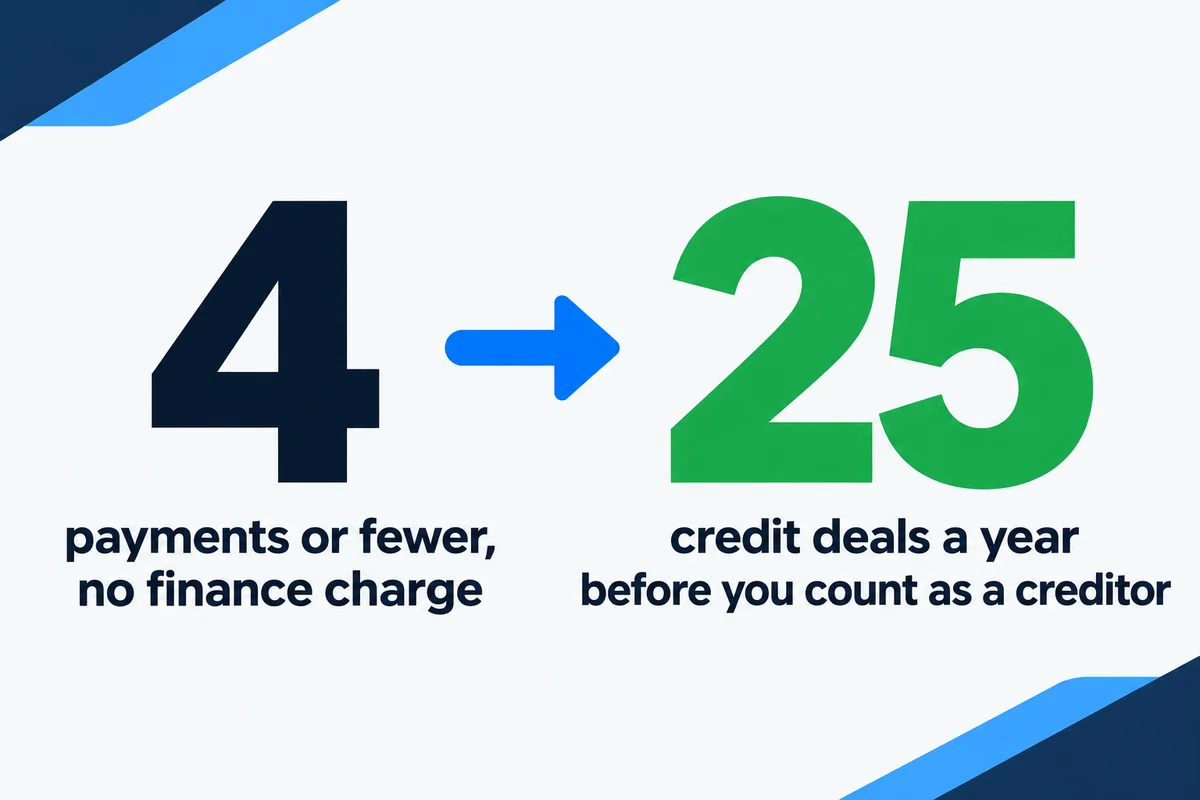
A roofing payment plan on an insurance job is safe ground when it has four payments or fewer and no finance charge. Cross either line, five or more payments in writing or any interest or plan-only fee, and the roofer meets the first test of "creditor" in the federal Truth in Lending rules. Do that often enough in a year and the plan needs loan disclosures, which most roofing offices are not set up to produce.
I build CRM For Claims, software for roofing and restoration companies that work insurance claims, and the product has an in-house financing window, so I spend more time than most people on this question. Today I read the pages that rank for contractor payment plans. They are written by lenders selling loans to your customers. None of them tells the roofer where their own plan stops being a favour and starts being credit, so I read the regulation itself.
When does a roofer's payment plan count as credit?
When it is written for more than four installments, or when it carries a finance charge, and you are the one the money is owed to. That is test (i) of the definition of creditor in Regulation Z, the rule that carries out the Truth in Lending Act:
"A person who regularly extends consumer credit that is subject to a finance charge or is payable by written agreement in more than four installments (not including a down payment), and to whom the obligation is initially payable." 12 CFR 1026.2(a)(17)(i), Consumer Financial Protection Bureau
"Regularly" has a number. The same section says a person regularly extends consumer credit only if they did it more than 25 times in the preceding calendar year, or more than 5 times for transactions secured by a dwelling. A roof on someone's home is the textbook household purchase, so the homeowner is a consumer. The official commentary adds a detail that catches people: the agreement has to be written to count as more than four installments, and "a letter that merely confirms an oral agreement" is not a written agreement. A finance charge counts whether it is written down or not.
So run every plan through four questions before you offer it:
- Is the homeowner paying you, not a bank?If a lender pays you in full and the homeowner owes the lender, the lender is the creditor. Your plan questions end here.
- Is there any charge for paying over time?Interest, a plan fee, a higher price than a customer paying at once would get. Any yes means a finance charge, and test (i) is met at any number of payments.
- Are there more than four payments after the down payment, in writing?The down payment is not counted. Five scheduled payments on a signed plan meets test (i) even at zero interest.
- Did you write more than 25 of these last year, or more than 5 secured by the home?This count only matters for a plan that failed question 2 or 3. Past the count, you are a creditor for that kind of plan.
One homeowner share, priced four ways
Here is an example roof. The carrier pays the covered replacement through its own checks. What the homeowner owes the roofer directly is this:
Deductible on the policy$2,500.00
Upgrade from standard to impact-rated shingles, the difference only$1,850.00
Two new skylights the owner chose, not storm damaged$1,450.00
Homeowner share$5,800.00
The homeowner asks to spread it out. These are four plans you could write for the same $5,800, and what test (i) says about each:
| Plan | Payments | Finance charge | Test (i) |
|---|---|---|---|
| A. Four monthly payments | 4 of $1,450.00 | None | Not met, at any volume |
| B. $1,000 down, then four payments | $1,000.00 down, 4 of $1,200.00 | None | Not met, the down payment is not counted |
| C. Six monthly payments | 5 of $966.67 and 1 of $966.65 | None | Met: more than four in writing |
| D. Four payments with 1.5% added to each | 4 of $1,471.75 | $87.00 in total | Met: there is a finance charge |
Plans C and D are not illegal. They mean that once the yearly count is crossed, you owe the homeowner Truth in Lending disclosures before they sign: the annual percentage rate, the finance charge, the amount financed and the total of payments, in the format the rule sets. Plan B is the one I'd put in front of most homeowners. It gets the roofer a real payment at signing, keeps the monthly amount readable and stays outside the definition.
What counts as a finance charge on a roof plan
Interest is the obvious one. The ones that slip in by accident are fees that exist only because the customer is paying over time. Regulation Z's own test is a comparison with a cash customer: a charge that a person paying the same job in full would also pay is not a finance charge. Section 1026.4 excludes charges imposed "uniformly in cash and credit transactions" and charges "for actual unanticipated late payment".
Counts as a finance charge
- Interest or a percentage added to each payment
- A one-time "plan setup" or "financing" fee
- A card processing fee you add to plan payments but not to a customer paying in full by card
- A higher job price for plan customers than for cash customers
Does not count
- A late fee charged only when a payment really is late
- A card fee every card customer pays, plan or not, where your state allows one
- Permit and disposal charges that every customer pays
- A discount anyone paying in full can take
The late fee needs care. The commentary looks at how the account actually works: if your terms never really expect the full payment on the due date and the "late" fee lands every month, it can be treated as a finance charge after all. Charge it when a payment is late, after a short grace period, and not as a routine part of the plan.
Keep the carrier's money off the plan
The plan covers what the homeowner owes from their own pocket and nothing else. The ACV check, the recoverable depreciation released after the work, a supplement the carrier approves: those come from the carrier on their own timeline and go on their own invoices. Put them on a monthly plan and two things go wrong. The amount financed suddenly looks like the whole roof, and the homeowner's payment dates get tied to a carrier who does not care about your schedule.
The deductible belongs on the plan as a full amount the homeowner pays, never as something reduced, absorbed or covered by "discounts". A payment plan spreads a deductible out. It does not waive any of it, and the rules on that are in what a contractor can and cannot do with the deductible. If the money the plan was waiting for is the held-back depreciation, the steps to release it are in recovering depreciation after the work is done.
If your plans are already over the line
Count last year's plans. If you wrote more than 25 that had five or more payments or any charge for time, you are a creditor for the plans you write now, and the disclosures are owed on each one. There is a second rule worth knowing before you call an attorney. For the homeowner's right to cancel a credit deal secured by their home, Regulation Z treats liens that arise by law as security interests, and the commentary names "mechanics' and materialmen's liens" as the example. A roofer who is a creditor can therefore owe the homeowner a rescission notice too.
This is the point to sit down with a consumer-finance attorney in your state, not to guess. The usual answers are to shorten plans back to four payments with no charge, or to send longer financing to a lender who handles the disclosures and pays you in full. State law can add its own rules on interest and home improvement contracts, and I have not covered those here.
Building the plan so it says what you meant
Most plan trouble starts with a plan that lives in a text thread and a spreadsheet, where nobody can later tell how many payments were promised. In CRM For Claims an in-house plan is created from the Customer Finance Dashboard on the project, in a Create Financing window with the financing amount, the term in months and the first payment date. Before you save, the window shows the payment schedule in one line, such as "6 payments: 5 of $966.67 and 1 of $966.65", so you see the count you are about to put in writing.
Include interest rate is its own Yes or No question, and so is whether the payments are ACH, with a processing fee type and amount asked for only when they are not. A late fee is optional, by amount or percent, with its own grace days. You choose whether invoices are e-mailed automatically and whether reminders go out a set number of days before each due date. Once the schedule exists, the amount, the term and the first payment date are fixed, so the plan cannot quietly grow a fifth payment.
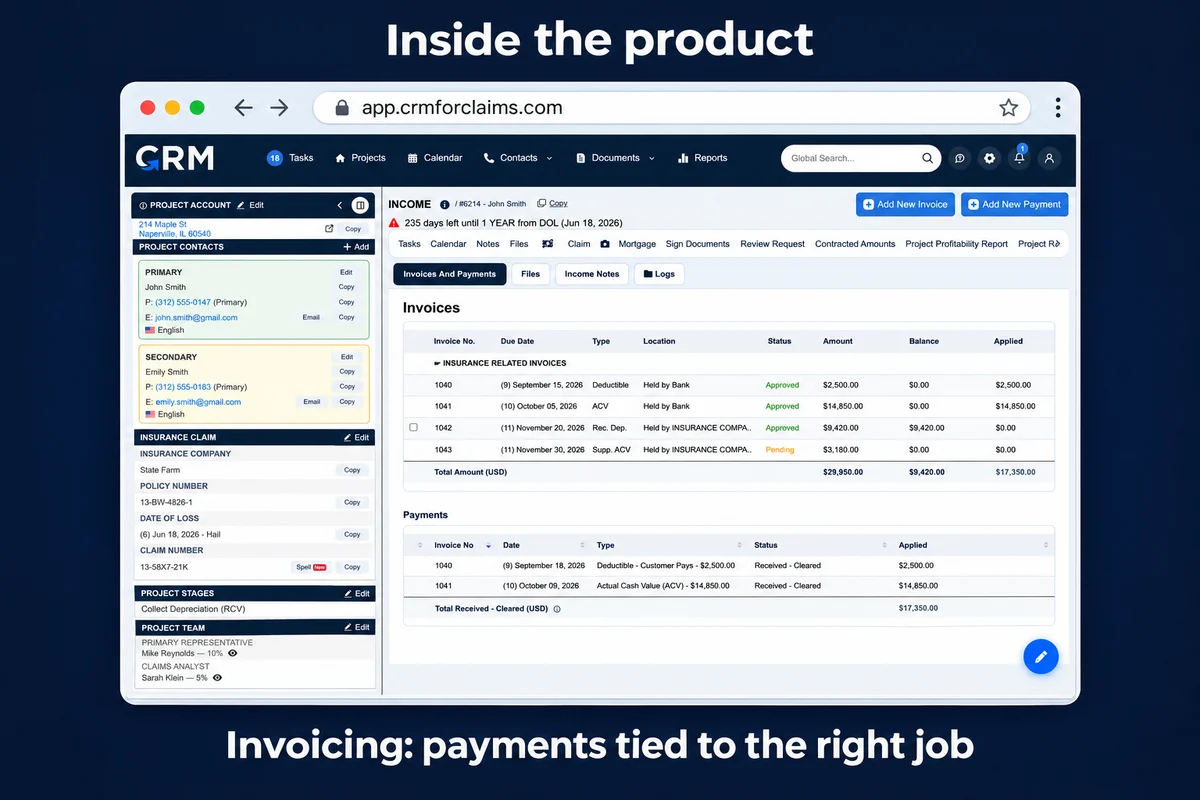
Each payment of the plan becomes its own invoice on the project, typed Retail Financed IN-HOUSE, while the carrier's money sits on insurance invoice types such as Deductible and Recoverable Depreciation (RC). The two never blend into one balance. The estimates and invoicing page shows how those invoice types work together, the features page covers the rest of the claim, and plans start at $59 a month on pricing. If you want to see a plan built on a real-looking project before you offer one, book a live walkthrough.