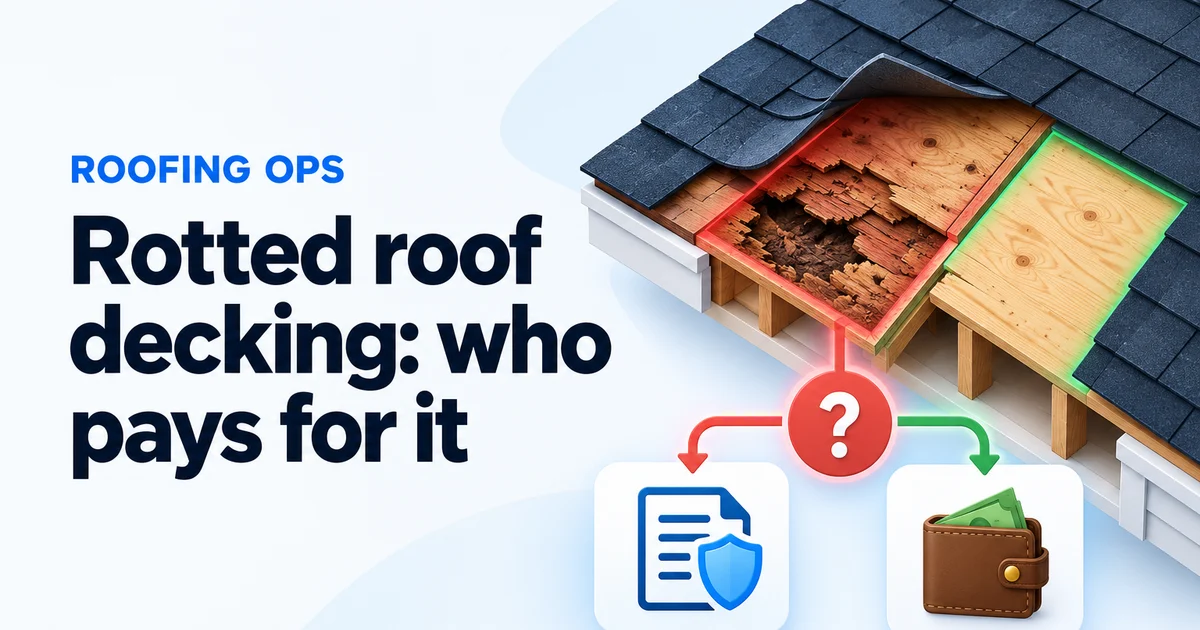
When the old shingles come off and the deck underneath is soft, rotted or full of gaps, who pays for the new decking on an insurance claim depends on why it is bad. Deck the storm broke is part of the covered loss. Rot that started after the storm, from water that got in through the damage, often is too. Old rot and wide-spaced boards are usually not storm damage at all, and the money for them comes from ordinance or law coverage if the code forces the change, or from the homeowner. On tear-off day your job is to prove which of those you are looking at, before a single new sheet goes down.
I build CRM For Claims, a CRM for roofing and restoration companies that work insurance claims. Rotted roof decking is the supplement that most often gets refused for a reason that has nothing to do with the roof: the crew replaced it first and asked later, and the only record is a sentence somebody remembers the adjuster saying on the walk.
Which kind of bad deck is this? Three questions, in order
Ask them in this order, because the first yes decides where the money comes from and the later questions stop mattering.
- Did the storm itself break or puncture the deck?Hail that cracked the sheathing, a limb that went through it, wind that tore boards loose with the shingles. You can see the fracture, the hole or the bent nails, and it lines up with the damage the adjuster already wrote up. Yes: it is part of the covered loss, priced like the shingles above it. Ask for it as a supplement with the photos.
- Did water get in through the storm damage and rot the deck afterwards?The soft wood sits under the missing shingles or the punctures, the stains are fresh, and the rest of the deck is sound. Many homeowners policies exclude rot in general but pay for it when it follows damage from a covered peril. The policy's own fungi and rot wording decides it, so read that section before you argue. Maybe: the homeowner has to show the rot came after the storm. Photos that tie each soft area to a storm opening above it are the evidence.
- Is it old rot, delaminated plywood or boards spaced too wide for shingles?Dark, crumbling wood under shingles that were never damaged, sheathing too thin, or 1x6 planks with gaps the shingle maker does not allow. The storm did not do this, but the new roof cannot legally go on top of it. Code item: if the local code requires the replacement, the cost can fall under ordinance or law coverage, up to its limit. What that coverage does not pay, the homeowner pays.
The third case is the one that ends in arguments, and the post on ordinance or law coverage on a roof claim walks through how that separate limit works. One warning from experience: an adjuster who says "that would be covered" on the walk has not approved anything. Get it in an email, or write it in your own email back to them the same day and ask them to confirm.
What a building department actually requires under the shingles
"The code says so" only works when you can show the code. Your village or county publishes its roofing rules, usually as a one-page handout for the permit. The Village of Wheeling, Illinois, a few miles from our office in Lincolnshire, is a good example of how plain they are.
- "Asphalt shingles shall be fastened to solidly sheathed decks."
- "A NEW sheathing shall be a minimum 1/2-inch thickness."
- "Existing 3/8-inch sheathing may remain if not compromised, rotted, deteriorated, moldy, etc."
- Sheathing is one of the required inspections, along with ice and water and the final.
Read the third line twice. Thin sheathing that is sound may stay, so the code alone does not force a new deck on every old roof. Rotted sheathing may not stay, whatever its thickness. And the sheathing inspection means the inspector is going to look at the bare deck, so the condition you are claiming will be seen by someone the carrier did not hire. Print your own jurisdiction's handout and put it in the file before you ask for anything.
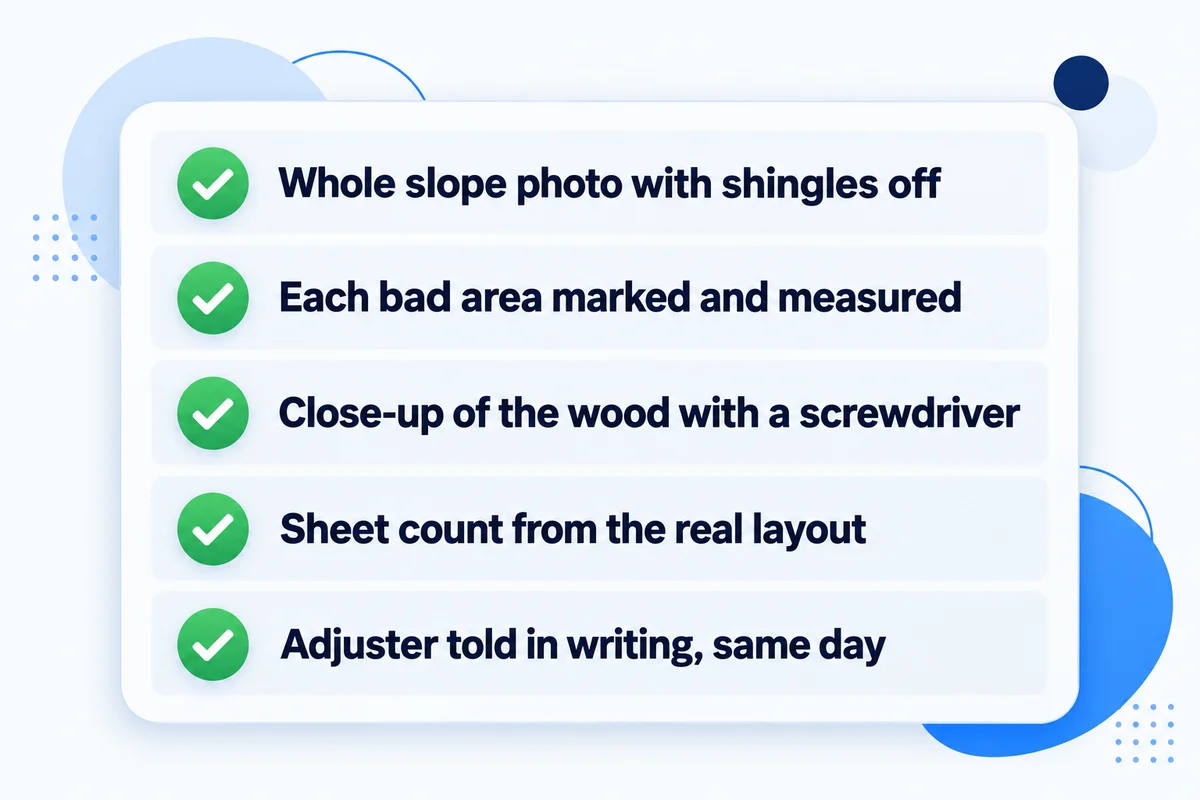
Tear-off day, in the order the photos have to be taken
A supplement for decking is judged on pictures of a deck that no longer exists. Once the new sheets are nailed, nobody can go back and look. So the crew lead takes these before the pry bar touches the bad wood, and in this order, because each shot answers a question the next reviewer will ask.
Then stop the crew on that slope for the length of one phone call. Call or email the adjuster with the photos, say how many sheets, and ask whether they want to see it themselves. Some will say go ahead, some will want a reinspection, and either answer in writing is worth more than a finished roof with a story. The post on claim photo documentation covers naming and dating the files so they survive the trip to the carrier.
Counting sheets the way the job is really built
Square footage and sheet count are two different numbers, and a decking supplement that only gives one of them invites a haircut. A 4x8 sheet covers 32 square feet, but you cannot nail a 1.5-sheet patch: every cut has to land on a rafter, and a narrow run along the eave still uses whole sheets ripped down. Here is one made-up roof to show how far apart the numbers get.
| Bad area, measured | Sq ft | Sheets by area | Sheets as laid |
|---|---|---|---|
| Valley above the back porch, 6 ft by 10 ft | 60 | 2 | 3 |
| Around the chimney, 4 ft by 9 ft | 36 | 2 | 2 |
| North eave strip, 2 ft by 24 ft | 48 | 2 | 3 |
| Whole roof | 144 | 5 (144 / 32) | 8 |
Example numbers only. Count your own layout on the roof with the tape in the photo.
Send the eight, with the square feet next to it and the layout photos that explain the difference. If the adjuster prices five, you know exactly which three sheets to argue about, and so do they. Write down any rafter or ridge board you find broken while the deck is open too: that is a separate problem from the sheathing, and it needs its own photos and its own line.
The line the homeowner signs before the tear-off
Every decking dispute gets easier if the homeowner agreed to the price per sheet before anyone knew how many sheets there would be. Put it in the contract or a short addendum, signed at the same time, with a blank for the count and the price filled in by you. Something like this:
Damaged or code-deficient roof decking found after tear-off will be replaced at per 4x8 sheet of sheathing. Before replacing it, the contractor will photograph and measure each area and send the photos to the homeowner and the insurance adjuster.
The contractor will ask the insurance company to pay for the decking as part of the claim. Any sheets the insurance company does not pay for are the homeowner's cost at the price above.
Homeowner initialsHave a lawyer in your state read your version once, then use it on every job. The homeowner who initialled it in the kitchen is not surprised when two sheets come back unpaid, and you are not stuck choosing between eating the cost and fighting a customer.
Keeping the deck on the claim in CRM For Claims
The roof is closed up by the end of the day, so the record has to be in the claim file by then too. Every project in CRM For Claims has a roof inspection checklist with a Damaged Decking field. Its choices are 10%, 25%, 50%, 100% and spaced, so the deck is on the record from the first inspection, before anyone climbs up with a pry bar.
A task can carry files, so the office task to send the decking photos to the adjuster holds the photos it is about. A Documents Hub template can ask the homeowner for initials as well as a signature, so the per-sheet line gets initials of its own. When the carrier approves the decking, the invoice can be typed as Supplemental ACV, and the held-back part later as Supplemental Recoverable Depreciation, so the decking money never blends into the first check. The supplement tracking page shows how a supplement moves from request to payment, and the post on supplements and approvals covers the partial approval that catches teams out.
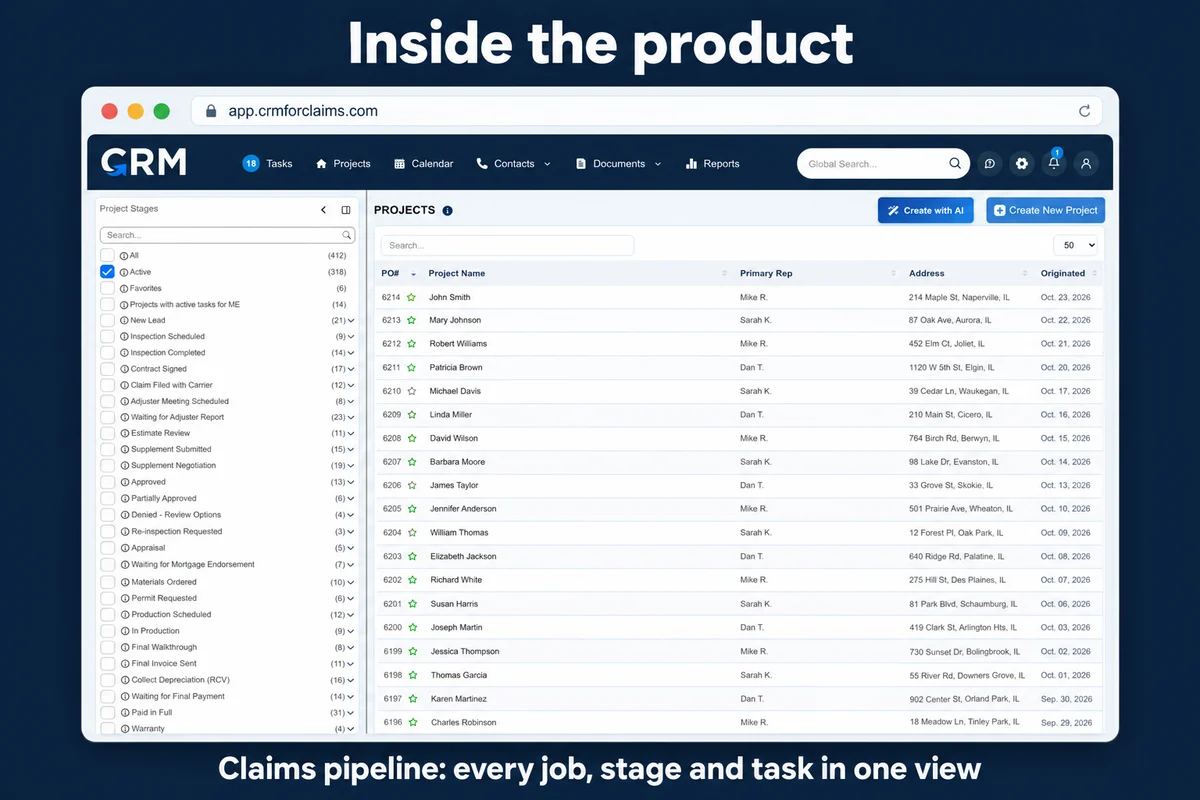
If you run roofs on insurance claims and want to see the inspection checklist and the supplement invoices on a real screen, the CRM for roofing contractors page shows the parts built for roofers, or book a live walkthrough and bring the last job where the deck surprised you.