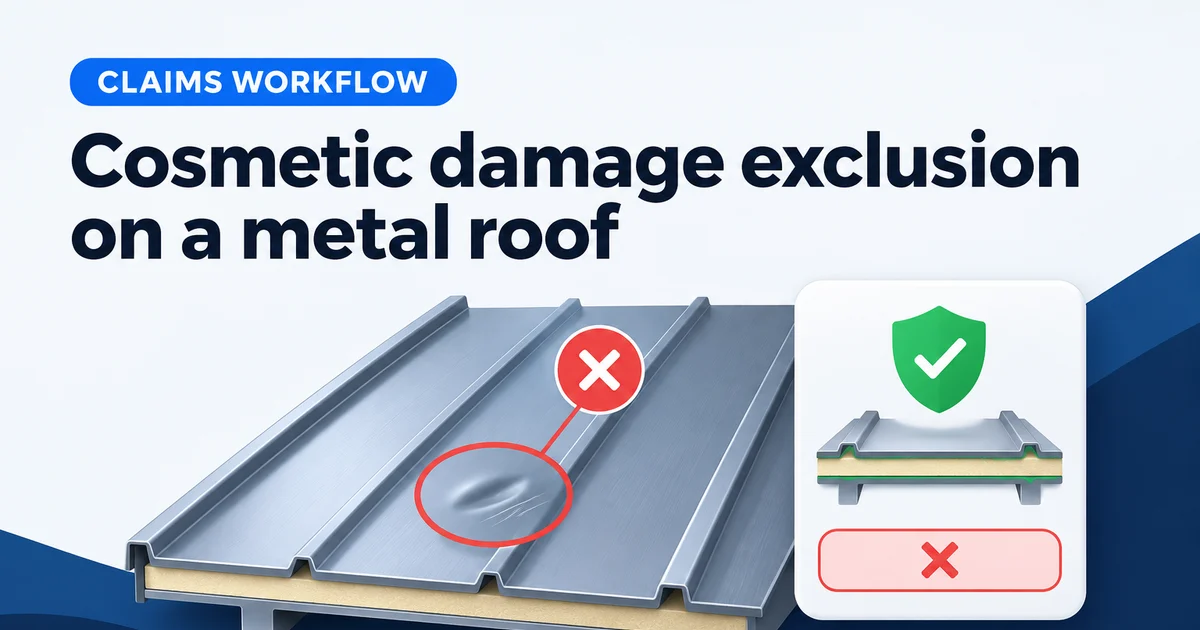
A cosmetic damage exclusion decides a dented metal roof claim through its exact wording, and three common wordings ask three different questions. One asks whether the roof can still do what it did before the storm. Another asks whether water came through. A third asks whether the covering failed at keeping the elements out. Same dents, and the answer can change with the form.
I build CRM For Claims, a CRM for roofing and restoration companies working insurance claims, and I'm not a lawyer. This is what I found in the rulings themselves on November 4, 2026, sorted for the person who has to walk that roof.
Is hail denting on a metal roof covered by insurance?
Usually yes, if the policy has no cosmetic exclusion and hail caused the dents. Once the policy has one, read the definition before anything else. Commercial forms have offered this option for years: a 2013 Independent Agent article on the ISO form describes it as a wind and hail exclusion for roof surfacing, and homeowner carriers write their own versions.
Here are the words that did the work in four recent disputes, cut down to the phrase each case turned on.
The degree wording
"to the same extent as it did before"
Hanover's commercial form, in Cannon Falls. The roof is compared with itself before the storm.
The water wording
"results in water leaking through"
Allstate homeowner forms, in Reininger and Amphay. The way out of the exclusion is a leak caused by the hail.
The function wording
"fail at its intended function"
CSAA's form, in Combs. It names water penetration and adds keeping out the elements over an extended period.
So ask the homeowner for the complete policy, endorsements included, before you tell anyone what you think that roof will get. The declarations page alone won't show you the definition. A signed roofing contingency agreement protects you if the carrier says no, which on this kind of roof is a real possibility.
What changed with the Cannon Falls ruling in July 2026?
The Eighth Circuit held that a roof doesn't have to leak to get outside Hanover's exclusion, if the dents already reduced what the roof can carry. It sent the case back without deciding coverage. Before this, a roofer could fairly assume that no leak meant no claim under that wording. That assumption is weaker now, in one court, on one form.
- April 2022Hail dents the metal roofs of two Minnesota school buildings. Nothing is punctured and neither roof leaks. Hanover denies the roofs under the exclusion.
- October 21, 2025The federal district court rules for Hanover: with no leak or other entry of the elements, the exclusion applies.
- July 27, 2026A divided Eighth Circuit panel vacates that ruling, applying Minnesota law. The majority's example is a roof that "could previously bear three feet of snow but now can only bear two."
- Sent backThe trial court has to rule first on whether the school district's expert can testify at all. Hanover's expert says the dents did not reduce the load the roofs can resist.
Read the limits of it as carefully as the win. The same majority said the policy looks at function now, so a shorter lifespan alone doesn't take a roof out of the exclusion. One judge dissented and would have followed courts that want actual entry of the elements. And a Minnesota-law decision doesn't bind a state court in Illinois or Texas, or change an Allstate form that talks about water.
Your shingle roof has metal on it too
This one will reach more of my readers than the school roofs will. In Combs v. CSAA, decided in federal court in Oklahoma on September 15, 2026, the homeowner had impact-resistant shingles and hail-marked valley metal. The homeowner argued that an exclusion for metal roof coverings couldn't reach a shingle roof. The court disagreed, and the homeowner had no evidence the valley damage was more than cosmetic, so the contract claim failed.
So on a shingle job, don't let dented valleys and flashing carry the claim on their own under wording like that. Document the shingles separately, slope by slope, the way you would for any claim photo set, and keep the metal as its own list with its own observation about whether it still moves water.
Which arguments have worked against the exclusion?
Evidence of something happening to the roof today has done better than predictions about tomorrow. I sorted the arguments from these cases by how they ended. Each result belongs to its own policy wording and its own court, and I've left the case name on every row so you can check it.
| The argument | Case | How it ended |
|---|---|---|
| The roof will wear out sooner | Cannon Falls (8th Cir. 2026) | Rejected. Lifespan is about the future. |
| It could leak later | Amphay v. Allstate (N.D. Tex. 2023) | Rejected as speculation. Allstate won. |
| Broken zinc coating will bring rust | Iyengar v. Liberty (W.D. Tex.) | Rejected on that form. The metal itself had to be penetrated. |
| Dents keep the elements off the panel | Iyengar v. Liberty | Rejected. The question was keeping them out of the home. |
| The roof carries less load now | Cannon Falls | Alive on the degree wording, if the expert survives the challenge. |
| Water came in at the hail damage | Iyengar v. Liberty | Enough to get past summary judgment on the contract claim. |
| The adjuster skipped the carrier's own steps | Allstate v. Reininger (Tex. App. 2021) | Treble damages upheld. No required engineer, and a requested second inspection never finished. |
That last row matters for how you keep a file. In Reininger, the record showed what the carrier was asked for and what it didn't do. A written request with a date on it is how that record gets made, and I went through how to ask in getting the adjuster back on the roof.
What to record on a dented metal roof
Record the condition today, tie anything you say about water to a place you can show, and keep it apart from your opinion. No ruling I read sets this order. It's my own list, built backward from what those cases rewarded and threw out.
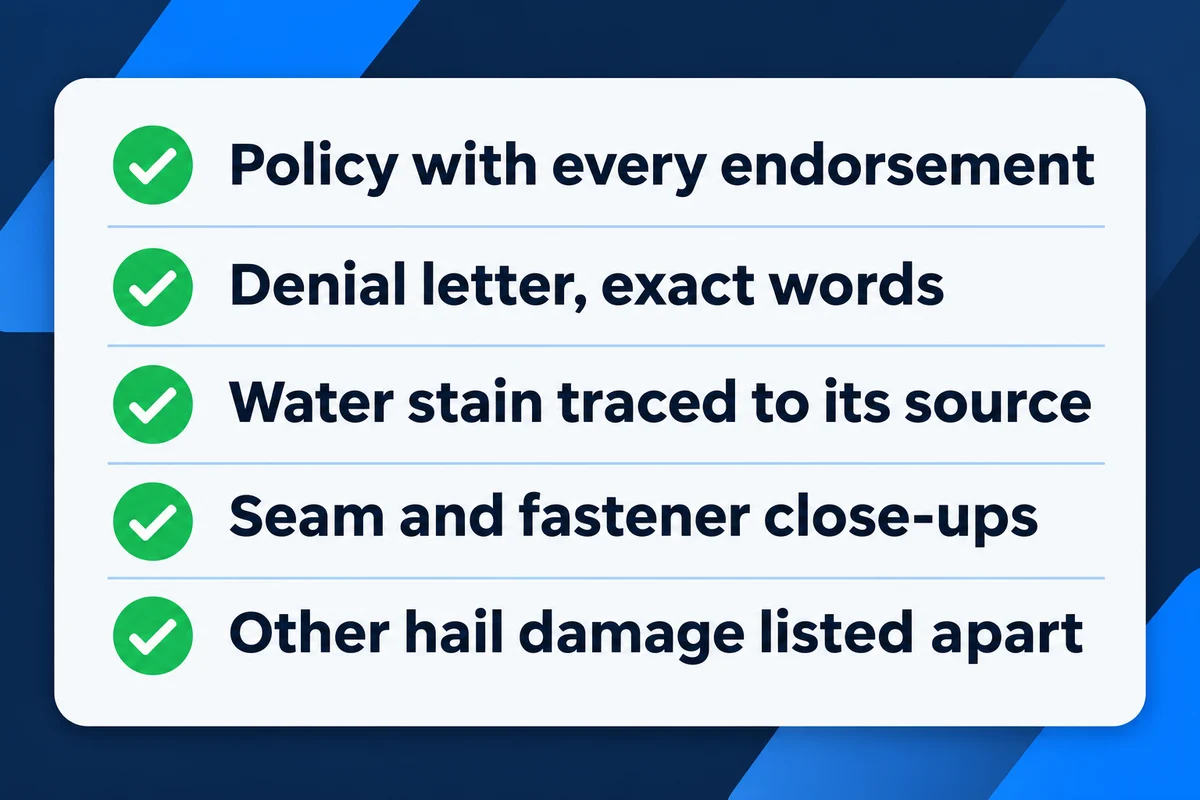
- Get the policy with all endorsements and note which wording you're dealing with. Everything below gets weighted by that.
- Draw the roof and mark dents by panel and slope, with a wide photo first and a close-up with a scale after it, so each close-up can be placed on the roof.
- Shoot seams, fasteners, ridge caps and penetrations on their own. Write what you see in plain words: open, lifted, backed out, or tight.
- Go inside. Photograph the attic and the underside of the deck, and if there's a stain, trace it upward and record where it stops. Ask the homeowner when they first saw it and whether it was there before the storm.
- List the other hail damage apart from the roof panels. Hanover paid other hail losses on those schools while denying the roofs, so gutters, vents and siding may stand on their own.
- Keep the denial letter and read which words of the definition it relies on. The answer to the letter has to deal with those words, and what to do when a carrier denies the claim covers the steps after that.
- On a big roof with the degree wording, raise an engineer with the homeowner early. A load opinion is what kept Cannon Falls alive, and it's also what is under challenge now, so it needs real testing behind it.
What Iowa law lets a roofer do about an exclusion
You can document the roof and price your work, but arguing the claim is licensed work in many states. The Iowa Insurance Division says the violation happens when someone other than a licensed public adjuster negotiates on behalf of an Iowa consumer to settle a property insurance claim. Rules differ by state, so read your own department of insurance before you write to a carrier.
On a cosmetic denial this comes up fast, because the whole dispute is about what a policy means. Your job is the facts of the roof and the scope of your repair. If the fight has become what "to the same extent" means, that's the homeowner's call to bring in a licensed public adjuster or an attorney, and handing the claim off without losing the file is what makes your photos useful to them.
Keeping that file together in CRM For Claims
A dispute like this can run for years. Cannon Falls started with a 2022 storm and was still in court in July 2026, and people leave companies in that kind of time. In CRM For Claims, Insurance Policy is one of the built-in folders on a project's files page. Denial letters go in the Insurance Claim Coverage Documents folder. Copies of emails, calls and texts with the carrier go in the Email Communication folder.
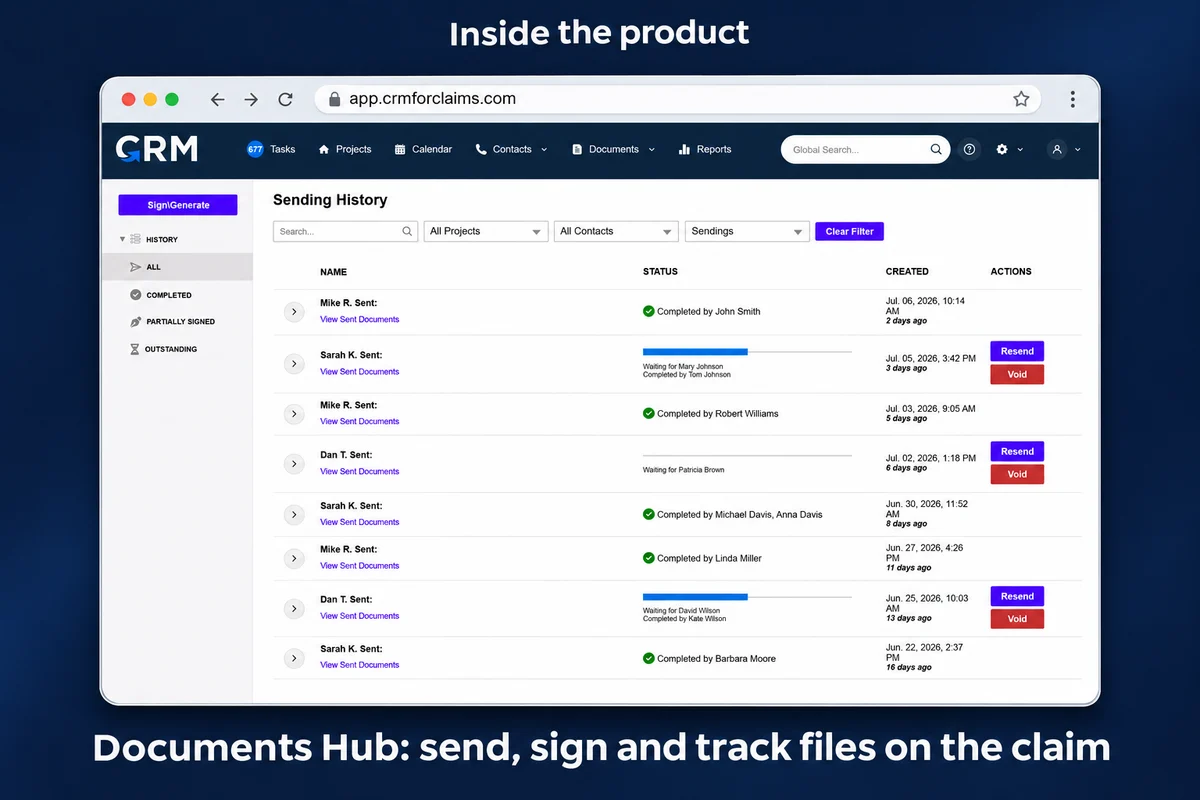
On the claim, Date Of Loss is a required field chosen from your list of storms. The page on storm and date of loss tracking walks through that list. A written request to the carrier gets a follow-up, and every task has a required Task Due Date. The Roof Inspection Checklist has a Power Vent Cover field with Metal as a choice, so the metal on a shingle roof can be noted during the inspection.
The full feature list shows the rest of the claim file. If you have a metal roof dispute open now, book a walkthrough and bring the denial letter, and I'll show you how that job would sit in the system.