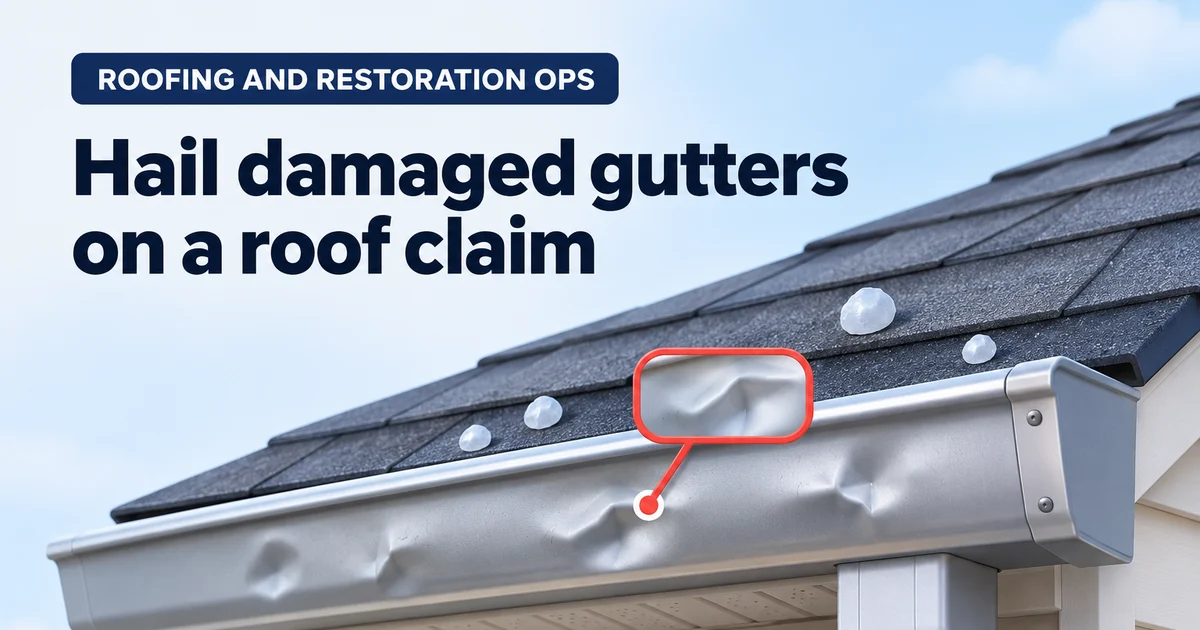
Hail damaged gutters do two jobs on a roof claim. First they are evidence: aluminum gutters and downspouts sit at eye level, take the same storm as the shingles, and keep a record of how big the hail was and where it came from. Second they can be a paid line of their own, but only when the policy covers the damage and the dents do more than change how the metal looks. A roofer who records the gutters properly gets the first job done every time and gives the second one a real chance.
I build CRM For Claims, a CRM for roofing and restoration teams that work insurance claims. Gutters are the part of a hail file I see handled worst. The rep takes one wide photo of a dented corner, writes "gutters damaged" in the notes, and the adjuster writes the whole run off as cosmetic. This post is the version I would want my own team to follow.
Are hail dents in gutters covered, or cosmetic?
It depends on the policy and on what the dent does. A standard homeowners policy treats hail as a covered peril, and house gutters normally fall under the dwelling coverage. The trouble starts when the policy has a cosmetic damage exclusion, or when the adjuster reads the dents as cosmetic anyway. Then the question becomes whether the gutter still works.
"Cosmetic damage is damage that affects the appearance but not the function of a specific property component."
From Insurance Journal, "Will Wind/Hail Cosmetic Damage Exclusion Endorsements Become the Norm?" (March 2013), describing the wind and hail endorsements written by AAIS and ISO.
Read the endorsement itself before you argue about it. The AAIS form that article describes names the exterior surfacing of walls, roofs, doors and windows. Whether gutters are inside that list depends on the exact form the carrier filed, so ask for the full policy, not the declarations page. On roof surfaces this fight has gone to court more than once, and I went through one long case in the post on cosmetic exclusions for metal roofs.
For gutters, the function argument has to be shown in a photo, not claimed in a sentence. A dent in the bottom of the trough that holds standing water after rain, a run that no longer falls toward its outlet, a seam that opened, a downspout crushed enough to slow the water, a vinyl gutter with a crack or a hole: each of these is a gutter that does its job worse than before the storm. A shallow ding on the front face of an aluminum gutter that drains fine is the case the adjuster will call cosmetic, and on a policy with the exclusion they may be right.
What hail does to each kind of gutter
The metal decides how much the gutter can tell you. InterNACHI's training series for inspectors, Mastering Roof Inspections: Hail Damage, Part 9, sets out the differences. Here they are turned into what each one means for the file.
| Gutter material | How hail marks it | What it means for the claim |
|---|---|---|
| Aluminum | Dents fairly easily; thinner gauges dent more | The best witness of hail size and direction on the house. Also the material most likely to be called cosmetic. |
| Copper | Harder than aluminum, softer than steel | Fewer dents for the same storm. Any clean dent here points to larger hail. |
| Steel | Highly resistant to hail | No dents on a steel gutter does not mean no hail on the shingles. Look at other soft metals instead. |
| Vinyl gutters and leaf guards | Cracks and punctures instead of dents | A crack or hole is a functional defect, which is the strongest case for a paid gutter line. |
Is it hail, or did something else dent it?
The adjuster will sort every mark you photograph into one of two piles. Do the sorting yourself first, and leave the marks that fail out of your packet. One ladder mark presented as hail makes the honest dents next to it look suspect too.
Marks hail leaves
- Downward dents in the bottom of the trough, from hail falling from above.
- Dents on the front face that point in or out, depending on which way the storm drove the hail.
- Rounded dents with no scratch inside them.
- Dents spread along the whole run, heavier on the side that faced the storm.
Marks something else left
- Two dents or scrapes about 16 inches apart, where a ladder would stand.
- A scratch or chipped paint inside the dent. Hail is not hard enough to scratch metal.
- A crease. Hail does not fold metal.
- A dent pushed in from below, or a deep dent from the side.
Check the dents against the storm
InterNACHI notes that hail dents in aluminum gutters and downspouts are typically smaller than the diameter of the hailstone that made them. That gives you a simple test. Take the largest hail size reported for the storm on that date, measure the widest dents on each run with a tape in the photo, and compare. Dents a bit smaller than the hail fit the storm. A dent far wider than any hail that fell that day needs another explanation, and you should find it before the adjuster does. The date of loss post covers how to tie the house to one storm in the first place.
Worked example: one storm, three gutter runs
Example numbers only, not a real claim. Largest hail reported for the date: 1.5 inches.
Nebraska's insurance department adds one more ground-level clue in its homeowner guide, Hail Damage: Does My Roof Need Repair?: a large amount of shingle granules at the end of the downspouts may show damage. The same page is careful to say granule loss does not prove it. Photograph the granules at each outlet anyway, then let the shingles carry the proof.
The gutter walk, elevation by elevation
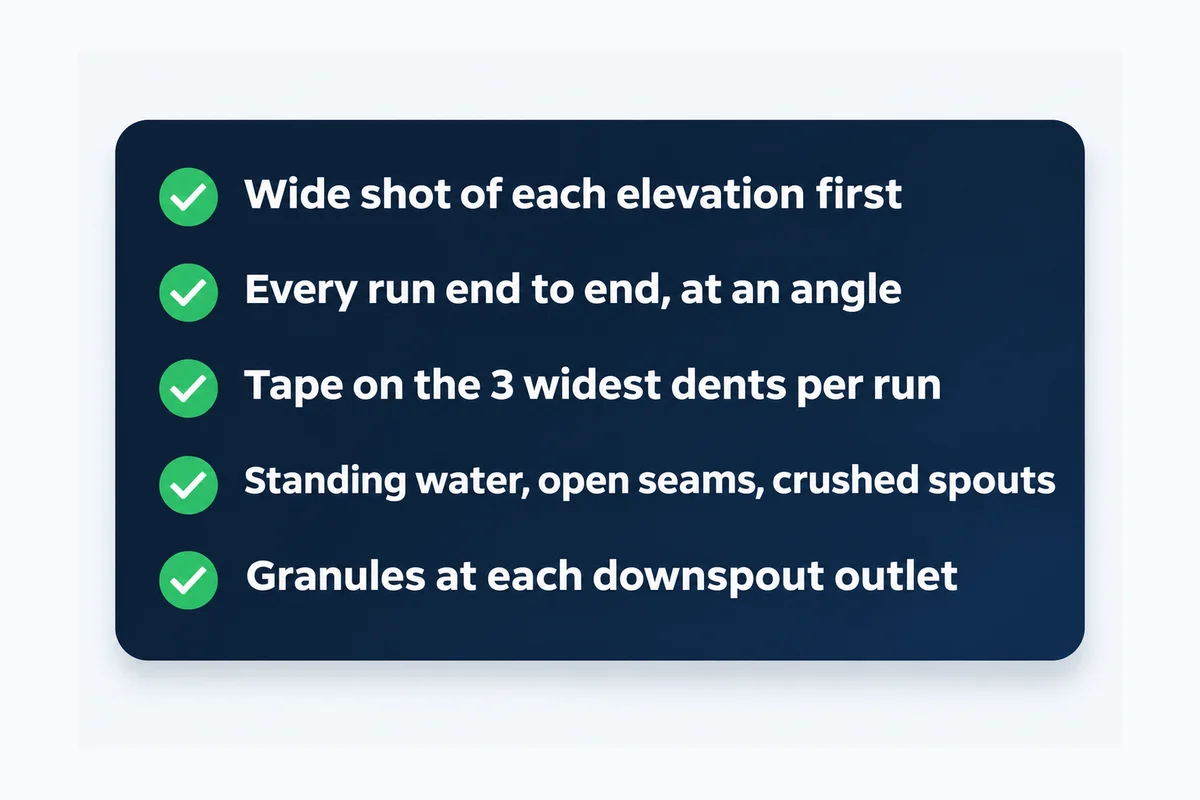
Do it on the same visit as the roof inspection and in the same order every time, so the photos read as a story. Start on the side that faced the storm.
- Take a wide shot of the elevation with the house number or a known window in frame, so every close-up after it is tied to a wall.
- Shoot each run end to end, at an angle along the gutter, so the light shows the dents.
- Lay a tape measure across the three widest dents of each run, on the bottom and on the face, and photograph each one.
- Record anything that stops the gutter working: standing water, an opened seam, a low spot, a crushed downspout. If it has rained, a short video of water sitting in the trough is worth more than ten stills.
- Photograph each downspout outlet, with the granules on the ground or in the splash block.
- Move on to the other soft metals on the same wall: window wraps, vents, meter covers, the air conditioner fins.
- Write the gutter details in the notes before you leave: aluminum or other, one piece per run or joined sections, the profile, and the total length per elevation.
Gutter replacement or detach and reset: the two lines that collide
On a roof replacement, the crew often has to take the gutters down to replace the drip edge and put them back afterwards. Estimates carry that as detach and reset, usually shortened to D&R. If the hail damage earns the gutters a replacement line of their own, the same run should not also carry a D&R line, because nobody resets a gutter that is going in the dumpster. Adjusters look for that double count, and finding it on your estimate costs you credibility on every other line.
The opposite mistake is more common. The gutters are fine, nobody wrote the D&R line, and the crew takes them down and puts them back for free. Decide on the inspection which of the two lines each run needs, and write it down there.
Most aluminum gutters on houses are formed on site from a coil, one continuous piece per run. A badly dented stretch in the middle of a one-piece run is rarely fixed by cutting in a section, and a new piece will not match a faded old one. If you ask for the whole run, the photos of the whole run are what support it.
In CRM For Claims, the roof inspection checklist on the project has a D&R Gutters line, answered Present, Absent or 50/50, with a description box for the details. The largest hail size of a storm is saved on its storm record, which is the number the dent check above is measured against. Gutters are a trade of their own on the project, with an installer picked for that trade. A building department record answers whether a permit for gutters is required, and how to get one. The rest of what a claim carries is on the features page, and there is a side by side comparison with generic CRMs if you are weighing one against the other.

If your reps are already photographing gutters and you want to see where those records would sit next to the roof, book a live walkthrough and bring a recent hail job as the example.