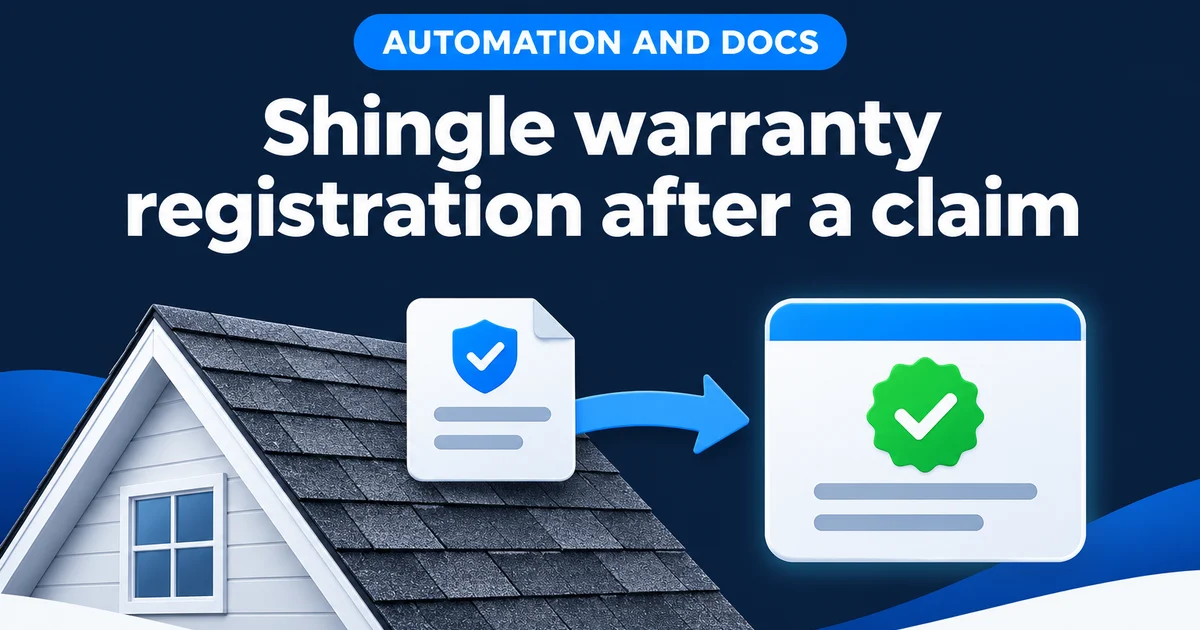
On an insurance roof job, the shingle warranty registration is the roofer's job, and the clock starts on the day the roof goes on, not on the day the last insurance check arrives. For an enhanced system warranty, the manufacturer expects the certified contractor to register it: GAF's Golden Pledge brochure gives the contractor 45 days after installation to register and pay. The basic material warranty usually needs no registration at all. Miss the enhanced one and the homeowner can end up with only the basic coverage, on a roof the carrier just paid for.
I build CRM For Claims, and the reason this slips in roofing offices is timing. The weeks after the build are the weeks the office spends on the certificate of completion, the depreciation release and the final invoice. The registration has no one chasing it. No adjuster asks for it, and the homeowner does not know it exists until they sell the house or call about a leak.
Who registers the warranty, and how long do you have?
It depends on the manufacturer and on the level of warranty, so read it off the document for the product you installed. Four manufacturer documents, opened on November 28, 2026, put it this way.
| Warranty | Who registers | Deadline | If it is not registered |
|---|---|---|---|
| GAF base warranty on shingles and accessories | Optional; the homeowner may register | None | GAF's register page says registration is not necessary to access the base warranty |
| GAF Golden Pledge (enhanced) | The GAF Master Elite contractor, through the GAF Partner Portal | 45 days after installation in the 5/20 edition of the brochure | GAF reserves the right not to issuethe warranty |
| Owens Corning System, Preferred and Platinum Protection | The Preferred or Platinum contractor, on the homeowner's behalf | Not stated on the registration help page | Check the warranty document for the product |
| CertainTeed warranties | Optional, through CertainTeed's online registration | None | CertainTeed's register page says it shall not void the warranty |
Two things follow. First, the enhanced warranties are the ones with a deadline, and they are the ones a certified contractor sells. Second, the number of days is printed in each edition of the brochure, and editions change. Keep a copy of the exact brochure you handed the homeowner in the job file, and work to the window printed in it.
Where the brochure rules meet the insurance scope
The enhanced warranty sets installation rules, and the carrier's estimate is written to restore the roof that was there. Most of the time they agree. Where they do not, you want to know before the crew loads the truck, because a rule broken on the roof cannot be fixed at the registration screen. These are lines from GAF's Golden Pledge brochure, form RESWT161B, and what each one means on a claim job.
You MUST install a full roof
Requirement 1- A carrier that approves two slopes out of four has paid for a partial roof, and a partial roof does not qualify. Either the homeowner pays to finish the other slopes, or the job goes out under the base warranty. Settle which one in writing before the build.
must NOT be installed over an existing roof
Requirement 3- Tear-off to the deck. If you find a second layer under the shingles, the removal is a separate question of who pays, covered in the post on two layers of shingles on a roof claim.
Metal drip edge MUST be used at eaves
Installation requirements- If the old roof had no drip edge, the estimate may not have a line for it. Photograph the eaves before tear-off and ask for the line before the crew needs it.
- GAF pre-cut Starter Strip Shingles at the eavesRequirement 7
- Starter is often a line of its own on the estimate. Check that the quantity covers the eaves, and that the product on the order is the manufacturer's own.
must pass GAF's final inspection
HOA and condo, multi-family, over 250 squares- On an association building the warranty waits for a manufacturer inspection. Book it early and tell the association who signs for what, as in the post on condo and HOA roof claims.
None of this is a reason to argue with the adjuster about the warranty itself. The carrier pays for the damaged roof. The warranty is a promise between the manufacturer and the homeowner, and the contractor who installed the roof makes that promise possible by following the rules and filing the paperwork.
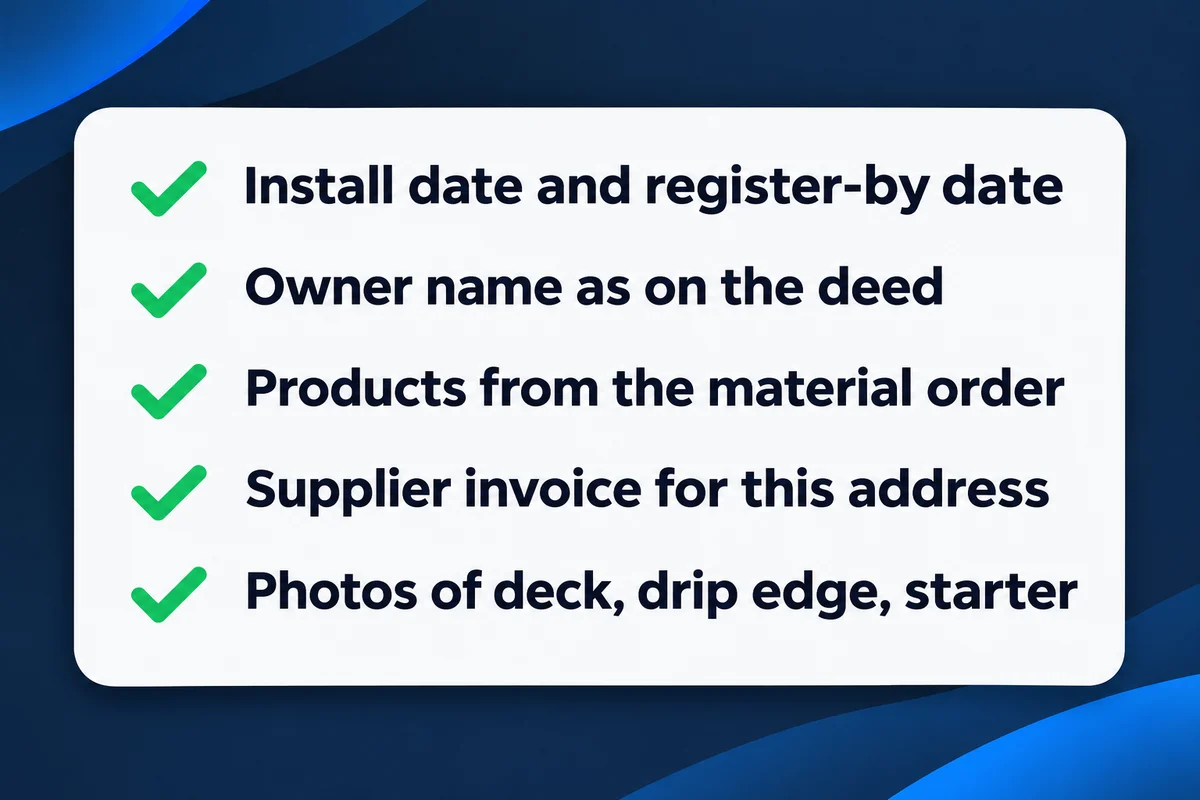
One registration file, filled in
The registration form itself takes ten minutes. Finding what goes into it takes the rest of the afternoon if nobody saved it as the job ran. This is what one complete file looks like.
Example roof: warranty registration file
An example to show the fields, not a real job or a real homeowner.
The owner's name is the line that most often goes wrong on claim jobs. The claim may be in two names, the mortgage company is on the check, and the person who signed your contract may be a family member who handled the storm. The warranty belongs to the property owner, so copy it from a document that shows ownership.
Why the warranty file matters at the next storm and the next sale
A registered warranty outlives your job. In a 2021 piece for insurers, PropertyCasualty360 reported that manufacturers with 80% of the asphalt shingle market give 15 years of non-prorated wind coverage up to 130 mph, and that most policyholders do not keep the details of their shingle warranty. The author's point was that carriers may look at the warranty at the next wind claim. If they do, the homeowner will ask the roofer who installed it for the papers.
The sale of the house is the other moment. Owens Corning's page on transferable roof warranties tells the new owner to submit the transfer within 60 days of the closing. GAF asks for notice within the time frame in the warranty and proof that the new owner owns the property. A buyer's agent who calls your office in year six wants the registration confirmation and the install date in one email, not a search through an old phone. How long to keep that file is in how long a roofing company should keep job records.
Keeping the warranty paperwork on the claim in your CRM
The registration is the last document of the job, so it belongs in the same place as the first one. Every project in CRM For Claims comes with a Building Materials Warranty Documents folder. Next to it is a Labor Warranty Documents folder for your own workmanship warranty. These warranty folders appear on the project once a signed contract is on file. The supplier's invoice goes in the Expense Invoices folder on the same project, which is where the proof of purchase for the registration lives.
The photos the brochure asks about start earlier. The roof inspection checklist on the project has lines for Drip Edge and for Ice and Water, so the office knows before the build what the old roof had. For the deadline, add a task on the day the roof is finished, assign it to one person, set its due date and send that person an email about it.
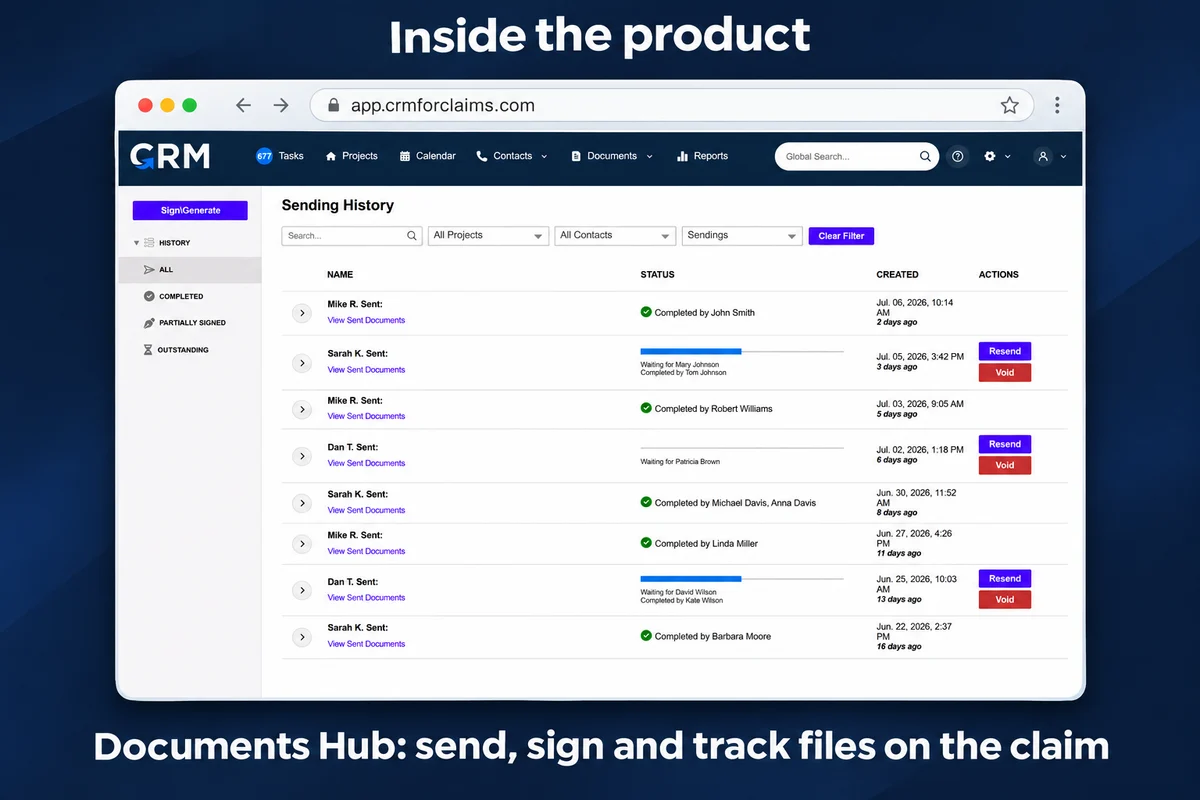
The registration sits right after the certificate of completion, which is covered in what a roof certificate of completion says and when to sign it. The full list of what the product does is on the features page, and if you want to see a job file set up this way, book a live walkthrough.