A roof certificate of completion is a short statement, signed by the homeowner and the contractor, that the work on an insurance claim is finished, on what date, and with what exceptions. It usually travels with the final invoice to the carrier so the money held back can be released. The homeowner signs it after walking the finished job, never before.
I build CRM For Claims, a CRM for roofing and restoration companies working insurance claims. When I went looking for what this paper should say, I found template sites and one-line mentions on consumer pages. So I wrote one out for the person who has to get it signed, with the reason for every line.
What does a roof certificate of completion need to say?
Eight lines will do it. I couldn't find a national form or a state rule that sets the wording, and some carriers have their own, so ask the desk before you use yours. Point at the estimate rather than retyping the scope, because a retyped scope is one more thing that can disagree with the file.
Certificate of completion
Contractor, signature and date:
I wrote this as a starting point. It isn't any carrier's form or legal advice, so have your attorney read it before it goes into your templates.
Keep it to the work. A release of claims or a lien waiver tucked into the same page turns a simple statement into something the homeowner should stop and question. Waivers belong on their own paper, matched to the payment they cover, as I explain in which lien waiver goes with which roof claim check.
When should the homeowner sign it?
After the crew has finished and the homeowner has seen the result. Regulators tell homeowners exactly this, in plain language, so a roofer who asks for the signature on contract day or tear-off day is asking for the thing the state warned them about.
"Do not sign a certificate of completion or make final payment until the work is done to your satisfaction." Item 9 of the Illinois Attorney General's home repair pamphlet
North Carolina says much the same. Its Department of Insurance scam guidance tells people never to pay in full or sign a completion certificate until the work is completed. A certificate signed early also says something untrue to an insurer that is about to pay on it, and I wouldn't want my company's name on that page.
In practice the order is short. The crew finishes and clears the site, someone from your office or your production manager walks the job with the homeowner, the punch list gets closed, and the signature comes last. If the last shingle goes on at 4 p.m. on a Friday and the homeowner works until six, send it on Monday. A weekend won't hurt the file. A date that doesn't fit the photos might.
Match it to the rest of the file before it goes out
Someone at the carrier reads this next to everything else you sent. Before anything leaves the office, one person should check each line against the paper it has to agree with. It takes about as long as making a coffee.
| On the certificate | Has to agree with | What to look for |
|---|---|---|
| Names | The policy and the carrier's letters | A spouse on the policy who is missing from your page |
| Claim number | The carrier's latest letter | A second claim on the same house has its own number |
| Estimate date | The newest estimate the carrier issued | A revised estimate after a supplement, with the old date still on your form |
| Finish date | Final invoice, completion photos, permit final | Three papers that tell three different stories |
| Exceptions | Final invoice | An item marked as not done that is still being billed |
| Signature date | The finish date | A signature dated before the work ended |
The rest of what goes in the envelope is covered in recovering depreciation after the work is done. The certificate is one page of that packet, and it can't carry the others.
Does the certificate prove the deductible was paid?
No, and in some states that takes separate paper. Texas Insurance Code section 707.004 lets a carrier with replacement cost coverage refuse to pay the holdback until it has reasonable proof the policyholder paid the deductible. Florida Statutes section 627.7011 does something similar where a roof deductible applies, limiting the roof payment to actual cash value until that proof arrives. Both accept a canceled check, a money order receipt, a card statement or a financing contract. A line on your certificate saying "deductible paid" isn't on that list.
Watch the words "paid in full" while you're at it. You'll see advice telling homeowners to send a paid-in-full invoice, but on a holdback job the last money due is often the money the carrier is still holding. Show the real numbers on the invoice: the total, what has been paid, and the balance. If a desk insists on something else, get that in writing and ask how it wants the balance shown. The rules you can and can't work with are in my article on deductibles and what contractors can do about them.
What if the homeowner won't sign?
Find out which of three situations you're in, because each one has a different next move.
There's still work to finish
Then they're right not to sign. Close the items, walk it again, and date the certificate that day. If one item has to wait on a part, write it on the open items line, have them sign with that on the page, and bring a second certificate when it's done.
They disagree about something you consider done
Let them write it on the open items line in their own words. You get a signed record of exactly what's in dispute, and the rest of the job stops being held hostage to one flashing detail. Then settle that item under the terms of your contract.
They've stopped answering
Never sign for them, and never have someone on your team do it "just to keep it moving." Send your own signed copy with the invoice and dated photos to the homeowner in writing, and tell them what the carrier is waiting for and that the policy can have a deadline for claiming the holdback. If they've authorized you to speak with the carrier, ask the desk in writing what it will accept without that signature. The steps for getting a quiet homeowner back are in keeping a claim moving when the homeowner goes quiet.
Two documents, one name
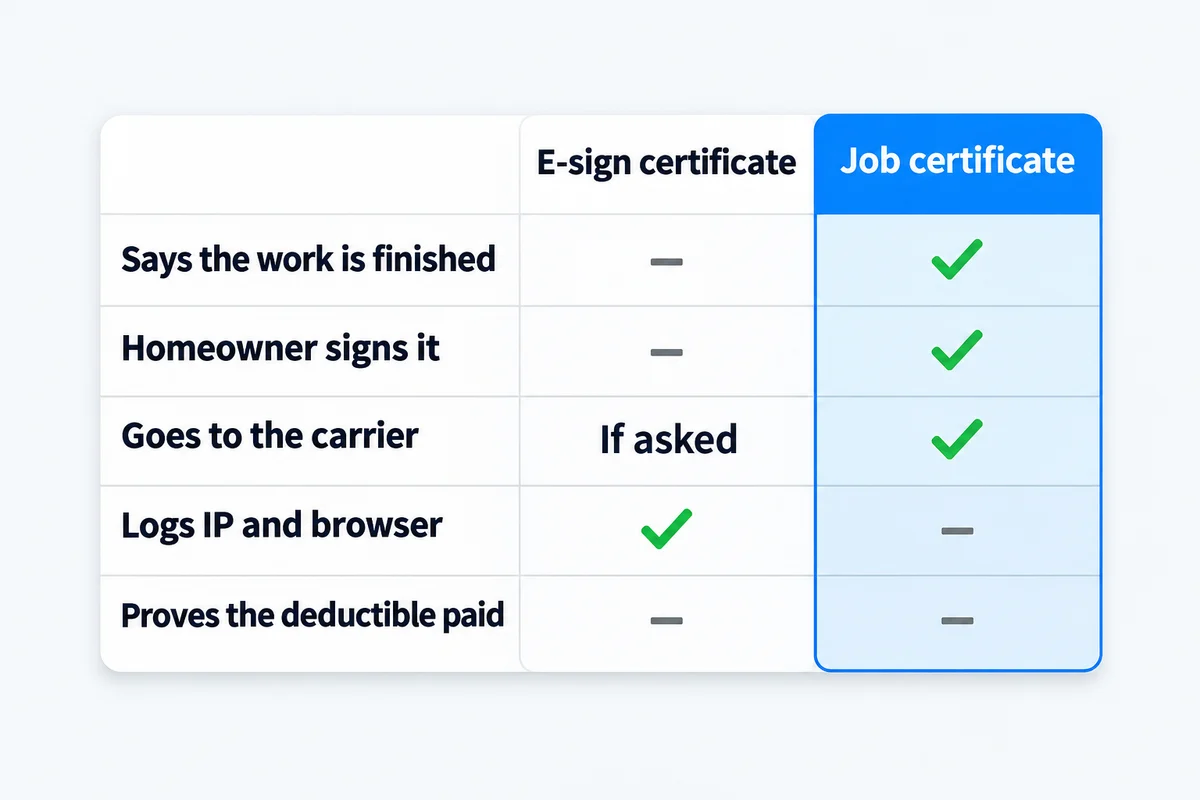
E-signature systems produce a page that is also called a Certificate of Completion. If your office sends that page to the carrier by mistake, the desk gets a log of timestamps and nothing at all about a roof.
The job certificate
Your company writes it. The homeowner and the contractor sign it.
It says the work is finished, on what date, and what is left open.
It goes to the carrier, and to the lender's desk if one is involved.
The e-sign certificate
The signing system creates it, and nobody signs it.
It records who signed which document, when, and from where.
It stays in your file until someone questions a signature.
How this runs in CRM For Claims
In CRM For Claims, your own certificate becomes a template in the Documents Hub, and it goes to the homeowner by e-mail or text. Send refuses a template that has no Signature box for one of its signers, so a two-person certificate can't go out with a box missing. When a couple shares one mailbox, each of them gets a separate e-mail with a signing link of their own. Automatic reminders go out only between 9:00 AM and 7:00 PM.
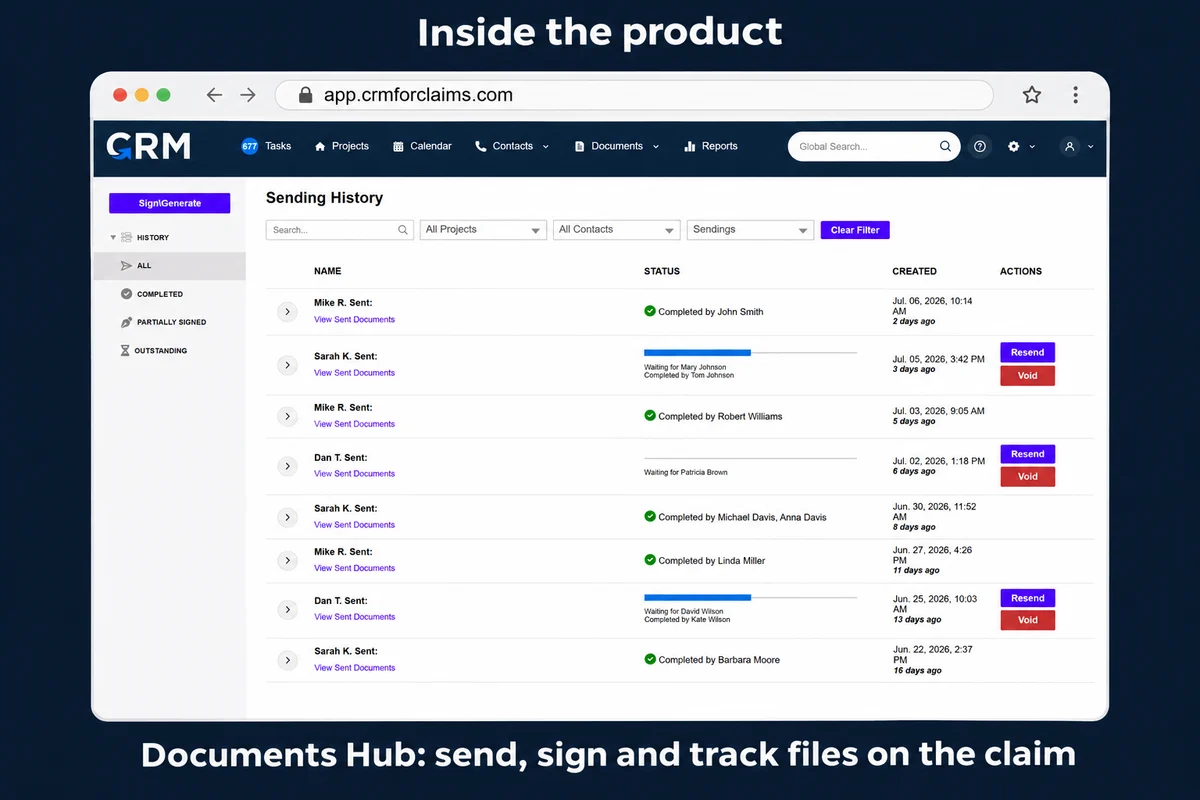
Before signing, each signer agrees to an electronic records disclosure, and a signature is not saved without that agreement. The e-sign certificate lists the signed documents, the signer's name, when signing started and finished, the IP address and the browser. It also shows how many signature boxes the signer clicked and the time of the first and last click. A SHA-256 fingerprint of each signed file is recorded too, so the copy can be checked later. Each signer's certificate is saved as its own file on the project.
The walk with the homeowner goes in as a task, and every task has a required Task Due Date, so the signature doesn't wait on somebody remembering it. The document management page shows how templates and signing fit together, and the features page has the rest of the product. If you want to see your own certificate sent and signed, book a walkthrough and bring the form you use today.